

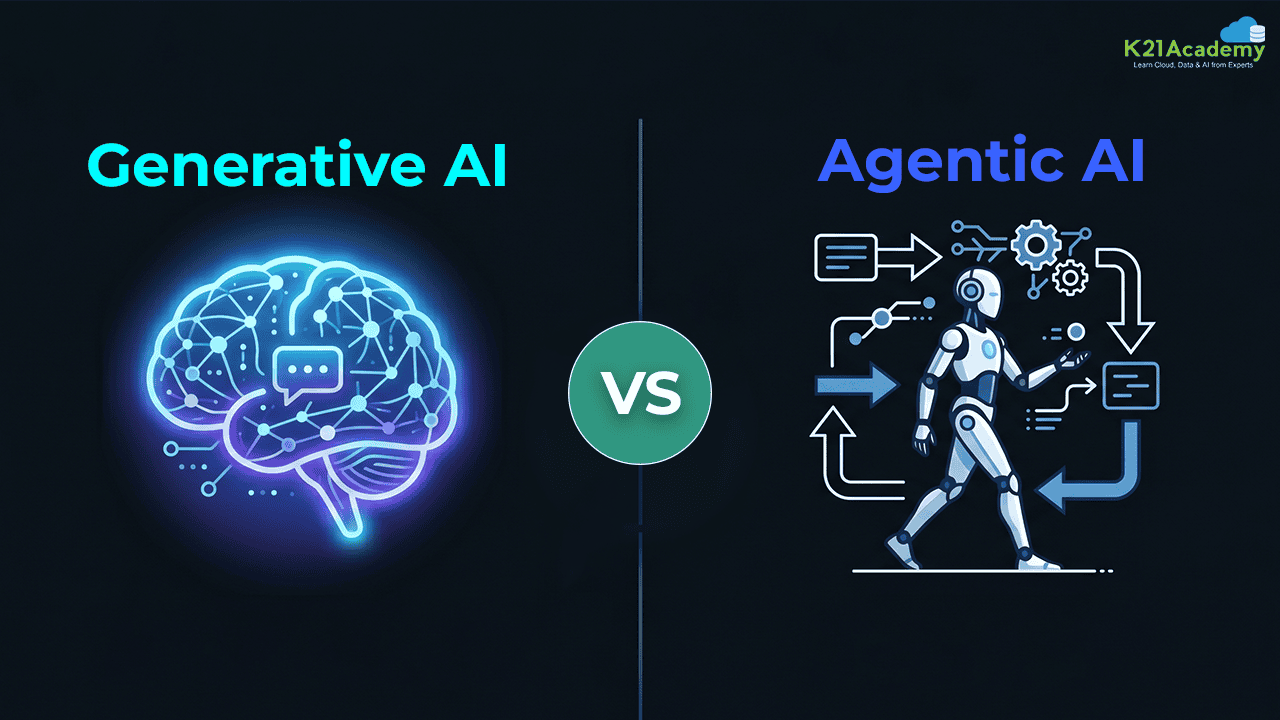



The AI industry is entering its second major wave.
The first wave was powered by Large Language Models (LLMs) that could generate text, code, images, and content. This wave created enormous demand for prompt engineers, chatbot developers, AI consultants, and cloud professionals familiar with Generative AI.
The second wave is now underway.
Organizations are no longer satisfied with AI systems that simply answer questions. They want intelligent systems capable of reasoning, planning, making decisions, connecting to enterprise applications, and executing business tasks autonomously.
This shift is creating a growing divide in the job market.
One group of professionals is learning how to use AI.
Another group is learning how to build AI agents.
The second group is increasingly commanding higher salaries and receiving greater attention from employers.
Before investing hundreds of hours into training, certifications, and projects, every IT professional should understand the difference between Generative AI and Agentic AI.

What Is Generative AI?
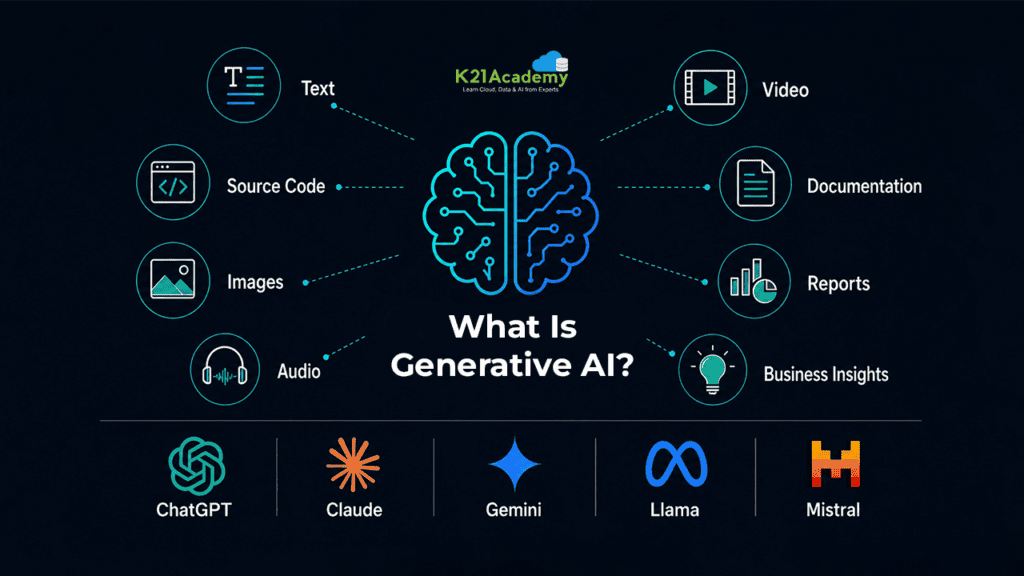
Generative AI is a branch of artificial intelligence focused on creating new content from existing knowledge.
Unlike traditional software that follows predefined rules, Generative AI uses machine learning and deep learning models to generate human-like outputs based on prompts provided by users.
These outputs can include:
- Text
- Source code
- Images
- Audio
- Video
- Documentation
- Reports
- Business insights
At the heart of Generative AI are Large Language Models (LLMs).
These models are trained on massive datasets containing books, articles, websites, code repositories, documentation, and other sources of information.
Popular Generative AI platforms include:
- ChatGPT
- Claude
- Gemini
- Llama
- Mistral
- Cohere
When a user enters a prompt such as:
“Create a Python script to upload files to AWS S3”
the model predicts the most likely sequence of words and code based on patterns learned during training.
Although this appears intelligent, the system is primarily generating responses rather than performing actions.
Core Characteristics of Generative AI
- Content creation
- Natural language understanding
- Question answering
- Code generation
- Summarization
- Translation
- Brainstorming
- Conversational interfaces
Generative AI excels at creating information.
However, it generally cannot execute tasks independently.
Related Readings: Generative AI Use Cases in Healthcare, Finance & Education
What Is Agentic AI?
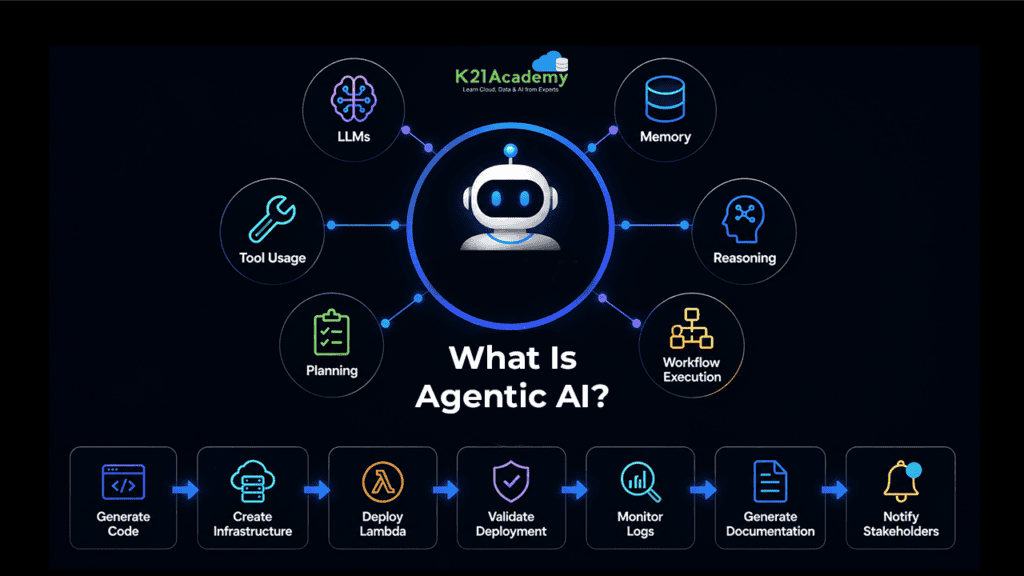
Agentic AI is the evolution of Generative AI.
Instead of only generating outputs, Agentic AI systems can pursue objectives.
These systems combine:
- LLMs
- Memory
- Tool usage
- Planning
- Reasoning
- Workflow execution
- Autonomous decision-making
An AI Agent behaves more like a digital employee than a chatbot.
For example:
A traditional chatbot might answer:
“Here is the Python code to deploy an AWS Lambda function.”
An AI Agent might:
- Generate the code
- Create the infrastructure
- Deploy the Lambda function
- Validate the deployment
- Monitor logs
- Generate documentation
- Notify stakeholders
All without requiring additional prompts.
This is why Agentic AI is attracting enormous enterprise investment.
Related Readings:- Agentic AI Use Cases: 10 Real-World Examples Transforming Industries
Why Enterprises Are Moving Toward Agentic AI
Most organizations have discovered that generating content is only part of the value equation.
Businesses need systems capable of taking action.
Examples include:
Banking
AI agents reviewing loan applications.
Healthcare
AI agents summarizing patient histories.
Cloud Operations
AI agents monitoring infrastructure and resolving incidents.
Cybersecurity
AI agents identifying vulnerabilities and applying fixes.
Software Development
AI agents building, testing, deploying, and monitoring applications.
This shift is creating demand for AI Engineers, Solution Architects, Cloud Architects, and Platform Engineers who understand Agentic AI architectures.
Related Readings:- The Future of AI Agents
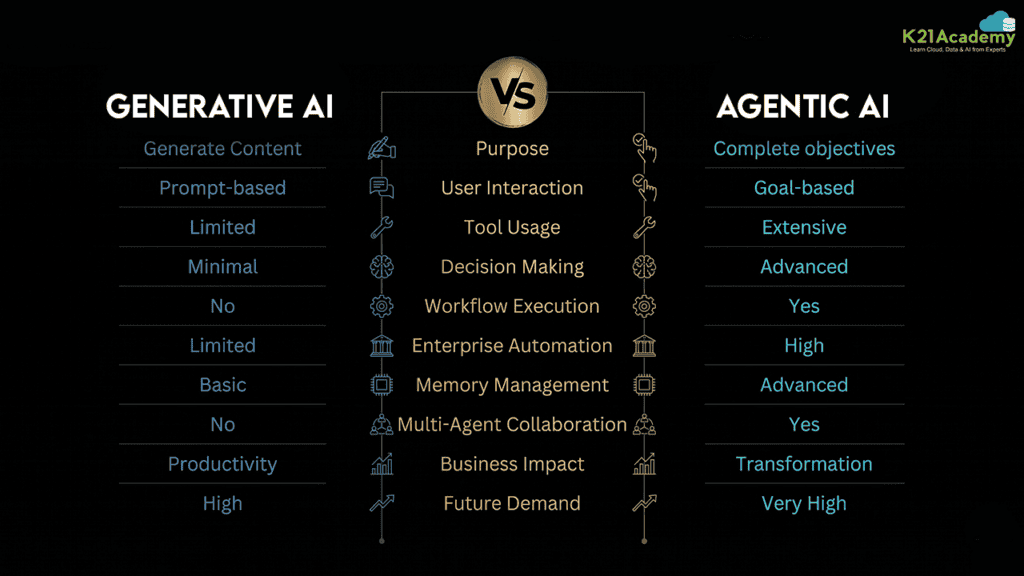
Generative AI vs Agentic AI: Detailed Comparison
Why AI Agents Are Becoming the Future
Most enterprises do not simply need content generation.
They need systems capable of performing business processes.
Examples include:
Customer Service Agents
AI agents can:
- Access CRM systems
- Retrieve customer history
- Generate responses
- Escalate issues
- Update tickets automatically
DevOps Agents
AI agents can:
- Analyze logs
- Detect issues
- Generate fixes
- Deploy updates
- Monitor infrastructure
Cloud Operations Agents
AI agents can:
- Manage AWS resources
- Optimize Azure workloads
- Trigger automation workflows
- Generate compliance reports
This is why companies are heavily investing in AI Agents rather than standalone chatbots.
Related Readings: ChatGPT Vs Copilot (Azure) Vs Amazon Q Vs Gemini
The Role of MCP (Model Context Protocol)
One of the most important technologies powering modern AI Agents is MCP.
Model Context Protocol enables AI systems to securely connect with external tools, applications, APIs, and data sources.
Without MCP:
An LLM can only generate text.
With MCP:
An AI Agent can:
- Access databases
- Read documents
- Query APIs
- Interact with enterprise software
- Execute workflows
MCP is rapidly becoming a critical skill for AI Engineers and Solution Architects building enterprise AI systems.
Claude Code and the Rise of Agentic Development
One of the biggest developments in 2026 is the rise of Claude Code.
Claude Code is transforming software engineering by enabling AI-driven development workflows.
For AI/ML Engineers and Solution Architects, Claude Code can:
- Generate production-ready Python code
- Debug applications
- Refactor systems
- Create infrastructure automation
- Build APIs
- Generate documentation
Many organizations now view Claude Code as one of the best chatbot development tools and AI coding assistants available.
Professionals who understand Claude Code, MCP, and AI Agents are positioning themselves for the next generation of software development.
Where AWS and Azure Fit Into the Picture
Cloud platforms are becoming the foundation of enterprise AI systems.
AWS Ecosystem
Important AWS services include:
- Amazon Bedrock
- AWS Lambda
- Amazon SageMaker
- Amazon OpenSearch
- Amazon DynamoDB
AWS professionals increasingly need skills in:
- LLM deployment
- RAG implementation
- Agent orchestration
- AI infrastructure design
- LLMOps
Amazon Bedrock is especially important for deploying enterprise-grade Generative AI and Agentic AI applications.
Azure Ecosystem
Microsoft Azure continues to dominate enterprise AI adoption.
Key services include:
- Azure AI Foundry
- Azure OpenAI
- Azure Machine Learning
- Azure AI Search
- Azure Functions
Azure Solution Architects are increasingly expected to understand:
- AI Agents
- Retrieval-Augmented Generation (RAG)
- Prompt Engineering
- LLMOps
- Multi-agent systems
Organizations are actively seeking architects who can design scalable AI solutions on Azure.
Understanding RAG: The Bridge Between LLMs and Enterprise Data
One major limitation of traditional LLMs is outdated knowledge.
This is where Retrieval-Augmented Generation (RAG) becomes essential.
RAG enables AI systems to:
- Search enterprise data
- Retrieve relevant information
- Provide accurate responses
- Reduce hallucinations
Modern AI Agents almost always rely on RAG architectures.
Popular RAG technologies include:
- Vector Databases
- Azure AI Search
- Amazon OpenSearch
- Pinecone
- Weaviate
For AI Engineers, RAG is becoming a mandatory skill.
Why LLMOps Matters More Than Ever
Just as DevOps revolutionized software deployment, LLMOps is transforming AI operations.
LLMOps focuses on:
- Model deployment
- Monitoring
- Prompt management
- Evaluation
- Governance
- Security
- Cost optimization
Organizations deploying enterprise AI solutions require professionals who understand how to operationalize Large Language Models at scale.
Skills in LLMOps are increasingly appearing in job descriptions for:
- AI Engineers
- Cloud Architects
- MLOps Engineers
- Solution Architects
Related Readings: Claude Code vs GitHub Copilot vs Cursor: Which AI Coding Assistant Should You Learn?
NLP Is Still Important
Many professionals believe NLP has become obsolete because of LLMs.
That is not true.
Natural Language Processing remains the foundation of modern AI systems.
Understanding NLP concepts helps professionals grasp:
- Tokenization
- Embeddings
- Vector Search
- Semantic Similarity
- Prompt Engineering
- Language Model Behavior
Strong NLP knowledge improves your ability to build effective AI applications.
Related Readings: Top 10 Claude Code Use Cases Every Developer Should Know
Python Remains the Most Important AI Skill
Whether you choose Generative AI or Agentic AI, Python remains essential.
Python is used for:
- AI development
- Machine learning
- RAG pipelines
- AI Agents
- MCP integrations
- Cloud automation
- Data engineering
Popular frameworks include:
Python continues to be the universal language of AI engineering.
Salary Comparison in 2026
The salary gap between Generative AI specialists and Agentic AI professionals is increasing rapidly.
India Salary Comparison
| Role | Average Salary |
|---|---|
| Generative AI Developer | ₹8–18 LPA |
| Prompt Engineer | ₹10–20 LPA |
| AI Application Developer | ₹12–25 LPA |
| AI Engineer | ₹18–40 LPA |
| Agentic AI Engineer | ₹25–60 LPA |
| AI Solution Architect | ₹35–80+ LPA |
| Principal AI Architect | ₹70 LPA–₹1.5 Cr+ |
Global Salary Comparison
| Role | Average Salary |
|---|---|
| Generative AI Developer | $90K–$140K |
| Prompt Engineer | $100K–$180K |
| AI Engineer | $140K–$220K |
| Agentic AI Engineer | $170K–$300K+ |
| AI Solution Architect | $180K–$350K+ |
| Principal AI Architect | $250K–$500K+ |
The highest salaries are increasingly concentrated around Agentic AI, LLMOps, and enterprise AI architecture.
Best Roles for Generative AI Professionals
Generative AI is ideal for professionals who enjoy creating intelligent applications and working with language models.
Popular Job Titles
- Generative AI Engineer
- Prompt Engineer
- AI Application Developer
- NLP Engineer
- Chatbot Developer
- AI Consultant
- Content Automation Engineer
- LLM Developer
Skills Required
- Python
- NLP
- Prompt Engineering
- LangChain
- OpenAI APIs
- Claude APIs
- Vector Databases
- RAG
Best Roles for Agentic AI Professionals
Agentic AI professionals focus on autonomous systems and enterprise automation.
Popular Job Titles
- Agentic AI Engineer
- AI Systems Engineer
- AI Platform Engineer
- AI Solution Architect
- AI Automation Architect
- LLMOps Engineer
- Multi-Agent Systems Engineer
- Enterprise AI Architect
Skills Required
- Python
- MCP
- LangGraph
- CrewAI
- AutoGen
- Semantic Kernel
- RAG
- AWS Bedrock
- Azure AI Foundry
- Kubernetes
- LLMOps
Best Certifications for Generative AI
Beginner Level
AI-901 Azure AI Fundamentals
AI-901 Covers:
- AI basics
- NLP
- Computer vision
- Generative AI fundamentals
AI Practitioner Certification
AI Practitioner Cert Provides foundational AI knowledge suitable for business and technical professionals.
Intermediate Level
- AI-103: Develop AI Apps & Agents on Azure
- Databricks Machine Learning Associate
- AWS Certified Machine Learning Engineer (MLA-C01)
Best Certifications for Agentic AI
Because Agentic AI is newer, certifications are often combined with cloud and architecture programs.
Highly Recommended
- AWS Solutions Architect Associate
- AWS Machine Learning Engineer Associate
- AWS Solutions Architect Professional
- Databricks Data Engineer Associate
- Azure Solutions Architect Expert
These certifications align closely with enterprise AI implementation.
Which Career Path Should You Choose?
Choose Generative AI If:
- You are a beginner.
- You want to understand LLM fundamentals.
- You work in content creation.
- You build chatbots and assistants.
- You are preparing for AI-901 or AI Practitioner certifications.
Choose Agentic AI If:
- You already understand LLMs.
- You work with AWS or Azure.
- You are a Solution Architect.
- You are an AI Engineer.
- You build enterprise automation systems.
- You want future-proof AI skills.
Related Readings: Comparing the Best AI Chatbots for Your Business: What’s Best for You?
8-Week Generative AI Roadmap
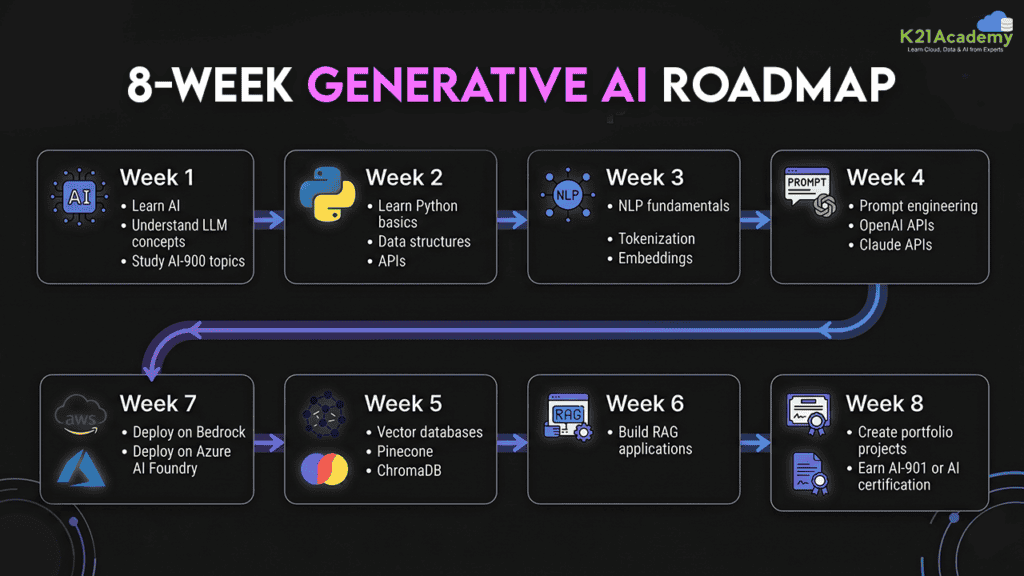
Week 1
- Learn AI fundamentals
- Understand LLM concepts
Week 2
- Learn Python basics
- Data structures
- APIs
Week 3
- NLP fundamentals
- Tokenization
- Embeddings
Week 4
- Prompt engineering
- OpenAI APIs
- Claude APIs
Week 5
- Vector databases
- Pinecone
- ChromaDB
Week 6
- Build RAG applications
Week 7
- Deploy on AWS Bedrock
- Deploy on Azure AI Foundry
Week 8
- Create portfolio projects
- Earn AI-901 or AI Practitioner certification
Related Readings:- 7 System Design Patterns Every Cloud AI Engineer Should know
8-Week Agentic AI Roadmap
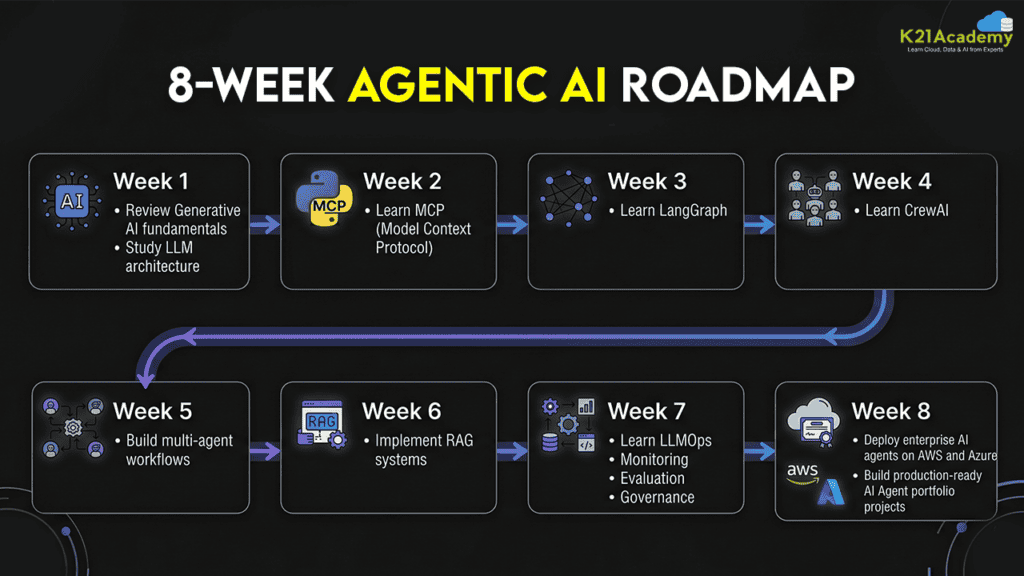
Week 1
- Review Generative AI fundamentals
- Study LLM architecture
Week 2
- Learn MCP (Model Context Protocol)
Week 3
- Learn LangGraph
Week 4
- Learn CrewAI
Week 5
- Build multi-agent workflows
Week 6
- Implement RAG systems
Week 7
- Learn LLMOps
- Monitoring
- Evaluation
- Governance
Week 8
- Deploy enterprise AI agents on AWS and Azure
- Build production-ready AI Agent portfolio projects
Related Readings:- How to Build Your Own AI Bot in 2026: A Complete Guide
Final Thoughts
Generative AI opened the door to the AI revolution.
Agentic AI is walking through that door and changing everything.
The highest-paying opportunities are no longer limited to prompt engineering or chatbot development. Organizations now need professionals who can design AI Agents, implement MCP integrations, build RAG architectures, manage LLMOps pipelines, and deploy enterprise AI systems across AWS and Azure.
For most IT professionals, the ideal path is not choosing one over the other.
Learn Generative AI first.
Then evolve into Agentic AI.
The future belongs to engineers and architects who can move beyond generating answers and build systems that can take action.
Those professionals will define the next decade of cloud computing, software engineering, and artificial intelligence.