

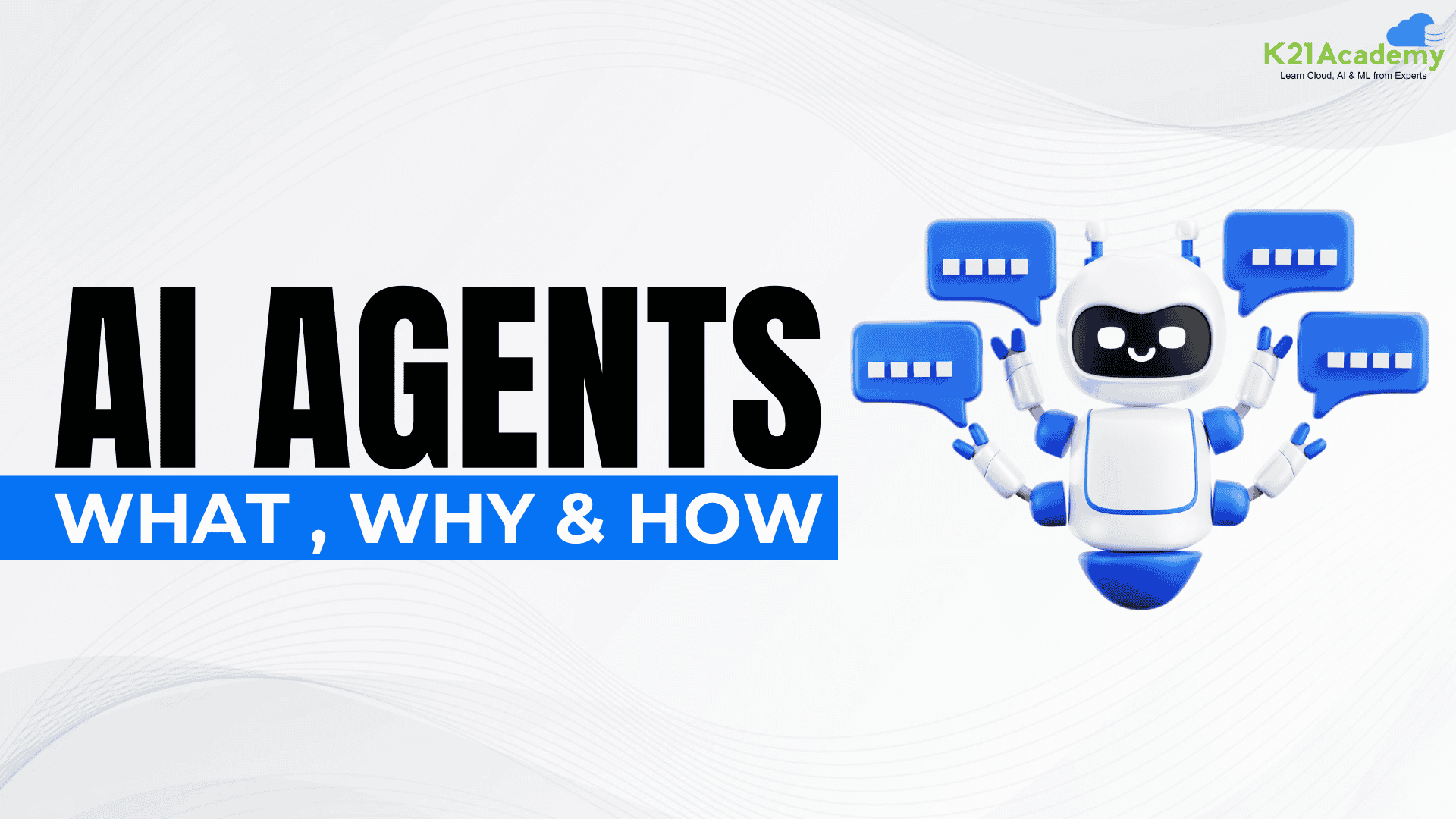



Artificial intelligence (AI) is moving beyond traditional automation into a more advanced realm known as agentic AI. These intelligent agents in AI are capable of autonomous decision-making, learning from feedback, and adapting to their environments in real time. Unlike conventional programs, they can dynamically adjust to new information, creating a transformative approach to tasks in various fields. This guide explores what (artificial intelligence) AI Agents are, their importance, types, challenges, and the impact they’re making.

What Are AI Agents?
Artificial Intelligence is rapidly evolving from simple chatbots into systems capable of making decisions, completing tasks, and acting independently. As businesses increasingly adopt automation and generative AI technologies, AI agents are becoming one of the most important concepts in modern AI applications. From virtual assistants and autonomous customer support systems to AI-powered research and workflow automation, AI agents are transforming how humans interact with technology.
So, what are AI agents? In simple terms, an AI agent is a software system that can perceive information, process data, make decisions, and take actions to achieve specific goals with minimal human intervention. The ai agent definition typically includes the ability to reason, learn, interact with environments, and respond intelligently based on user inputs or changing conditions.
Unlike traditional software programs that follow fixed instructions, AI agents can adapt dynamically using machine learning, natural language processing, and large language models. Modern AI agents are capable of handling multi-step tasks such as answering questions, scheduling meetings, generating content, analyzing data, writing code, and even interacting with external applications and APIs.
Today, organizations across industries are using AI agents to improve productivity, reduce operational costs, and automate repetitive workflows. As generative AI adoption accelerates, understanding what is an AI agent and how these systems work is becoming essential for developers, cloud professionals, business leaders, and AI practitioners.
In this article, you’ll learn:
- The complete AI agent definition
- How AI agents work
- Different types of AI agents
- Real-world use cases and examples
- Benefits and limitations
- AI agent architecture and components
- Future trends shaping autonomous AI systems
By the end, you’ll have a clear understanding of how AI agents operate and why they are becoming a foundational part of the next generation of intelligent applications.

Why are Agents in Artificial Intelligence Important?
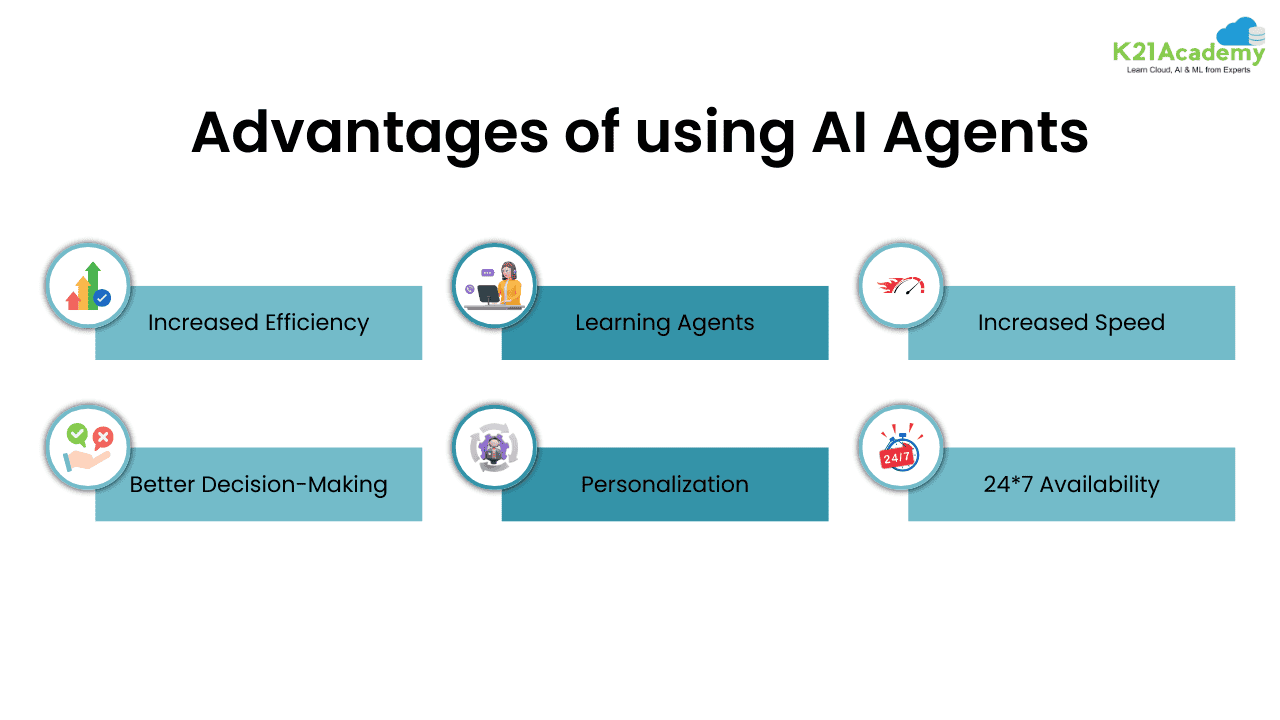
Agents in artificial intelligence bring enhanced efficiency and flexibility to workflows. For developers, this means defining a goal and allowing the agent to create and execute a plan, reducing time spent on repetitive tasks.
Key Benefits of Intelligent Agents
- Increased Efficiency: AI agents streamline processes, from code linting to debugging, saving time and minimizing errors.
- Improved Collaboration: Multi-agent systems, like GitHub’s Copilot Workspace, integrate agents into collaborative workflows, helping developers by generating code, running tests, and managing pull requests.
- Modular Flexibility: AI agents can be designed as modular components, making it easy to combine them into scalable systems for larger tasks.
Types of AI Agents
As artificial intelligence continues evolving, AI agents are becoming more sophisticated and capable of handling increasingly complex tasks. However, not all AI agents function the same way. Different types of AI agents are designed for different environments, goals, and decision-making capabilities.
Understanding the types of AI agents is important because each category solves specific real-world problems — from simple automation systems to advanced autonomous AI applications. In modern AI systems, the choice of agent architecture directly impacts performance, adaptability, learning capability, and business outcomes.
In computer science and artificial intelligence, AI agent types are commonly classified based on:
- Decision-making ability
- Learning capability
- Environmental awareness
- Goal-oriented behavior
- Autonomy level
These different types of AI agents form the foundation of robotics, virtual assistants, autonomous systems, recommendation engines, and generative AI applications.
Overview of Different Types of AI Agents

| Type of AI Agent | Key Characteristic | Real-World Example |
|---|---|---|
| Simple Reflex Agents | React to current conditions only | Automatic doors |
| Model-Based Reflex Agents | Use internal memory/model | Robot vacuum cleaners |
| Goal-Based Agents | Work toward specific goals | Navigation systems |
| Utility-Based Agents | Optimize decisions for best outcome | Recommendation engines |
| Learning Agents | Improve performance through experience | AI chatbots and self-driving systems |
This classification helps explain how AI systems evolve from rule-based automation into intelligent autonomous agents.
1. Simple Reflex Agents
Simple reflex agents are the most basic ai agent types. They make decisions solely based on current input conditions without considering past experiences or future consequences.
These agents follow predefined “if-then” rules:
- If a condition occurs → perform an action
- No memory or learning involved
Example
- Automatic doors opening when motion is detected
- Thermostats adjusting room temperature
- Basic spam filters
Key Characteristics
- Fast response time
- Simple implementation
- No memory or reasoning capability
Limitation
They struggle in dynamic environments because they cannot adapt beyond programmed rules.
2. Model-Based Reflex Agents
Model-based reflex agents improve upon simple reflex systems by maintaining an internal understanding of the environment. They use stored information to make better decisions even when some data is missing.
These types of AI agents are commonly used where the environment changes over time.
Example
- Robot vacuum cleaners mapping room layouts
- Warehouse automation robots
- Smart surveillance systems
Key Features
- Internal memory/model
- Better environmental awareness
- More adaptive than simple reflex agents
Practical Relevance
Modern robotics and IoT systems often use model-based agent architectures for navigation and monitoring.
3. Goal-Based Agents
Goal-based agents make decisions by evaluating actions that help achieve a specific objective. Unlike reflex agents, they consider future outcomes before acting.
These different types of AI agents are widely used in planning and optimization tasks.
Example
- GPS navigation systems finding shortest routes
- AI scheduling assistants
- Autonomous drones
Key Characteristics
- Goal-oriented reasoning
- Action planning capability
- Decision evaluation before execution
Real-World Importance
Goal-based AI agents are critical in logistics, autonomous vehicles, and enterprise workflow automation.
4. Utility-Based Agents
Utility-based agents take decision-making one step further by choosing actions that maximize overall usefulness or satisfaction. Instead of simply reaching a goal, they evaluate the quality of possible outcomes.
These AI agent types are commonly used in recommendation and optimization systems.
Example
- Netflix or YouTube recommendation systems
- Financial trading algorithms
- E-commerce product recommendation engines
Key Features
- Utility scoring mechanisms
- Cost-benefit analysis
- Preference-based optimization
Why They Matter
Utility-based systems help organizations optimize user experience, operational efficiency, and business performance.
5. Learning Agents
Learning agents are among the most advanced types of AI agents because they continuously improve using experience, feedback, and data.
These agents typically combine:
- Learning modules
- Decision-making systems
- Performance evaluation mechanisms
Example
- AI virtual assistants
- Generative AI copilots
- Self-driving vehicles
- AI-powered customer support bots
Key Characteristics
- Self-improvement capability
- Adaptive learning
- Pattern recognition
- Continuous optimization
Industry Relevance
Learning agents power many modern AI applications including ChatGPT-like assistants, autonomous systems, and enterprise AI platforms.
Why Understanding AI Agent Types Matters
Understanding the types of AI agents helps businesses and developers:
- Choose the right AI architecture
- Improve automation strategies
- Build scalable intelligent systems
- Optimize decision-making processes
- Design more adaptive AI applications
As AI adoption accelerates globally, organizations are increasingly combining multiple AI agent types to create advanced autonomous systems capable of reasoning, planning, learning, and acting independently.
Today, AI agents are widely used across:
- Healthcare
- Finance
- Cloud computing
- Cybersecurity
- E-commerce
- Autonomous vehicles
- Customer service automation
The future of AI will likely involve multi-agent systems where multiple intelligent agents collaborate to solve complex real-world problems more efficiently.
Memory in AI Agents
Each agent has a certain amount of long-term memory in addition to short-term memory. Knowing how to construct your AI application system and business logic, as well as the long-term memory types to include in your toolkit, requires an understanding of the distinctions between the two.

Short-term Memory
The temporary storage area where an agent keeps the data it is now using is known as short-term memory, or working memory. Active information such as the context of the current conversation, recent communications, and intermediate steps in reasoning are usually kept in this memory.
Long-term Memory
Long-term memory is of 3 types:
Semantic Memory: Factual knowledge and generic world information are stored in semantic memory. The knowledge your agent has acquired that isn’t connected to particular situations is stored there. This comprises meanings, facts, ideas, and concepts that aid in the agent’s comprehension of the outside environment.
Procedural Memory: Knowledge regarding how to carry out activities or adhere to particular procedures is stored in procedural memory. Procedural memory, which specifies how the AI agents should behave in various scenarios, is frequently implemented as functions, algorithms, or code. This could be as basic as a user greeting template or as sophisticated as a multi-step problem-solving reasoning procedure. Procedural memory records the agent’s application of information, as opposed to semantic memory, which records the agent’s understanding.
Episodic Memory: Certain prior events and experiences are stored in episodic memory. These are the things that happened to us at specific times and locations; they are our autobiographical memories as humans. Episodic memory enables AI agents to recall and gain knowledge from previous user encounters.
How Do AI Agents Work?
As AI systems become more advanced, understanding how AI agents work is becoming increasingly important for developers, businesses, and technology professionals. AI agents are designed to perceive information, process data, make decisions, and take actions autonomously to achieve specific goals. Unlike traditional software programs that follow static instructions, intelligent agents can adapt dynamically based on inputs, environments, and learned experiences.
At a high level, AI agents work through a continuous cycle of:
- Perceiving the environment
- Processing and analyzing information
- Making decisions
- Taking actions
- Learning from outcomes
This intelligent decision-making loop forms the foundation of modern AI systems including chatbots, autonomous vehicles, virtual assistants, recommendation engines, robotics, and generative AI applications.
AI Agent Architecture Explained
The ai agent architecture defines how an AI agent is structured internally to perform tasks intelligently. While architectures may vary depending on the complexity of the system, most intelligent agent structures include several core components.
Core Components of AI Agent Architecture
| Component | Function |
|---|---|
| Sensors/Input Layer | Collects information from the environment |
| Processing Engine | Analyzes data and makes decisions |
| Knowledge Base | Stores memory, rules, or learned information |
| Decision-Making Module | Selects the best action |
| Actuators/Output Layer | Executes actions or responses |
| Learning Mechanism | Improves performance using feedback |
Together, these components create an intelligent agent structure capable of interacting with dynamic environments.
Step-by-Step Process: How AI Agents Work
1. Perception and Data Collection
The first step in how AI agents work is gathering information from their environment. AI agents use various input mechanisms such as:
- User prompts
- APIs
- Sensors
- Cameras
- Databases
- System events
Example
- A chatbot receives a customer query
- A self-driving car detects nearby vehicles
- A recommendation engine analyzes user activity
This stage helps the agent understand the current state of the environment.
2. Data Processing and Interpretation
After collecting information, the AI agent processes the input using machine learning models, logical reasoning, or natural language processing algorithms.
This stage may involve:
- Pattern recognition
- Context analysis
- Intent detection
- Predictive modeling
Example
A virtual assistant analyzing:
“Schedule a meeting tomorrow at 3 PM”
The system identifies:
- User intent
- Date and time
- Required action
Modern generative AI agents often use large language models (LLMs) during this processing stage.
3. Decision-Making
Once data is interpreted, the agent determines the most appropriate action based on its goals, rules, or learned behavior.
Decision-making in intelligent agent structures may involve:
- Rule-based logic
- Goal optimization
- Utility scoring
- Reinforcement learning
Example
A navigation AI agent may evaluate:
- Traffic conditions
- Distance
- Estimated arrival time
before selecting the fastest route.
4. Action Execution
After making a decision, the AI agent performs an action.
Actions may include:
- Generating responses
- Sending notifications
- Updating databases
- Executing commands
- Controlling physical devices
Example
- A chatbot replying to a customer
- A robot moving an object
- An AI assistant sending an email
This stage allows AI agents to interact directly with users or systems.
5. Learning and Improvement
One of the most important aspects of how do AI agents work is continuous learning. Advanced AI agents improve performance over time using feedback and historical data.
Learning mechanisms may include:
- Machine learning
- Reinforcement learning
- User feedback analysis
- Behavioral adaptation
Example
Streaming platforms improving recommendations based on viewing history.
This learning capability enables intelligent systems to become more accurate and personalized over time.
Intelligent Agent Structure in Real-World Applications
Different industries use intelligent agent structures for different purposes.
| Industry | AI Agent Application |
|---|---|
| Healthcare | AI diagnosis assistants |
| Finance | Fraud detection systems |
| Retail | Recommendation engines |
| Customer Service | AI chatbots |
| Transportation | Autonomous vehicles |
| Cybersecurity | Threat detection systems |
These applications demonstrate how AI agents operate in practical business environments.
Example of AI Agent Workflow
Here’s a simplified example of how an AI customer support agent works:
| Step | Process |
|---|---|
| 1 | User submits a question |
| 2 | Agent analyzes intent |
| 3 | Knowledge base is searched |
| 4 | Best response is selected |
| 5 | AI generates and sends response |
| 6 | Feedback improves future accuracy |
This workflow highlights the core principles of modern ai agent architecture.
Key Technologies Behind AI Agents
Modern AI agents rely on multiple technologies working together.
Common Technologies Used
- Machine Learning (ML)
- Natural Language Processing (NLP)
- Large Language Models (LLMs)
- Reinforcement Learning
- Knowledge Graphs
- Cloud Computing
- APIs and Automation Frameworks
These technologies enable AI agents to reason, communicate, and automate complex tasks.
Why AI Agent Architecture Matters
A strong ai agent architecture is critical because it determines:
- Scalability
- Accuracy
- Learning capability
- Decision quality
- Automation efficiency
Poorly designed intelligent agent structures may struggle with:
- Context understanding
- Long-term memory
- Complex reasoning
- Dynamic environments
As AI systems become more autonomous, architecture design is becoming a major focus area in enterprise AI development.
Future of Intelligent AI Agents
The future of AI agents is moving toward:
- Autonomous multi-agent systems
- AI copilots
- Human-AI collaboration
- Real-time reasoning systems
- Self-improving autonomous workflows
Modern enterprises are increasingly investing in advanced AI agent architectures capable of handling complex business operations with minimal human intervention.
As generative AI evolves, intelligent agents are expected to become more context-aware, collaborative, and capable of performing sophisticated multi-step tasks across digital ecosystems.
AI Agents vs Traditional Programs
As artificial intelligence evolves, many organizations are comparing ai agents vs traditional ai systems to understand which approach is better for modern applications. While traditional software follows fixed instructions, AI agents can learn, adapt, and make decisions dynamically based on data and changing environments.
Understanding how do AI agents differ from traditional programs is important for choosing the right solution for automation, decision-making, and business workflows.
| Feature | AI Agents | Traditional Programs |
|---|---|---|
| Decision Making | Dynamic and adaptive | Fixed rule-based logic |
| Learning Ability | Can improve using data | No self-learning |
| Flexibility | Handles changing scenarios | Works best in predictable conditions |
| User Interaction | Conversational and context-aware | Limited predefined responses |
| Automation Level | High autonomy | Manual or semi-automated |
| Problem Solving | Can analyze and reason | Executes predefined commands |
| Examples | ChatGPT, AI copilots, virtual assistants | Calculator apps, payroll software |
One of the biggest differences in ai agent vs software systems is adaptability. Traditional programs work well when tasks are repetitive and rules are clearly defined. However, AI agents are better suited for dynamic environments where systems must learn, respond intelligently, and handle unpredictable inputs.
For example:
- A payroll management system is better as a traditional program because rules rarely change.
- A customer support chatbot benefits more from AI agents because conversations vary constantly.
When to Choose Which?
Choose Traditional Programs When:
- Tasks are repetitive and rule-based
- Predictability and stability are critical
- No learning or adaptation is required
Choose AI Agents When:
- Systems need decision-making capability
- User interactions are dynamic
- Automation and personalization are important
As businesses increasingly adopt intelligent automation, AI agents are becoming more valuable for handling complex workflows that traditional software cannot efficiently manage.
Challenges of Developing Intelligent Agents
Creating reliable agents presents several technical challenges:
- Unpredictability: As AI agents adapt to their environments, their responses are not always predictable, making debugging a challenge in complex, autonomous systems.
- Evaluating Performance: Assessing an AI agent’s improvement can be difficult as it’s hard to determine if changes result from the agent’s model, data, or external factors. Developers often require advanced methods for accurate evaluation.
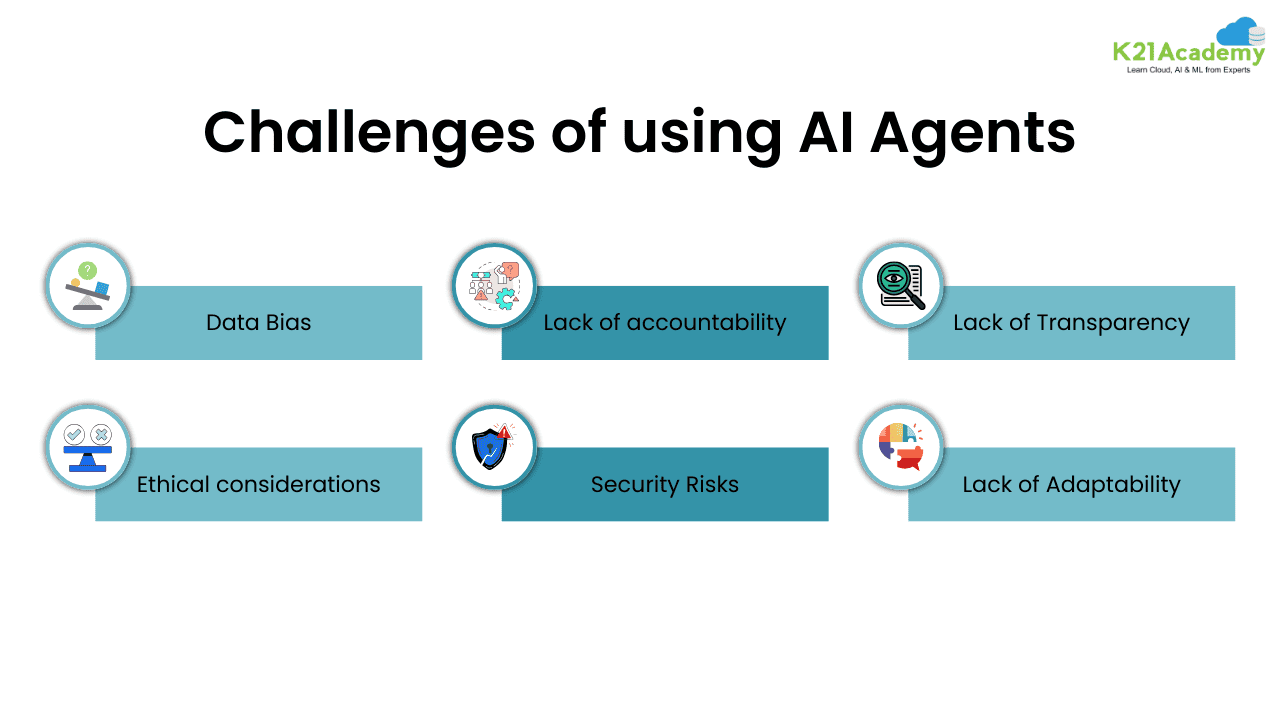 These challenges highlight the need for clear metrics, transparency, and reliable testing processes to ensure agent effectiveness.
How to Build an AI Agent
As businesses increasingly adopt intelligent automation, many developers and technology professionals want to learn how to create AI agent systems for real-world applications. Modern AI agents can perform tasks such as answering questions, automating workflows, generating content, and interacting with external tools and APIs.
Building an AI agent typically involves combining a large language model, memory, decision-making logic, and external integrations using an ai agent framework.
Prerequisites
Before you build AI agent applications, you should have:
- Basic Python knowledge
- An OpenAI or LLM API key
- Python installed on your system
- A code editor such as VS Code
- Basic understanding of APIs and prompts
Popular AI Agent Tools & Frameworks
| Tool/Framework | Purpose |
|---|---|
| LangChain | AI agent orchestration |
| AutoGen | Multi-agent workflows |
| CrewAI | Collaborative AI agents |
| OpenAI API | LLM integration |
| Pinecone | Vector database memory |
These ai agent tools help simplify agent development and workflow automation.
Step 1: Install Required Libraries
First, install the required Python libraries.
pip install openai langchain
This installs the basic ai agent framework components needed to create an AI-powered assistant.
Step 2: Configure API Access
Next, configure your API key.
import os
os.environ["OPENAI_API_KEY"] = "your-api-key"
This allows your AI agent to communicate with the language model.
Step 3: Create a Simple AI Agent
Now create a basic AI assistant.
from langchain.chat_models import ChatOpenAI

llm = ChatOpenAI()

response = llm.predict("Explain cloud computing in simple words")

print(response)
This simple example shows how to create AI agent functionality using an LLM.
Step 4: Add Memory and Tools
Advanced AI agents often include:
- Memory
- External APIs
- Search tools
- Decision-making workflows
This allows the agent to perform multi-step tasks instead of generating single responses.
Step 5: Test Your AI Agent
Run the script and verify:
- Responses are generated successfully
- API connection works
- Prompts return meaningful answers
Expected Output
The AI agent should generate a readable explanation based on the prompt provided.
When to Use AI Agents
AI agents are commonly used for:
- Customer support chatbots
- AI copilots
- Workflow automation
- Research assistants
- Content generation
- Data analysis systems
As AI adoption grows, learning how to build AI agent applications is becoming a valuable skill for developers, cloud professionals, and AI engineers.
FAQs
Q1. What are AI agents?
AI agents are intelligent software systems that can perceive information, process data, make decisions, and take actions autonomously to achieve specific goals. The ai agent definition typically includes learning, reasoning, and interaction capabilities, allowing AI agents to automate tasks and respond dynamically to changing environments.
Q2. How do AI agents work?
AI agents work by collecting information from their environment, processing data using AI models, making decisions, and executing actions. Modern AI agents often use machine learning, natural language processing, and large language models to improve responses and adapt to changing conditions over time.
Q3. What are the different types of AI agents?
Different types of AI agents include simple reflex agents, model-based agents, goal-based agents, utility-based agents, and learning agents. These AI agent types vary in complexity, decision-making ability, memory usage, and learning capability, depending on the tasks and environments they are designed for.
Q4. What are the benefits of AI agents?
AI agents help automate repetitive tasks, improve decision-making, enhance customer experiences, and increase operational efficiency. Businesses use AI agents for customer support, workflow automation, recommendation systems, and data analysis, enabling faster processes and reducing manual effort across various industries.
Q5. How do AI agents differ from traditional programs?
The main difference between AI agents and traditional software is adaptability. Traditional programs follow fixed instructions, while AI agents can learn from data, make autonomous decisions, and respond dynamically to changing situations. This makes AI agents more suitable for complex and unpredictable environments.
Q6. How can beginners start learning AI agents?
Beginners can start learning AI agents by understanding AI fundamentals, Python programming, machine learning concepts, and AI agent frameworks such as LangChain or AutoGen. Building simple chatbot or automation projects is an effective way to gain practical experience with intelligent agent systems.
Conclusion
Agentic AI is redefining automation, collaboration, and efficiency in software development and beyond. Intelligent agents in AI enable us to focus on higher-value tasks by automating and optimizing routine operations. As technology advances, these agents are expected to play an even more significant role across industries, making them an exciting area of AI with vast potential. With continuous development, it promise to enhance productivity and innovation, bringing us closer to a future of intelligent, autonomous systems.
Next Task: Enhance Your Agentic AI Skills
Ready to master Agentic AI & generative AI? Join K21 Academy’s Agentic AI FREE class and take the first step toward a career in Agentic AI and GenAI—even if you’re a beginner! Secure your spot now!