




The need for experts who can create safe and scalable AI solutions has never been higher as businesses use generative AI more and more to automate processes, create AI assistants, and create intelligent business applications.
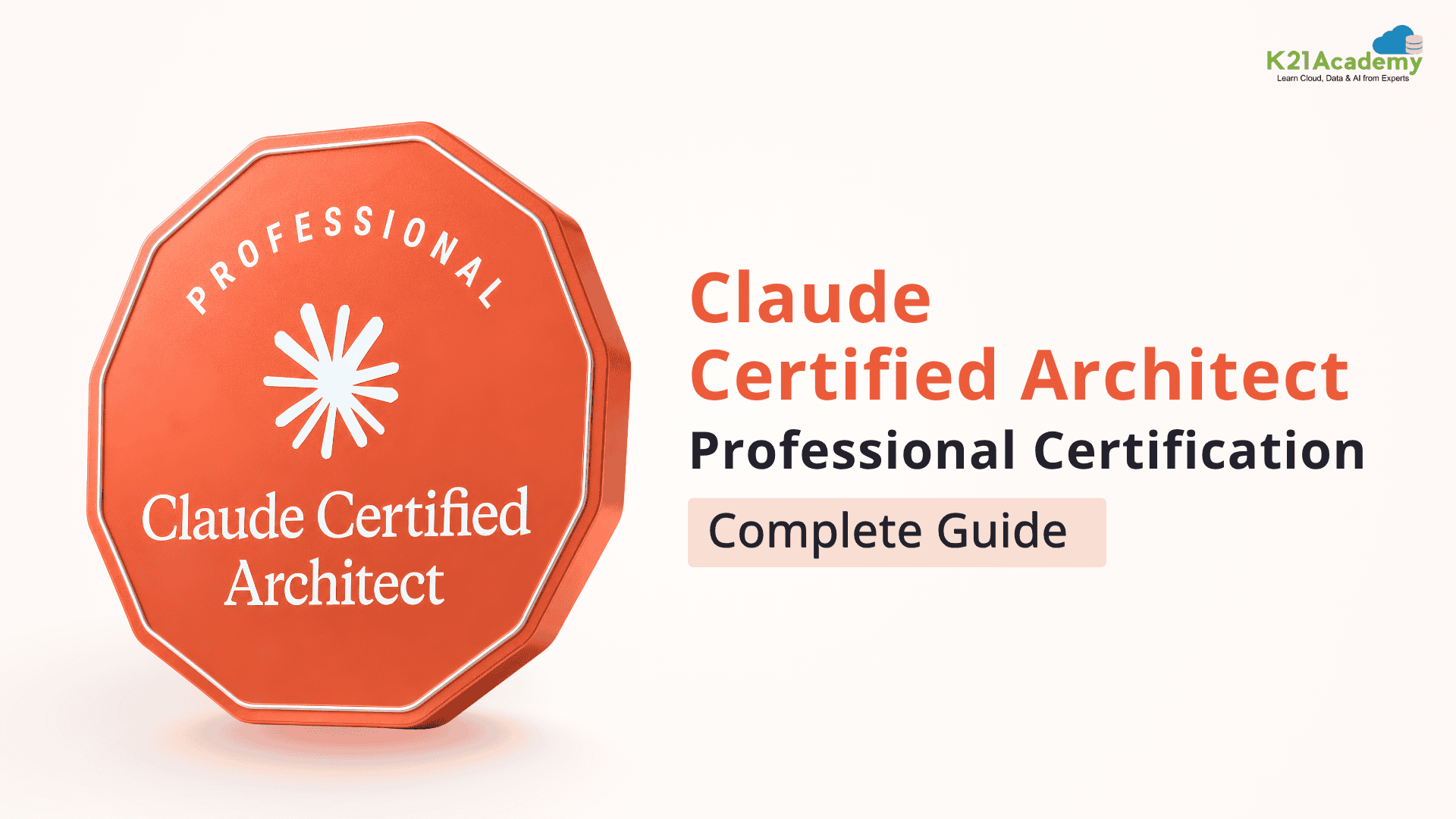
To address this growing demand, Anthropic introduced the Claude Certified Architect – Professional certification. This credential validates your ability to design, build, and deploy production-grade AI solutions using the Claude platform and its ecosystem. Rather than testing basic prompt-writing skills, it focuses on real-world architectural decisions that enterprise AI professionals make every day.
Everything you need to know about the certification will be addressed in this guide, including the test format, target audience, domains covered, suggested experience, preparation advice, and whether or not it’s the best certification for your AI career.
What is the Claude Certified Architect – Professional Certification?
The Claude Certified Architect – Professional (CCAR-P) is Anthropic’s professional-level certification designed for architects and experienced AI practitioners responsible for designing enterprise AI applications. This certification assesses your capacity to design comprehensive AI solutions using Claude, in contrast to certifications that concentrate on machine learning techniques or data science principles. It evaluates how well you can convert business needs into scalable AI systems while taking governance, security, compliance, model selection, fast engineering, API integration, evaluation, and operational excellence into account. In other words, the certification isn’t about asking Claude better questions; it’s about designing intelligent AI systems that organisations can confidently deploy in production.
Related Readings: Claude Code for AI/ML Engineers: Should You Invest the Time? Honest 2026 Worth-It Breakdown
Why Should You Consider This Certification?
Projects involving generative AI are progressing quickly from proof-of-concept to production. Instead of just text-generating chatbots, organisations increasingly demand AI systems that are dependable, safe, scalable, and in line with business objectives. This certification demonstrates that you possess the architectural knowledge needed to build those production-ready systems. Some key benefits include the following:
- Validate Enterprise AI Architecture Skills: Your proficiency in designing AI systems beyond prompt engineering is demonstrated by the certification. Throughout the whole AI lifecycle, it verifies architectural thinking.
- Stay Relevant in the AI Job Market: As AI Architect and GenAI Solution Architect roles continue to grow, employers increasingly seek professionals with validated expertise in enterprise AI platforms.
- Build Production-Ready AI Solutions: The exam emphasises practical implementation topics such as integrations, evaluation, governance, optimisation, and operational enablement—skills directly applicable to real-world projects.
- Improve Career Opportunities: Whether you’re already working as a Cloud Architect, AI Engineer, Technical Lead, or Software Architect, this certification strengthens your profile for enterprise AI roles.
- Learn Modern AI Best Practices: Preparing for the certification exposes you to industry best practices around prompt engineering, model selection, RAG architecture, observability, AI safety, and compliance.
Who Should Take the Claude Certified Architect – Professional Certification?
This certification is meant for mid- to senior-level technical experts who are in charge of creating and delivering production-grade AI solutions employing big language models, according to Anthropic.
It is ideal for:
- AI Solution Architects
- Generative AI Architects
- AI/ML Engineers
- Senior Software Engineers
- Technical Leads
- Cloud Solution Architects
- Platform Engineers
- Enterprise Architects
- AI Consultants
- Engineering Managers involved in AI initiatives
These professionals typically bridge the gap between business requirements and technical implementation while making critical architectural decisions around AI systems.
Related Readings: AI Engineer vs AI Architect
Recommended Experience and Prerequisites
One of the advantages of the Claude Certified Architect – Professional certification is that there are no mandatory prerequisites. Your eligibility depends entirely on passing the exam.
However, Anthropic recommends candidates have experience in several key areas before attempting the certification.
Recommended Experience
- Strong understanding of software engineering best practices
- Around 3+ years of experience in systems architecture or platform engineering
- At least 6 months of hands-on experience working with Claude or similar LLM-based systems in production
- Experience delivering end-to-end AI solutions from design through deployment and operational management
Claude Certified Architect – Professional Exam Details
| Feature | Details |
|---|---|
| Certification | Claude Certified Architect – Professional |
| Exam Code | CCAR-P |
| Questions | 63 |
| Question Type | Multiple Choice & Multiple Response |
| Duration | 120 Minutes |
| Passing Score | 720 / 1000 |
| Exam Fee | USD $175 |
| Delivery Mode | Online Proctored or Pearson VUE Test Center |
| Validity | 12 Months |
| Result | Pass/Fail with Domain-wise Performance Report |
The exam’s provision of a domain-wise performance breakdown upon completion is one intriguing feature. This helps pinpoint areas that require attention before your next try, even if you don’t pass.
Claude Certified Architect – Professional Exam Domains
The exam measures your knowledge across seven key domains, each representing a different aspect of designing enterprise AI systems.
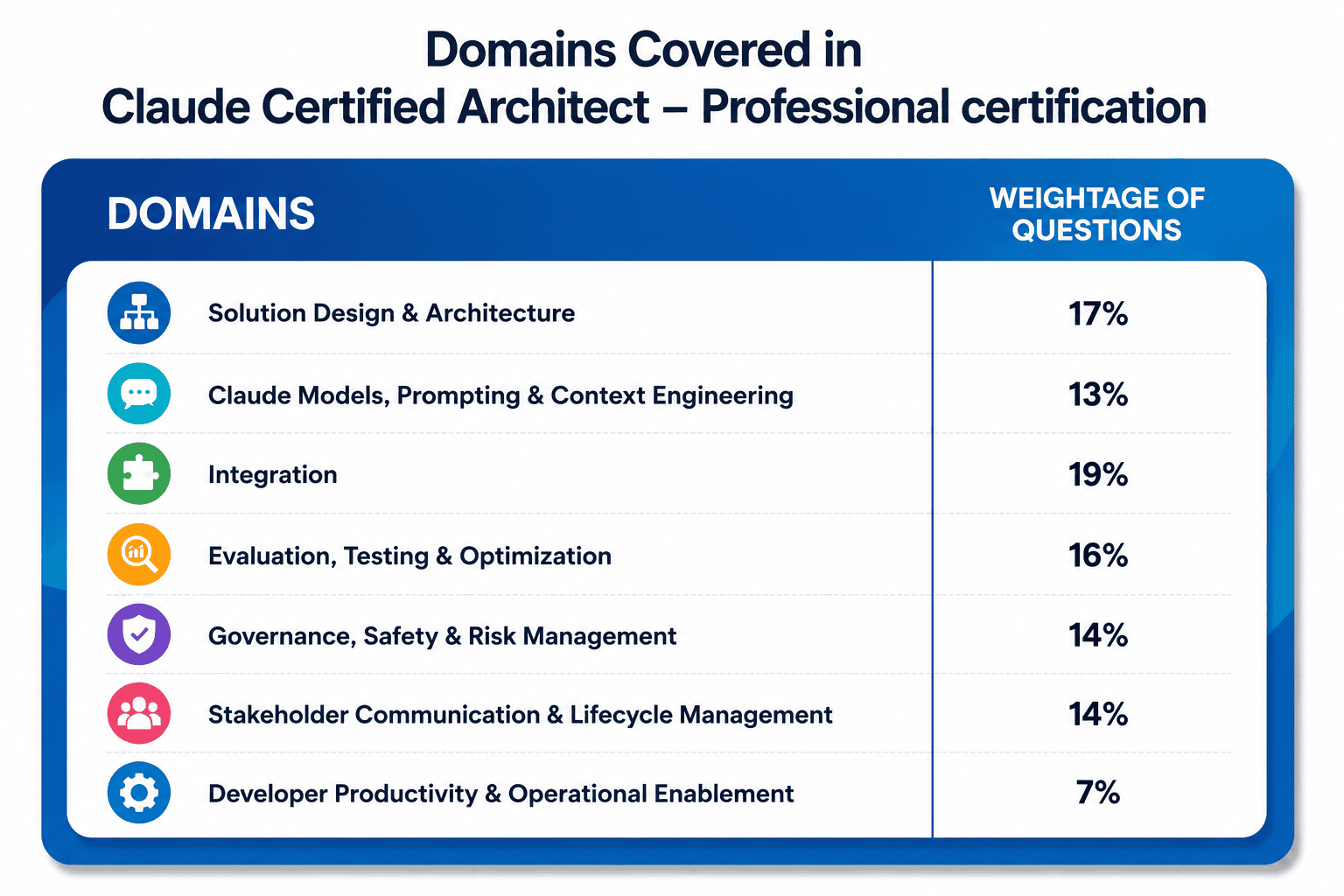
Domain 1: Solution Design & Architecture (17%)
This domain carries a significant portion of the exam because designing an AI solution starts long before writing prompts or calling an API.
- Translate business problems into Claude-based AI solutions
- Design end-to-end architectures (input → processing → output → feedback loops)
- Select appropriate architectural patterns (workflow, agentic, augmented LLM)
- Design multi-agent systems and orchestration strategies
- Apply decomposition techniques for complex problem solving
- Align solutions to business value pillars (efficiency, transformation, productivity, cost, performance SLAs)
Domain 2: Claude Models, Prompting & Context Engineering (13%)
This domain focuses on selecting models based on trade-offs such as performance, cost, and latency.
- Select appropriate Claude models based on trade-offs
- Design system prompts, templates, and guardrails
- Apply prompt engineering techniques (zero-shot, few-shot, chain-of-thought)
- Optimize context windows and manage token usage
- Implement prompt reuse strategies (caching, modular prompts, Skills)
Related Readings: Claude Code Career Roadmap: Skills Developers and AI Engineers Need in 2026
Domain 3: Integration (19%)
Integration is the largest weighted domain in the Claude Certified Architect – Professional exam, highlighting the importance of connecting Claude with enterprise systems securely and efficiently.
- Evaluate tool/agent configuration for capability bloat
- Analyze authentication and authorization requirements to identify security gaps
- Evaluate accuracy-latency trade-offs and justify configuration decisions
- Analyze observability challenges and select monitoring strategies at scale
- Design a RAG pipeline with appropriate chunking and indexing strategies
- Apply retrieval strategies matched to data shape and query pattern
- Evaluate connection protocols and select the appropriate integration mechanism (MCP, API/CLI, agent-to-agent)
- Evaluate progressive discovery vs. monolithic context strategy
Domain 4: Evaluation, Testing & Optimization (16%)
This domain evaluates your ability to measure AI system performance and continuously improve it using structured evaluation frameworks.
- Define evaluation metrics (accuracy, latency, cost, safety, security)
- Design evaluation datasets and test frameworks using mixed methodologies
- Conduct A/B testing and iterative improvements
- Diagnose system issues (prompt failure, hallucinations, model mismatch)
- Optimize token usage, latency, and cost-performance trade-offs
- Monitor system performance using logging and observability tools
Domain 5: Governance, Safety & Risk Management (14%)
This domain focuses on designing AI systems that are secure, compliant, and aligned with organisational governance policies.
- Implement guardrails and safety controls
- Identify risks, limitations, and failure modes of LLM systems
- Apply human-in-the-loop validation strategies
- Ensure compliance with regulations (e.g., GDPR, HIPAA, FedRAMP)
- Address ethical AI considerations (bias, fairness, transparency)
Domain 6: Stakeholder Communication & Lifecycle Management (14%)
This domain assesses your capacity to oversee the entire lifespan of an AI project, from obtaining business needs to assisting with production deployments.
- Conduct structured discovery and requirement gathering
- Communicate architectural decisions and trade-offs
- Manage stakeholder feedback loops and expectation alignment (including SLAs)
- Document architectures and provide implementation guidance
- Support lifecycle phases (discovery, design, handoff, monitoring, iteration)
Domain 7: Developer Productivity & Operational Enablement (7%)
Despite having the least weight, this domain is nevertheless crucial to contemporary AI design.
- Configure Claude tools and environments for teams (e.g., Claude Code)
- Improve developer workflows using AI-assisted tooling
- Support debugging and operational issue resolution
Pros and Cons of the Certification
| Pros | Cons |
|---|---|
| Official professional-level Anthropic certification | Not suitable for beginners |
| Strong focus on enterprise AI architecture | Requires prior experience with LLM systems |
| Covers modern topics like MCP, RAG, governance, and evaluation | Valid for only 12 months before renewal is required |
| Validates practical architectural decision-making | Primarily focused on the Claude ecosystem |
| Helps strengthen AI Architect and Solution Architect profiles | Hands-on experience is essential for success |
Career Opportunities After Certification
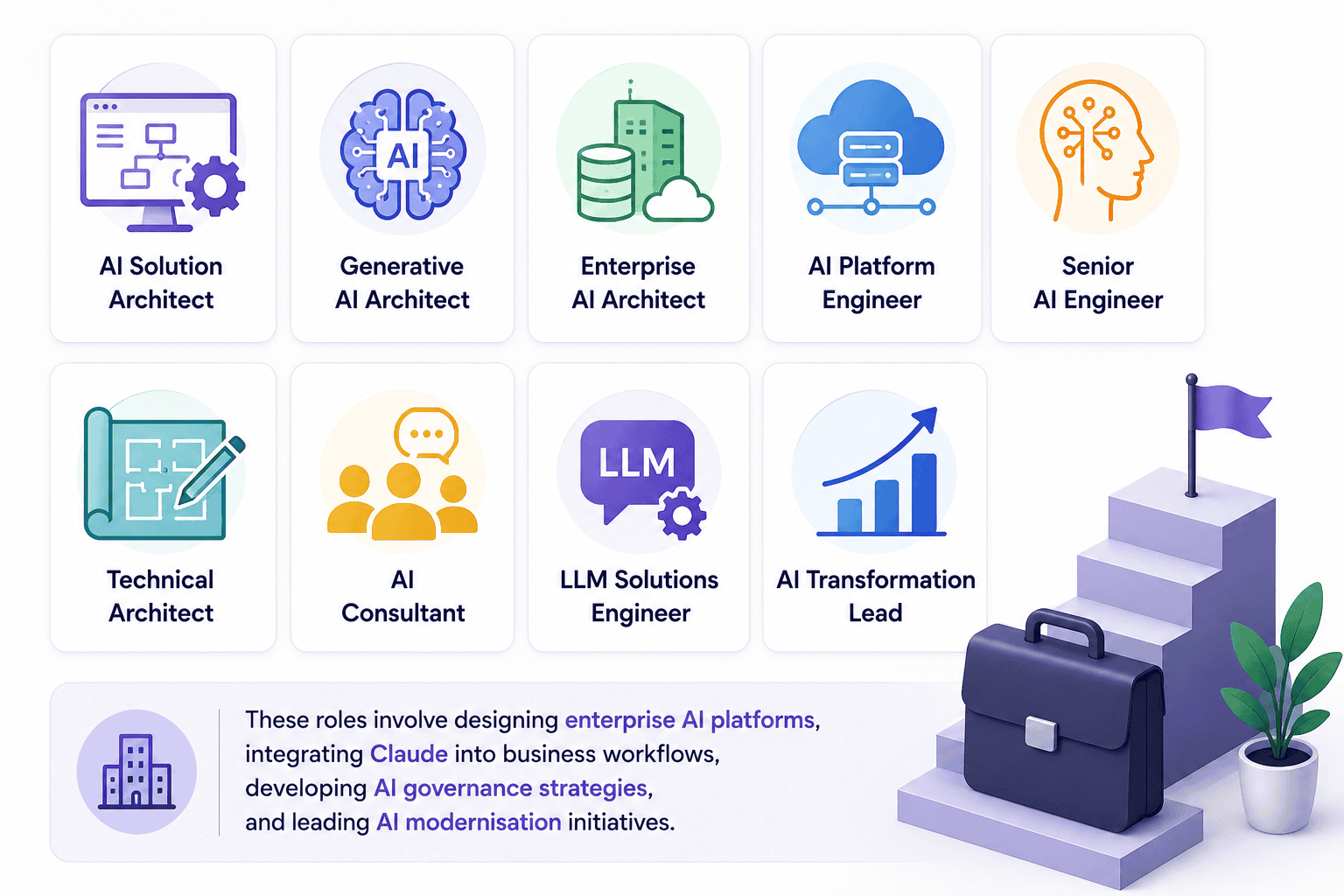
Organisations are searching for experts that can go beyond experimentation and create AI systems that are ready for production as enterprise AI adoption continues to pick up speed.
After earning this certification, you may pursue roles such as:
- AI Solution Architect
- Generative AI Architect
- Enterprise AI Architect
- AI Platform Engineer
- Senior AI Engineer
- Technical Architect
- AI Consultant
- LLM Solutions Engineer
- AI Transformation Lead
These roles often involve designing enterprise AI platforms, integrating Claude into business workflows, developing AI governance strategies, and leading AI modernisation initiatives.
Related Readings: Top 10 Claude Code Use Cases Every Developer Should Know
Salary Structure for Claude Certified Architect – Professional (India, USA, UK & Global)
Professionals with experience creating production-grade Claude solutions are among the highest-paid AI specialists as businesses continue to invest in Generative AI and Agentic AI. Obtaining the Claude Certified Architect – Professional certification can boost your profile for senior AI architecture and solution design employment, even though pay varies according on experience, region, industry, and technical proficiency.
| Country/Region | Average Annual Salary | Typical Job Roles |
|---|---|---|
| India | ₹30 LPA – ₹70 LPA | AI Solution Architect, GenAI Architect, AI Consultant |
| United States | $170,000 – $260,000 | Enterprise AI Architect, AI Platform Engineer, AI Transformation Lead |
| United Kingdom | £90,000 – £145,000 | AI Architect, Technical Architect, LLM Solutions Engineer |
| Canada | CAD 140,000 – CAD 210,000 | AI Solutions Engineer, Enterprise AI Consultant |
| Australia | AUD 170,000 – AUD 240,000 | AI Architect, Cloud AI Architect |
| Middle East (UAE/Saudi Arabia) | AED 320,000 – AED 520,000 | Enterprise AI Architect, AI Strategy Consultant |
Note: These are approximate market ranges and may vary based on company size, role, location, certifications, and total compensation (bonuses, stock awards, and benefits).
Conclusion
The Claude Certified Architect – Professional certification is intended for seasoned professionals who wish to demonstrate their proficiency in utilising Claude to create production-grade AI solutions. It stresses architectural decision-making throughout the whole AI lifecycle, from solution design and integrations to governance, evaluation, and operational excellence, in contrast to entry-level AI certifications.
This certification offers a reliable means of showcasing your proficiency if you are currently working with generative AI or intend to move into an AI architect position. You’ll be well-positioned to create safe, scalable, and business-ready AI solutions that satisfy the needs of contemporary businesses by fusing practical project experience with methodical planning.