





Modern enterprise systems are becoming incredibly complex. Solution Architects today are expected to review the following:
- Hundreds of microservices
- Multi-cloud infrastructure
- AI pipelines
- Kubernetes environments
- Event-driven systems
- Distributed databases
- Security and compliance workflows
And most of the time they’re expected to understand everything quickly, often with incomplete documentation and constantly changing codebases. That’s exactly why Claude Code for Solution Architects is becoming one of the most exciting developments in modern architectural engineering.
Imagine having an AI-powered architecture co-pilot that can:
- Analyze repositories
- Understand service relationships
- Explain infrastructure logic
- Review implementation patterns
- Suggest refactoring opportunities
- Detect architectural risks
This is where Agentic AI changes the game. Instead of manually tracing dependencies across dozens of repositories, Solution Architects can now work with intelligent AI systems that actively assist in design reviews, modernisation planning, and system analysis.
This blog will discuss how Claude Code for Solution Architects is changing architecture workflows, practical applications, advantages, drawbacks, and the reasons why Agentic AI is becoming crucial to contemporary system design.
What is Claude Code?
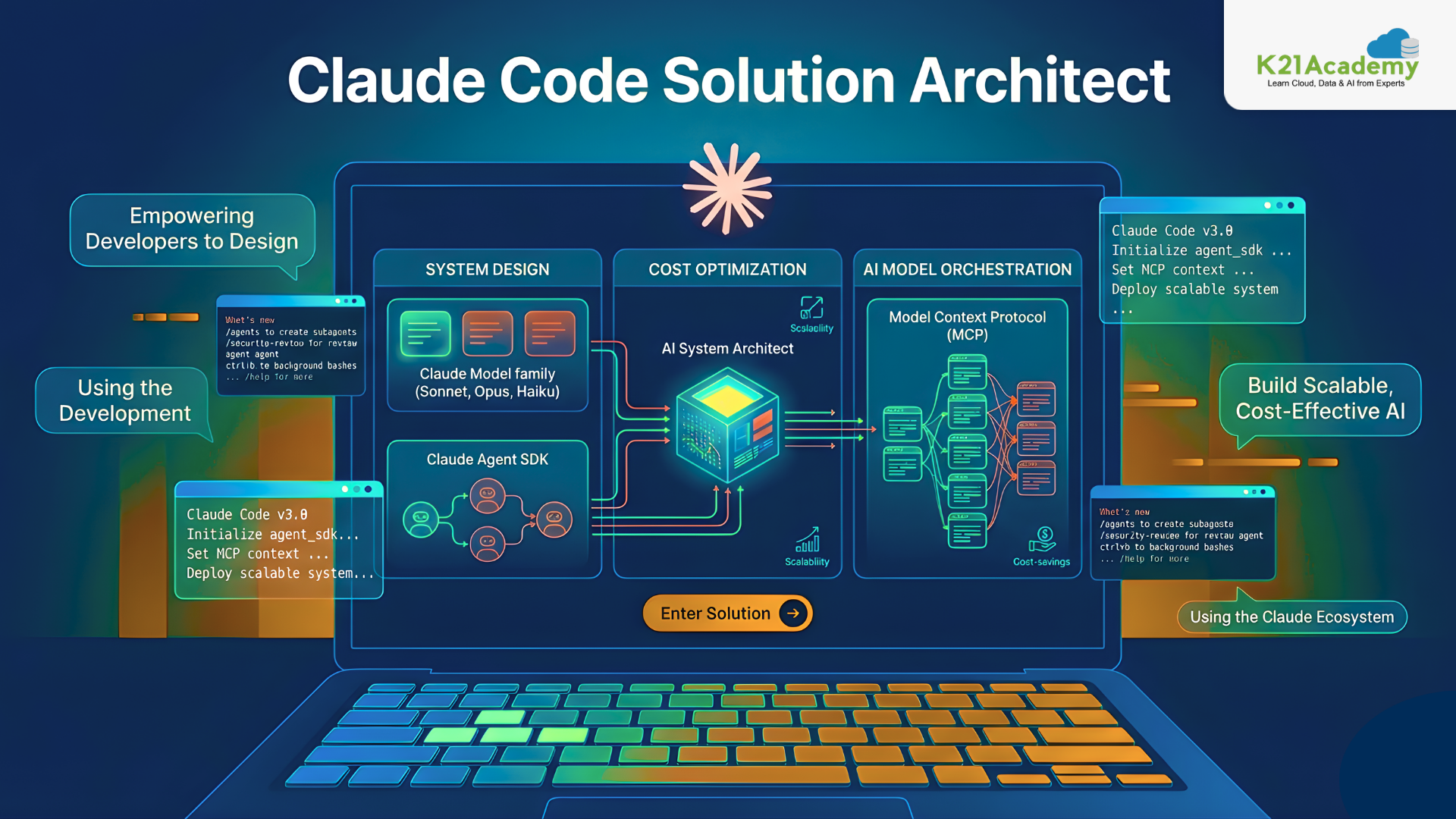
Anthropic created Claude Code, an AI-powered coding and reasoning assistance. It is intended for multi-step reasoning and deep system knowledge, in contrast to conventional AI coding tools that mostly concentrate on autocomplete recommendations. It is able to:
- Audit all of the repositories
- Recognise the connections between services
- Review the configurations of the infrastructure.
- Handle complex architectures
- Help with technical evaluations
- Provide justifications for implementation
- Assist with Agentic AI processes
Because of this, Claude Code for Solution Architects is significantly more useful than a standard AI coding assistance. It acts less like a straightforward code generator and more like an intelligent architecture analyst.
Why Learning Claude Code Matters for Solution Architects in 2026
Although they have historically been among the top paid specialists in enterprise IT, solution architects’ roles are changing quickly. Architects who can simply create cloud infrastructure or examine system diagrams are no longer sought after by organisations. Professionals that can use contemporary AI engineering tools to build, evaluate, and optimise AI-native systems are becoming more and more in demand.
In 2026, incomes for Solution Architects capable of designing and evaluating AI-native systems with Claude Code will range from $200,000 to $280,000+. In the meantime, it is becoming more and more common for architects without AI-assisted design talents to collaborate with someone who does.
Why Architects Are Suddenly Paying Attention to Claude Code
Most architects don’t struggle with designing systems. They struggle with understanding existing systems fast enough. A modern enterprise platform may include the following:
- 100+ microservices
- Multiple engineering teams
- Different cloud platforms
- Legacy integrations
- Event-driven workflows
- AI orchestration pipelines
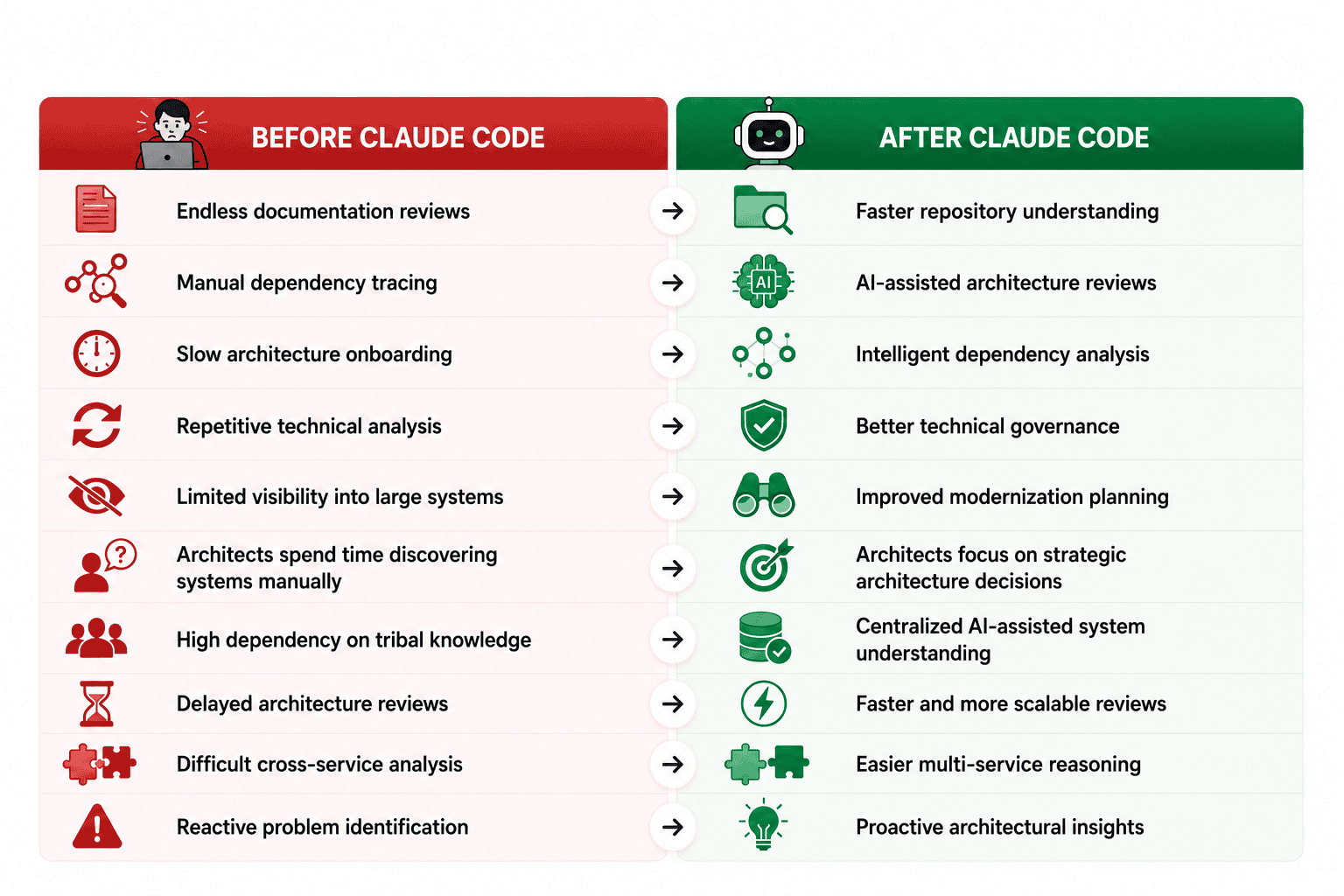
Reviewing all of this manually is slow, exhausting, and error-prone. This is exactly where Claude Code for Solution Architects becomes powerful. Instead of spending weeks manually analyzing repositories, architects can use AI-assisted reasoning to:
- Understand architecture faster
- Review implementations intelligently
- Detect hidden dependencies
- Accelerate onboarding
- Improve governance
The result is faster architecture decision-making with significantly better visibility into complex systems.
Related Readings: Top 10 Claude Code Use Cases Every Developer Should Know
Understanding Agentic AI in Architecture
Traditional AI tools are reactive:
You ask a question.
The AI answers.
The interaction ends.
Agentic AI works differently. Agentic systems can:
- Plan multi-step workflows
- Maintain context across tasks
- Analyze repositories iteratively
- Use tools autonomously
- Re-evaluate outputs
- Execute reasoning chains
This is why Agentic AI is becoming so important for architecture workflows. For Solution Architects, this means AI can now assist with:
- Architecture reviews
- Dependency mapping
- Migration planning
- Refactoring analysis
- Technical governance
- Infrastructure reasoning
This shift is one of the biggest reasons why Claude Code for Solution Architects is gaining attention across enterprise engineering teams.

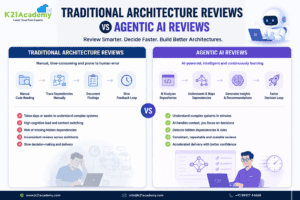
Traditional Architecture Reviews vs Agentic AI Reviews
Key Use Cases of Claude Code for Solution Architects
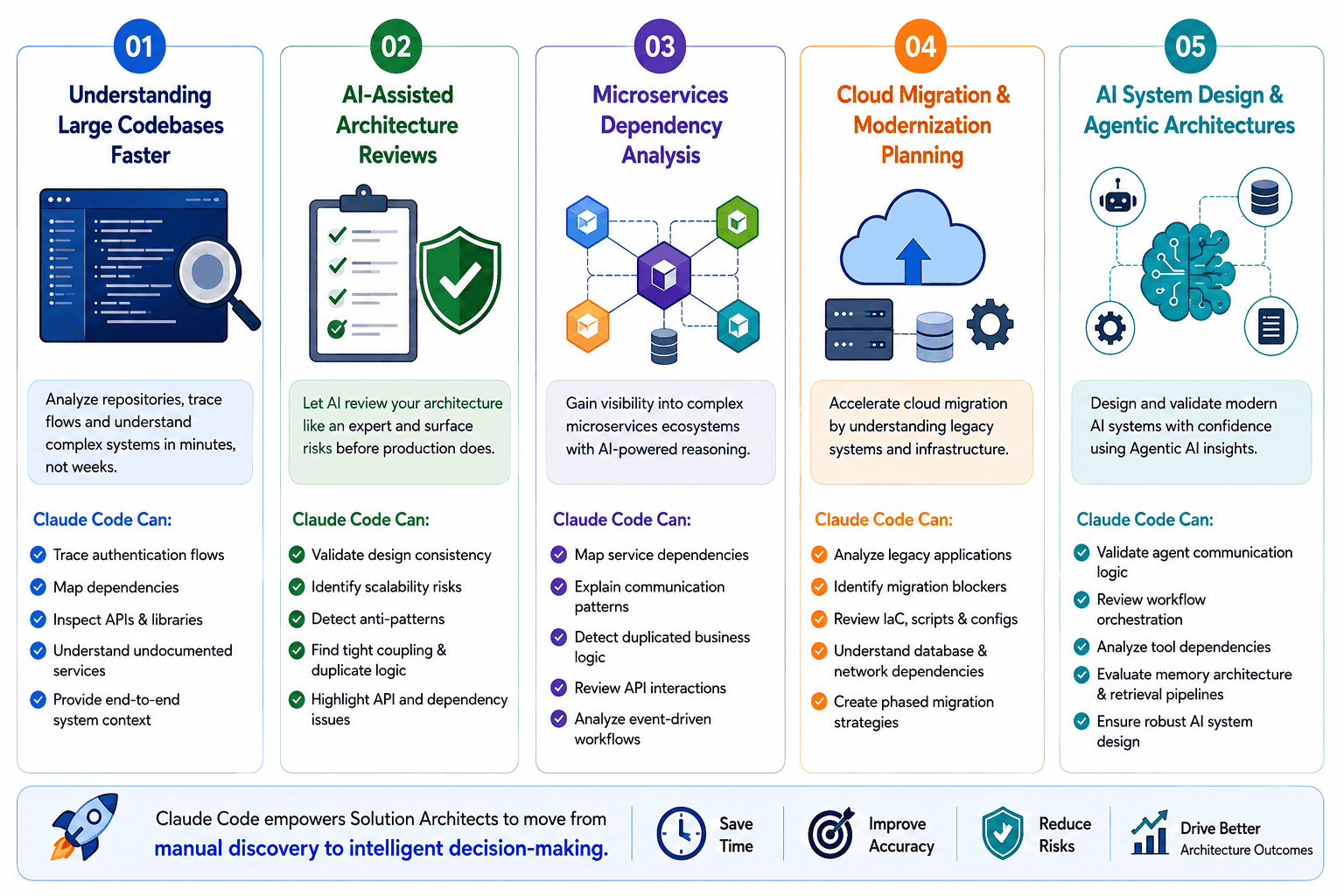
Some key use cases of claude code for solution architects are the following:
1) Understanding large codebases faster
Solution Architects can use Claude Code to quickly analyze repositories, trace authentication flows, map dependencies, and understand undocumented systems without spending weeks on manual reviews.
2) AI-Assisted Architecture Reviews
Before they affect production systems, Claude Code assists architects in identifying design flaws, tight coupling, inconsistent APIs, duplicate logic, and scalability hazards.
3) Microservices Dependency Analysis
Claude Code may map service relationships, examine API interactions, examine event-driven workflows, and enhance visibility across dispersed systems in intricate microservices setups.
4) Cloud Migration & Modernization Planning
To speed up cloud modernisation projects, architects can use Claude Code to examine legacy apps, infrastructure dependencies, deployment scripts, and migration roadblocks.
5) Designing Agentic AI Systems
For contemporary AI-powered applications, Claude Code helps architects validate RAG pipelines, multi-agent systems, workflow orchestration, memory architecture, and AI tool integrations.
Integrating Claude Code with Architecture Tools
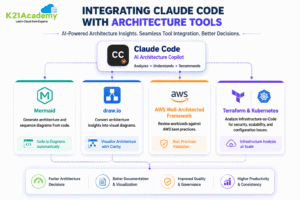
Claude Code works well alongside tools already used by Solution Architects, including:
- Mermaid – Generate architecture and sequence diagrams from code.
- draw.io – Convert architecture insights into visual diagrams.
- AWS Well-Architected Framework – Review workloads against AWS best practices.
- Terraform & Kubernetes – Analyze Infrastructure-as-Code for security, scalability, and configuration issues.
Together, these tools help architects streamline design reviews and documentation.
Best Practices for Using Claude Code as a Solution Architect
- Prior to beginning AI-assisted reviews, clearly define your architecture goals.
- To comprehend repositories and find dependencies, start with Claude Code.
- Gradually transition from exploration to optimisation and refactoring.
- AI recommendations should always be verified for security, scalability, and compliance.
- Make smarter judgements by combining AI-assisted technical analysis with human expertise.
- AI should be used to expedite evaluations rather than to take the place of architectural judgement.
- Architects should prioritise strategic planning over tedious analysis.
Challenges and Limitations
- AI might overlook historical dependencies and hidden runtime behaviours.
- Strong security and governance controls are still necessary for enterprise systems.
- Compliance and source code privacy are still major issues.
- Recommendations made by AI should never be taken at face value.
- Infrastructure and architecture decisions require human monitoring.
- Human assessment is still necessary for operational complexity and commercial context.
- Poor architectural choices can result from an over-reliance on automation.
The Future of Solution Architecture with Agentic AI
The future of architecture workflows will likely include:
- Autonomous architecture review agents
- AI-driven governance systems
- Continuous design validation
- Real-time dependency analysis
- Intelligent modernization planning
- Automated documentation generation
This is why Claude Code for Solution Architects is more than just another AI coding tool. It represents the early evolution of AI-assisted architecture engineering. Architects who learn to collaborate effectively with Agentic AI systems will likely become significantly more productive and impactful in the coming years.
Related Readings: What Are AI Agents? Definition, Types, Examples & How They Work [2026]
What Hiring Managers Look for in 2026
Organisations are looking for Solution Architects who can combine architecture expertise with AI-assisted workflows.
Key skills include:
- Reviewing large codebases with Claude Code
- Designing AI-native and cloud-native architectures
- Identifying scalability and security risks
- Accelerating cloud modernization projects
- Creating clear architecture documentation
Architects with these skills are increasingly preferred for roles such as Principal Solution Architect, Enterprise Architect, and AI Solutions Architect.
Conclusion
The role of Solution Architects is evolving rapidly. Tomorrow’s architects won’t just design systems manually — they’ll collaborate with intelligent AI systems capable of:
- Comprehending repositories
- Reviewing architectures
- Identifying hazards
- Aiding in the modernisation process
- Technical governance acceleration
That’s exactly why Claude Code for Solution Architects is becoming increasingly important in enterprise engineering. Instead of spending countless hours manually tracing dependencies and reviewing disconnected documentation, architects can now leverage Agentic AI to:
- Understand systems faster
- Improve architecture reviews
- Accelerate migration planning
- Enhance governance workflows
- Reduce technical analysis effort
The future of architecture isn’t AI replacing architects. It’s architects becoming dramatically more effective with AI. And Claude Code is one of the clearest examples of that transformation already happening today.
Related Readings: 8 Best Agentic AI Courses for 2026: Pricing, Curriculum & Career Outcomes
Next Step: Level Up with Claude Code
Ready to go beyond basics?
Join our Claude Code free class to learn how to build, debug, and optimise code using Claude Code with real examples and expert guidance. Take this opportunity to learn from industry experts and advance your AI career.