




AI Is Everywhere, But Where Should You Build It? Artificial Intelligence is no longer limited to research labs or tech giants. Today, startups, enterprises, and independent developers are building AI-powered applications faster than ever. From Generative AI assistants and recommendation engines to computer vision systems and predictive analytics, AI has become a key driver of business innovation.
It is not the only matter of selecting suitable AI models when you are going to build a good AI product. It will also come down to your choice of a cloud platform.
If the cloud platform you pick doesn’t suit a project it will determine you will face problems like training ML models, deploying AI, infrastructure handling, workload scaling, and cost control. A cloud platform that will cause your team to face higher expenses, slower development, and bigger operational challenges as your AI projects become larger.
With every major cloud provider investing heavily in AI services, developers often ask:
- Which cloud platform is best for AI development?
- Should I choose AWS, Microsoft Azure, or Google Cloud?
- Which platform offers the best Generative AI services?
- Which cloud is best for startups and which one suits enterprise AI?

In this guide, we’ll compare the best cloud platforms for AI development in 2026, explore their strengths, ideal use cases, and help you decide which platform best fits your AI journey.
Why Choosing the Right Cloud Platform Matters
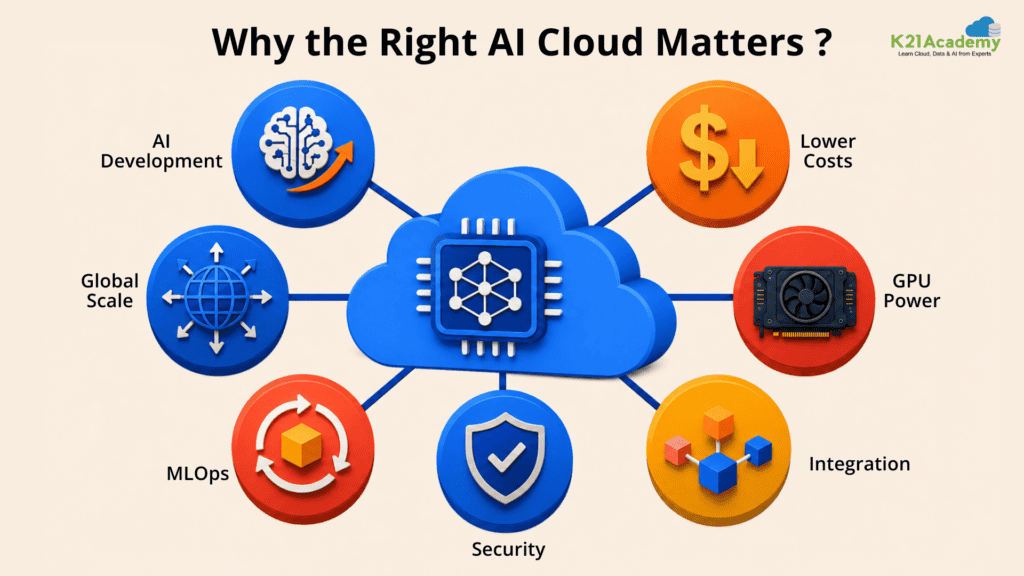
The cloud platform forms the backbone of every AI application. It provides the infrastructure, tools, and managed services needed to build, train, deploy, and monitor AI models efficiently.
Choosing the right platform helps you:
- Accelerate AI development with managed machine learning services
- Reduce infrastructure and operational costs
- Scale AI applications globally
- Access GPUs and specialized AI hardware
- Simplify MLOps and model deployment
- Strengthen security and regulatory compliance
- Integrate seamlessly with your existing technology stack
The wrong choice, however, can increase costs, introduce unnecessary complexity, and slow down your AI initiatives.
Key Factors to Consider Before Choosing an AI Cloud Platform
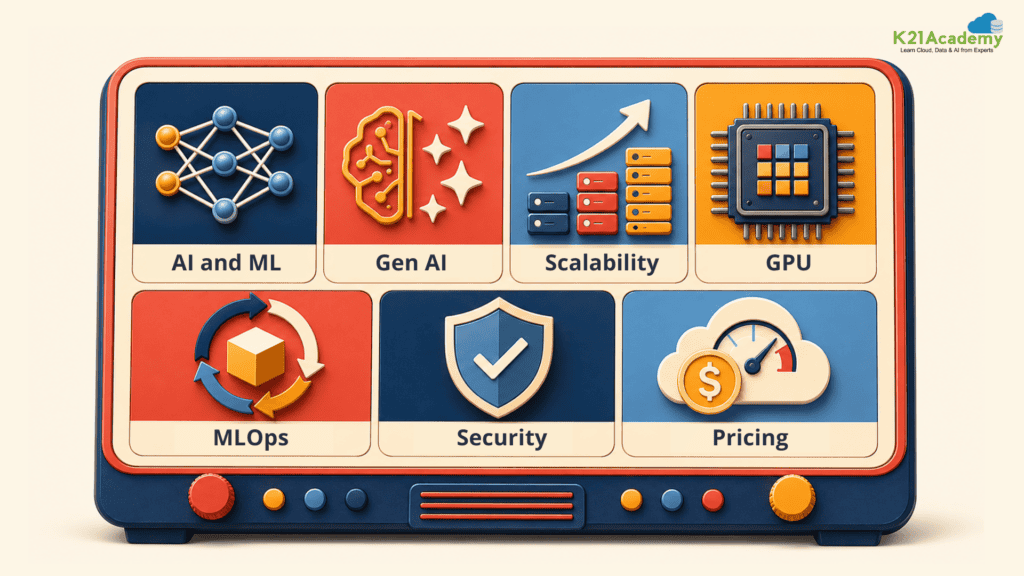
Before comparing providers, evaluate your requirements based on these criteria:
AI and Machine Learning Services
Look for managed services that support model training, deployment, monitoring, and automation.
Generative AI Capabilities
If you’re building AI assistants, chatbots, or content generation tools, check whether the platform supports foundation models and LLM integration.
Scalability
Choose a platform capable of handling growing workloads without requiring significant infrastructure changes.
GPU and Hardware Support
AI workloads often require high-performance GPUs or specialized AI accelerators for efficient model training and inference.
MLOps Features
A strong MLOps ecosystem simplifies model versioning, deployment, monitoring, retraining, and collaboration.
Security and Compliance
Enterprise applications require robust identity management, encryption, governance, and compliance certifications.
Pricing
Evaluate compute, storage, networking, GPU pricing, and managed AI service costs before making a decision.
Related Readings:- 7 System Design Patterns Every Cloud AI Engineer Should know
Top 10 Cloud Platforms for AI Development in 2026
1. Microsoft Azure AI Platform
Overview
Azure is most likely your best option if you already have Microsoft infrastructure. The platform works incredibly well with security frameworks, DevOps workflows, and current data systems. It is especially powerful in sectors like government, healthcare, and finance, where compliance is mandatory. Azure Machine Learning is now more than just a set of tools; it’s a truly comprehensive MLOps solution.
Key Features
- Azure Machine Learning is the preferred platform for managing the complete ML lifecycle.
- Enterprise-level generative AI is being brought to market by the Azure OpenAI Service.
- Integration with native MLOps, GitHub, and Azure DevOps.
- Improved governance controls, RBAC, and compliance features.
Best For
- Microsoft-affiliated, well-established companies.
- Regulated industries such as finance, healthcare, and government.
- Hybrid or multi-cloud setups needing seamless integration.
Why Choose Azure
A significant amount of the friction between AI development and real business operations is eliminated by Azure. It’s not just for notebook experimentation; it’s made for teams that need to ship.
2. Google Cloud AI Platform (Vertex AI)
Overview
It is evident that Google has decades of internal ML experience. Training, deployment, and monitoring are all combined into one unified platform by Vertex AI. Google’s infrastructure excels when working with large datasets or computationally demanding models. Their background in research translates into platform features that other providers are still lagging behind.
Key Features
- Vertex AI provides unified ML workflows
- AutoML alongside custom model training options
- Seamless BigQuery integration for data-heavy workloads
- First-class support for TensorFlow and JAX
Best For
- Teams where data is the foundation of everything
- Organizations with serious ML expertise
- AI-native startups building from the ground up
Why Choose Google Cloud
Google Cloud doesn’t simplify things. You’ll value this depth if your team has solid ML foundations. However, it does assume that you are competent.
3. Amazon Web Services (AWS) AI & ML Stack
Overview
The most comprehensive cloud ecosystem available is still AWS. You have fine-grained control over every stage of the ML lifecycle with SageMaker, which is both a benefit and a potential pain. AWS gives you the tools and lets you create your own procedures; it doesn’t compel you to work in a certain way. For engineering teams with unique requirements, that flexibility is invaluable.
Key Features
- Amazon SageMaker for end-to-end ML development
- Extensive portfolio of specialized AI services
- Mature MLOps tooling and automation options
- Unmatched global infrastructure reach
Best For
- Production workloads running at serious scale
- Platform engineering teams building custom pipelines
- Organizations that need maximum architectural flexibility
Why Choose AWS
Almost anything can be handled by AWS. Just be aware that expenses and complexity can quickly escape you in the absence of effective internal governance.
4. IBM Watson Studio
Overview
Compared to the hyperscalers, IBM adopts a different strategy. From the beginning, Watson Studio was designed with governance, explainability, and auditability in mind. This is crucial if you work in a field where you must justify each model choice to regulators. Here, innovation may proceed more slowly, but you’re also avoiding needless risk.
Key Features
- Built-in explainable AI capabilities
- Comprehensive model governance and monitoring
- Hybrid and on-premises deployment options
- Enterprise-grade compliance frameworks
Best For
- Financial services institutions
- Healthcare organizations
- Government agencies and contractors
Why Choose IBM
Being defensible is more important to Watson than being innovative. It’s not a bad trade-off when your AI decisions result in legal liability.
Related Readings:- AI Engineer vs AI Architect
5. Oracle Cloud Infrastructure (OCI) AI
Overview
Oracle is marketing OCI as the economical, performance-focused substitute. OCI facilitates the integration of legacy infrastructure if you are already well-versed in the Oracle ecosystem. However, the overall ecosystem isn’t yet as deep as AWS or Azure, the AI capabilities are strong and getting better.
Key Features
- High-performance GPU infrastructure at competitive prices
- Tight integration between data services and AI tools
- Aggressive pricing that undercuts major competitors
- Natural fit for Oracle database workloads
Best For
- Existing Oracle customers
- Budget-conscious enterprises
- Workloads with heavy data processing requirements
Why Choose Oracle
Strong raw performance is provided by OCI at a lower cost. Just keep in mind that the cost advantage comes at the expense of some ecosystem maturity.
6. Salesforce Einstein AI
Overview
The goal of Einstein AI is not to become a general-purpose machine learning platform. Its primary focus is on integrating AI into customer service, marketing, and sales processes. Einstein is most likely the quickest route to value if your use case is contained within Salesforce. Look elsewhere if you need something that isn’t related to CRM.
Key Features
- Direct integration with Salesforce CRM data
- Pre-trained models for common business scenarios
- Low-code tools that business users can actually use
- Enterprise security baked in
Best For
- Sales and marketing-driven organizations
- CRM-specific AI applications
- Business teams without deep technical resources
Why Choose Salesforce
Einstein exchanges speed for flexibility. You will be operational in weeks rather than months if you are attempting to integrate AI into your sales process.
Related Readings:- Claude Code Explained
7. Alibaba Cloud AI Platform
Overview
Alibaba Cloud is the leader in AI infrastructure in Asia and is growing internationally. It manages massive scale, such as e-commerce on Singles’ Day, and incorporates that experience into the platform. Although it is still concentrated, adoption outside of Asia is increasing. Depending on the service, documentation quality can vary widely.
Key Features
- Infrastructure built for massive-scale ML training
- Comprehensive AI development and deployment tools
- Proven capabilities in e-commerce and logistics
- Competitive pricing, especially in APAC markets
Best For
- Companies operating primarily in Asia
- High-volume AI workloads
- Organizations focused on cost-effective scaling
Why Choose Alibaba Cloud
Alibaba provides unparalleled regional infrastructure for AI scaling in Asia. Although it is still uneven, global enterprise support is getting better.
Related Readings:- Claude Code vs GitHub Copilot vs Cursor: Which AI Coding Assistant Should You Learn?
8. Databricks Lakehouse Platform
Overview
The integration of data engineering and AI is being reevaluated by Databricks. The lakehouse architecture provides data storage, processing, and ML in one building. Databricks is a pain-free solution for models that require data to be easily accessible. It assumes you care about data quality and governance.
Key Features
- Unified platform bridging data and ML workflows
- MLflow for open-source MLOps
- Strong collaboration features for cross-functional teams
- Cloud-agnostic deployment across AWS, Azure, and GCP
Best For
- Organizations where data engineering is a core competency
- Analytics-heavy use cases
- Multi-cloud strategies
Why Choose Databricks
By using Databricks, data teams can seamlessly connect with ML teams. To maximize efficiency, one must possess solid data fundamentals.
9. H2O.ai Cloud
Overview
Our focus is on making AI more efficient and accessible through H2O.ai. Why? AutoML features make it possible to create good models without extensive manual adjustments. Enterprise features are getting better, but it’s still catching up to the major platforms in some areas.
Key Features
- Automated machine learning that actually works
- Explainability tools for model transparency
- Cloud-scalable deployment options
- Open-source roots with enterprise extensions
Best For
- Business analysts taking on ML projects
- Rapid prototyping and experimentation
- Teams without dedicated ML engineers
Why Choose H2O.ai
The speedy transformation from concept to operational model is facilitated by H2O.ai. Advanced customization comes with its own set of challenges.
10. OpenAI API (Cloud-Hosted AI Platform)
Overview
OpenAI has become a foundational infrastructure for generative AI, even though it is not entirely cloud-based. Why? The majority of companies are not selecting between OpenAI and other platforms; they are integrating OpenAI models into their current cloud architecture. The models are advanced, but you must also take into account governance, costs, and vendor dependence.
Key Features
- Industry-leading large language models and multimodal AI agents
- Simple API-driven integration
- Fast pace of innovation and new capabilities
- Enterprise-grade security and privacy options
Best For
- Generative AI applications and features
- AI assistants and copilots
- Product features requiring advanced language understanding
Why Choose OpenAI
OpenAI’s current models are challenging to match. Ensure that you have a cost control plan and prevent lock-in.
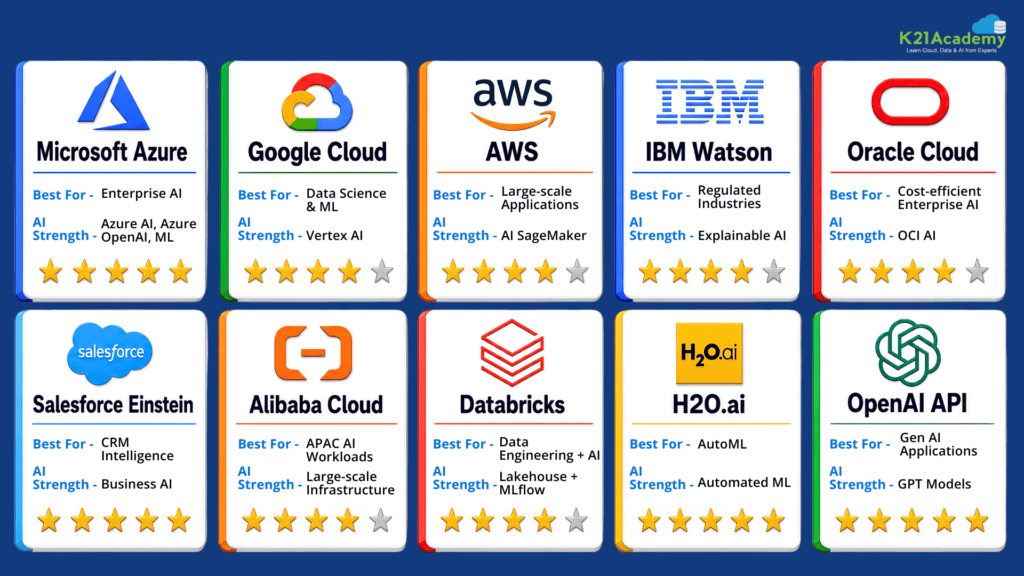
Quick Comparison: Best Cloud Platforms for AI Development
Future Trends in AI Cloud Platforms
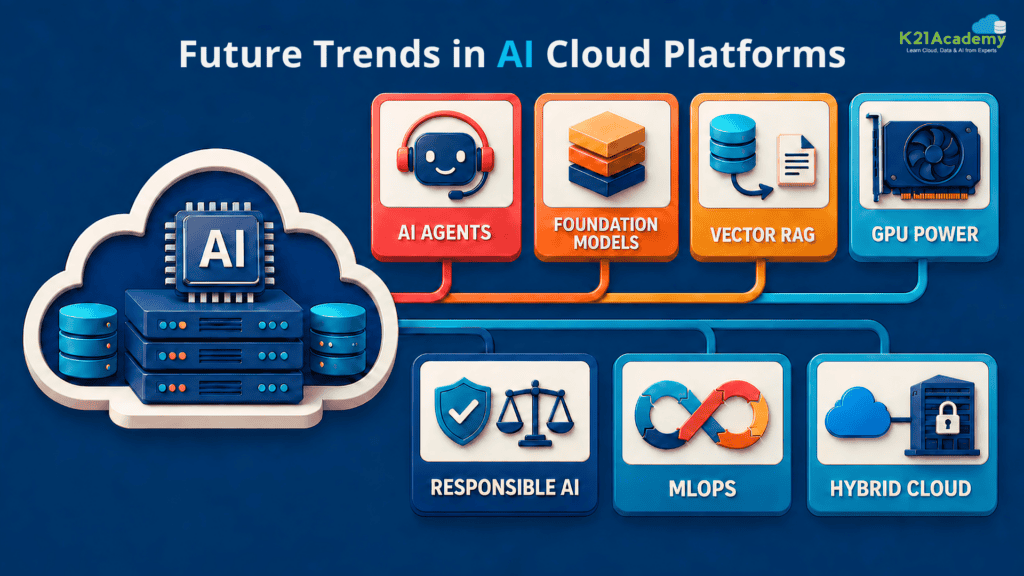
Cloud platforms are evolving beyond simply hosting AI models. In 2026 and beyond, we can expect to see:
- Native support for AI agents and autonomous workflows
- Expanded availability of foundation models
- Integrated vector databases for Retrieval-Augmented Generation (RAG)
- Improved GPU infrastructure for faster training and inference
- Greater emphasis on responsible AI and governance
- Simplified MLOps and AI lifecycle management
- Enhanced multi-cloud and hybrid AI deployment options
Organizations that choose scalable, AI-ready cloud platforms today will be better positioned to adapt to these advancements.
Best Cloud Platforms by Use Case
| Use Case | Recommended Platform |
| Enterprise AI | Microsoft Azure |
| Large-scale ML | Google Cloud |
| Flexible AI Infrastructure | AWS |
| Regulated Industries | IBM Watson |
| Oracle Ecosystem | Oracle Cloud |
| CRM Automation | Salesforce Einstein |
| APAC Deployments | Alibaba Cloud |
| Data + AI | Databricks |
| AutoML Projects | H2O.ai |
| Generative AI Applications | OpenAI API |
Choosing the Right AI Cloud Platform in 2026
No single platform is the best choice here.’ The sole platform that accurately reflects how your organization functions is the proper one.
As an enterprise, MLOps maturity is a priority that includes governance frameworks and transparent cost structures. For startups, consider developer speed, flexibility, and iteration rates as crucial factors to consider. Avoid being sidetracked by feature checklists. Identify the appropriate platform for both your data strategy and team’s actual capabilities.
AI projects are either successful or unsuccessful in production, not just on screen.
Related Readings:- Is Claude Code Worth Learning for Cloud Engineers? Salary Impact, Time-to-ROI, and Best Resources
Conclusion
Choosing the ideal cloud platform to develop AI in 2026 is essentially identifying the one that is the best fit for achieving your business objectives, technical capabilities, and long-range plans for AI. If you look at a list containing the most secure enterprise platform – Microsoft Azure, state-of-the-art machine learning – Google Cloud, highly customizable infrastructure – AWS, and fast Generative AI – OpenAI, you have multiple excellent options. The decision-making will probably include factors like scalability, availability of MLOps cost compliance, and how easily they can be integrated.
As AI technology is constantly developing, cloud platforms will increasingly help to speed up the innovation and decrease complexities of deployment of AI. A smart move today could be investing in a scalable and future-proof platform that helps your company reduce the complexity of development, enhance the efficiency of operations, and stay ahead of the curve in the face of upcoming technologies like AI agents, RAG, and advanced automation. The best choice of a cloud platform would not only support your existing AI projects but also provide the necessary base for realizing your future goals and achievements.