




Artificial Intelligence has revolutionized the way companies engage with their customers. Responding to customer queries instantly, assisting them during the purchase process, etc. are only some of the tasks chatbots have made possible in the realm of digital customer experience. Go forward to 2026, chatbot technology is evolving to be more intelligent, conversational, and can manage complex tasks without a human.
For developers, startups, and large companies, selecting a AI chatbot development tool is a vital decision. A good platform can not only shorten the time that your developers spend coding but also enhance the scalability of the product and offer advanced AI, powered interactions for the customers.
This article will share some of the best chatbot development tools for 2026 and their distinct features, along with a little insight on how they may aid businesses in developing smart conversational systems.
Why Chatbots Are More Important Than Ever ?
Before we get into the tools, let’s first see why chatbots are increasingly becoming a business necessity.
Nowadays, companies primarily rely on chatbots to:
- Provide 24/7 customer support
- Automate repetitive queries
- Improve customer engagement
- Reduce operational costs
- Personalize user interactions
Breakthroughs in natural language processing (NLP) and the availability of large language models (LLM) have significantly enhanced the capabilities of chatbots beyond classical rule – based systems. Modern chatbots are capable of grasping context, inferring user intentions, and generating responses akin to human ones.
Related Readings:- Learn about Agentic AI.
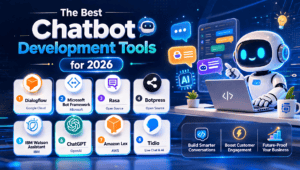
1. Dialogflow
A product of Google, is still the first choice chatbot development platform for the majority of people. Developers can build conversational interfaces for websites, mobile applications, messaging platforms, and voice assistants.
Key Features
- Natural language understanding (NLU)
- Integration with Google Cloud services
- Multi-language support
- Voice and text chatbot development
- Easy integration with apps and APIs
Why Developers Use It
Dialogflow is recognized for its robust NLP features and the ability to scale, which is why large businesses that are interested in rolling out intelligent conversational agents consider it as their first choice.
2. Microsoft Bot Framework
Microsoft Bot Framework is a comprehensive development tool set for creating sophisticated chatbots, especially at the enterprise level.The major advantage of Microsoft Bot Framework is that it helps developers to design chatbots that can interact with users over multiple communication channels.
Key Features
- Cross-platform bot development
- Integration with Azure AI services
- Advanced bot analytics
- Multi-channel deployment (Teams, Slack, websites)
- Strong developer ecosystem
Why It’s Popular
It is common for companies that are already using the Microsoft ecosystem to pick this framework because it integrates very well with Azure AI services and cloud infrastructure.
3. Rasa
Rasa is a chatbot development kit that is free and open source, specifically made for developers who would like to have complete control over their AI models and data. Besides, it is one of the most widely used platforms for creating top, notch conversational AI systems.
Key Features
- Fully customizable chatbot architecture
- Open-source platform
- Strong NLP capabilities
- On-premise deployment support
- High privacy and security
Why Developers Love It
Rasa is perfect for businesses who want to keep their data private, want a highly customizable chatbot, and want to have full control of the systems.
4. Botpress
Botpress is one among the fastest expanding chatbot platforms. It supplies a robust development environment alongside an intuitive visual interface to lay out the dialogues.
Key Features
- Visual conversation builder
- Built-in NLP engine
- Modular architecture
- Integration with multiple APIs
- Open-source flexibility
Why It’s Growing Fast
Botpress finds a fine balance between giving the developer a lot of freedom and making things easy. As a result, it can be used both by small startups and big enterprises.

5. IBM Watson Assistant
IBM Watson Assistant is a chatbot platform of enterprise grade that allows the development of AI driven virtual assistants primarily for business purposes.
Key Features
- Advanced AI conversation capabilities
- Enterprise-grade security
- Integration with enterprise systems
- Voice assistant support
- Analytics and insights
Best For
Large organizations mostly go for Watson Assistant because of its top notch security, high availability, and ability to integrate with the whole enterprise infrastructure.
6. ChatGPT
The advent of large language models has revolutionized the chatbot field, and ChatGPT is one of the top AI systems used for developing conversational applications.
Key Features
- Human-like conversational responses
- Context-aware conversations
- Code generation and automation
- Integration through APIs
- Large knowledge base
Why It’s Transformative
ChatGPT opens a world of opportunities for developers to create extremely smart conversational systems without having to build from scratch complex NLP models.
7. Amazon Lex
Amazon Lex is a chatbot service of AWS that lets developers develop conversational interfaces with voice and text.
Key Features
- Automatic speech recognition
- Natural language understanding
- Integration with AWS services
- Scalable cloud architecture
- Easy deployment
Best For
Besides having a great integration with AWS infrastructure and cloud services, Amazon Lex is often selected by companies that are already using AWS.
8. Tidio
Tidio is a chatbot platform mainly oriented towards customer support and sales automation. It enjoys a great popularity especially among small and medium sized businesses.
Key Features
- No-code chatbot builder
- Website and e-commerce integration
- Customer interaction analytics
- AI-powered responses
- Live chat integration
Ideal For
Companies that desire to quickly implement chatbots without having to be technically proficient.
Related Readings:- Learn about Top 10 Real-World Applications of Agentic AI.
Key Factors to Consider When Choosing a Chatbot Tool
There are several factors that you have to consider when selecting a chatbot development tool since the number of available options is very large.
1. Scalability
If your chatbot will be able to serve the needs of thousands of users, then you require a platform that is capable of scaling up very efficiently.
2. Integration Capabilities
The chatbot should be able to easily integrate with existing tools like CRM systems, databases, and APIs.
3. Natural Language Processing
High NLP capabilities enable the bot to interpret user intentions properly and deliver suitable answers.
4. Customization
Developers generally favor platforms that give them the liberty to customize workflows, AI models, and integrations.
5. Security and Privacy
For industries like healthcare and finance, security and privacy of data happen to be the topmost concerns.
The Future of Chatbot Development
The advancement of generative AI, autonomous AI agents, and multimodal interactions will greatly determine the chatbot development landscape.
In the coming years, chatbots will:
- Understand user emotions and context
- Handle complex business workflows
- Integrate with AI agents and automation systems
- Provide more human-like conversations
- Become central to digital customer experience
Chatbots driven by AI are no longer just simple support tools but rather intelligent digital assistants that can deal with both business processes and customer relationships.
Final Thoughts
Chatbot technology is continuously evolving and the tools that will be available in 2026 will be much more powerful than the ones of even a few years ago. If you are a developer, startup founder or an enterprise leader, the right chatbot development platform can help you create scalable and intelligent conversational systems.
Dialogflow, Microsoft Bot Framework, Rasa, Botpress, and ChatGPT are some of the platforms that are influencing the future of conversational AI. Every tool has its exclusive features and you can pick one according to the requirements of your project.
As AI keeps advancing, chatbots will become an even more integral means of customer engagement, automation, and digital transformation. Companies that decide to implement these technologies early will be at a greater advantage in providing their customers with quicker, smarter, and more personalized experiences.