





AI and ML technologies are now so pervasive and widely used that their presence as drivers of innovation can be felt in virtually all kinds of industries such as healthcare, finance, retail cybersecurity manufacturing, and even education. As it turns out, the more quickly an organization goes the AI and ML route, the more the market looks for professionals who have the right skills in AI and ML.
At the same time, learning a bit of Python and taking an online course or two might just not be sufficient to make yourself shine in the talent pool. Modern AI tools are the real thing with the ability to raise the productivity levels, shorten the development time, enable the automation of workflows as well as facilitate the creation of realistic AI applications.
If you are a student, software developer, or data scientist, and regardless of whether you are considering transitioning to AI, getting good with the right set of AI tools is definitely something that will open new doors and change your professional fortune for the better in a short time.
In this guide, we will go over some of the most effective AI development tools that can help an individual or a team in his or her career development in AI or ML. We shall point out where each of these platforms is applicable in the AI development cycle and give advice, which ones would be good to invest your first learning time in, respectively.
Why Learning AI Tools Matters
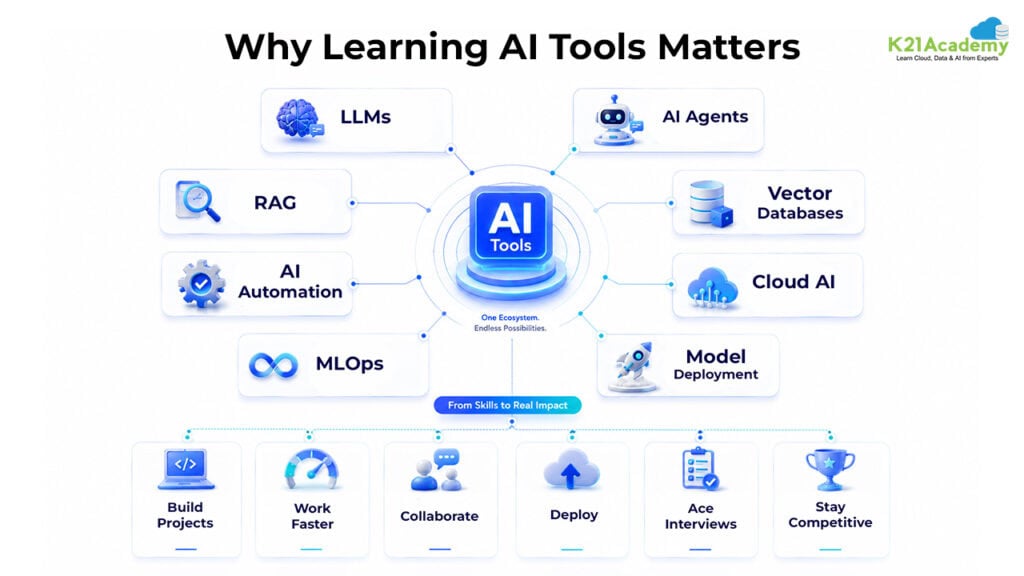
The AI industry has evolved far beyond traditional machine learning models. Modern AI engineers work with:
- Large Language Models (LLMs)
- AI Agents
- Vector Databases
- AI Automation
- Cloud AI Platforms
- MLOps
- Retrieval-Augmented Generation (RAG)
- Model Deployment
Companies now expect professionals who can build complete AI applications, not just train machine learning models.
Learning industry-standard AI tools helps you:
- Build practical AI projects
- Improve development speed
- Collaborate with AI teams
- Deploy production-ready applications
- Prepare for AI job interviews
- Stay competitive in the rapidly evolving AI landscape
Related Readings:- 7 System Design Patterns Every Cloud AI Engineer Should know
Top AI Tools Every AI/ML Professional Should Learn
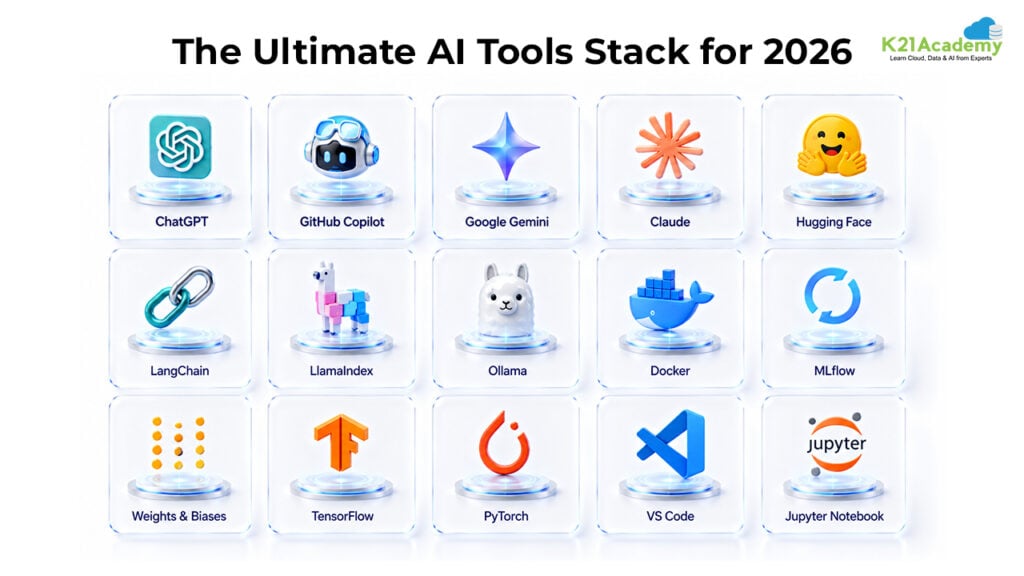
1. ChatGPT

ChatGPT has become one of the most widely used AI productivity tools for developers and data scientists. Powered by advanced language models, it assists with coding, debugging, documentation, research, and learning new concepts.
Key Features
- Code generation
- Bug fixing
- SQL query generation
- Documentation writing
- Research assistance
- Prompt engineering
- Learning complex AI topics
Best For
- Students
- AI beginners
- Machine Learning engineers
- Software developers
- Data scientists
Career Benefits
Instead of replacing developers, ChatGPT helps them become significantly more productive by reducing repetitive tasks and accelerating development.
Related Readings:- How GPT Technology Powers the Best AI Chatbots
2. GitHub Copilot

Why Learn It?
- Faster coding
- Intelligent code completion
- Test generation
- Documentation support
- Multiple language support
Ideal For
- Python developers
- AI engineers
- ML engineers
- Backend developers
Related Readings:- AI Engineer vs AI Architect
3. Google Gemini

Google Gemini is a powerful multimodal AI assistant capable of understanding text, code, images, and documents.
Developers use Gemini for:
- Research
- Coding
- Data analysis
- AI application development
- Content generation
Gemini integrates well with Google’s AI ecosystem and cloud services.
4. Claude

Strengths
- Excellent coding support
- Large context window
- Document analysis
- Research assistance
- Technical writing
Many AI developers use Claude Code alongside ChatGPT for comparing responses and improving code quality.
Related Readings: Top 10 Claude Code Use Cases Every Developer Should Know
5. Hugging Face

It provides:
- Pretrained models
- NLP models
- Computer Vision models
- Speech AI models
- Model hosting
- Datasets
- Transformers library
Why It’s Important
Instead of training AI models from scratch, developers can fine-tune existing models for real-world applications.
Popular Libraries
- Transformers
- Datasets
- Accelerate
- Diffusers
- PEFT
Related Readings:- Claude Code for AI/ML Engineers: Should You Invest the Time? Honest 2026 Worth-It Breakdown
6. LangChain
LangChain has become the standard framework for building LLM-powered applications.
It helps developers build:
- AI chatbots
- RAG systems
- AI agents
- Document Q&A systems
- Multi-step AI workflows
Core Components
- Prompt Templates
- Memory
- Chains
- Agents
- Retrievers
- Output Parsers
If you’re planning to become an AI Engineer, LangChain is one of the most valuable frameworks to learn.
7. LlamaIndex
LlamaIndex specializes in connecting Large Language Models with external data sources.
It simplifies:
- PDF search
- Knowledge bases
- Enterprise search
- RAG applications
- Document indexing
Many enterprise AI applications combine LangChain and LlamaIndex.
Related Readings:- Claude Code vs GitHub Copilot vs Cursor: Which AI Coding Assistant Should You Learn?
8. Ollama
Ollama allows developers to run large language models locally without relying on cloud APIs.
Benefits include:
- Better privacy
- Offline development
- Faster experimentation
- Lower API costs
Popular models include:
- Llama
- Mistral
- Gemma
- DeepSeek
- Qwen
9. Docker
AI projects often become difficult to deploy because of dependency conflicts.
Docker solves this by packaging applications into portable containers.
Benefits include:
- Consistent environments
- Easy deployment
- Team collaboration
- Production readiness
Almost every AI engineer today is expected to understand Docker basics.
10. MLflow
MLflow is one of the leading MLOps platforms.
It helps teams:
- Track experiments
- Version models
- Manage deployments
- Compare training runs
Large organizations commonly use MLflow in production AI systems.
11. Weights & Biases (W&B)
Weights & Biases simplifies machine learning experiment tracking.
Features include:
- Training visualization
- Hyperparameter tuning
- Model comparison
- Collaboration dashboards
- Experiment management
It’s especially useful for deep learning and computer vision projects.
Related Readings:- Is Claude Code Worth Learning for Cloud Engineers? Salary Impact, Time-to-ROI, and Best Resources
12. TensorFlow
TensorFlow remains one of the most popular deep learning frameworks.
It’s widely used for:
- Neural networks
- Image classification
- Object detection
- Recommendation systems
- Production AI deployment
Many enterprise AI applications continue to rely on TensorFlow.
13. PyTorch
PyTorch has become the preferred framework for AI research and deep learning development.
Advantages include:
- Dynamic computation graphs
- Easy debugging
- Strong research community
- GPU acceleration
- Extensive ecosystem
Most modern generative AI models are built using PyTorch.
Related Readings:- The Best Chatbot Development Tools for 2026: A Complete Overview
14. VS Code
Visual Studio Code has become the preferred IDE for AI developers.
Popular extensions include:
- GitHub Copilot
- Python
- Jupyter
- Docker
- GitLens
- Remote SSH
An optimized development environment can significantly improve productivity.
Related Readings:- Comparing the Best AI Chatbots for Your Business: What’s Best for You?
15. Jupyter Notebook
Jupyter Notebook remains an essential tool for:
- Data analysis
- Exploratory Data Analysis (EDA)
- Machine learning experiments
- Model visualization
- Interactive coding
Nearly every data scientist uses Jupyter during model development.
Related Readings:- How to Build Your Own AI Bot in 2026: A Complete Guide
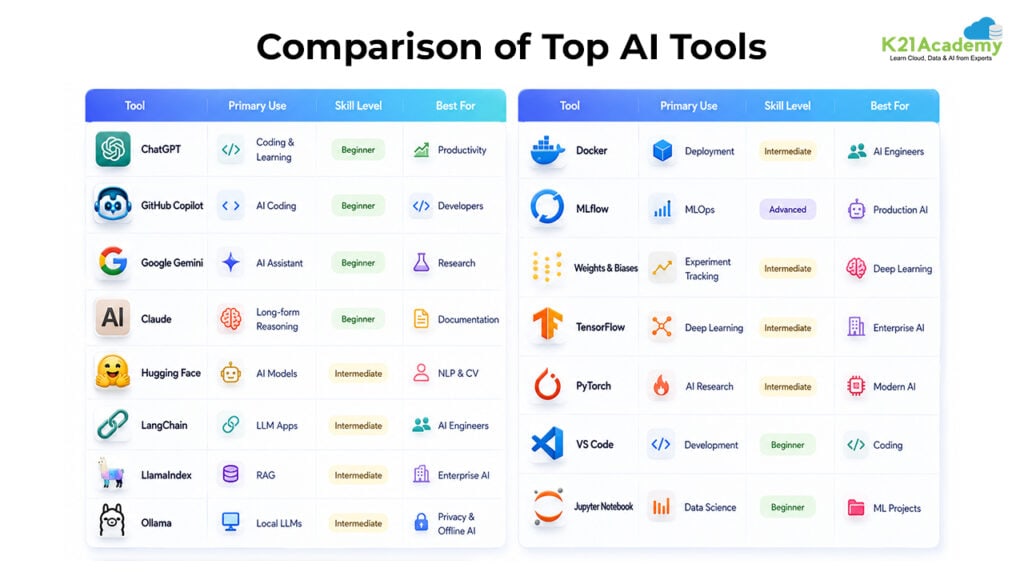
Comparison Table of Top AI Tools
Recommended Learning Roadmap
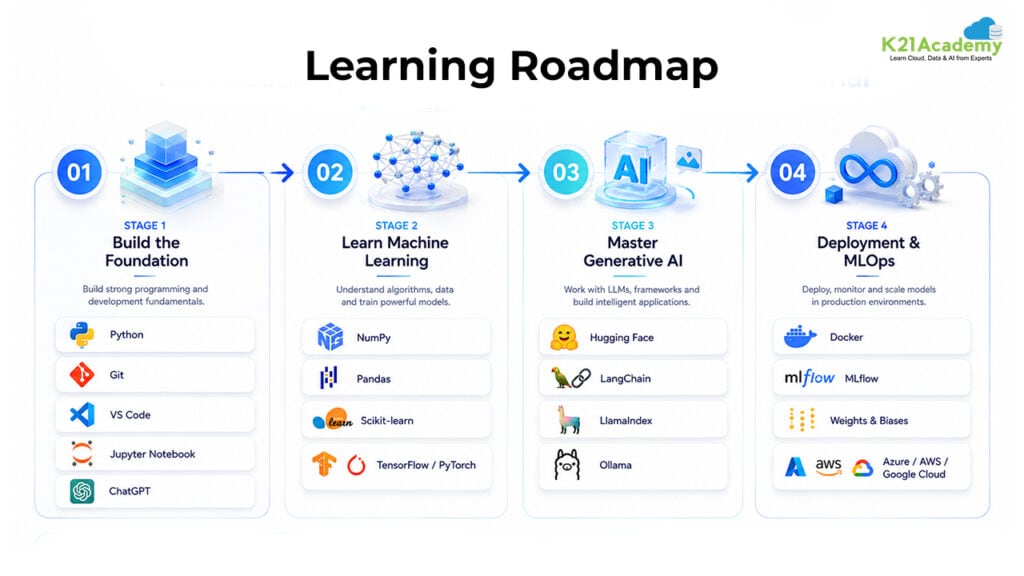
If you’re starting your AI/ML journey, follow this progression:
Stage 1: Build the Foundation
- Python
- Git
- VS Code
- Jupyter Notebook
- ChatGPT
Stage 2: Learn Machine Learning
- NumPy
- Pandas
- Scikit-learn
- TensorFlow or PyTorch
Stage 3: Master Generative AI
- Hugging Face
- LangChain
- LlamaIndex
- Ollama
Stage 4: Learn Deployment & MLOps
Related Readings:- AI Chatbots and Conversational AI: Transforming Customer Interaction in 2026
Tips to Accelerate Your AI Career
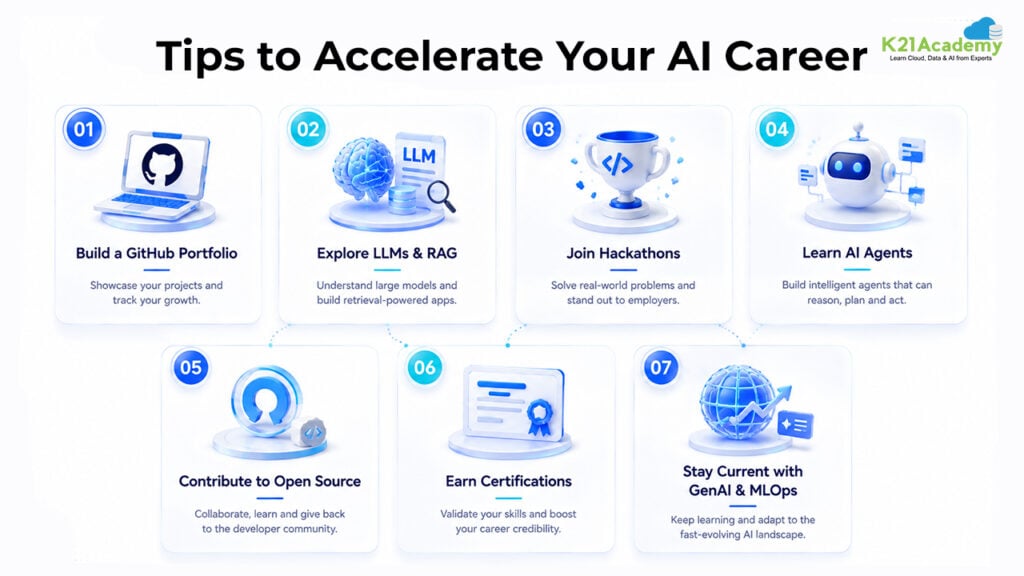
Learning tools alone isn’t enough. Employers look for professionals who can apply these tools to solve real business problems.
Here are some practical ways to stand out:
- Build AI portfolio projects on GitHub.
- Experiment with open-source LLMs and RAG applications.
- Participate in AI hackathons and coding competitions.
- Learn prompt engineering and AI agent development.
- Contribute to open-source AI projects.
- Earn industry-recognized AI and cloud certifications.
- Stay updated with the latest advancements in generative AI and MLOps.
Final Thoughts
The AI industry’s development is happening at a speed rarely encountered in this area, and the repertoire of AI professionals’ tools is expanding all the time. Of course, mastery of one specific tool is not going to lead you to success in the profession. Yet, learning a blend of AI assistants, machine learning setups, LLM development platforms, and MLOps tools will greatly enhance your technological skills and job opportunities.”
First, learn the tools like ChatGPT, GitHub Copilot, VS Code, and Jupyter Notebook. Only after, explore advanced technologies like Hugging Face, LangChain, LlamaIndex and MLflow. In the meanwhile, developing skills in practical implementation should be enhanced by a strong cloud computing background and by constantly learning to compile the whole set of skills as one’s strong AI profile.
It is likely you’re thinking of a job like AI Engineer, Machine Learning Engineer, Data Scientist or Generative AI Developer. Whatever the case, putting effort in familiarizing yourself with what I just mentioned tools will keep you not only current but also future-ready in the rapidly growing field of AI.
Frequently Asked Questions (FAQs)
1. Which AI tool should beginners learn first?
Beginners should start with ChatGPT, Python, VS Code, and Jupyter Notebook. These tools provide a strong foundation before moving on to advanced AI frameworks.
2. Is LangChain necessary for AI careers?
If you want to build LLM-powered applications, AI agents, or Retrieval-Augmented Generation (RAG) systems, LangChain is a valuable framework to learn.
3. Which deep learning framework is better: TensorFlow or PyTorch?
PyTorch is widely preferred for research and generative AI, while TensorFlow remains popular for enterprise and production deployments. Learning either or both can be beneficial depending on your career goals.
4. What is the role of MLOps tools like MLflow and Weights & Biases?
These tools help manage the machine learning lifecycle by tracking experiments, versioning models, monitoring performance, and streamlining deployment workflows.
5. Can AI tools replace AI/ML professionals?
No. AI tools are designed to enhance productivity by automating repetitive tasks and assisting with development. Professionals who know how to use these tools effectively are likely to have a competitive advantage in the AI job market.