



What if your Chatbot lets down customers and they never return? A customer comes on your site at midnight and simply wants an answer to one question. Rather than getting an almost immediate and correct answer, they are met with an ai chatbots that completely misunderstands their request, plays back a few times its pre-written answers and finally says to “get in touch with support during working hours” which is a pretty vague answer.
That customer leaves, within a few minutes, and goes to your competitor to make a purchase. Now suppose that situation occurs hundreds, even thousands of times per month.
A year from now when a bad customer experience occurs it won’t just cause frustration anymore, it will actually cost companies money. When a business doesn’t give customer service it loses sales, its name is put in jeopardy and it should be outdone by other businesses who have smart AI chatbots, conversational AI, AI Agents and large-scale language models (LLMs). Customers nowadays demand round-the-clock personalized multilingual and intelligent responses across their favourite means of communication like web browsers, mobile devices, messaging apps, and voice assistants.
You will lose loyal and repeat customers if they know that your website AI can’t deliver the customer experience they expect. The right customers will always look for companies where they do not need to put up with being asked to contact customer support because they were online and a robot couldn’t help them. The new breed of AI-based conversation technologies is completely changing customer interactions. With the support of very powerful LLMs, Agentic AI, Retrieval-Augmented Generation (RAG) models and cloud AI from AWS and Microsoft Azure, state-of-the-art AI-powered bots go way past being mere QA tools. Modern Chatbots can perform reasoning, workflow automations, enterprise data usage and even handle sophisticated operations without human assistance regularly.
Throughout this post, our focus is on showing how AI Chatbots and customer chatbots are radically reshaping customer experience management in 2026. We’ll highlight what technologies fuel this trend, and show you the best AI platform providers including: cloud AI Foundry – Azure AI, Azure AI Services, AWS (SageMaker & Amazon Bedrock, for eg.), LLM providers such as claude & others, as well how your organization can integrate these AI tools to build highly intelligent customer engagement experience systems.
The Evolution of AI Chatbots
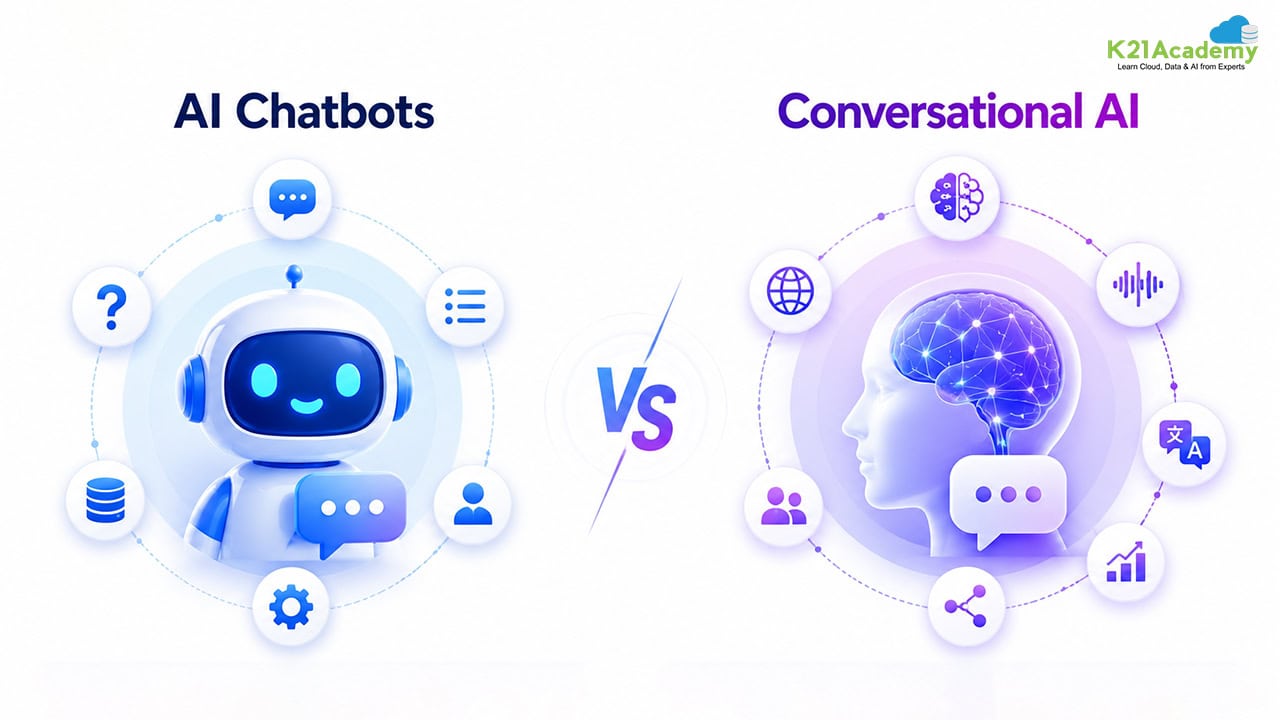
Traditional chatbots relied on predefined rules, decision trees, and keyword matching. They could answer only a limited set of questions and often failed when conversations became more complex.
Modern AI chatbots are powered by Large Language Models (LLMs), enabling them to understand natural language, maintain context, generate human-like responses, and perform reasoning across multiple steps. Instead of simply replying to questions, they assist customers, automate business processes, and improve operational efficiency.
This shift marks the transition from rule-based automation to intelligent Conversational AI.
What Is Conversational AI?
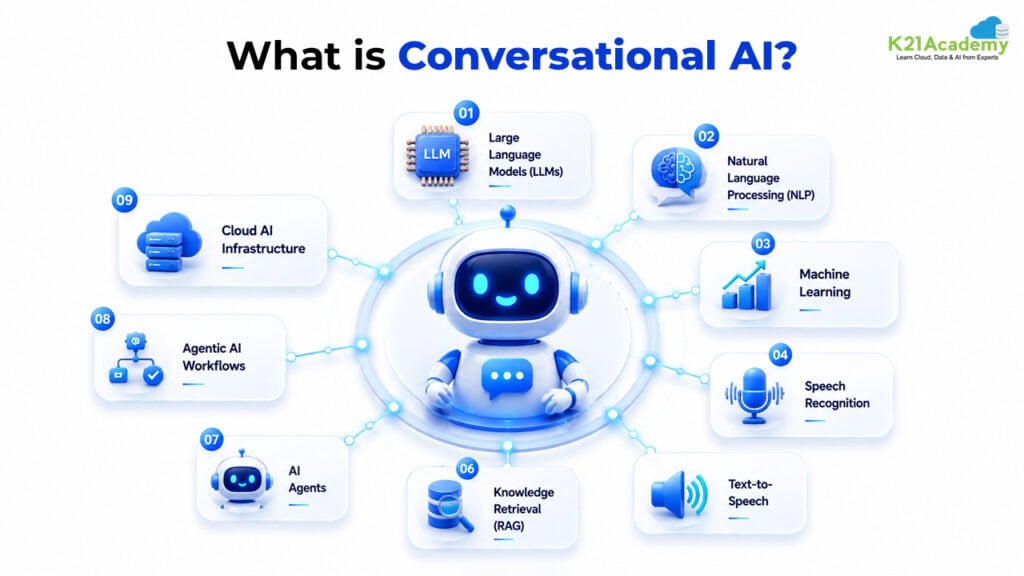
Conversational AI combines several technologies to create intelligent, human-like interactions:
- Large Language Models (LLMs)
- Natural Language Processing (NLP)
- Machine Learning
- Speech Recognition
- Text-to-Speech
- Knowledge Retrieval (RAG)
- AI Agents
- Agentic AI workflows
- Cloud-based AI infrastructure
Together, these technologies enable businesses to provide personalized, contextual, and scalable customer experiences.
From AI Chatbots to AI Agents
One of the biggest trends in 2026 is the rise of AI Agents.
Unlike traditional chatbots that simply answer questions, AI Agents can:
- Understand user intent
- Plan multi-step tasks
- Access enterprise databases
- Search internal documents
- Call APIs
- Generate reports
- Schedule appointments
- Process orders
- Trigger workflows
- Collaborate with other AI agents
This new paradigm, often called Agentic AI, transforms AI from a conversational assistant into an intelligent digital employee capable of completing business tasks with minimal human intervention.
The Role of Large Language Models (LLMs)
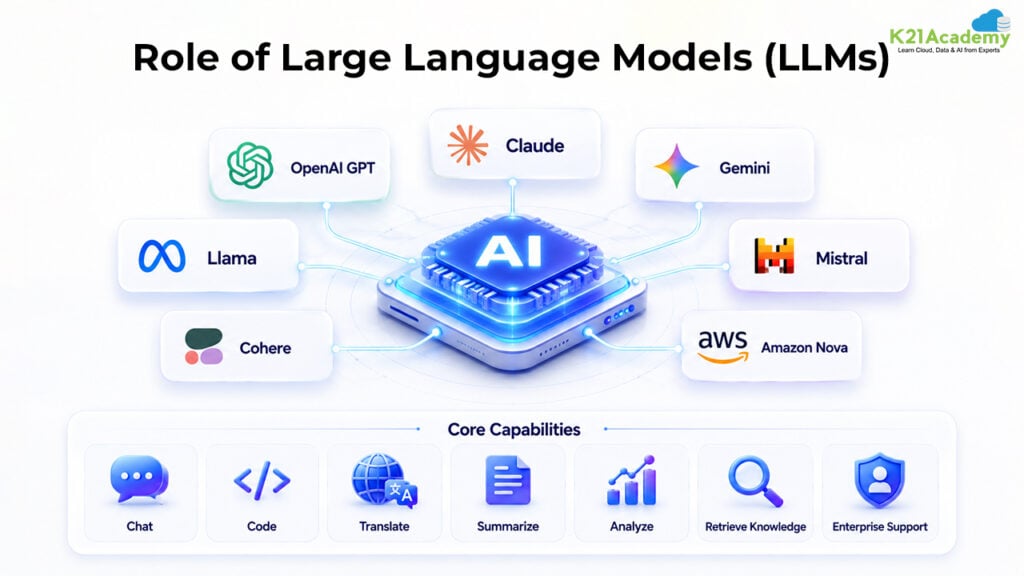
LLMs are the foundation of modern Conversational AI.
Popular LLMs include:
- OpenAI GPT models
- Claude
- Google Gemini
- Meta Llama
- Mistral
- Cohere Command
- Amazon Nova models
These models provide:
- Natural conversations
- Content generation
- Translation
- Summarization
- Code generation
- Customer support
- Data analysis
- Knowledge retrieval
Organizations often choose models based on cost, reasoning ability, latency, multilingual support, and enterprise requirements.
Related Readings:- How to Build Your Own AI Bot in 2026: A Complete Guide
Cloud Platforms Driving AI Innovation
Microsoft Azure AI
Microsoft continues to be a leader in enterprise AI through its comprehensive ecosystem.
Key services include:
Azure AI Services
A suite of pre-built AI capabilities including:
- Speech Services
- Vision AI
- Language AI
- Translator
- Document Intelligence
- Content Safety
These services help developers build enterprise-grade conversational applications with minimal infrastructure management.
Azure AI Foundry
Azure AI Foundry provides a unified environment for building, evaluating, deploying, and managing generative AI applications. It supports multiple foundation models, prompt engineering, model evaluation, responsible AI practices, and enterprise governance.
Businesses can rapidly prototype AI chatbots and AI agents while maintaining security, scalability, and compliance.
GitHub Copilot
Integrated into the Azure ecosystem, GitHub Copilot helps developers accelerate software development by generating code, suggesting improvements, writing documentation, and assisting with debugging.
Amazon Web Services (AWS) AI Ecosystem
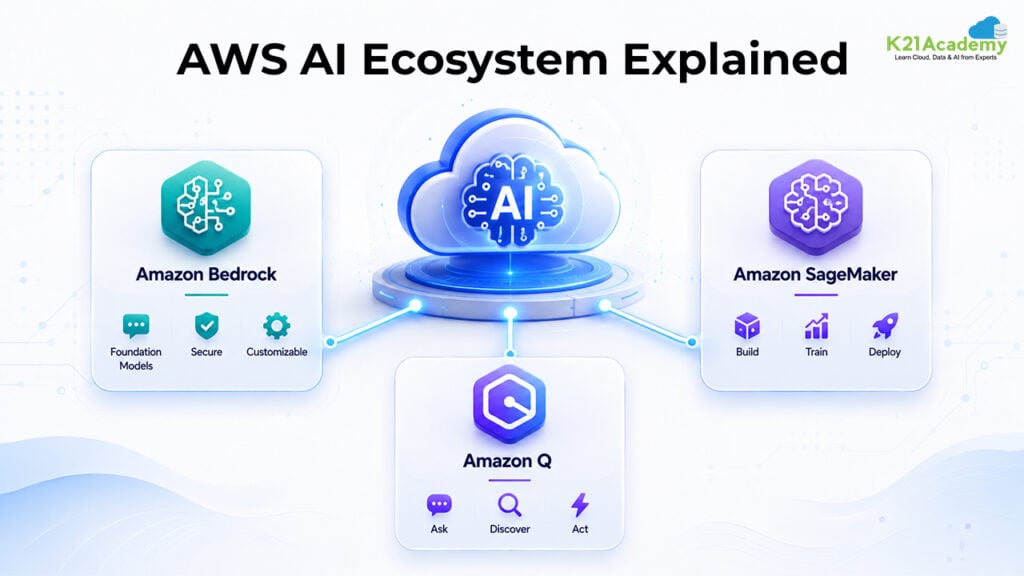
AWS offers one of the most comprehensive cloud AI portfolios for building conversational applications.
Amazon Bedrock
Amazon Bedrock enables organizations to build generative AI applications using foundation models from multiple providers through a fully managed service.
Benefits include:
- Access to multiple foundation models
- Secure enterprise deployment
- RAG integration
- AI Agent capabilities
- Knowledge bases
- Guardrails for responsible AI
Developers can build sophisticated chatbots without managing infrastructure.
Amazon SageMaker
Amazon SageMaker simplifies the end-to-end machine learning lifecycle by enabling teams to:
- Prepare data
- Train models
- Fine-tune LLMs
- Deploy AI models
- Monitor performance
- Scale production workloads
Organizations often combine SageMaker with Amazon Bedrock for advanced AI applications.
Amazon Q
Amazon Q is an AI assistant designed for business users and developers. It can answer questions about enterprise data, assist with AWS services, generate code, and automate cloud operations.
Claude and Enterprise Conversational AI
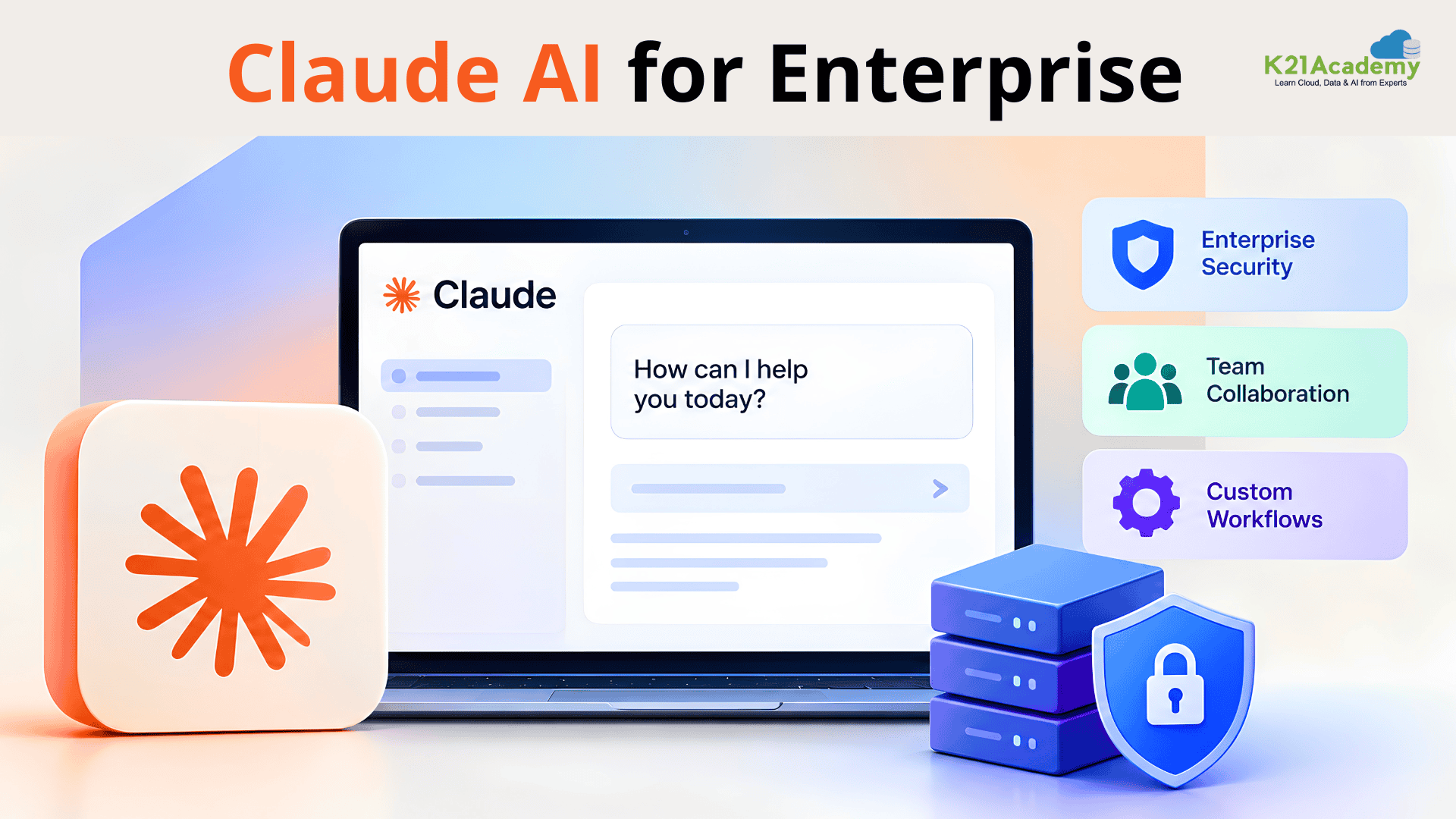
Claude has become one of the preferred LLMs for enterprise applications due to its strong reasoning capabilities, large context window, and high-quality writing.
Businesses use Claude for:
- Customer support
- Legal document review
- Knowledge management
- Research assistance
- Business analysis
- Internal AI assistants
Its ability to process lengthy documents makes it particularly valuable for organizations with extensive documentation.
Related Readings:- Comparing the Best AI Chatbots for Your Business: What’s Best for You?
Building Smarter AI Chatbots with RAG
One of the biggest limitations of standalone LLMs is that they don’t automatically know your organization’s latest internal information.
This is where Retrieval-Augmented Generation (RAG) comes in.
RAG allows AI chatbots to retrieve relevant information from:
- Company documentation
- Knowledge bases
- Product manuals
- CRM systems
- Databases
- Internal wikis
The result is more accurate, context-aware, and trustworthy responses without retraining the model.
AI Agents + MCP: The Next Generation of Automation
Modern AI systems increasingly use the Model Context Protocol (MCP) to securely connect LLMs with external tools, databases, APIs, and business applications.
Combined with AI Agents, MCP enables capabilities such as:
- Booking appointments
- Updating CRM records
- Creating support tickets
- Fetching live inventory
- Processing payments
- Generating invoices
- Querying enterprise databases
Instead of only chatting, AI becomes capable of completing real business tasks.
Cloud Code and AI-Assisted Development
Developers are increasingly relying on AI-powered coding assistants such as GitHub Copilot, Claude Code, and cloud-based development tools to accelerate software delivery.
These tools help with:
- Code generation
- Refactoring
- Debugging
- Documentation
- Test creation
- Infrastructure as Code (IaC)
- API development
By integrating AI into modern DevOps workflows, teams can reduce development time and improve code quality.
Business Benefits of Conversational AI
Organizations implementing AI chatbots and AI agents report significant improvements:
- 24/7 customer support
- Faster response times
- Reduced support costs
- Personalized customer experiences
- Increased customer satisfaction
- Higher employee productivity
- Better lead generation
- Improved sales conversions
- Multilingual support
- Scalable customer engagement
These benefits make Conversational Bot a strategic investment rather than just a customer service tool.
Industries Leading AI Adoption
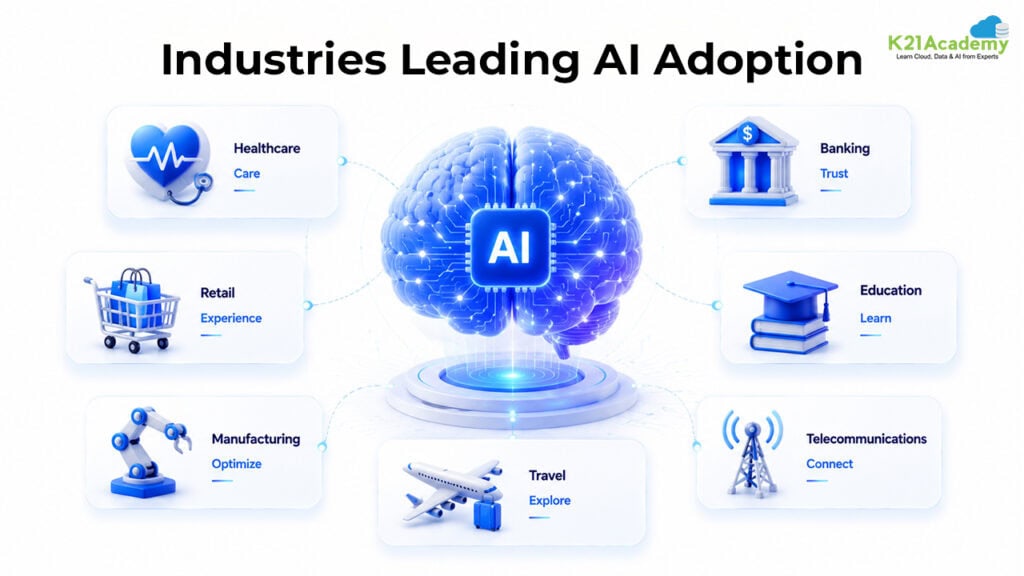
Conversational AI is transforming nearly every industry:
- Healthcare: Virtual assistants, appointment scheduling, patient engagement.
- Banking and Finance: Fraud detection, customer support, financial advisory.
- Retail and E-commerce: Personalized shopping, product recommendations, order tracking.
- Education: AI tutors, admissions support, student services.
- Manufacturing: Maintenance support, internal knowledge assistants.
- Travel and Hospitality: Booking assistance, itinerary management, multilingual support.
- Telecommunications: Automated troubleshooting and customer care.
Related Readings:- The Best Chatbot Development Tools for 2026: A Complete Overview
Best Practices for Building Enterprise AI Chatbots
To maximize the value of Conversational AI:
- Choose the right LLM for your use case.
- Implement Retrieval-Augmented Generation (RAG).
- Use AI Agents for workflow automation.
- Deploy on trusted cloud platforms like Microsoft Azure or AWS.
- Secure enterprise data with governance and access controls.
- Continuously monitor and evaluate AI performance.
- Keep humans in the loop for high-risk decisions.
- Optimize prompts and regularly update knowledge sources.
The Future of Conversational AI in 2026 and Beyond
Customer interaction’s new future is not about answering questions, but about completing outcomes.
As Agentic AI, multimodal AI Agents, cloud-native AI platforms, and intelligent orchestration get matured and integrated, the companies will be setting up a team of special AI agents that work together across departments, securely access enterprise systems, and offer personalized experiences at a large scale.
Azure AI Foundry, Azure AI Services, Amazon Bedrock, Amazon SageMaker, etc. Amazon Q Claude GitHub Copilot, are making AI at an enterprise level more easily available today than ever before. Those organizations will be better prepared to introduce new products and services, enhance the customers’ experience, and get the edge in AI-powered markets.
Related Readings:- What Is a Conversational Bot and How It’s Used in 2026?
Conclusion
Customer engagement strategies are nowadays heavily supported by AI Chatbots and Conversational AI as major tools. Powered by technologies such as LLMs, AI Agents, Agentic AI, cloud platforms like Microsoft Azure and AWS, these tools have completely transformed how companies connect, automate, and scale up their operations.
Whether you’re building an AI-driven customer support bot, sales chatbot, or multi-agent process workflow, your ability to deliver will depend mostly on the combination of top-performing models, cloud platforms, and architectural styles that you decide to go with that reflect your company’s goals and needs. By leveraging such tools as Azure AI Foundry, Azure AI Services, Amazon Bedrock, Amazon SageMaker, Claude, RAG, MCP, and AI Agents, businesses could deliver faster, wise, and highly customized experiences resulting in customer loyalty and company success.