




Is AI Development Becoming the New Standard for Software Engineers?
Artificial Intelligence has revolutionized software development. It is not limited to chatbots and content generation anymore. Developers use intelligent applications, AI agents, code assistants, workflow automation, and large language model (LLM)-based business solutions for their products and services.
As more and more organizations realize the benefits of AI in enhancing productivity, customer experience, streamlining business operations, and expediting their software production processes, AI implementation is fast becoming a core business element. But the mere use of AI products or software is not sufficient anymore.
There is a demand for software engineers who can create robust, secure, and production-level AI products that are not only AI integrated but that can also interact at a very deep level. These include building AI systems with large language models, managing workflows that involve AI, engineering prompts and contexts for LLMs, optimizing model performances, security of AI systems, and delivering software that is resilient over time.
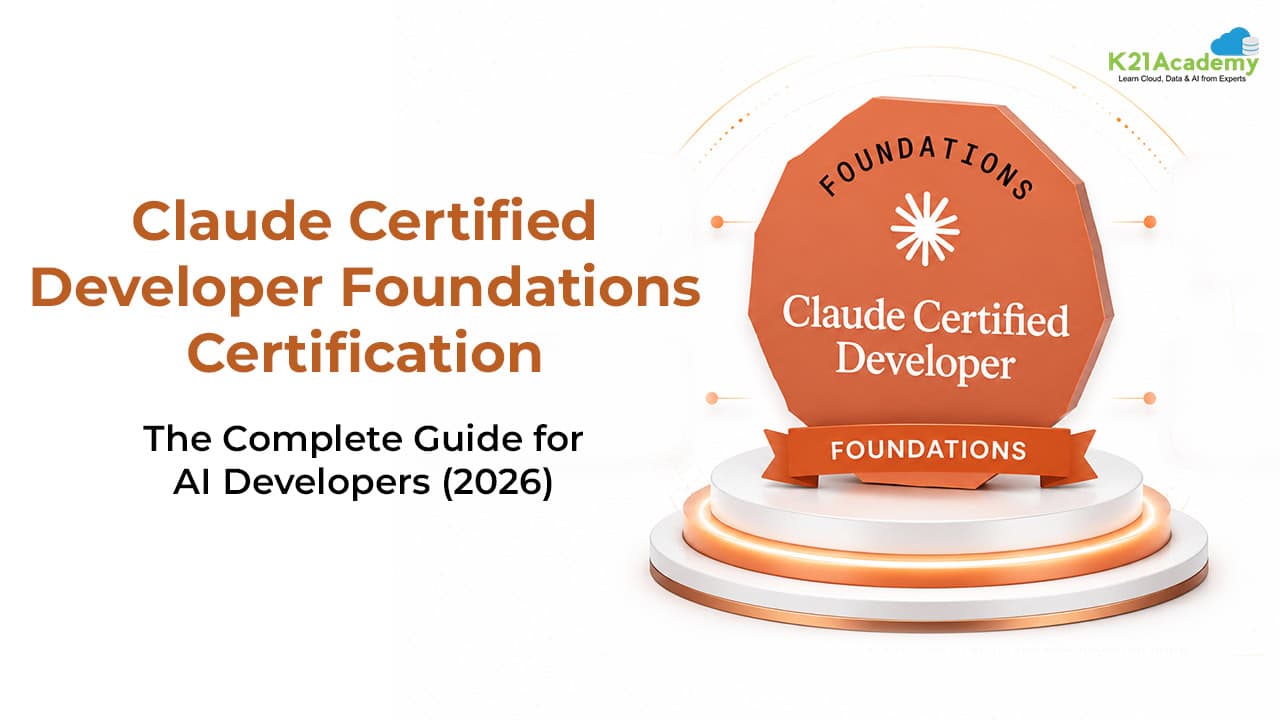
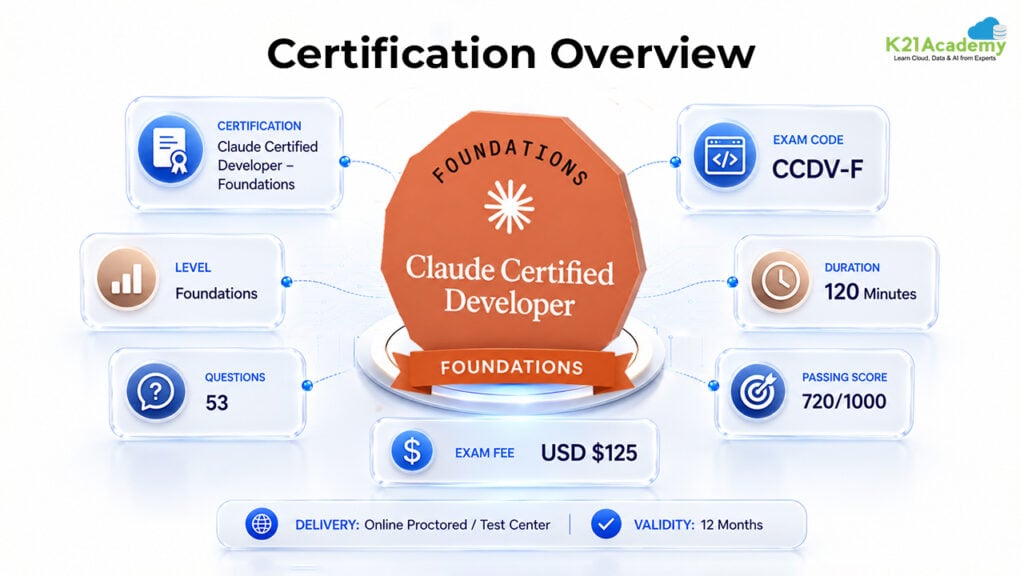
To address the emerging trends and expectations, Anthropic released the Claude Certified Developer – Foundations (CCDV-F) certification. CCDV-F is different from most certifications that are theory oriented. CCDV-F actually tests you against required development skills to create a product-level AI solution with a minimum reliance.
Whether you’re a software developer, AI engineer, cloud developer, or technical architect, this certification provides a structured path to building modern AI applications.
What is the Claude Certified Developer – Foundations Certification?
The Claude Certified Developer – Foundations (CCDV-F) certification validates your ability to build and deploy AI-powered applications using Claude’s APIs and development platform.
Rather than testing theoretical AI concepts, the exam focuses on practical software engineering skills, including:
- Building AI-powered applications and agents
- Integrating Claude APIs and SDKs
- Prompt and context engineering
- Model selection and optimization
- AI security and guardrails
- Claude Code configuration
- Model Context Protocol (MCP)
- Testing and debugging AI applications
The certification demonstrates that you can design and implement production-ready AI solutions that meet enterprise requirements.
Why This Certification Matters
AI has become a core component of modern software development. Organizations increasingly require developers who understand both software engineering and AI application development.
Earning this certification helps you:
- Validate AI development skills
- Learn enterprise AI best practices
- Build intelligent AI agents
- Improve API integration expertise
- Understand AI security
- Optimize AI performance and cost
- Strengthen your resume
- Increase opportunities in AI-focused roles
As AI adoption continues to grow, certified developers will remain in high demand across industries.
Certification Overview
Who Should Take This Certification?
The certification is ideal for professionals involved in AI application development, including:
- Software Developers
- AI Engineers
- Machine Learning Engineers
- Python Developers
- TypeScript Developers
- Backend Developers
- Full-Stack Developers
- Cloud Developers
- DevOps Engineers
- Technical Architects
- AI Solution Architects
- Engineering Students interested in AI
Although there are no mandatory prerequisites, Anthropic recommends experience with software development, REST APIs, Python or TypeScript, and basic knowledge of Claude or similar LLM platforms.
Key Skills You’ll Learn
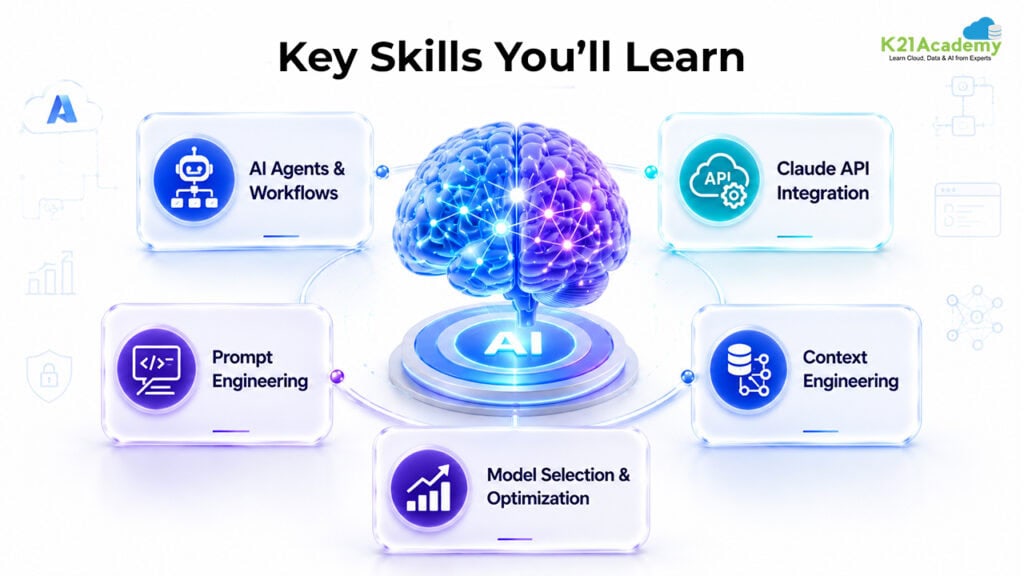
1. AI Agents and Workflows
You’ll learn how to design intelligent AI systems capable of completing multi-step tasks using autonomous agents, workflow orchestration, manager-worker architectures, memory management, and context handling.
2. Claude API Integration
The certification teaches practical API development, including:
- Messages API
- SDK integration
- Streaming responses
- Vision capabilities
- Batch processing
- Error handling
- Tool calling
These skills allow developers to integrate AI into enterprise applications efficiently.
3. Prompt Engineering
Prompt engineering is essential for reliable AI applications. You’ll learn:
- Zero-shot and Few-shot prompting
- System prompts
- Prompt refinement
- Structured outputs
- Instruction hierarchy
- Input sanitization
- Output constraints
These techniques improve response accuracy and consistency.
4. Context Engineering
Managing context is critical for large AI applications.
Topics include:
- Context window management
- Memory optimization
- Context isolation
- Long conversation handling
- Token efficiency
- Context compaction
Proper context management improves both performance and cost efficiency.
Related Readings:- Claude Certified Associate – Foundations (CCAO-F) Certification
5. Model Selection & Optimization
Selecting the right Claude model is essential for building efficient, cost-effective, and high-performing AI applications. As part of the Claude Certified Developer – Foundations certification, you’ll learn how to evaluate different models based on reasoning capability, speed, latency, context requirements, and operational cost, ensuring the best fit for each use case.
You’ll learn how to:
- Select the appropriate Claude model for different application requirements
- Balance reasoning quality, response speed, latency, and cost
- Understand token usage and context window considerations
- Optimize API performance using prompt caching and cache checkpointing
- Apply model version pinning for application stability and predictable behavior
- Manage token budgets for scalable and cost-efficient AI deployments
Understanding the Claude Model Family
Claude Opus
Claude Opus is Anthropic’s most capable model, designed for advanced reasoning, complex problem-solving, research, multi-step planning, and tasks that require high accuracy. It is best suited for enterprise decision-making, sophisticated coding assistance, and scenarios where quality is more important than speed or cost.
Claude Sonnet
Claude Sonnet provides an excellent balance between intelligence, speed, and cost. It is the recommended model for most production applications, including AI assistants, business automation, document analysis, coding support, and enterprise workflows.
Claude Haiku
Claude Haiku is optimized for low latency and high throughput. It is ideal for real-time chatbots, customer support, content classification, data extraction, and other high-volume applications where fast responses and lower operational costs are the primary requirements.
Claude Fable
Claude Fable is optimized for long-form creative writing, storytelling, role-playing, and rich conversational experiences. It excels at generating engaging narratives, maintaining consistent characters and plot over extended interactions, and supporting applications such as interactive fiction, game dialogue, educational simulations, and creative content development where imagination and coherence are prioritized.
Additional Optimization Topics
In addition to model selection, you’ll also gain hands-on knowledge of:
- Prompt Caching – Reusing previously processed prompt prefixes to reduce latency and API costs.
- Cache Checkpointing – Creating reusable cache checkpoints within long prompts to improve efficiency across repeated requests.
- Model Version Pinning – Locking applications to a specific Claude model version to ensure consistent behavior and avoid unexpected changes after model updates.
- Token Budgeting – Planning and managing token consumption to balance context size, performance, and cost while optimizing production workloads.
Mastering these optimization techniques helps developers build scalable, reliable, and cost-efficient Claude-powered applications while ensuring consistent performance in enterprise environments.
6. Claude Code
Candidates also learn Claude Code fundamentals such as:
- Rules
- Skills
- Commands
- CLAUDE.md
- Repository configuration
- settings.json
- Reusable development workflows
7. AI Security
Security is a major focus of the certification.
Topics include:
- Prompt injection protection
- Jailbreak prevention
- Data privacy
- Authentication
- Authorization
- API security
- API key management
- Secret management
- Hooks
- Least-privilege access
- Guardrails
These practices help build secure enterprise AI applications.
8. Testing & Evaluation
Reliable AI applications require continuous testing.
You’ll learn:
- Output validation
- Error diagnosis
- Trace analysis
- Structured output verification
- Debugging
- Performance monitoring
9. Tools and MCP
Modern AI systems extend their capabilities through external tools and the Model Context Protocol (MCP).
You’ll explore:
- Function calling
- Custom tools
- Tool schemas
- MCP servers
- External integrations
- Enterprise system connectivity
These capabilities enable AI applications to interact securely with databases, APIs, CRMs, and business systems.
Related Readings:- Claude Certified Architect Foundations (CCA-F) Certification
What Does the Claude Certified Developer – Foundations Exam Cover?
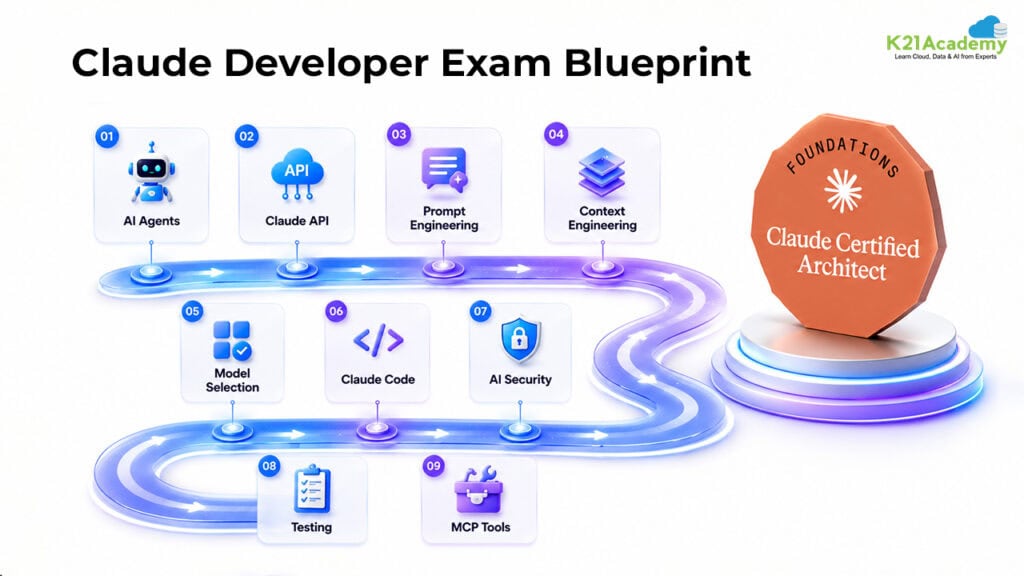
The certification measures your ability to build, integrate, optimize, and secure Claude-powered applications in real-world development environments.
According to the official exam blueprint, the exam is divided into eight content domains, each representing a key area of AI application development.
Domain 1: Agents and Workflows (14.7%)
AI agents are transforming how software automates complex tasks. This domain evaluates your understanding of designing intelligent agent architectures and orchestrating multi-step workflows.
Topics covered include:
- Agent architecture principles
- Workflow vs. autonomous agents
- Manager and supervisor hierarchies
- Sub-agent coordination
- Claude Agent SDK
- Custom agent loops
- Managed deployment models
- Hooks for deterministic actions
- Agentic frameworks like LangGraph, Strands, and PydanticAI
- Memory management and context handling
Developers should understand how to select the right architectural approach based on application requirements.
Domain 2: Applications and Integration (33.1%)
This is the largest and most heavily weighted section of the exam.
It focuses on designing and integrating Claude into production applications.
Topics include:
- Translating business requirements into technical solutions
- Software development lifecycle (SDLC)
- Claude Messages API
- Streaming responses
- Vision capabilities
- Batch API processing
- Third-party integrations
- REST APIs
- JSON handling
- Asynchronous programming
- Version control
- Claude application architecture
- Configuration management
- CLAUDE.md
- settings.json
- Prompt versioning
- Plugin management
A strong understanding of software engineering fundamentals and API integration is essential for success in this domain.
Domain 3: Claude Code (3.1%)
This domain focuses on using Claude Code to accelerate software development.
Candidates should understand:
- Rules
- Skills
- Commands
- Agent Memory
- Session management
- Built-in and custom slash commands
- Streaming mode
- Auto mode
- Repository initialization
- CLAUDE.md hierarchy
- Configuration using settings.json
Claude Code helps developers integrate AI directly into coding workflows, improving productivity and code quality.
Domain 4: Evaluation, Testing, and Debugging (2.6%)
Building an AI application doesn’t end once it starts generating responses. Production-ready AI systems must be tested, monitored, and continuously improved to ensure reliability and accuracy. This domain focuses on evaluating Claude-powered applications, identifying failure points, and implementing debugging strategies.
Candidates should understand how to:
- Identify different types of AI application errors
- Distinguish between integration issues and model-generated errors
- Analyze traces and logs to identify failures
- Debug API responses
- Validate structured outputs
- Select appropriate recovery strategies
- Improve production reliability
Unlike traditional software bugs, AI applications may fail because of poor prompts, insufficient context, incorrect tool usage, or model limitations. Understanding how to isolate these issues is an essential skill for AI developers.
Related Readings:- Claude Code for AI/ML Engineers: Should You Invest the Time? Honest 2026 Worth-It Breakdown
Domain 5: Model Selection and Optimization (16.8%)
Choosing the right AI model is just as important as writing quality code. Different Claude models are designed for different workloads, and selecting the appropriate one can significantly impact performance, latency, and operational costs.
This domain covers:
Large Language Model (LLM) Fundamentals
Before selecting a model, developers should understand the core concepts behind LLMs, including:
- Tokens
- Context windows
- Next-token prediction
- Sampling
- Non-deterministic responses
- Temperature
- Zero-shot prompting
- One-shot prompting
- Few-shot prompting
Understanding these concepts helps developers create more predictable AI applications.
Technical Fundamentals
Candidates should also understand:
- SDK integrations
- REST APIs
- WebSockets
- API request handling
- Response streaming
- Basic engineering practices
Model Selection
Developers should know when to use different Claude models based on:
- Response quality
- Cost efficiency
- Speed
- Latency
- Reasoning capability
- Adaptive thinking support
Understanding the trade-offs between Claude Opus, Sonnet, and Haiku allows developers to build cost-effective AI applications without compromising user experience.
Cost and Token Optimization
Since enterprise AI applications often process millions of requests, developers must optimize operational costs.
Key concepts include:
- Token budgeting
- Prompt caching
- Cache checkpointing
- Batch processing
- Cost estimation
- Monitoring token consumption
Organizations value developers who can balance performance with infrastructure costs while maintaining application quality.
Domain 6: Prompt and Context Engineering (11%)
Prompt engineering is no longer limited to writing clever prompts. Modern AI systems require developers to carefully manage both prompts and the context provided to the model.
Context Engineering
This section focuses on maintaining high-quality conversations over extended interactions.
Topics include:
- Context window management
- Preventing context drift
- Reducing unnecessary context
- Tool output pruning
- Context compaction
- Memory management
- Context isolation using sub-agents
- Multi-step workflows
Proper context management ensures that AI applications remain accurate, efficient, and cost-effective even during long-running sessions.
Prompt Engineering
Candidates should understand best practices such as:
- Writing clear system prompts
- Instruction hierarchy
- Few-shot prompting
- Prompt refinement
- Input sanitization
- Output constraints
- Structured prompting
- Iterative prompt improvement
Well-designed prompts improve response consistency, reduce hallucinations, and increase application reliability.
Output Handling
Developers should also learn how to:
- Validate AI responses
- Produce structured outputs
- Parse responses safely
- Handle unexpected outputs
- Verify generated content before using it in production
This ensures that AI-generated information can be consumed reliably by downstream applications.
Related Readings:- Claude Code Career Roadmap: Skills Developers and AI Engineers Need in 2026
Domain 7: Security and Safety (8.1%)
As organizations integrate AI into critical business processes, security has become one of the most important aspects of AI development.
This domain evaluates your understanding of secure AI application design and responsible deployment.
AI Application Security
Candidates should understand:
- Prompt injection attacks
- Jailbreak techniques
- Handling untrusted input
- Preventing data leakage
- Personally Identifiable Information (PII) protection
- Authentication
- Authorization
- Confidentiality
- Integrity
Understanding these concepts helps developers build AI systems that protect sensitive enterprise data.
Guardrails and Safe Deployment
Organizations expect AI applications to operate within defined boundaries.
Topics include:
- Layered guardrails
- Content policies
- Secure-by-design principles
- Identity and access management
- Least privilege
- Responsible AI
Claude Hooks
Candidates should understand how Claude Hooks can be used to enforce safety controls and prevent destructive or unauthorized actions during AI execution.
Identity and Secret Management
Developers must also know how to:
- Secure API keys
- Manage credentials
- Protect secrets
- Validate user identity
- Monitor authorized access
- Configure production environments securely
Security is no longer optional, it is a core requirement for deploying AI solutions in enterprise environments.
Domain 8: Tools and Model Context Protocol (MCP) (10.6%)
One of the distinguishing features of Claude-powered applications is their ability to interact with external systems through tools and the Model Context Protocol (MCP).
This domain focuses on extending Claude’s capabilities beyond conversation by enabling it to access APIs, databases, enterprise systems, and custom services.
Tool Implementation
Candidates should understand:
- Function calling
- Tool schemas
- Tool descriptions
- Client-side tools
- Server-side tools
- External system interaction
- Error handling
- Tool approval patterns
- Best practices for tool design
MCP Server Development
The exam also covers:
- Building MCP servers
- Server deployment
- MCP resources
- MCP prompts
- Communication using stdio and sockets
- Integrating MCP with Claude applications
Agentic Customization
Developers should know how to decide between:
- Built-in Claude tools
- Custom tools
- Skills
- MCP servers
Choosing the right approach depends on scalability, maintainability, security, and business requirements. Understanding these trade-offs is essential for designing flexible AI architectures.
6-Week Study Roadmap
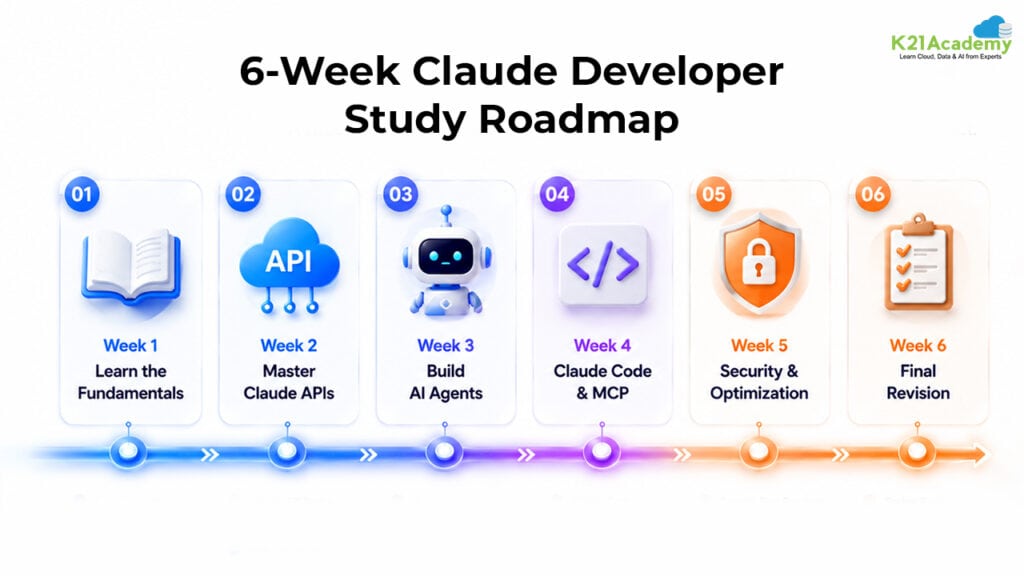
A structured study plan combined with hands-on practice is the best way to prepare for the Claude Certified Developer – Foundations certification.
Week 1 – Learn the Fundamentals
Focus on understanding:
- Claude platform and ecosystem
- LLM fundamentals
- Prompt engineering basics
- REST APIs and SDKs
- AI application architecture
Spend time exploring Claude’s capabilities and experimenting with different prompting techniques.
Week 2 – Master Claude APIs
Practice integrating Claude into applications by learning:
- Claude Messages API
- Streaming responses
- Vision capabilities
- SDK implementation
- Authentication
- Error handling
- Batch processing
Build simple applications that interact with Claude through APIs.
Related Readings:- Top 12 Prompt Engineering Tools for AI Projects in 2026 (Tested & Compared)
Week 3 – Build AI Agents
Learn how to create intelligent workflows using:
- Claude Agent SDK
- Multi-agent systems
- Agent loops
- Memory management
- Context handling
- Workflow orchestration
- Tool usage
Create an AI assistant capable of performing multi-step tasks.
Week 4 – Explore Claude Code & MCP
Focus on developer productivity and integrations by practicing:
- Claude Code
- CLAUDE.md
- Skills and Commands
- Repository configuration
- Model Context Protocol (MCP)
- Custom tools
- Function calling
Week 5 – Security & Optimization
Study production-ready AI practices, including:
- Prompt injection prevention
- AI guardrails
- Token optimization
- Prompt caching
- Output validation
- Debugging
- Cost optimization
Deploy a secure AI application and evaluate its performance.
Related Readings:- Agentic AI real world use cases
Week 6 – Final Revision
Use the last week to:
- Review every exam domain
- Practice mock exams
- Build one complete AI project
- Revise weak concepts
- Study official documentation
Hands-on development remains the most effective way to prepare for the certification.
Hands-on Projects to Build Your Portfolio
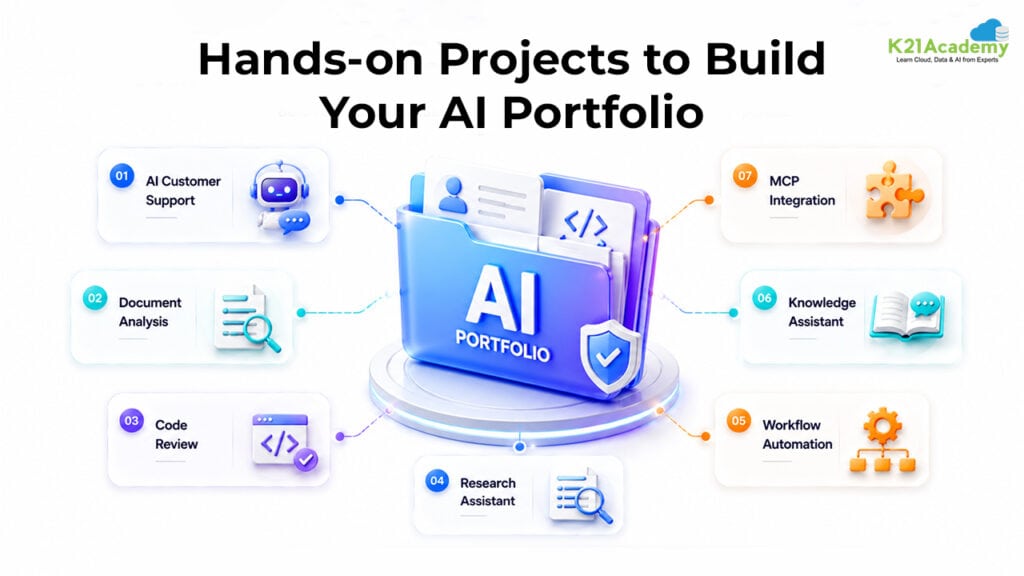
Practical projects help reinforce concepts while showcasing your AI development skills to employers.
1. AI Customer Support Assistant
Develop a chatbot that answers FAQs, retrieves information from a knowledge base, and escalates complex queries.
Skills covered:
- Claude API integration
- Prompt engineering
- Context management
- Tool calling
- Response validation
2. AI Document Analysis Platform
Create an application that analyzes uploaded documents and generates:
- Executive summaries
- Key insights
- Risk analysis
- Action items
- Frequently asked questions
Related Readings:- Comparing the Best AI Chatbots for Your Business: What’s Best for You?
3. AI Code Review Assistant
Build an assistant capable of:
- Reviewing pull requests
- Explaining code
- Identifying bugs
- Suggesting improvements
- Generating documentation
4. AI Research Assistant
Design an AI application that:
- Collects information
- Summarizes research
- Compares documents
- Extracts insights
- Generates reports
Related Readings:- AI Learning Path for IT Leaders and Managers (No Deep Coding Required)
5. AI Workflow Automation Agent
Develop an autonomous AI agent that automates business tasks such as:
- Email processing
- Calendar scheduling
- Task management
- Notifications
- Workflow execution
6. Enterprise Knowledge Assistant
Build an internal AI chatbot capable of answering employee questions using company documentation through semantic search and retrieval.
7. MCP-Based Enterprise Integration
Create an MCP server that connects Claude with enterprise systems like CRMs, HR portals, ticketing platforms, or inventory management applications.
These projects demonstrate practical AI development experience that employers value alongside certifications.
Common Mistakes to Avoid
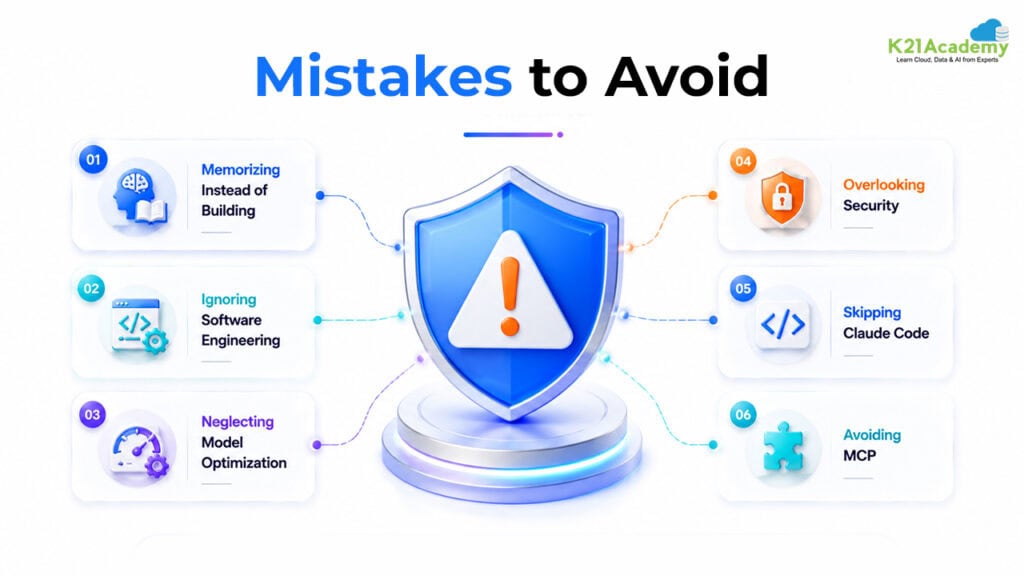
Many candidates struggle because they focus on theory rather than practical implementation. Avoid these common mistakes:
Memorizing Instead of Building
Reading documentation alone is not enough. Build real applications to understand how AI systems behave in production.
Ignoring Software Engineering Fundamentals
Strong knowledge of REST APIs, JSON, asynchronous programming, configuration management, and version control is essential for success.
Neglecting Model Optimization
Understand when to use Claude Opus, Sonnet, or Haiku based on speed, reasoning ability, and cost.
Overlooking Security
Be prepared for questions on:
- Prompt injection
- Authentication
- Authorization
- Data privacy
- API security
- Guardrails
Skipping Claude Code
Although it carries a smaller exam weight, Claude Code is still part of the certification and should not be ignored.
Avoiding MCP
Model Context Protocol (MCP) is becoming increasingly important in enterprise AI development. Understanding MCP concepts will strengthen both your exam performance and real-world AI integration skills.
Related Readings:- How to Use Claude AI in Your CI/CD Pipeline (3 Patterns: From Beginner to Agentic)
Career Opportunities After Certification
The Claude Certified Developer – Foundations certification can help professionals transition into specialized AI development roles.
Popular career opportunities include:
- AI Application Developer
- Generative AI Engineer
- AI Software Engineer
- Claude Developer
- AI Engineer
- AI Solutions Architect
- AI Platform Engineer
- Backend AI Developer
- Full-Stack AI Developer
- Prompt Engineer
- AI Integration Specialist
- AI Automation Engineer
- Technical Consultant
- Developer Advocate (AI)
As organizations continue adopting generative AI, professionals with practical AI development skills will remain in high demand.
Industries Hiring AI Developers
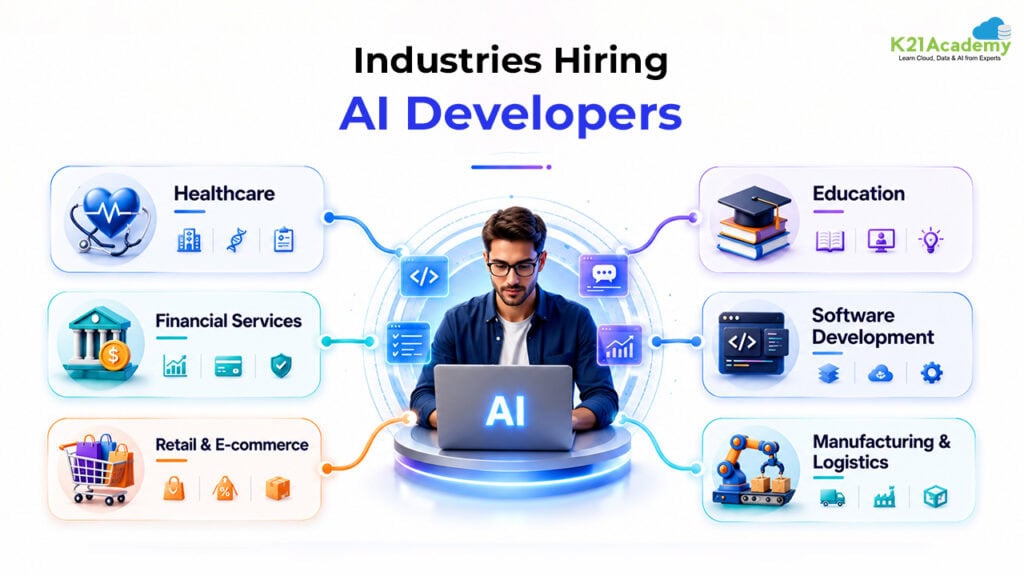
Claude-powered applications are being adopted across multiple industries.
Healthcare
AI is improving:
- Clinical documentation
- Patient communication
- Research
- Administrative automation
Financial Services
Organizations use AI for:
- Customer support
- Fraud detection
- Risk analysis
- Compliance
- Financial reporting
Related Readings:- Claude Code Review 2026: Honest Pros, Cons, and Whether It’s Worth $20/$100 a Month
Retail & E-commerce
AI helps businesses:
- Personalize customer experiences
- Generate product descriptions
- Analyze customer feedback
- Improve marketing
- Automate inventory support
Education
Educational institutions use AI for:
- Personalized learning
- Course creation
- Research assistance
- Student support
- Automated assessments
Related Readings:- Is Claude Code Worth Learning for Cloud Engineers? Salary Impact, Time-to-ROI, and Best Resources
Software Development
Development teams integrate Claude for:
- Code generation
- Documentation
- Debugging
- Requirement analysis
- Code reviews
- DevOps automation
Manufacturing & Logistics
AI supports:
- Supply chain optimization
- Inventory forecasting
- Process documentation
- Predictive maintenance
- Operations planning
Related Readings: Top 10 Claude Code Use Cases Every Developer Should Know
Salary Structure for Claude Certified Developers (India, USA, UK & Global)
As organizations increasingly adopt Generative AI, AI agents, and LLM-powered applications, professionals with practical AI development skills are commanding competitive salaries worldwide. While salaries vary by experience, location, and company, the Claude Certified Developer – Foundations (CCDV-F) certification can strengthen your profile for AI-focused software engineering roles.
Average Salary by Region
| Region | Entry Level (0–2 Years) | Mid-Level (3–6 Years) | Senior (7+ Years) |
|---|---|---|---|
| India | ₹8–15 LPA | ₹18–35 LPA | ₹40–80+ LPA |
| United States (USA) | $100,000–$140,000 | $140,000–$200,000 | $200,000–$350,000+ |
| United Kingdom (UK) | £45,000–£65,000 | £65,000–£95,000 | £95,000–£150,000+ |
| Europe | €55,000–€80,000 | €80,000–€120,000 | €120,000–€180,000+ |
| Australia | AUD 90,000–120,000 | AUD 120,000–170,000 | AUD 170,000–250,000+ |
| Canada | CAD 85,000–115,000 | CAD 115,000–160,000 | CAD 160,000–230,000+ |
| Middle East (UAE, Saudi Arabia) | AED 180,000–280,000 | AED 280,000–450,000 | AED 450,000–700,000+ |
Note: These figures are approximate and vary based on employer, location, technical skills, and total compensation (bonus, stock options, and benefits).
How K21 Academy Can Help
Preparing for a developer-focused AI certification becomes much easier with structured learning and guided practice.
A quality training program should include:
- Instructor-led live sessions
- Hands-on Claude API labs
- Real-world AI application development
- Prompt engineering workshops
- AI agent development
- MCP implementation
- Practice assessments
- Expert mentorship
- Learning resources and recordings
- Certification preparation support
K21 Academy offers industry-focused training designed to help professionals build practical AI development skills while preparing confidently for the Claude Certified Developer – Foundations certification.
Related Readings:- 5 Resume Mistakes That Stop AI Professionals From Getting Interview Calls
Final Thoughts
Artificial Intelligence is revolutionizing software development, and developers who are fluent in creating, constructing, and implementing secure AI applications will soon become the most highly sought-after specialists in the software development industry.
Being a Claude Certified Developer – Foundations (CCDV-F) is one of the most effective ways for someone to learn enterprise AI development. Rather than going through an extensive AI theory session, what the certification is doing is verifying that you have practical skills in API integration, development of AI agent, prompt engineering, context management security testing, optimization, and Model Context Protocol (MCP).
Regardless of your current occupation – whether you’re a software engineer venturing into AI, a cloud specialist working on bringing the machine intelligence layer to existing services, or a tech person trying to anticipate and avoid obsoletion, this certification will act as the perfect launching ground.
With organizations rapidly increasing investments in AI-powered systems, acquiring the Claude Certified Developer – Foundations is one of the practical ways through which you can get the competence required to thrive in the subsequent iterations of software development.