





Has AI Really Already Become Your Career Substitute? AI is changing business operations quickly. Through AI, businesses now have a tool that enables them both to produce good stuff, offer good customer support, and software development, among other areas besides automation. They are employing and integrating it in every part of their operations.
But, as the uptake of AI gets momentum, many of the professionals are still facing the issue of demonstrating and certifying skills related to AI to potential employers. Employing tools like ChatGPT or CLAUDE is already pretty good. But, the employers are interested in people who have the ability to utilize AI at the workplace in actual business environments.
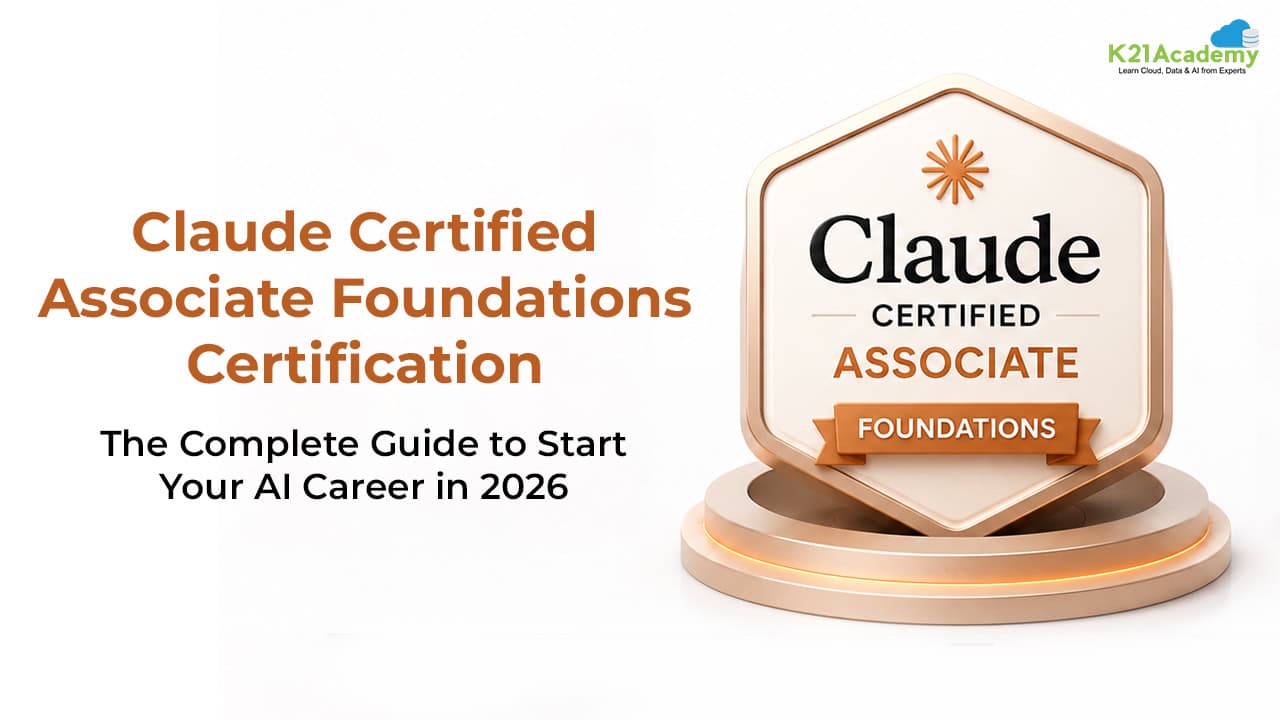
That, for instance, prompts engineering, AI workflows, responsible AI, model building, and enterprise AI implementation. So the biggest reason for the Claude Certified Associate, Foundations (CCAO-F) certification is to close that particular gap. The certification is the brainchild of Anthropic, it confirms that a candidate is able to work well in business and technical environments with the aid of Claude.
Through this article, readers will walk through a complete guide for the CCAO-F certification starting from the exam, the main skills you need, some preparation strategies, to the kind of job opportunities the certification can open for you.

What is the Claude Certified Associate – Foundations Certification?
The Claude Certified Associate – Foundations (CCAO-F) is a certification at foundation level by Anthropic meant to test through practical experience the extent to which a person is familiar with using Claude for doing business and productivity work in a real-life scenario.
Instead of certifications that put much emphasis on machine learning algorithms or coding, this one showcases professional skills by focusing on different ways to utilize AI in day-to-day tasks.
You’ll learn how to:
- Write effective prompts
- Evaluate AI-generated responses
- Select the right Claude model for different tasks
- Build AI-powered workflows
- Manage projects and knowledge sources
- Apply responsible AI practices
- Troubleshoot and optimize AI outputs
Rather than testing theoretical AI concepts, the exam measures whether you can use Claude effectively to improve productivity and solve business problems.
Related Readings:- Claude Certified Architect Foundations (CCA-F) Certification
Certification Overview
| Feature | Details |
| Certification | Claude Certified Associate – Foundations |
| Exam Code | CCAO-F |
| Level | Associate / Beginner |
| Role | AI User, Business Professional, Technical Professional |
| Exam Duration | 120 Minutes |
| Questions | 60 Multiple Choice & Multiple Response |
| Passing Score | 720 / 1000 |
| Exam Fee | USD $99 |
| Delivery | Online Proctored or Pearson VUE Test Center |
| Credential Validity | 12 Months |
These details are defined in the official exam guide.
Why Should You Earn This Certification?
Generative AI is a game-changer for all sectors of the economy, the challenge for most professionals still seems to be a barrier that they just cannot get past when it comes to more advanced use of AI.
Claude Certified Associate certification is a tool that makes it much easier for the average person to get a grip on and be productive with AI that is not very complex but very efficient. One thing that the business communities have been pointing out is that they are starting to prefer people who are practically AI skilled.
Some key benefits include:
- Demonstrate your understanding of Generative AI fundamentals
- Discover the best ways to work with Large Language Models (LLMs)
- Raise your productivity by applying Claude in different business scenarios
- Develop a good level of skill for prompts engineering and AI-assisted workflows
- Get an insight to AI governance, privacy, and responsible use
- Certification to make your resume more attractive for jobs in different sectors.
- Prepare for more advanced AI certifications and enterprise AI roles
Whether you’re beginning your AI journey or looking to formalize your skills, this certification provides a strong foundation.
Who Should Take This Certification?
One of the biggest advantages of the Claude Certified Associate – Foundations certification is that it is designed for a broad audience.
It is suitable for:
- Business Analysts
- Project Managers
- Product Managers
- Consultants
- Marketing Professionals
- HR Professionals
- Operations Managers
- Developers
- Software Engineers
- Technical Writers
- Customer Success Teams
- AI Enthusiasts
- Students exploring AI careers
The certification focuses on practical AI adoption rather than deep software engineering, making it accessible to professionals from both technical and non-technical backgrounds.
Related Readings:- Claude Code for AI/ML Engineers: Should You Invest the Time? Honest 2026 Worth-It Breakdown
Prerequisites
There are no mandatory prerequisites for the certification.
According to the official exam guide:
- No previous Claude experience is required.
- No programming or API experience is required.
- No cloud certification is required.
- Prior AI knowledge is helpful but not mandatory.
However, having basic computer skills and an understanding of how AI tools are used in everyday work can make preparation easier.
Related Readings:- Top 12 Prompt Engineering Tools for AI Projects in 2026 (Tested & Compared)
Key Skills You’ll Learn
Preparing for this certification helps you develop practical skills that can be applied immediately in the workplace.
These include:
1. Prompt Engineering
Get familiar with making prompts that are not only clear but also help in the best possible outputs from AI.
2. Output Evaluation
Learn how to evaluate AI-generated material. This includes identifying hallucinations, fact-checking, and refining results for use.
3. Claude Model Selection
Claude models are optimized for different needs. Choose the smallest model that meets your requirements to balance performance, speed, and cost.
| Model | Best Used For |
| Claude Haiku 4.5 | Fast, low-cost tasks like chatbots, summarization, classification, and data extraction. |
| Claude Sonnet 5 (Recommended) | General-purpose applications, coding, document analysis, and most business or productivity tasks. |
| Claude Opus 4.8 | Complex reasoning, advanced coding, research, and technical problem-solving where maximum capability is needed. |
| Claude Fable 5 | creating an AI agents, multi-step workflows, and autonomous enterprise automation. |
Quick Guide:
- Haiku → Fastest and most cost-effective.
- Sonnet → Best default for most use cases.
- Opus → Best for difficult reasoning tasks.
- Fable → Best for autonomous AI agents and complex workflows.
4. Workflow Integration
Use Claude to complement your processes like research, planning, creating documents, automating business processes and facilitating collaboration with teammates.
5. Knowledge Management
Create and manage a Claude Project store, organize and reference your knowledge, and get better results over time.
6. Responsible AI
Know how to handle data confidentiality compliance ethical issues, and what policies you should observe while using AI systems in your work.
7. AI Optimization
By analyzing your queries and AI outputs you can locate problems, fix them and optimize your workflow to keep getting better performance.
Related Readings:- Claude Code Career Roadmap: Skills Developers and AI Engineers Need in 2026
What Does the Claude Certified Associate – Foundations Exam Cover?
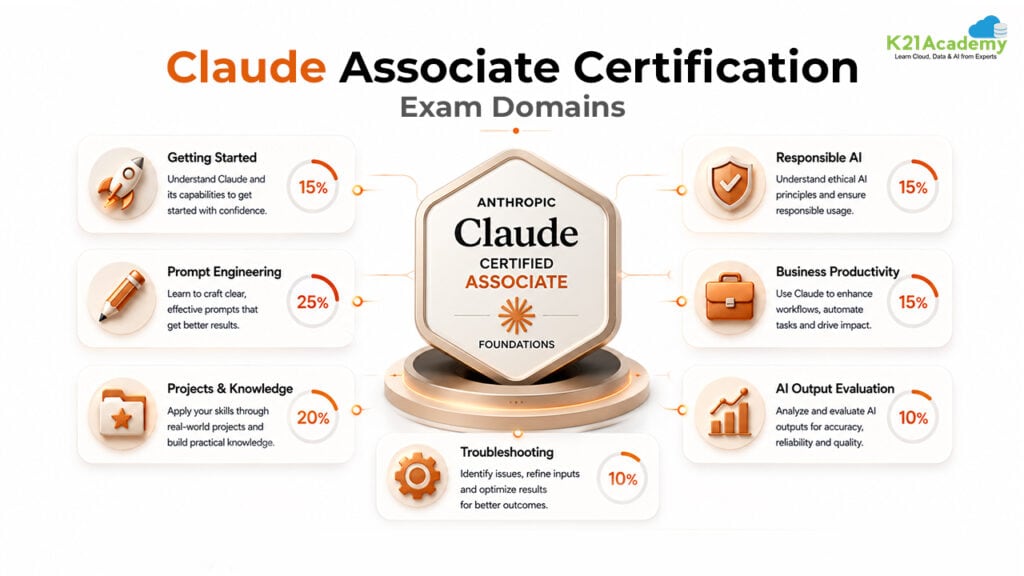
The certification measures your ability to use Claude effectively across different business scenarios rather than testing deep AI programming knowledge. According to the official exam guide, the exam is divided into six core domains that represent the practical skills required to work with Claude in professional environments.
| Domain | Content Domain | Weight |
| 1 | Prompting and Task Execution | 14% |
| 2 | Output Evaluation and Validation | 21% |
| 3 | Product and Model Selection | 12% |
| 4 | Workflow Integration and Solution Design | 16% |
| 5 | Configuration and Knowledge Management | 12% |
| 6 | Governance, Risk, and Responsible Use | 15% |
| 7 | Troubleshooting and Optimization | 10% |
| Total | 100% |
Domain 1: Prompting and Task Execution (14%)
This domain evaluates your ability to create effective prompts that help Claude perform business and technical tasks accurately and efficiently. You’ll learn how to structure prompts for different scenarios, break down complex requests into manageable steps, and continuously refine prompts to improve response quality.
Objectives:
- Create effective prompts for business and technical tasks
- Apply task decomposition techniques to structure complex requests
- Iterate prompts to improve output quality
- Adapt prompting strategies based on task type (analysis, research, drafting, brainstorming)
Domain 2: Output Evaluation and Validation (21%)
This domain focuses on evaluating Claude-generated responses to ensure they are accurate, complete, and reliable. Candidates should be able to identify hallucinations, inconsistencies, or bias, verify information using fact-checking techniques, and determine when human review is necessary before using AI-generated content.
Objectives:
- Evaluate Claude-generated outputs for accuracy and completeness
- Identify hallucinations, inconsistencies, and biases in responses
- Apply fact-checking and validation techniques
- Determine when human review or additional verification is required
- Edit, adapt, refine, and compare outputs for the intended audience
- Organize and curate information and select appropriate output formats (artifacts, inline, structured data)
Related Readings:- Understanding RAG with LangChain
Domain 3: Product and Model Selection (12%)
This domain measures your understanding of Claude’s products and model offerings. Candidates should know when to use features like Projects, Research Mode, Chat, or Artifacts, differentiate between Claude model families such as Haiku, Sonnet, and Opus, and choose the right model based on cost, speed, and performance requirements.
Objectives:
- Select appropriate Claude product features (Projects, research mode, chat, artifacts)
- Differentiate between Claude model types (Haiku, Sonnet, Opus)
- Align model selection with task requirements (cost, speed, quality)
- Understand and manage context limitations and memory considerations (when to restart, summarize, or persist)
Domain 4: Workflow Integration and Solution Design (16%)
This domain evaluates your ability to integrate Claude into business workflows and design AI-assisted solutions. It covers analyzing requirements, supporting research and planning, improving existing processes, and communicating Claude’s capabilities and limitations to stakeholders.
Objectives:
- Apply Claude to analyze requirements and use cases
- Leverage Claude for research, planning, and process optimization
- Use Claude to support solution design, development, and iteration
- Integrate Claude into existing workflows to augment or redesign them
- Communicate Claude’s value and limitations to stakeholders
Domain 5: Configuration and Knowledge Management (12%)
This domain focuses on configuring Claude Projects, managing knowledge sources, and maintaining system-level instructions to ensure consistent and accurate AI interactions across different workflows.
Objectives:
- Configure Claude Projects with instructions and knowledge sources
- Manage uploaded knowledge and connectors (e.g., Google Drive, Gmail)
- Create effective system-level instructions
- Inform, maintain, and update Claude configurations, knowledge sources, and instructions
Related Readings:- Agentic AI real world use cases
Domain 6: Governance, Risk, and Responsible Use (15%)
This domain tests your understanding of responsible AI practices, including identifying appropriate use cases, protecting sensitive data, following organizational policies, and considering the ethical implications of AI usage.
Objectives:
- Identify appropriate and inappropriate use cases
- Apply data sensitivity, regulatory, and privacy considerations
- Follow organizational AI policies and governance standards
- Understand the ethical implications of AI usage
Domain 7: Troubleshooting and Optimization (10%)
This domain measures your ability to identify and resolve issues with AI-generated outputs, improve prompt effectiveness, and optimize workflows for better efficiency and overall performance.
Objectives:
- Identify, diagnose, and resolve issues with underperforming prompts or poor outputs
- Adjust approach based on feedback and results
- Optimize workflows for efficiency and effectiveness
Related Readings:- Comparing the Best AI Chatbots for Your Business: What’s Best for You?
6-Week Study Roadmap for Success
Preparing for the Claude Certified Associate exam doesn’t require months of study. With a structured approach, most learners can build the necessary skills in about six weeks.
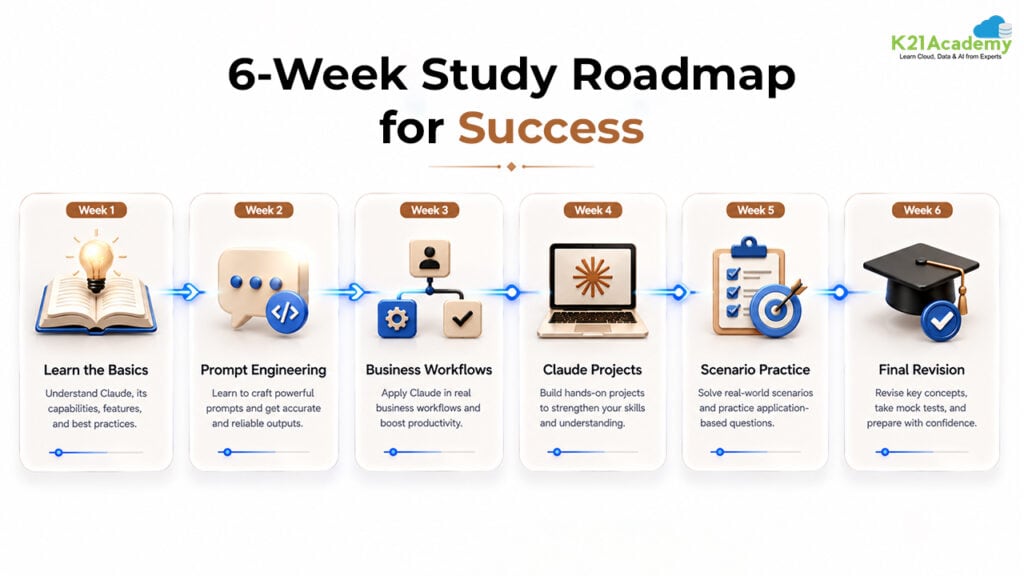
Week 1: Learn the Basics
Focus on understanding:
- What is Generative AI?
- Introduction to Claude & Claude code
- LLM fundamentals
- Common business use cases
- Responsible AI concepts
Spend time interacting with Claude and exploring its interface.
Week 2: Master Prompt Engineering
Practice writing prompts for different scenarios.
Experiment with:
- Zero-shot prompting
- Few-shot prompting
- Role-based prompting
- Chain-of-thought prompting
- Structured output generation
The more prompts you write, the more intuitive effective prompting becomes.
Week 3: Build Real Business Workflows
Use Claude to complete everyday tasks such as:
- Writing professional emails
- Summarizing lengthy documents
- Creating project plans
- Drafting meeting notes
- Developing marketing content
- Brainstorming ideas
This helps you understand how AI fits into real workplace scenarios.
Related Readings:- AI Learning Path for IT Leaders and Managers (No Deep Coding Required)
Week 4: Explore Claude Projects
While Week 4 introduces Claude Projects, it would be even more valuable to include additional hands-on exercises covering features that are part of the certification exam. For example:
- Creating and managing Projects
- Using Artifacts effectively
- Working with Memory
- Using Connectors to access external data
- Evaluating AI-generated outputs
- Identifying and handling hallucinations
- Applying best practices for prompt refinement and validation
Including practical exercises for these topics would better prepare learners for the exam while also helping them build confidence using these features in real-world workflows, especially for recurring individual and team tasks.
Week 5: Practice with Scenario-Based Questions
Instead of memorizing facts, focus on solving practical problems.
Ask yourself:
- Which prompt produces the best result?
- Which Claude feature should be used?
- How can the response be improved?
- Is the output trustworthy?
- What are the privacy implications?
This mirrors the decision-making required in the actual exam.
Week 6: Final Revision and Practice
During the final week:
- Review all exam domains
- Practice sample questions
- Revisit weak areas
- Refine prompt-writing techniques
- Study responsible AI principles
- Build confidence through hands-on exercises
Consistency is more important than long study sessions.
Related Readings:- How to Build Your Own AI Bot in 2026: A Complete Guide
Build Practical Projects
A certification becomes even more valuable when paired with hands-on experience.
Consider building projects such as:
AI Knowledge Assistant
Create an assistant that answers questions using your company’s documentation.
AI Customer Support Bot
Develop an intelligent chatbot capable of resolving common customer issues while escalating complex cases to human agents.
AI Research Assistant
Build a workflow that summarizes articles, extracts insights, and generates reports from uploaded documents.
AI Meeting Assistant
Automatically summarize meetings, identify action items, and generate follow-up emails.
These portfolio projects demonstrate your ability to apply AI in practical business scenarios.
Related Readings:- Top AI/ML Projects on AWS & Azure Cloud in 2026
Tips to Pass the Claude Certified Associate Exam
Many candidates focus only on theory, but success comes from applying AI effectively.
Keep these tips in mind:
- Practice with Claude every day.
- Understand why one prompt performs better than another.
- Learn how Projects and Knowledge improve consistency.
- Always evaluate AI responses before trusting them.
- Review responsible AI guidelines carefully.
- Focus on practical business applications rather than memorizing technical jargon.
- Take practice assessments to identify weak areas.
Remember, the certification measures your ability to use AI effectively, not simply your ability to recall definitions.
Career Opportunities After Earning the Claude Certified Associate – Foundations Certification
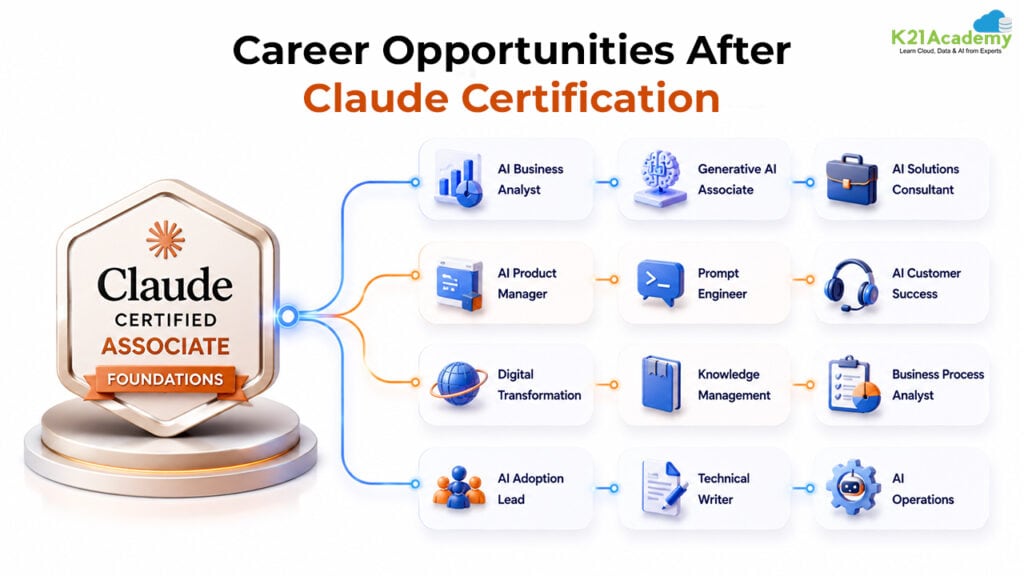
Today, Artificial Intelligence has surpassed its status as a niche technology to become one of the fundamental business capabilities.
Many organizations in healthcare banking, retail, education, manufacturing, and government sectors, for example, are currently using Generative AI to automate various business processes, provide a better customer experience, and increase productivity levels.
With the growth of AI-related work, the need for professionals who are familiar with AI assistants like Chatgpt, Claude is also on the rise. Even though this is an associate-level certification, it can enable you to apply for different AI-related jobs and also be a step forward for your career development.
Some of the roles where Claude skills are becoming increasingly relevant include:
- AI Business Analyst
- AI Engineer
- Generative AI Associate
- AI Solutions Consultant
- AI Product Manager
- Customer Success Specialist (AI)
- Digital Transformation Consultant
- Knowledge Management Specialist
- Business Process Analyst
- AI Adoption Lead
- AI Operations Specialist
As organizations continue integrating Large Language Models (LLMs) into their daily operations, professionals who can bridge the gap between business and AI technology will be in high demand.
Salary Structure for Claude Certified Associate Professionals (India, USA, UK & Global)
As Generative AI becomes an essential part of modern workplaces, professionals with practical AI skills are increasingly valued across industries. While the Claude Certified Associate – Foundations (CCAO-F) certification is an entry-level credential, it demonstrates your ability to use AI effectively in real business scenarios and can enhance your prospects for AI-enabled roles.
Compensation varies depending on factors such as location, experience, industry, and overall technical expertise. Professionals who combine AI knowledge with business, project management, marketing, operations, or software development skills often receive higher salary packages.
Average Salary by Region
| Region | Entry Level (0–2 Years) | Mid-Level (3–6 Years) | Senior (7+ Years) |
|---|---|---|---|
| India | ₹5–10 LPA | ₹12–22 LPA | ₹25–45+ LPA |
| United States (USA) | $70,000–100,000 | $100,000–140,000 | $140,000–220,000+ |
| United Kingdom (UK) | £35,000–50,000 | £50,000–75,000 | £75,000–120,000+ |
| Europe | €40,000–60,000 | €60,000–90,000 | €90,000–140,000+ |
| Australia | AUD 70,000–95,000 | AUD 95,000–140,000 | AUD 140,000–200,000+ |
| Canada | CAD 65,000–90,000 | CAD 90,000–130,000 | CAD 130,000–180,000+ |
| Middle East (UAE, Saudi Arabia) | AED 120,000–220,000 | AED 220,000–350,000 | AED 350,000–550,000+ |
Note: These are approximate market ranges and may vary based on company size, role, location, certifications, and total compensation (bonuses, stock awards, and benefits).
How Claude Skills Apply Across Different Industries
One of the biggest advantages of learning Claude is its versatility. The skills you develop can be applied across almost every industry, helping teams automate knowledge work, improve productivity, and make better decisions.
Healthcare
Healthcare organizations use Claude to:
- Summarize lengthy patient records into concise clinical overviews
- Draft prior authorization letters and referral documentation
- Convert doctor-patient conversations into structured clinical notes
- Answer internal policy and compliance questions using hospital documentation
- Review medical research papers and generate evidence summaries for clinicians
Banking and Financial Services
Financial institutions use Claude to:
- Analyze financial reports and produce executive summaries
- Review regulatory documents and explain compliance requirements
- Summarize fraud investigation cases for faster decision-making
- Generate client-ready investment and portfolio reports
- Assist relationship managers by answering questions from internal knowledge bases
Retail and E-commerce
Retail businesses use Claude to:
- Generate high-quality product descriptions tailored to different marketplaces
- Analyze thousands of customer reviews to identify product improvements
- Create personalized customer support responses using company policies
- Produce merchandising and inventory insights from sales reports
- Draft promotional campaigns, product launch content, and seasonal marketing materials
Education
Educational institutions use Claude to:
- Develop lesson plans, quizzes, and teaching resources aligned with learning objectives
- Provide personalized tutoring and explain complex concepts at different skill levels
- Summarize academic papers and research publications
- Create study guides from textbooks and lecture notes
- Draft administrative communications for students, faculty, and parents
Software Development
Engineering teams use Claude to:
- Explain large codebases and unfamiliar architectures
- Generate technical documentation directly from source code
- Review pull requests and identify potential bugs or edge cases
- Convert business requirements into technical specifications
- Assist with debugging by analyzing error logs and suggesting solutions
Marketing
Marketing teams use Claude to:
- Generate SEO-optimized landing pages, and website copy
- Create personalized email campaigns for different customer segments
- Analyze competitor messaging and identify content opportunities
- Build comprehensive campaign briefs, messaging frameworks, and content calendars
Related Readings: Top 10 Claude Code Use Cases Every Developer Should Know
Why This Certification Matters in 2026
AI adoption is no longer optional.
Businesses are shifting from just trying out AI to fully integrating AI at their core business operations. From industry patterns, one can figure out that businesses are pouring big bucks into AI copilots, AI agents, enterprise search and workflow automation all with one aim to boost productivity and reduce operational costs.
The problem is that quite a number of organizations are faced with the problem of not having professionals who are able to use these tools efficiently.
The Claude Certified Associate – Foundations certificate bridges this gap. It assesses the candidates skills on real-time AI tool usage unlike theoretical AI knowledge.
It demonstrates that you understand how to:
- Communicate effectively with AI systems
- Design better prompts
- Evaluate AI-generated outputs
- Use AI responsibly
- Improve workplace productivity
- Collaborate with AI in real-world scenarios
These are transferable skills that remain valuable regardless of the underlying AI model.
Related Readings:- The Future of AI Agents
Common Mistakes to Avoid During Preparation
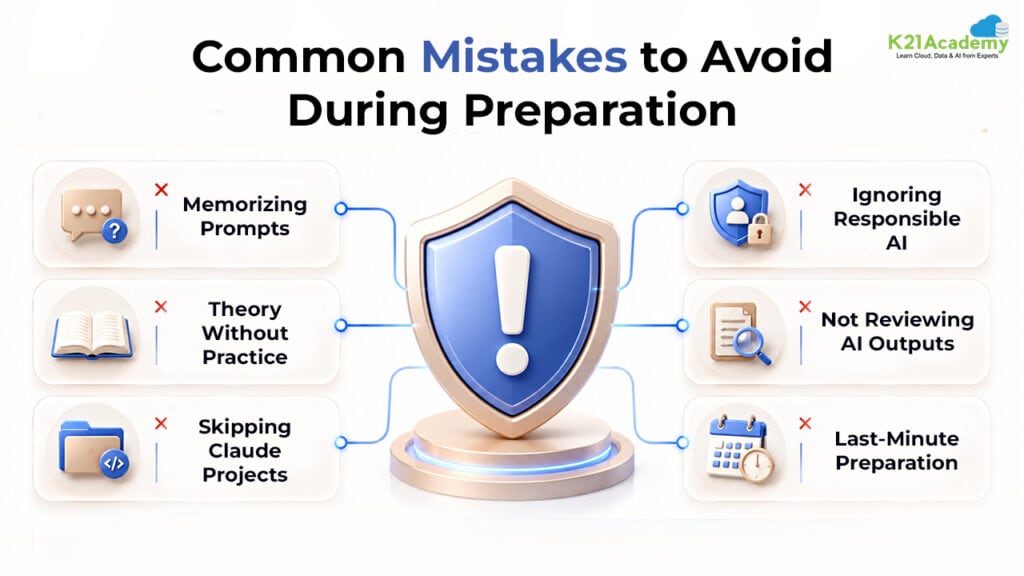
Many candidates make avoidable mistakes that impact their performance.
Avoid these pitfalls:
- Memorizing prompts instead of understanding prompt design.
- Ignoring responsible AI concepts.
- Focusing only on theory without practical experimentation.
- Neglecting to review AI-generated outputs for accuracy.
- Overlooking features like Claude Projects and Knowledge.
- Waiting until last week to start practicing.
Consistent hands-on practice is the best preparation strategy.
Related Readings:- 5 Resume Mistakes That Stop AI Professionals From Getting Interview Calls
How K21 Academy Can Help You Prepare
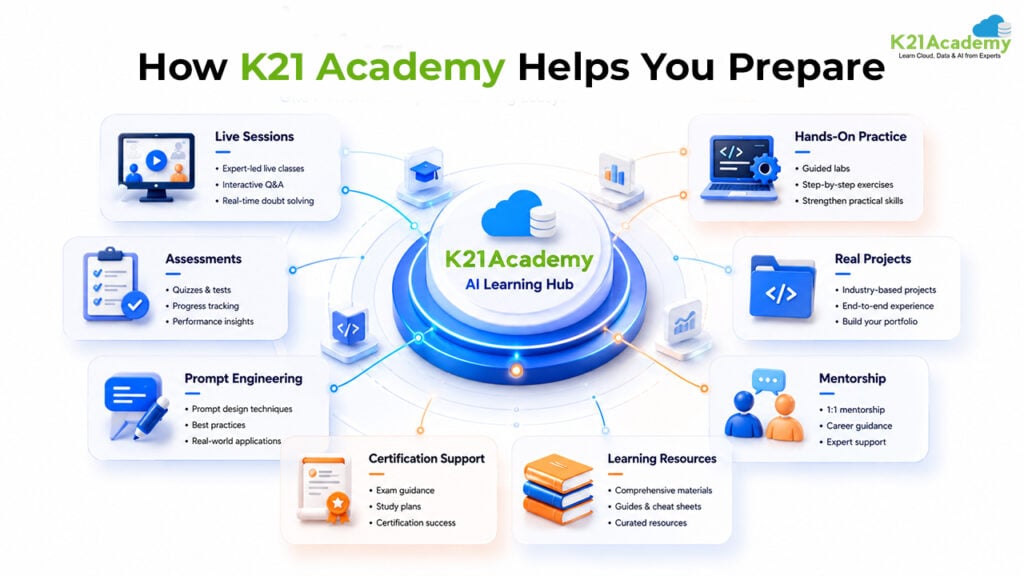
Preparing for an AI certification is much easier with structured guidance and practical experience.
A comprehensive training program should provide:
- Instructor-led live sessions
- Hands-on demonstrations
- Practice assessments
- Real-world AI use cases
- Prompt engineering workshops
- Personalized mentorship
- Certification preparation guidance
- Access to learning resources and recordings
At K21 Academy, learners gain practical exposure to Generative AI, Agentic AI, cloud technologies, and enterprise AI solutions through structured training paths. Whether you’re starting your AI journey or expanding your existing skills, guided learning can help you prepare with confidence and build job-ready expertise.
Related Readings:- How to Become an Agentic AI Expert
Final Thoughts
Artificial intelligence is changing the way organizations carry out their processes, communicate and innovate. Around the world, the AI experts who implement this tech with an appropriate level of responsibility and proficiency will most likely be among the top performers at work regardless of their sector.
The Claude Certified Associate – Foundations certification is a great first step toward gaining a valuable set of practical AI abilities. Instead of simply getting bogged down with explanations, it’s all about hands-on skills like prompt engineering, workflow optimization, knowledge management, and responsible AI.
If you’re a working person wanting to be more efficient in what you do, a developer looking at the possibilities of AI in developing software, or simply a person considering how to get into AI as a new career track, this certification is a solid foundation for further developing yourself.
As AI is still very much in its infancy stage with platforms like Claude, Azure AI, Amazon’s Bedrock, and enterprise AI services becoming ever more significant, it makes sense to learn the basics well now and be ready to take advantage of tomorrow’s opportunities.