



Every IT leader I speak to right now is facing the same pressure: your organization is moving into AI, your team is asking questions you cannot answer yet, and every course you find online assumes you want to be a developer. You do not. You want to lead AI initiatives, evaluate the right tools, keep your team aligned, and make sound decisions. That is a completely different skill set, and it deserves a completely different learning path.
This guide is for IT managers, IT directors, and technology leads who already know their domain and want to add AI leadership to what they have built. Not career starters. Experienced professionals who need a structured path, to become an AI Leader or AI Engineer.
From what I have seen in the industry, the professionals who make the fastest progress are not the ones who sign up for everything at once. They follow a phased approach that builds real-world confidence before committing to a certification. That is exactly what this path gives you.

Why IT Leaders Do Not Need to Code to Lead AI
There is a persistent misconception in this space: that you need to understand algorithms, write scripts, or have a data science background to contribute meaningfully to AI. This is not true, and it is worth addressing directly before you invest a single hour of your time. While an MS in Data Science can be valuable for professionals who want to build machine learning models, work as data scientists, or move into AI research, it is not a prerequisite for leading AI initiatives within an organisation. IT leaders are expected to make strategic decisions, evaluate AI solutions, manage cross-functional teams, and ensure responsible AI adoption, not develop models from scratch.
The difference between generative AI vs machine learning is a useful place to start. Machine learning refers to systems that learn patterns from data over time, usually built and maintained by data scientists and ML engineers. Generative AI refers to models (like the ones behind ChatGPT, Microsoft Copilot, and Claude) that produce text, images, code, and analysis when prompted by a user. As an IT leader, you will almost never build either of these from scratch. Your job is to understand what they can and cannot do, evaluate which tools fit your organization’s needs, manage the teams implementing them, and ensure proper governance around their use.
You do not need to know how a car engine is assembled to be a skilled driver and a responsible fleet manager.
An AI project manager in a modern organization is responsible for scope, risk, vendor relationships, stakeholder communication, and outcomes, not the model weights underneath. The most effective IT leaders in AI connect business needs to technical execution. That connection is built through context, judgment, and structured thinking, not code.
Here are the skills that actually matter at your level:-
- Evaluating AI tools and vendors against business requirements
- Understanding AI risk and governance so you can ask the right questions
- Communicating AI project goals clearly to both executives and engineers
- Building internal alignment around AI adoption and change management
- Knowing when to scale and when to pause an AI initiative
None of these require a programming background. All of them require a structured approach.
Related Readings:- How to Use Claude AI in Your CI/CD Pipeline
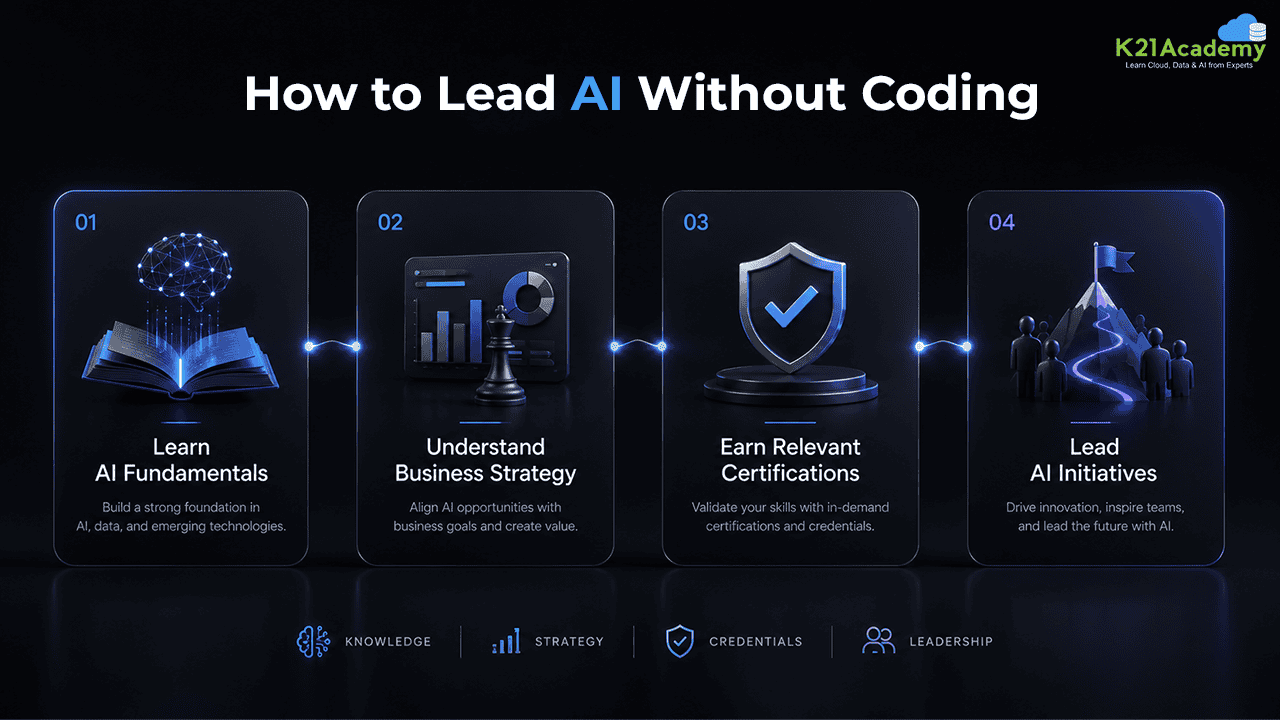
Phase 1: Build Your AI Foundation (Weeks 1-4)
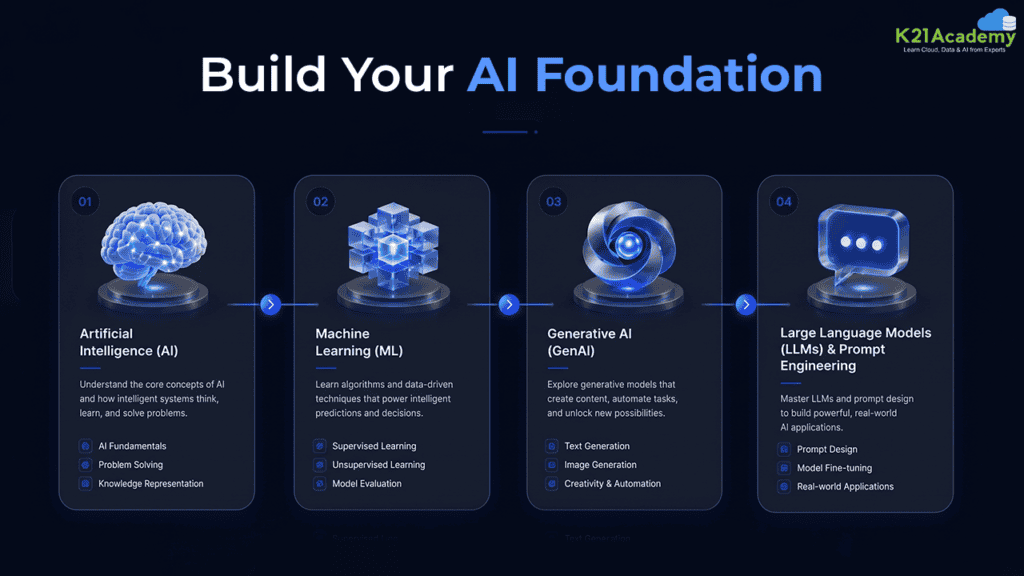
Before you can lead AI initiatives, you need to speak the language. Not fluently, but well enough to hold a substantive conversation with your technical team, ask the right questions in vendor demos, and recognize when something does not add up.
What to learn in this phase
Focus on these four concepts in plain language:-
- Artificial Intelligence (AI): The broad field of building systems that perform tasks we associate with human intelligence, like reading, recognizing images, and making decisions.
- Machine Learning (ML): A subset of AI where systems improve their performance by learning from data without being explicitly programmed for every scenario.
- Generative AI (GenAI): AI that creates new content (text, images, code, audio) based on patterns learned from vast training datasets. This is the technology behind tools your team is already using.
- Large Language Models (LLMs) and Prompt Engineering: LLMs are the engines behind generative AI tools. Prompt engineering is the skill of giving those tools clear, structured instructions to get reliable, useful outputs.
You do not need to understand math. You need to understand the use cases, the limitations, and the vocabulary.
No-code AI tools to explore right now
The best thing you can do in weeks 1 to 4 is spend 20-30 minutes a day actually using AI tools, not just reading about them. No-code AI platforms like the ones below require zero technical setup:-
- ChatGPT (OpenAI): Great starting point for understanding text-based AI
- Microsoft Copilot: Integrated into Microsoft 365, directly relevant to most IT environments
- Claude (Anthropic): Useful for document analysis, summarization, and structured reasoning
- Google Gemini: Connected to Google Workspace, relevant if your org runs on Google tools
- Notion AI: Good example of no-code AI embedded into a productivity tool
These tools are where your intuition gets built. From my experience, the managers who understand AI best are the ones who use it regularly, not the ones who read about it most. Try drafting a project update, summarizing a vendor document, or building a simple meeting agenda with AI assistance. The hands-on time matters more than the study time at this stage.
Free resources for this phase
- Microsoft AI Skills Initiative (free, browser-based, no setup)
- AWS Skill Builder free tier
- Google Cloud AI learning paths
- K21 Academy’s free AI Masterclass (practical orientation for IT professionals new to the space)
Phase 2: Understand AI Strategy and Business Application (Weeks 5-8)
Once you have a working vocabulary and direct experience with AI tools, the next step is building your strategic lens. This is where your role as an AI project manager starts to come into focus.
How to evaluate AI use cases in your organization
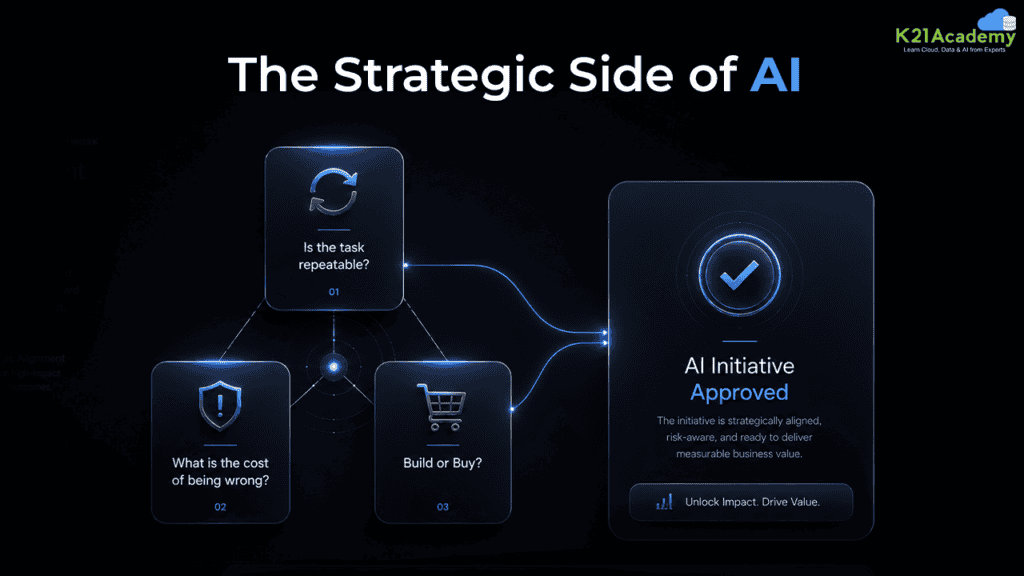
Not every business problem is an AI problem. One of the most valuable skills for an IT manager in this space is knowing how to assess whether an AI solution is the right fit. Here is a simple three-question framework to start with:-
- Is there a clear, repeatable task that generates enough data? AI performs best on well-defined, high-volume tasks.
- What is the cost of a wrong answer? High-stakes decisions (medical, legal, financial) require human oversight layers.
- Does the build-vs-buy math work? Most organizations at this stage are buyers and integrators, not builders.
Run every proposed AI initiative through these three questions before you commit resources.
Related Readings:- 5 Resume Mistakes That Stop AI Professionals From Getting Interview Calls
AI risk, ethics, and governance basics
As an IT manager, you are accountable for what happens when an AI system produces a biased result, leaks sensitive data, or makes a decision that should have stayed with a human. You do not need to understand how bias enters a model technically. You need to know:-
- What your organization’s data governance policy says about AI inputs
- Which regulatory frameworks apply to your industry (GDPR, EU AI Act, sector-specific rules)
- How to build a human-in-the-loop review into high-stakes AI workflows
- What vendor accountability looks like in your contracts
This is an area where many IT managers underinvest early and pay for it later.
Communicating AI initiatives to stakeholders
Technical teams speak in capabilities. Executives speak in outcomes. Your job as an AI project manager is to translate between the two. A few patterns that work well:-
- Lead with the business problem, not the technology choice
- Frame outcomes in time saved, errors reduced, or revenue influenced, not in model accuracy percentages
- Set realistic expectations early. AI tools require training, testing, and iteration
- Build a feedback loop so your team’s real-world experience improves the system over time
Related Readings: Top 10 Claude Code Use Cases Every Developer Should Know
Phase 3: The Right Certifications for Non-Technical IT Leaders (Weeks 9-16)
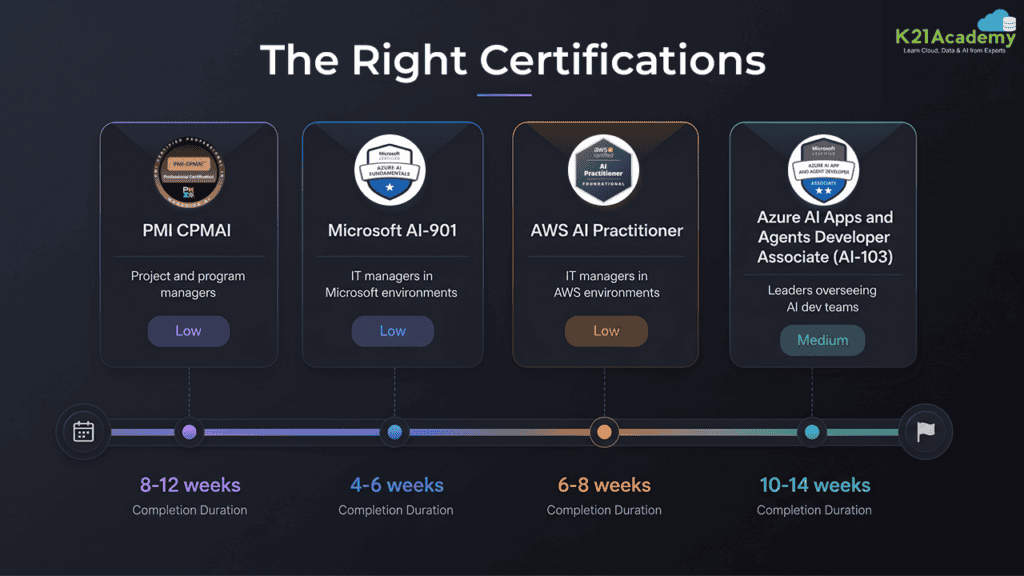
By week 9, you have built context and hands-on familiarity. Now is the right time to formalize your knowledge with a certification that signals your AI competency to your organization and the broader market. Here are the most relevant options for non-technical IT leaders:-
1. PMI CPMAI (Certified AI Project Manager)
The PMI CPMAI is specifically designed for project managers and IT leaders who want to manage AI initiatives without being engineers. It covers the full project lifecycle for AI, from scoping and data requirements through deployment and governance. If your background is project management or program management, this is the most direct path. The credential is globally recognized and increasingly requested in enterprise job descriptions.
K21 Academy offers training that prepares you for the CPMAI exam, with real-world case studies and structured labs that apply directly to your work environment.
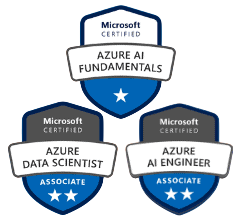
2. Microsoft AI Certification Path (AI-901 to AI-103)
The Microsoft AI certification path starts with Azure AI Fundamentals (AI-901), which is built specifically for non-technical professionals. It covers the core concepts of machine learning, computer vision, natural language processing, and generative AI using Azure services, with no coding requirement. From there, the path leads to Azure AI Apps and Agents Developer Associate (AI-103), which goes deeper into implementation and is more relevant if you want to oversee an AI development team closely.
For most IT managers, AI-901 as a foundation, paired with a broader leadership certification, is the right combination. The Microsoft Azure AI certification is one of the most recognized credentials in enterprise environments, and the Azure ecosystem is already in place for a large percentage of IT organizations.
“Everyone, whether a current IT professional or not, who believes their job will one day be taken over by AI needs to learn the AI/ML programs offered by K21 Academy. The lecture sessions are live, easy-to-follow, and backed by solid lab exercises that help students deploy real-life AI apps and agents.” Sanjeev Saksena, Risk and AI Governance Leader, Financial Services (USA), earned the Microsoft Certified AI Transformation Leader credential within 3 weeks of joining K21.
3. AWS Gen AI Certification (AWS Certified AI Practitioner)
The AWS Certified AI Practitioner is AWS’s answer to the growing need for non-technical AI literacy at a professional level. It covers AI, ML, and generative AI concepts on the AWS platform and requires no hands-on coding. This is particularly relevant for organizations running workloads on AWS infrastructure. The AWS Certified AI Practitioner is a newer credential, which means early adopters gain a meaningful certification before the market becomes saturated.
K21 Academy’s training for the AWS Certified AI Practitioner covers both foundational AI concepts and AWS-specific services like Amazon Bedrock, Amazon SageMaker, and Amazon Q, with a practical, scenario-based approach.
“Since I work full-time, I attend weekend classes to continue advancing my skills. K21 Academy’s structured learning and practical labs have been instrumental in helping me balance my professional responsibilities with my career goals.” Tim (USA), earned the AWS Certified AI Practitioner while employed full-time.
4. Best Agentic AI Course for Leaders
Agentic AI represents the next evolution after generative AI: systems that do not just respond to prompts but take multi-step actions to complete a goal. For IT leaders, understanding agentic AI at a conceptual and governance level is increasingly important, even if your engineers are the ones building the agents. When evaluating agentic AI courses for a non-technical leader, look for programs that focus on architecture decisions, oversight frameworks, and real-world deployment scenarios rather than coding exercises. K21 Academy’s Agentic AI Certification covers this layer with a module designed for leaders who need to evaluate and govern agentic systems rather than build them.
Certification comparison at a glance
| Certification | Best For | Technical Depth | Time to Complete |
| PMI CPMAI | Project and program managers | Low | 8-12 weeks |
| Microsoft AI-901 | IT managers in Microsoft environments | Low | 4-6 weeks |
| AWS AI Practitioner | IT managers in AWS environments | Low | 6-8 weeks |
| Azure AI Apps and Agents Developer Associate (AI-103) | Leaders overseeing AI dev teams | Medium | 10-14 weeks |
K21 Academy provides training that prepares professionals for these vendor exams. The certifications themselves are awarded directly by PMI, Microsoft, and AWS.
Phase 4: Lead AI Projects in Practice
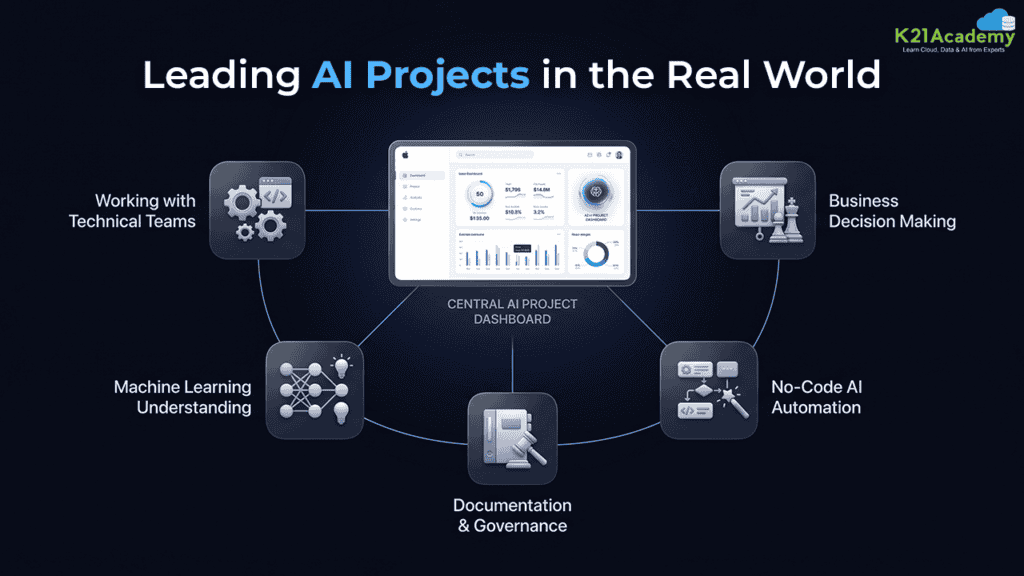
Certification proves you understand the concepts. Practical experience is what makes you effective. Here is how to build that experience alongside your certification journey.
Working effectively with your technical team
The biggest gap I see in organizations is not technical, it is communicative. IT managers who lead AI projects well have learned how to work with data scientists and engineers without trying to become one. A few habits that help:-
- Ask your engineers to explain trade-offs, not just options (“What are we giving up if we choose this approach?”)
- Review AI project outputs against business criteria, not just technical metrics
- Set clear documentation requirements for every AI component so you can audit decisions later
- Create space for your technical team to flag concerns without being overruled by business pressure
Related Readings:- Claude Code for AI/ML Engineers: Should You Invest the Time? Honest 2026 Worth-It Breakdown
Hands-on practice with no-code AI platforms
You do not need to build AI systems to understand how they behave. No-code AI platforms give you the ability to prototype workflows, test edge cases, and develop intuition about where AI succeeds and where it fails. Tools worth exploring at this stage:-
- Microsoft Power Automate with Copilot: Automate workflows using natural language, no code required
- Zapier AI: Connect apps and build AI-assisted automations visually
- Make (formerly Integromat): Visual workflow builder with AI integration options
- Google Vertex AI AutoML: More advanced, but has no-code options for classification and prediction tasks
Spend time building at least one real workflow, even a small one. The experience of debugging a no-code automation gives you practical insight that no course can fully replicate.
Going one level deeper: best ML course recommendations
After completing your certification, some IT leaders want to build a deeper understanding of machine learning to be a more effective partner to their technical teams. The best ML course recommendations at this stage are programs that balance conceptual depth with real-world application without requiring you to become a practitioner yourself. Look for courses that cover:-
- How training data is collected, cleaned, and prepared
- What model evaluation metrics actually mean in business terms
- How to interpret model outputs and confidence scores
- The production pipeline from model development to deployment
K21 Academy’s AI/ML training programs are structured around career-oriented outcomes and include modules specifically designed for IT leaders who want to develop strategic, not just technical, fluency.
5 Mistakes IT Managers Make on the AI Learning Journey
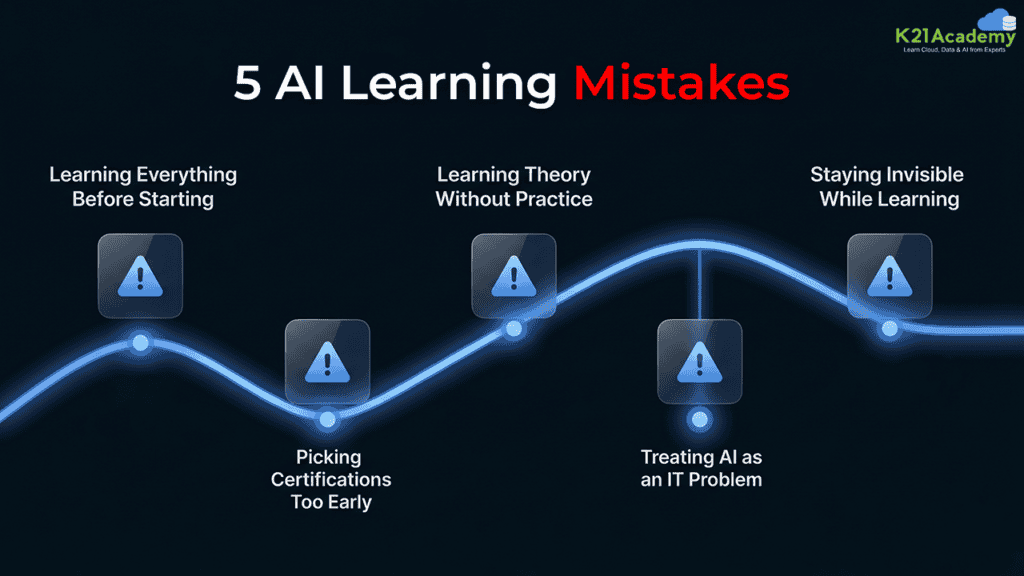
From what I have seen in the industry, these five patterns are the most common reasons professionals stall before they ever gain traction:-
Trying to learn everything before starting anything
AI is a broad field and there is always another course, another certification, another framework to explore. The professionals who make progress pick a focused starting point and move through it. Depth in one area beats surface-level exposure to ten.
Picking a certification before building context
Certifications are valuable, but they are much harder to retain and apply when you have no hands-on experience to anchor the concepts. Spend four to six weeks using AI tools before you start formal exam prep. This is especially true if you have been burned by a self-paced course before: the problem was usually sequence, not the cert itself.
Learning only theory and skipping tool exploration
Theoretical knowledge is necessary, but real learning takes place when you put what you have learned into practice. Block time each week to actually use the tools.
Treating AI as an IT problem instead of a business strategy issue
AI initiatives that live only in the IT department rarely get the organizational buy-in they need to succeed. The managers who advance fastest are the ones who connect AI capability to business outcome at every stage of the conversation.
Not building internal visibility while learning
Your learning journey has value beyond your own development. Share what you are discovering with your team and your leadership. Write a brief internal post, run a lunch-and-learn, or mention one AI insight in your next leadership meeting. Visibility accelerates both your influence and your accountability.
Related Readings:- Claude Code Career Roadmap: Skills Developers and AI Engineers Need in 2026
Final Thoughts
A structured AI learning path for IT leaders is not about becoming a data scientist. It is about developing the judgment to evaluate, lead, and govern AI initiatives in a way that drives real outcomes for your organization. The four-phase approach in this guide, foundation first, then strategy, then certification, then practice, gives you the scaffolding to do that in a focused 16-week window.
What has been the biggest barrier for you in starting your AI learning journey? Picking the right resource, finding the time, or knowing where to begin? Share in the comments. I read every response and would love to hear what is actually getting in the way.
Frequently Asked Questions:-
Ques: Do IT managers need to know how to code to work with AI?
Answer: No. IT managers leading AI initiatives need strategic, evaluation, and governance skills, not programming skills. Certifications like the PMI CPMAI and Microsoft AI-901 are specifically designed for non-technical professionals
Ques: What is the best AI certification for non-technical IT leaders?
Answer: The PMI CPMAI is purpose-built for project and program managers. Microsoft AI-901 (Azure AI Fundamentals) and the AWS Certified AI Practitioner are also strong options with no coding requirements.
Ques: What is the difference between generative AI and machine learning?
Answer: Machine learning involves systems that learn patterns from data, typically built by engineers. Generative AI refers to models that create new content (text, images, code) from a prompt. Most IT leaders will oversee generative AI integrations rather than building ML models from scratch.
Ques: What is an AI project manager?
Answer: An AI project manager oversees the planning, execution, and governance of AI initiatives within an organization. The role focuses on stakeholder alignment, vendor management, risk oversight, and outcome delivery, not technical development.