

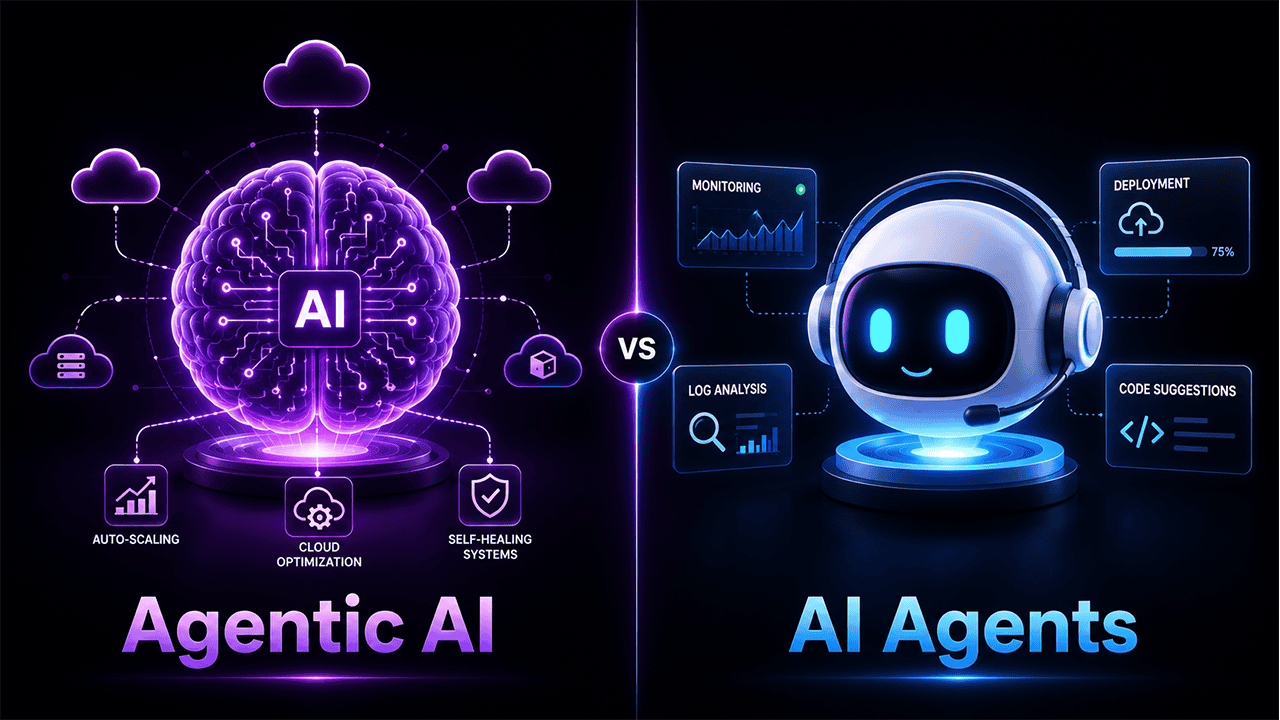



Artificial Intelligence is evolving faster than ever. Terms like AI Agents, Agentic AI, Autonomous AI Systems, and AI Copilots are now appearing across cloud platforms, enterprise software, developer tools, and automation workflows.
But Many professionals still confuse AI Agents vs Agentic AI.
Are they the same thing?
Is Agentic AI just another buzzword for AI agents?
Or is there a deeper architectural difference?
The answer matters because enterprises are now investing billions into autonomous systems powered by platforms like OpenAI, Microsoft Azure AI Foundry, Amazon Bedrock, Google Cloud Vertex AI, and LangChain.

What Are AI Agents?
An AI Agent is a software system that can:
- Observe its environment
- Process information
- Make decisions
- Perform actions to achieve a goal
AI agents are usually task-oriented systems designed to execute specific workflows with limited autonomy.
Examples include:
- Customer support chatbots
- AI coding assistants
- Email automation bots
- IT monitoring assistants
- Virtual scheduling assistants
- Autonomous workflow bots
Popular AI agent frameworks include:
- LangChain
- CrewAI
- AutoGen by Microsoft
- Semantic Kernel
- Haystack
These systems usually operate within predefined boundaries.
For example:
- A coding agent may generate code
- A support agent may answer customer questions
- A DevOps agent may restart failed services
However, most traditional AI agents still rely heavily on human instructions and workflow constraints.
Related Readings:- Claude Code Career Roadmap
What Is Agentic AI?
Agentic AI refers to AI systems capable of autonomous reasoning, planning, memory management, multi-step decision-making, and dynamic goal execution with minimal human intervention.
Instead of performing a single isolated task, Agentic AI behaves more like an intelligent autonomous system capable of:
- Long-term planning
- Self-correction
- Tool selection
- Multi-agent collaboration
- Context persistence
- Adaptive reasoning
- Independent decision loops
In simple terms:
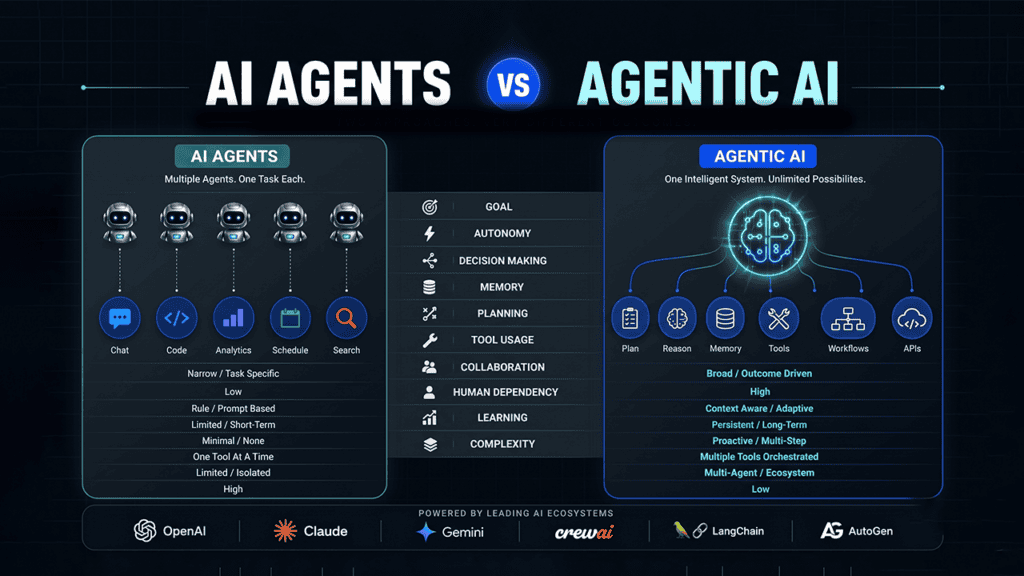
AI Agents perform tasks.
Agentic AI manages objectives.
Agentic AI systems are often built using multiple AI agents working together under a coordinated reasoning framework.
This is why many experts describe Agentic AI as:
“The evolution from reactive AI tools to autonomous AI ecosystems.”
AI Agents vs Agentic AI: Core Difference
Simple Real-World Analogy
Imagine a company employee.
AI Agent
An AI agent is like an intern who follows instructions carefully.
You say:
- “Reply to support tickets.”
- “Generate this report.”
- “Summarize these emails.”
The intern performs the assigned task.
Related Readings:- Claude Code for AI/ML Engineers: Should You Invest the Time? Honest 2026 Worth-It Breakdown
Agentic AI
Agentic AI is like an operations manager.
You say:
- “Improve customer retention.”
The system then:
- Analyzes customer behavior
- Identifies churn risks
- Launches campaigns
- Coordinates marketing tools
- Generates reports
- Optimizes outreach
- Learns from outcomes
All with minimal supervision.
That is the fundamental difference.
Related Readings: Top 10 Claude Code Use Cases Every Developer Should Know
Architecture Difference
AI Agent Architecture
A traditional AI agent usually includes:
- Input processing
- LLM reasoning
- Tool execution
- Response generation
Workflow:
User → Agent → Tool → Output
This architecture is relatively linear.
Agentic AI Architecture
Agentic AI systems are far more advanced.
Typical components include:
- Planning engine
- Memory systems
- Multi-agent orchestration
- Reflection loops
- Goal decomposition
- Autonomous tool chaining
- Decision validation
- Long-term optimization
Workflow:
Goal → Planner → Multiple Agents → Tools → Memory → Reflection → Optimization → Final Outcome
This creates a self-improving autonomous ecosystem.
Related Readings: The Best Chatbot Development Tools
Key Technologies Powering Agentic AI
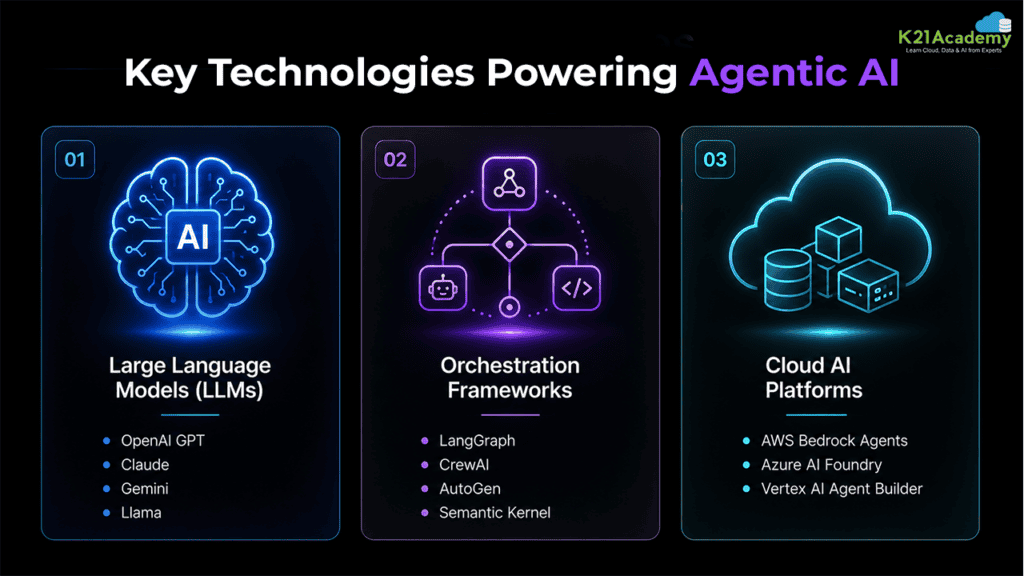
Modern Agentic AI systems are powered by:
Large Language Models (LLMs)
Examples:
- OpenAI GPT models
- Anthropic Claude
- Google DeepMind Gemini
- Meta Llama
Orchestration Frameworks
Popular orchestration frameworks include:
- LangGraph
- CrewAI
- Microsoft AutoGen
- Semantic Kernel
Cloud AI Platforms
Major cloud providers are heavily investing in Agentic AI infrastructure:
- AWS Bedrock Agents
- Azure AI Foundry
- Google Vertex AI Agent Builder
Real-World Examples of AI Agents
1. AI Customer Support Bot
Handles FAQs and support tickets.
Capabilities:
- Responds to queries
- Escalates complex issues
- Uses knowledge bases
Limitation:
Cannot independently redesign customer support strategy.
2. AI Coding Assistant
Tools like:
can:
- Suggest code
- Fix bugs
- Generate functions
But they still depend heavily on developer prompts.
Related Readings: Claude Code vs GitHub Copilot vs Cursor: Which AI Coding Assistant Should You Learn?
3. AI DevOps Assistant
Can:
- Detect outages
- Trigger alerts
- Restart containers
Yet it generally cannot autonomously redesign infrastructure strategy.
Real-World Examples of Agentic AI
1. Autonomous Software Development Systems
Advanced systems can:
- Analyze product requirements
- Generate architecture
- Write code
- Run tests
- Fix failures
- Deploy applications
- Monitor production
- Improve based on telemetry
This goes beyond a single coding assistant.
Related Readings:- 7 System Design Patterns Every Cloud AI Engineer Should know
2. Autonomous Cybersecurity Operations
Agentic AI systems can:
- Detect threats
- Correlate attack patterns
- Launch countermeasures
- Patch vulnerabilities
- Reconfigure security rules
- Generate compliance reports
All continuously.
3. Enterprise Workflow Optimization
Large organizations use Agentic AI to:
- Optimize supply chains
- Predict operational failures
- Automate HR workflows
- Manage financial forecasting
- Coordinate multi-department decisions
Related Readings: MLOps, AIOps and different -Ops frameworks
Why Agentic AI Matters in 2026
The industry is shifting from:
“AI as a tool”
to
“AI as an autonomous collaborator.”
This transformation is happening because organizations want:
- Faster operations
- Lower costs
- 24/7 autonomous execution
- Reduced manual intervention
- Intelligent workflow orchestration
- Scalable enterprise automation
According to enterprise AI trends, Agentic AI is becoming a major focus across:
- Cloud engineering
- DevOps
- Cybersecurity
- Data engineering
- Customer operations
- Software development
Related Readings:- How to Build Your Own AI Bot in 2026: A Complete Guide
Benefits of AI Agents
Easier Implementation
AI agents are simpler to deploy and maintain.
Lower Risk
Since they operate within strict boundaries, there is less unpredictability.
Faster ROI
Companies can quickly automate repetitive tasks.
Better for Narrow Tasks
Ideal for:
- Chat support
- Scheduling
- Ticket routing
- Data extraction
Related Readings:- Learn about conversational bot
Benefits of Agentic AI
High-Level Automation
Can automate entire business processes.
Reduced Human Dependency
Operates with minimal supervision.
Adaptive Intelligence
Can dynamically change strategies based on outcomes.
Scalable Enterprise Operations
Supports large-scale autonomous ecosystems.
Related Readings:- How to Become an Agentic AI Expert
Challenges of Agentic AI
Despite its power, Agentic AI introduces major challenges.
Governance Risks
Autonomous systems require strict controls.
Security Concerns
More autonomy means larger attack surfaces.
Hallucination Risks
Poor reasoning can lead to costly business mistakes.
Ethical Issues
Questions arise around:
- Accountability
- Transparency
- Human oversight
- Compliance
Related Readings:- How to Create an AI Agent: Step-by-Step Guide
AI Agents vs Agentic AI for Cloud Engineers
Cloud engineers are increasingly interacting with both technologies.
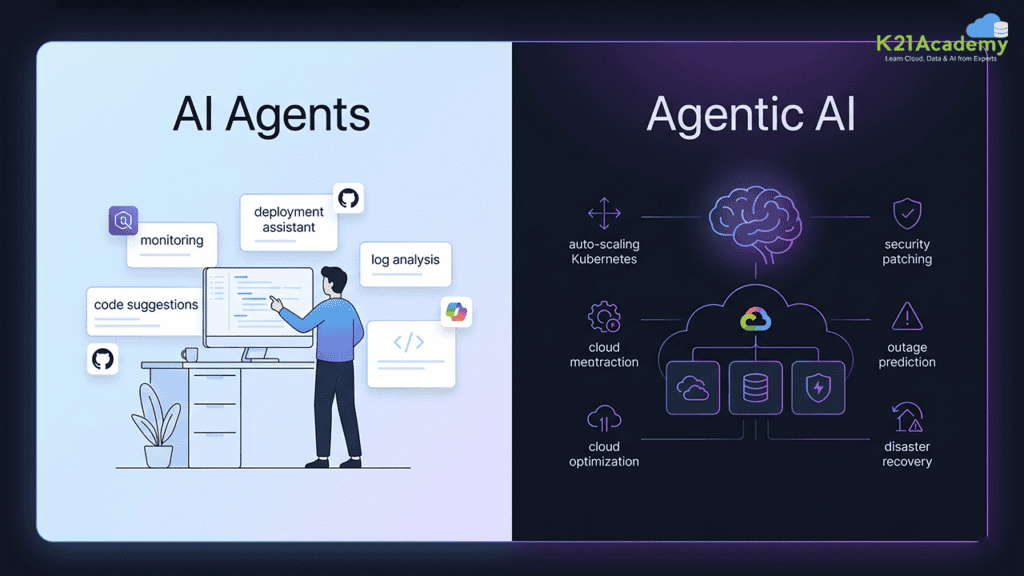
AI Agents in Cloud Engineering
Examples:
- Monitoring bots
- Infrastructure assistants
- Deployment copilots
- Log analysis systems
Tools include:
- Amazon Q Developer
- GitHub Copilot
- Azure Copilot
Related Readings:- Comparing Copilot (Azure) Vs Amazon Q Vs Gemini
Agentic AI in Cloud Engineering
Future systems may autonomously:
- Optimize cloud costs
- Scale infrastructure
- Patch vulnerabilities
- Handle disaster recovery
- Tune Kubernetes clusters
- Predict outages
- Govern multi-cloud environments
This is where autonomous cloud operations are heading.
Related Readings: Generative AI vs Agentic AI: Key Differences
Future of Agentic AI
Over the next few years, we will likely see:
Multi-Agent Enterprise Systems
Organizations deploying entire AI workforces.
AI Operating Systems
Persistent autonomous environments coordinating business operations.
Autonomous DevOps Pipelines
Self-healing infrastructure and autonomous deployments.
AI-to-AI Collaboration
Different agents negotiate and coordinate tasks independently.
Should You Learn AI Agents or Agentic AI?
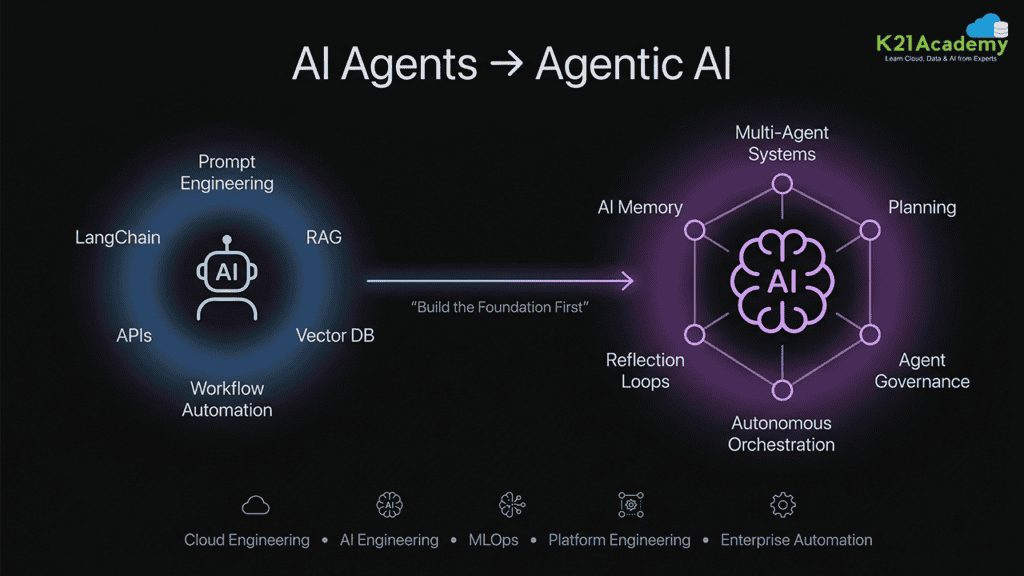
The answer is both.
Start with AI agents because they form the foundation of modern autonomous systems.
Learn:
- Prompt engineering
- LangChain
- RAG architecture
- API orchestration
- Vector databases
- Workflow automation
Then move into Agentic AI concepts:
- Multi-agent system
- Planning architectures
- AI memory systems
- Autonomous orchestration
- Reflection loops
- Agent governance
Professionals with these skills are becoming highly valuable across:
- Cloud engineering
- AI engineering
- MLOps
- Platform engineering
- Enterprise automation
Related Readings: What is Generative AI & How It Works?
Final Thoughts
AI Agents and Agentic AI are related, but they are not identical.
AI agents are specialized task executors.
Agentic AI represents a broader vision of autonomous intelligent systems capable of reasoning, planning, adapting, and operating with minimal supervision.
As enterprise AI matures, the shift toward Agentic AI will likely redefine how businesses operate, how developers build software, and how cloud infrastructure is managed.
The companies and professionals that understand this transition early will have a significant advantage in the AI-driven economy of the future.
Related Readings:- The Future of AI Agents