



Generative AI is revolutionizing the way we create content, build software, and even automate routine tasks. Whether it’s through the power of AI chatbots like ChatGPT and Claude, or image, video, and code generators, Generative AI is making its mark in today’s tech landscape.
However, what is Generative AI, and how does it function?
This guide will walk you through what Generative AI is, how it works, its applications, pros and cons, and some popular Generative AI tools. Additionally, we will talk about how cloud platforms like Amazon Web Services and Microsoft Azure can assist in building Generative AI applications.

What is Generative AI?
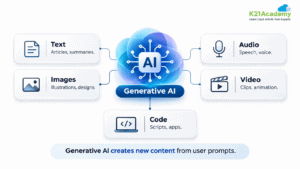
Generative Artificial Intelligence (Generative AI) is a form of artificial intelligence technology that is capable of generating new content in various forms like text, image, video, audio, and computer programming codes. It uses sophisticated machine learning algorithms to learn patterns and respond according to instructions or prompts provided by users.
Generative AI in 2026 works using modern AI technologies like LLMs, transformers, and diffusion models. Some popular forms of generative AI include ChatGPT, Claude, and Gemini which allow users to generate content, solve problems, analyze data, and build applications.
Generative AI in 2026 is used in different business applications that involve writing content, providing customer support using AI, coding assistants, RAG, and AI agents which can use external tools to perform actions.
Related Reading: What Is Prompt Engineering?
History and Emergence of Generative AI
I have watched Generative AI grow a deal over many years. From the days of artificial intelligence research Generative AI moved to the modern Large Language Models and AI agents that we see today.
Generative AI started with research into machine intelligence and neural networks. Over time as learning, computing power and large datasets grew Generative AI systems began to create text, images, audio and videos that look more and more real. I find this progress fascinating.
Key Milestones in Generative AI
- 1950: Alan Turing published his research on machine intelligence introducing what later became known as the Turing Test.
- 2013: Variational Autoencoders (VAEs) introduced advances in generative modeling.
- 2014: Ian Goodfellow and his collaborators introduced Generative Adversarial Networks (GANs) enabling realistic synthetic data generation.
- 2017: The Transformer architecture was introduced, laying the foundation for modern Large Language Models.
- 2020: GPT-3 demonstrated advances, in large-scale language generation.
- 2022: ChatGPT brought Generative AI to a broader audience.
- 2023–2024: Multimodal AI systems advanced, enabling models to process and generate combinations of text, images, audio and other information.
- 2025–2026: AI agents, reasoning models, multimodal applications and enterprise AI workflows became important areas of Generative AI development.
By 2026 Generative AI has grown beyond content creation. Businesses are using Retrieval-Augmented Generation (RAG) AI agents and multimodal models to build applications that pull information talk to tools and automate complex workflows. I think this will change industries.
Understanding the difference between generative AI and traditional ML
Generative AI and traditional Machine Learning are both parts of intelligence but they have different roles.
Traditional Machine Learning mainly looks at data that already exists to find patterns make guesses and sort information. For instance Machine Learning models can predict if a customer will stop using a service find money transactions or guess how much something will sell for.
Generative AI is different because it makes new things using patterns it has learned. It can create writing, pictures, movies, sounds and even computer code when someone asks for it.
Both kinds of technology are useful. A lot of new AI tools use both predictive Machine Learning and Generative AI to fix problems, in businesses.
Generative AI vs Traditional Machine Learning
| Feature | Traditional Machine Learning | Generative AI |
|---|---|---|
| Primary Purpose | Prediction and classification | Content generation |
| Output | Predictions, labels, and scores | Text, images, audio, video, and code |
| Common Models | Decision Trees, Random Forests, Regression | LLMs, GANs, Diffusion Models |
| Example | Predicting customer churn | Generating customer support responses |
| Business Applications | Fraud detection, forecasting, risk analysis | AI chatbots, coding assistants, content creation |
Both technologies are valuable, and many modern AI applications combine predictive Machine Learning with Generative AI to solve business problems.
The Technology Behind Generative AI
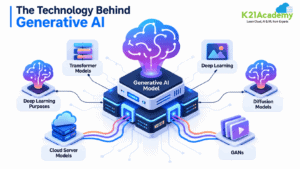
Generative AI works because of technologies like Machine Learning, Deep Learning, Large Language Models (LLMs) and Transformers. These technologies let AI systems find patterns, process data and create things. These things can be text, images, audio, videos and code.
1. Artificial Intelligence (AI):
Artificial Intelligence is about computer systems that do tasks that usually need thinking. These tasks include thinking, solving problems learning and making choices.
2. Machine Learning (ML)
Machine Learning is part of Artificial Intelligence. It allows systems to learn from data and make predictions or decisions. It does this without needing to be told what to do for every task.
3. Deep Learning (DL)
Deep Learning uses networks with many layers to handle complicated information. It is very important in Generative AI projects. These projects include writing text making images and processing speech.
4. Large Language Models (LLMs)
Large Language Models are AI models that are trained on amounts of data. They can work with language. They are used in AI assistants, tools for coding summaries of documents and chat programs.
Some examples are GPT, Claude, Gemini and Llama model families.
Related Reading: What Is a Large Language Model (LLM)?
5. Transformers
Transformers are types of networks. They use attention mechanisms to find connections in the data they get. They are the base for modern LLMs and other Generative AI systems.
6. Diffusion Models
Diffusion models learn to create content by undoing a process where noise is added. They are often used to create images, videos and audio.
7. Generative Adversarial Networks (GANs)
GANs use two parts: a generator that makes data and a discriminator that checks if the fake data looks real.
8. Variational Autoencoders (VAEs)
VAEs learn how to compress data and then use that to make samples that have similar features.
9. Retrieval-Augmented Generation (RAG)
RAG mixes Generative AI models with sources like company files, databases or knowledge bases. It helps AI make answers using information without changing the main model.
Related Reading: Understanding RAG with LangChain
10. AI Agents and Agentic AI
AI agents use AI models along with tools, instructions and steps to do tasks beyond writing text. Depending on how they’re made agents can find information use APIs take actions and finish complex steps.
These technologies are being used together more and more to build Generative AI applications, for business automation helping customers, building software and analyzing data.
How Does Generative AI Work?
Generative AI works by studying patterns and connections in sets of data and then using that learning to make new things based on what a person asks. Today’s generative AI systems use tools like Large Language Models, Transformers and diffusion models to make text, pictures, sounds, videos and code.
How Generative AI Works: Step by Step
- Step 1: Model Training: Generative AI models are trained on collections of text, images, code or other kinds of information. During training models learn the patterns and connections that help them create things.
- Step 2: User Prompt: The process starts when a person gives a prompt like “Explain cloud computing in words” or “Write Python code to look at sales data.” The prompt tells the model what to do.
- Step 3: Tokenization: For text-based models the input is broken into parts called tokens. Tokens can be words, parts of words or other text bits.
- Step 4: AI Model Processing: The model works on the input using what it has learned. Transformer-based models use a way called attention to look at how the parts connect and understand what is needed.
- Step 5: Content Generation: The model makes a response by guessing and picking the part of the answer, one piece at a time. This keeps going until the answer is done or a rule says to stop.
- Step 6: Response Evaluation and Safety: Many AI systems have checks to make sure the answer is safe, clean and correct. These checks help make the answer better and more trustworthy.
Example of Generative AI in Action
Imagine a person asks an AI assistant:
“Summarize this customer feedback report in five bullet points.”
The AI looks at the report finds the points and makes a short summary.
In companies generative AI can also use Retrieval-Augmented Generation to find information, from company files or outside sources before making a reply.
Different generative AI models use ways to make things. For instance diffusion models make pictures by removing noise and GANs use two networks that work against each other during training.
Related Reading: Prompt Engineering & Context Engineering in 2026: Complete Developer Guide with RAG
Use cases for generative AI
Generative AI is used widely in industries to automate tasks boost productivity make customer experiences better and create digital content. In 2026 businesses use more Large Language Models (LLMs) Retrieval-Augmented Generation (RAG) multimodal AI and AI agents to build smart applications.
1. Content Creation
- Text Generation: Create blog posts, emails, marketing copy, product descriptions, reports and social media posts.
- Image and Video Generation: Make visuals, marketing creatives, product mockups, animations and videos from text prompts or reference pictures.
- Audio and Voice Generation: Make voiceovers, speech, sound effects and music for videos training materials and other uses.
2. Customer Experience
- AI Chatbots and Virtual Assistants: Build helpers that answer customer questions give product info and solve support requests.
- Personalized Customer Communication: Make emails, marketing messages and customer replies based on relevant info.
- Enterprise Knowledge Assistants: Use RAG to pull information from company documents and make answers based on business knowledge.
3. Software Development
- AI Coding Assistants: Help developers write, explain, debug and refactor code using tools like GitHub Copilot, Claude Code and ChatGPT.
- Automated Testing: Make unit tests, test cases, documentation and suggestions to improve software quality.
- Application Development: Help developers build websites, APIs and apps using natural language instructions.
4. Business Automation and AI Agents
- AI Agents: Build agents that can talk to APIs pull data. Run tasks with connected tools.
- Workflow Automation: Automate tasks like document processing, report prep, customer support flows and data retrieval.
- Multi-Agent Systems: Coordinate specialized AI agents to handle hard tasks, like research, analysis and flow execution.
5. Healthcare and Scientific Research
- Medical Documentation: Help healthcare workers summarize notes and prepare medical docs.
- Drug Discovery: Help researchers make and evaluate molecule structures for drug development.
- Scientific Research: Support literature analysis, hypothesis creation and research docs.
6. Education and Training
- AI Tutors: Give explanations learning tips and practice questions.
- Learning Content Generation: Make quizzes, summaries, presentations and training materials.
- Coding Education: Help learners grasp programming ideas, debug code and practice tech skills.
7. Banking and Financial Services
- Financial Document Analysis: Summarize reports, contracts and regulatory docs.
- Customer Support: Build AI helpers that explain banking products and answer customer questions.
- Financial Research: Help analysts pull data generate reports and write research summaries.
These examples show how Generative AI can help with both technical work. Companies should put in security, privacy, accuracy checks and human oversight when using Generative AI in business settings.
Benefits of generative AI
Generative AI helps businesses and individuals boost productivity, automate routine work and create content faster and more efficiently. As Large Language Models, multimodal AI and AI agents keep improving the uses of Generative AI keep growing across industries.
Key Benefits of Generative AI
1. Increased Productivity: Automates repeatable jobs like writing emails summarizing reports and making presentations.
2. Faster Content Creation: Produces text, images, videos and marketing ads quickly. With less effort.
3. Improved Customer Support: Powers smart. Virtual assistants that can answer customer questions anytime.
4. Software Development: Helps programmers write code fix errors, test programs. Write clear documentation.
5. Business Automation: Uses AI agents to manage workflows find information and carry out tasks without human help.
6. Personalization: Builds learning tools, customized ads and experiences that match individual needs.
7. Knowledge Management: Uses Retrieval-Augmented Generation to pull and summarize facts from company documents.
8. Innovation: Supports teams, in coming up with ideas building early models and creating fresh solutions faster.
Generative AI works best when it uses data, strong security and human supervision.
Limitations of generative AI
Generative AI offers benefits but Generative AI also has limits that businesses and individuals must think about.
Key Limitations of Generative AI
1. Hallucinations: AI models can make up deceptive information that looks right.
2. Bias and Fairness: AI responses might show biases that exist in the data used to train them.
3. Data Privacy: Using private data in AI applications can create privacy and security risks.
4. High Costs: Training, deploying and operating AI models can need a lot of computing power.
5. Security Risks: AI applications can be vulnerable to injection, data leakage and unsafe tool use.
6. Limited Reliability: AI models may have trouble, with reasoning, changing data and tasks that need exact accuracy.
To overcome these limits organizations should use AI practices. They should have oversight, security controls and check AI outputs regularly.
Some examples of generative AI tools
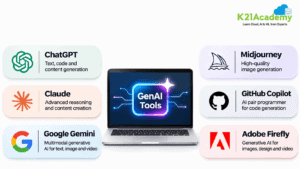
Generative AI tools help individuals and businesses create content generate images develop software and automate workflows. Here are some popular Generative AI tools and platforms in 2026.
-
Text Generation and AI Assistants
- ChatGPT: Helps with content writing, research, coding, data analysis and problem-solving.
- Claude: Supports writing, document analysis, coding and complex reasoning tasks.
- Google Gemini: Assists with writing, research, multimodal tasks and productivity.
-
Image and Video Generation
- ChatGPT Images: Edits images using natural language instructions.
- Midjourney: Generates images and visual designs.
- Adobe Firefly: Supports AI-powered image creation and creative editing.
- Runway: Provides AI-powered video generation and editing tools.
-
AI Coding Assistants
- GitHub Copilot: Helps developers write, understand and improve code.
- Claude Code: Supports coding, debugging, testing and software development workflows.
- Cursor: An AI-powered code editor for software development.
-
Voice and Audio Generation
- ElevenLabs: Generates AI voices, speech and audio content.
- Murf AI: Creates AI voiceovers for presentations, videos and training materials.
-
Enterprise Generative AI Platforms
- Amazon Bedrock: Helps developers build Generative AI applications using foundation models.
- Microsoft Foundry: Provides tools and services for building, evaluating and managing AI applications and agents.
- Google Vertex AI: Supports the development and deployment of Generative AI and machine learning applications.
These tools support use cases, from everyday productivity to enterprise AI development.
AWS Services for Generative AI
Amazon Web Services (AWS) offers cloud services that help you build, launch and manage Generative AI applications. These services back foundation models, Retrieval-Augmented Generation (RAG) AI agents and machine learning workflows.
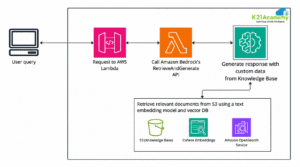
1. Amazon Bedrock: Amazon Bedrock is a managed service that gives you access to foundation models for building Generative AI applications while you do not have to manage the underlying model infrastructure.
2. Amazon Bedrock Knowledge Bases: Knowledge Bases help RAG applications by linking foundation models to enterprise documents and other data sources so they can create relevant responses.
3. Amazon Bedrock AgentCore: AgentCore offers managed infrastructure and services that let you deploy, run and secure AI agents. It includes features for runtime execution, memory and tool connectivity.
4. Amazon SageMaker AI: Amazon SageMaker AI assists developers and data scientists in building, training, customizing and deploying machine learning models including those used for Generative AI.
5. AWS Lambda: AWS Lambda allows serverless execution of application logic, API integrations and automated tasks inside Generative AI workflows.
6. Amazon S3: Amazon Simple Storage Service (S3) holds documents, datasets and other files that Generative AI applications and RAG pipelines use.
7. Amazon Bedrock Guardrails: Bedrock Guardrails supplies safeguards that help filter harmful content protect sensitive information and support responsible AI applications.
8. Amazon CloudWatch: Amazon CloudWatch monitors application logs, performance metrics and operational activity, for AI applications.
Together these AWS services let developers build Generative AI applications, enterprise knowledge assistants and AI-powered automation solutions.
Learn more about Amazon SageMaker
Building a Generative AI Model on AWS
AWS lets developers build Generative AI applications with foundation models through Amazon Bedrock without training models from scratch. Here is a simple step‑by‑step guide:
- Select a Foundation Model: Choose a foundation model with Amazon Bedrock that fits your application needs, such as text generation, summarization or conversational AI.
- Prepare and Connect Data: Store your business documents and datasets in Amazon S3. Then use Amazon Bedrock Knowledge Bases to link your enterprise data and support Retrieval-Augmented Generation (RAG).
- Develop the Application: Add Amazon Bedrock to your application using AWS SDKs and APIs. Use AWS Lambda for serverless application logic and integrations with other APIs.
- Build AI Agents: If your app needs automated workflows, use Amazon Bedrock AgentCore to deploy AI agents that can use tools and interact with external services.
- Implement Security and Guardrails: Apply AWS IAM for access control and use Amazon Bedrock Guardrails to help filter harmful content and protect sensitive information.
- Monitor and Optimize: Track model usage, app performance, errors and costs with Amazon CloudWatch.
These services help developers build Generative AI applications, AI‑powered chatbots, RAG systems and enterprise AI agents, on AWS.
Related Reading: AWS Generative AI Hands-On Labs: Step-by-Step Guide
Azure Services for Generative AI
Microsoft Azure offers cloud-based services that help you build deploy and manage Generative AI applications. These Azure services support Large Language Models, Retrieval-Augmented Generation AI agents and enterprise AI workflows.
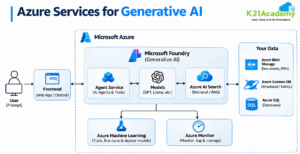
- Microsoft Foundry: Microsoft Foundry is a platform that lets you develop, test, deploy and manage AI models, applications and agents.
- Foundry Models: Foundry Models gives you access to a catalog of AI models from providers like Microsoft, OpenAI, Anthropic and Meta for Generative AI applications.
- Foundry Agent Service: Foundry Agent Service assists developers in building, deploying and managing AI agents that can work with tools fetch data and automate processes.
- Azure AI Search: Azure AI Search offers search and retrieval functions that help you build RAG applications that link Generative AI models to enterprise data.
- Azure Machine Learning: Azure Machine Learning lets developers and data scientists build, train, deploy and manage custom machine learning models.
- Azure Functions: Azure Functions offers serverless computing that lets you connect AI applications, to APIs, databases and automated workflows.
- Azure AI Content Safety: Azure AI Content Safety helps you detect content and supports responsible AI use.
- Azure Monitor and Application Insights: Azure Monitor and Application Insights help you track application performance, troubleshoot problems and monitor AI-powered applications.
Learn more about Azure Machine Learning
Building a Generative AI Model on Azure
Microsoft Azure gives developers the tools to build Generative AI applications using Microsoft Foundry. There is no need to train foundation models from the beginning. Here is a simple step-by-step guide:
- Set Up Microsoft Foundry: Start by creating a project in Microsoft Foundry. This project will help you organize your AI models, applications and all related resources.
- Deploy an AI Model: Pick a foundation model from the Foundry model catalog. Deploy it for tasks like generating text, summarizing content or creating AI.
- Connect Enterprise Data: Use Azure AI Search to pull information from company documents. This supports Retrieval-Augmented Generation or RAG which makes AI responses more accurate and relevant.
- Develop AI Applications and Agents: Integrate the AI models into your app using supported SDKs and APIs. Use Foundry Agent Service to build agents that can use tools and handle automated workflows.
- Implement Security and Responsible AI: Secure your application with Microsoft Entra ID for identity and access control. Apply content safety rules. Check AI responses, for accuracy and reliability.
- Optimize: Use Azure Monitor, Application Insights and Foundry evaluation tools. Track how well your application runs, how good the responses. What the operational costs are.
These Azure services help developers create enterprise-level chatbots, RAG-powered applications and AI agents that support business automation.
Related Reading: Azure AI Foundry: A Comprehensive Guide
Conclusion
Generative AI is changing the way businesses and individuals make content build software and manage tasks. Developments in Large Language Models or LLMs Retrieval-Augmented Generation multimodal AI and AI agents are helping this technology grow across many different fields.
Cloud platforms like Amazon Bedrock and Microsoft Foundry are making it easier to create and run Generative AI apps. These platforms let users build solutions without having to train base models from the beginning.
As Generative AI keeps improving learning the basics will be important. Understanding real-world examples. Getting practical experience, with AI tools will help professionals who want to grow in the AI and cloud technology fields.
Frequently Asked Questions (FAQs)
What is Generative AI in simple words?
Generative AI is a type of artificial intelligence that creates new content, such as text, images, videos, audio and code based on user prompts. Popular examples include ChatGPT, Claude and Gemini.
How does Generative AI work?
Generative AI uses machine learning models trained on datasets to identify patterns and generate new content. Large Language Models (LLMs), for example, process user prompts and generate responses by predicting tokens.
What is the difference between AI and Generative AI?
Artificial Intelligence (AI) is a broad field that includes prediction, classification, reasoning and automation. Generative AI is a subset of AI focused on generating content, such as text, images and code.
What are the popular Generative AI tools in 2026?
Popular Generative AI tools include ChatGPT, Claude, Google Gemini, Midjourney, GitHub Copilot and Adobe Firefly. These tools support content creation, coding, research, image generation and productivity.
What are the main applications of Generative AI?
Generative AI is used for content creation, customer support, software development, document analysis, personalized learning and business automation. It also powers RAG applications and AI agents.
What is the difference between Generative AI and Agentic AI?
Generative AI focuses on creating content in response to prompts. Agentic AI extends these capabilities by using AI models, tools and workflows to perform tasks, make decisions within defined boundaries and interact with external systems.
Which AWS and Azure services support Generative AI?
AWS provides Amazon Bedrock, Bedrock Knowledge Bases, AgentCore and SageMaker AI. Microsoft Azure offers Microsoft Foundry, Foundry Agent Service, Azure AI Search and Azure Machine Learning for building AI applications.
Do you need coding skills to learn Generative AI?
No. Beginners can explore Generative AI using tools like ChatGPT and Claude without coding. However, Python, APIs and cloud computing skills are useful for developing advanced AI applications and pursuing technical AI roles.