





Think about how regularly you interact with AI in your daily life, whether it’s asking a virtual assistant for directions, speaking with a support bot on a website, or utilizing an AI-powered product inside your workspace. Not long ago, these interactions felt futuristic, almost experimental. In 2026, however, they have become a routine element of how we work, interact, and obtain information.
AI Chatbots & Conversational AI has rapidly grown from being a novelty feature into a core aspect of modern digital experiences. Businesses rely on technology to boost customer interaction, employees utilize it to accelerate everyday processes, and individuals gain from more intuitive access to knowledge and services. Rather than browsing complex menus or continuously seeking solutions, consumers may now simply ask. This change has positioned conversational bots at the heart of contemporary human technology interaction. But what exactly is a conversational bot, and how does it vary from the standard chatbots we’ve seen for years? Let’s explore.

What Is a Conversational Bot?
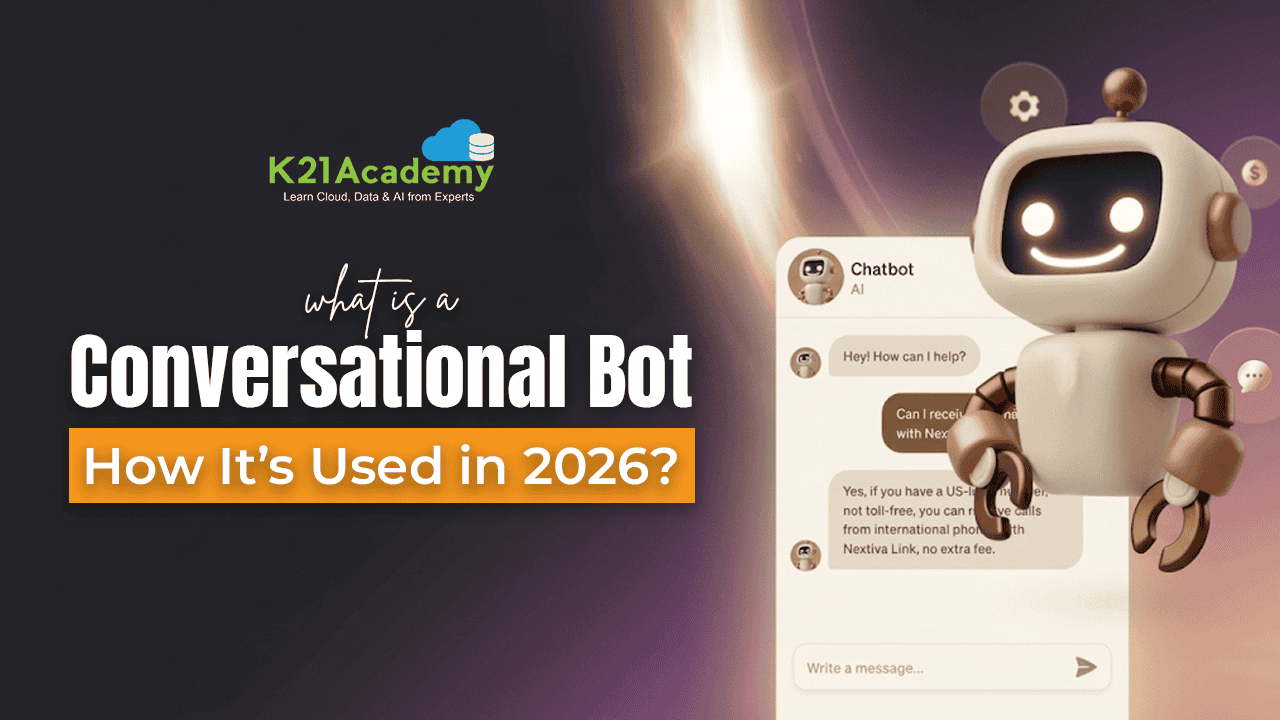
A conversational bot is an AI-powered system designed to communicate with users in natural language, either through text or voice.
Unlike traditional scripted chatbots that rely on fixed rules, conversational bots are built to understand intent, interpret context, and generate responses dynamically.
They are designed to make interactions feel less like “talking to software” and more like “having a conversation.”
Simple Definition
A conversational bot is software that uses technologies like Natural Language Processing (NLP) and Large Language Models (LLMs) to understand human input and respond in a meaningful, context-aware way.
Related Readings: How to Build Your Own AI Bot in 2026: A Complete Guide
Conversational Bot vs Traditional Chatbot
Although the terms are often used interchangeably, the difference is significant.
| Feature | Traditional Chatbot | Conversational Bot |
| Logic | Predefined rules | AI-driven reasoning |
| Responses | Scripted replies | Dynamic responses |
| Context Handling | Minimal | Context-aware |
| Flexibility | Limited | Highly adaptive |
| Learning Capability | Rare | Continuously improving |
Traditional chatbots follow a script.
Conversational bots follow the conversation.
This distinction is why modern AI chatbot experiences feel more fluid and intelligent than earlier generations.
How Conversational Bots Work?
Behind every natural-feeling AI conversation is a combination of multiple technologies working together to understand human language, process intent, and generate meaningful responses.
Conversational bots are designed to simulate human communication while also performing tasks, retrieving information, and automating workflows.
1. Natural Language Processing (NLP)
Natural Language Processing (NLP) is a branch of artificial intelligence that enables computers to understand, interpret, and respond to human language in a meaningful way.
Instead of simply matching keywords, NLP analyses:
- Sentence structure (syntax)
- Meaning (semantics)
- Context
- Intent
- Sentiment
What NLP Enables in Bots
- Understanding user questions
- Identifying intent (what the user wants)
- Extracting entities like names, dates, and locations
- Handling variations in language
- Supporting multiple languages
Example:
User: “Book me a meeting tomorrow at 3 PM.”
NLP extracts:
- Intent → Schedule meeting
- Time → 3 PM
- Date → Tomorrow
2. Large Language Models (LLMs)
Large Language Models are advanced AI systems trained on massive datasets of text to understand language patterns, context, and meaning. They enable conversational bots to generate human-like responses instead of relying on scripted replies.
Examples include models developed by organizations like OpenAI and Google.
How LLMs Work:
They analyze sentence structure and word relationships using neural networks (transformers).
- They predict the most relevant response based on context.
- They maintain conversation continuity across multiple turns.
What LLMs Enable in Bots:
- Natural conversations (not robotic replies)
- Context awareness (remembering previous messages)
- Flexible dialogue flow
- Summarization and reasoning
- Multilingual interaction
Simple Example:
User: “I forgot my password.”
LLM-powered bot: “No problem. I can help you reset it. Would you like me to send a reset link to your registered email?”
Instead of matching keywords, the system understands intent and context.
3. Intent Recognition
Intent recognition is the process of identifying what the user wants to accomplish from their message.
It answers the question:
“Why is the user saying this?”
Common Intent Types:
- Asking a question
- Requesting help
- Performing an action
- Reporting a problem
- Seeking recommendations
How It Works:
The system analyses:
- Keywords
- Sentence structure
- Context
- User history
- Entities (dates, names, locations)
Example:
User: “I need to change my flight tomorrow.”
Detected intent → Modify booking
Why It Matters:
Without intent detection, bots would only respond literally instead of intelligently.
4. Backend Integrations
Backend integration connects the conversational bot to real systems and data sources, allowing it to perform actions, not just talk.
This transforms a chatbot into a digital assistant.
Common Integrations:
- Databases (user data, orders, records)
- APIs (payment systems, booking engines)
- CRM platforms (customer profiles)
- Ticketing systems (support cases)
- Enterprise software (HR, IT systems)
- Knowledge bases
Example:
User: “Where is my order?”
Bot action:
- Calls the order database API
- Retrieves status
- Responds with tracking info
Key Value:
Backend integration = automation power.
Without it, bots only provide static answers.
5. Response Generation
Response generation is the process of creating the final reply delivered to the user after understanding intent and retrieving data.
It combines:
- User input
- Context
- Backend information
- AI reasoning
Types of Responses Bots Can Generate:
- Direct answers
- Recommendations
- Step-by-step guidance
- Confirmations
- Summaries
- Alerts
- Workflow prompts
Example Workflow:
User: “Book a meeting with Rahul tomorrow at 3 PM.”
System steps:
- Intent detected → Schedule meeting
- Extract entities → Rahul, tomorrow, 3 PM
- Check the calendar API
- Create meeting
- Generate confirmation
Final response:
“Your meeting with Rahul has been scheduled for tomorrow at 3 PM.”
Advanced Capabilities:
Modern AI can:
- Adjust tone based on user sentiment
- Personalize responses
- Provide proactive suggestions
- Handle multi-step conversations
How These Components Work Together
A conversational bot typically follows this pipeline:
- User sends a message
- NLP processes language
- Intent recognition identifies the goal
- LLM understands context
- Backend integration retrieves or updates data
- Response generation creates a reply
- The bot sends a response
This entire process often happens in milliseconds.
Key Insight
- LLMs = Intelligence
- Intent Recognition = Understanding
- Backend Integration = Action
- Response Generation = Communication
Together, they create modern conversational AI experiences.
Related Readings:- Create Azure OpenAI Service Resources using Console & CLI
Types of Conversational Bots
-
Rule-Based Bots
Rule-based bots operate using predefined logic and decision trees.
Characteristics:
-
- Fixed conversation flows
- Predictable responses
- Limited flexibility
- Works well for FAQs and structured tasks
Example: Customer service menus.
-
AI-Powered Bots
AI-powered bots use NLP and machine learning to understand context and generate dynamic responses.
Characteristics:
-
- Context awareness
- Flexible conversations
- Continuous learning
- More natural interaction
These are the most common modern conversational systems.
-
Voice Bots
Voice bots use speech recognition and text-to-speech technologies.
Characteristics:
-
- Voice interaction instead of text
- Used in assistants and call centers
- Hands-free operation
Examples include virtual assistants and automated phone systems.
-
Agentic Bots (Emerging)
Agentic bots are more advanced systems capable of:
-
- Goal-oriented reasoning
- Multi-step decision making
- Tool usage
- Task execution
They represent the transition toward autonomous AI agents.
Related Readings:- The Future of AI Agents
Key Use Cases of Conversational Bots
Conversational AI is now widely used across industries.
 Benefits of Conversational Bots
 Benefits of Conversational Bots
 - Efficiency: Bots automate repetitive tasks, allowing human teams to focus on complex work.
- Cost Optimization: Organizations reduce operational costs by minimizing manual support requirements.
- Scalability: Bots can handle thousands of interactions simultaneously without performance loss.
- 24/7 Availability: Users receive assistance anytime without waiting for human agents.
- Personalization: AI can tailor responses using user data and history.
- Faster Decision Support: Bots can instantly deliver insights, recommendations, and summaries.
Challenges and Limitations
Despite their advantages, conversational bots still face challenges.
- AI Hallucinations: Models may generate incorrect or misleading information.
- Context Limitations: Maintaining long-term memory across conversations is still evolving.
- Privacy & Security Risks: Sensitive data requires strong protection and compliance measures.
- Poor Conversational Design: Bad user experience can reduce trust and adoption.
- Over-Automation: Not every interaction should be automated; human intervention remains important.
Conversational Bots vs AI Agents
| Aspect | Conversational Bots | AI Agents |
|---|---|---|
| Role | Communication | Autonomous action |
| Focus | Dialogue | Goal execution |
| Behaviour | Reactive | Proactive |
| Decision Making | Limited | Advanced reasoning |
| Capabilities | Answer questions | Perform tasks end-to-end |
Simple way to understand: “Conversational bots talk. AI agents act”
Modern systems increasingly combine both.
Related Readings: Generative AI vs Agentic AI: Key Differences
Future Trends Beyond 2026
The evolution of conversational AI is moving toward more intelligent and integrated systems.
- Persistent AI Memory: AI remembers user preferences across sessions and devices.
- Multimodal Conversations: Combining text, voice, images, and video interactions.
- Emotionally Aware AI: Better sentiment detection and emotional understanding.
- Hyper-Personalized Assistants: AI is adapting to individual workflows and behaviour patterns.
- Deeper System Integration: AI is embedded into enterprise platforms and operating systems.
Key Takeaways
- Conversational bots enable natural human AI interaction.
- They rely on NLP and large language models.
- They can perform tasks through backend integrations.
- Use cases span nearly every industry.
- Benefits include efficiency, scalability, and personalization.
- Challenges include hallucinations and security risks.
- AI agents represent the next major evolution beyond chatbots.
Conclusion
Conversational bots have become essential digital interfaces. They are no longer experimental tools in 2026; they are genuine systems that help with communication, automation, and decision-making in many kinds of enterprises.
Organizations should not only utilize or make AI Agent/AI chatbots, but also make sure that the conversations they have are safe, dependable, and helpful for their business.
In a future when more and more interactions happen through conversation instead of interfaces, professionals and students need to know how to use conversational AI.
Related Readings:- Claude Code vs GitHub Copilot vs Cursor: Which AI Coding Assistant Should You Learn?