




Choosing the Wrong AI Platform Could Cost Your Company Thousands
Just a few years ago, selecting a cloud platform was mostly about compute, storage, and networking.
Today, AI has become the deciding factor.
Organizations building Generative AI applications, AI agents, RAG systems, intelligent chatbots, copilots, and autonomous workflows face a critical decision:
Should you build on Amazon Bedrock vs Azure OpenAI vs Google Vertex AI?
The answer matters more than many organizations realize.
The platform you choose will impact:
- Development speed
- Model availability
- Infrastructure costs
- AI agent capabilities
- Enterprise security
- Compliance requirements
- Multi-cloud flexibility
- Long-term scalability
For AI Engineers, Solution Architects, Cloud Architects, and enterprise leaders, understanding the strengths and weaknesses of each platform is becoming a critical skill.
This guide compares Amazon Bedrock, Azure OpenAI, and Google Vertex AI across pricing, features, AI models, enterprise readiness, AI agent capabilities, RAG support, MLOps, and real-world use cases.

The Rise of Enterprise AI Platforms
The first wave of Generative AI focused primarily on using ChatGPT.
The second wave focused on integrating LLMs into business applications.
The third wave is now underway.
Organizations are building:
- Agentic AI systems
- Multi-agent workflows
- Enterprise copilots
- RAG platforms
- Autonomous customer support
- Intelligent document processing
- Multi-agent systems
- AI-powered software engineering tools
To support these workloads, cloud providers have created dedicated AI platforms.
Amazon Bedrock
AWS’s fully managed service for accessing foundation models and building Generative AI applications.
Azure OpenAI Service
Microsoft’s enterprise platform for deploying OpenAI models securely within Azure.
Google Vertex AI
Google Cloud’s end-to-end AI and machine learning platform combining traditional ML and Generative AI.
What Is Amazon Bedrock?
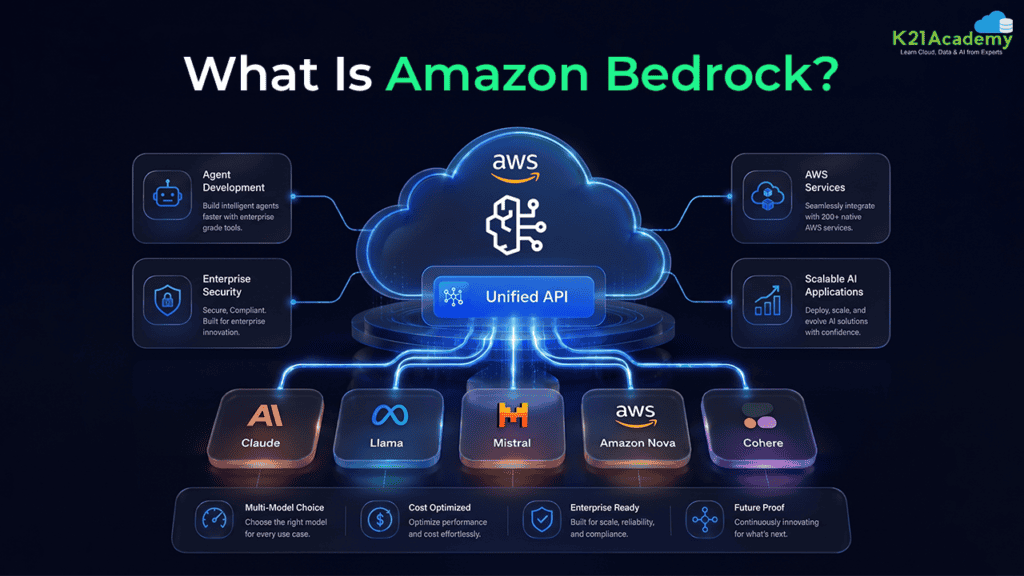
Amazon Bedrock is AWS’s managed Generative AI platform that provides access to multiple foundation models through a unified API.
Unlike Azure OpenAI, Bedrock is model-agnostic.
Developers can choose from:
- Claude models
- Llama models
- Mistral models
- Amazon Nova
- Cohere models
without changing cloud providers.
Key Strengths
- Multi-model ecosystem
- Strong AWS integration
- Agent development capabilities
- Enterprise security
- Flexible pricing
Best For
- AWS-centric organizations
- Multi-model strategies
- Agentic AI applications
- Enterprise-scale deployments
Related Readings:- Claude Code Career Roadmap: Skills Developers and AI Engineers Need in 2026
What Is Azure OpenAI Service?
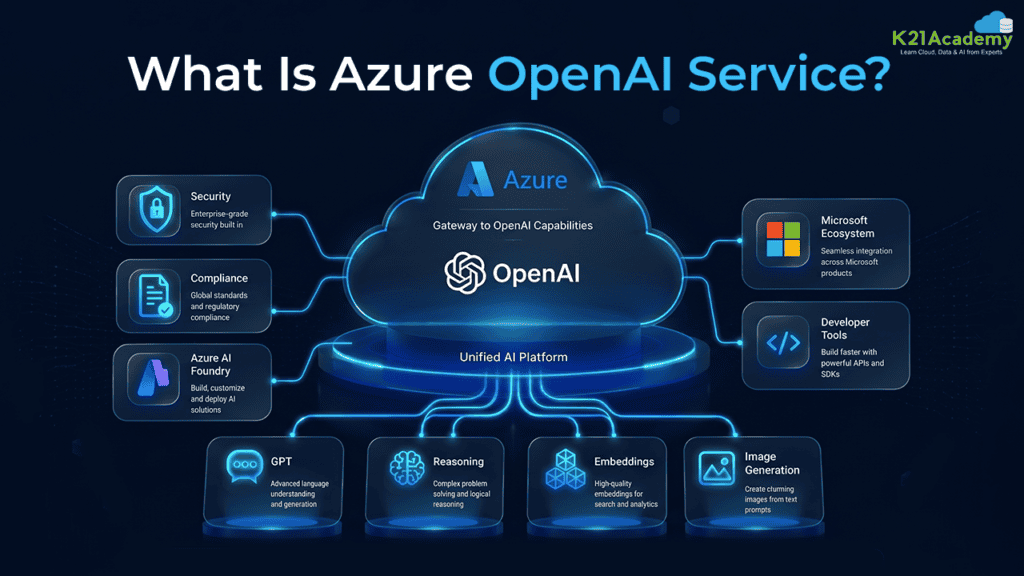
Azure OpenAI combines OpenAI’s models with Azure’s AI Services & enterprise infrastructure.
Organizations gain access to:
- GPT models
- Reasoning models
- Embedding models
- Image generation models
while maintaining Azure governance, compliance, and security.
Key Strengths
- Deep OpenAI integration
- Enterprise security
- Strong Microsoft ecosystem
- Azure AI Foundry integration
- Excellent developer experience
Best For
- Microsoft-focused organizations
- Enterprise copilots
- Internal AI assistants
- Productivity applications
Related Readings:- Claude Code for AI/ML Engineers: Should You Invest the Time? Honest 2026 Worth-It Breakdown
What Is Google Vertex AI?
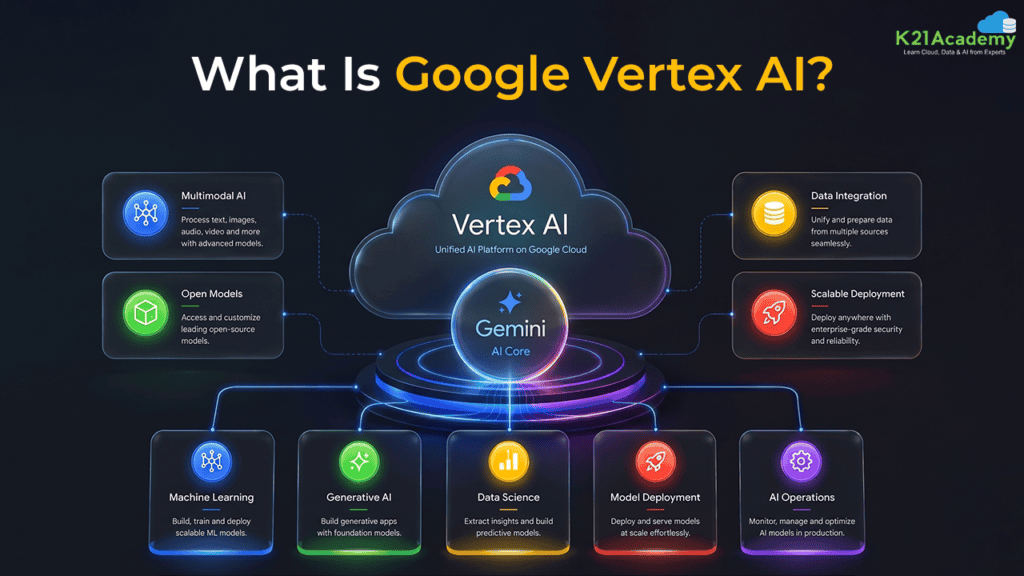
Vertex AI is Google’s unified AI platform that combines:
- Machine Learning
- Generative AI
- Data Science
- Model Deployment
- AI Operations
into a single environment.
Vertex AI provides access to Google’s Gemini models while supporting open-source and third-party models.
Key Strengths
- Strong machine learning ecosystem
- Gemini models
- Data science integration
- Excellent multimodal capabilities
Best For
- AI-first organizations
- Data-heavy workloads
- Advanced ML teams
- Multimodal AI applications
Related Readings: Top 10 Claude Code Use Cases Every Developer Should Know
Model Availability Comparison
| Feature | Amazon Bedrock | Azure OpenAI | Vertex AI |
| Claude Models | Yes | Limited/Region Dependent | No |
| GPT Models | No | Yes | No |
| Gemini Models | No | No | Yes |
| Llama Models | Yes | Yes | Yes |
| Mistral Models | Yes | Limited | Yes |
| Cohere Models | Yes | Limited | Limited |
| Multiple Model Vendors | Excellent | Moderate | Good |
Winner: Amazon Bedrock
Bedrock offers the broadest selection of foundation models from multiple providers.
This flexibility allows AI Engineers and Solution Architects to choose the best model for each workload.
AI Agent Development Comparison
The future of enterprise AI is shifting toward Agentic AI.
Let’s compare support for AI agents.
| Capability | Bedrock | Azure OpenAI | Vertex AI |
| Native Agents | Excellent | Good | Good |
| Tool Calling | Yes | Yes | Yes |
| Multi-Agent Workflows | Strong | Moderate | Moderate |
| MCP Integration | Growing | Growing | Growing |
| Agent Orchestration | Advanced | Moderate | Moderate |
Why Bedrock Leads
AWS has invested heavily in:
- Amazon Bedrock Agents
- Multi-step reasoning
- Tool integrations
- Enterprise workflows
making Bedrock particularly attractive for Agentic AI projects.
RAG Capabilities Comparison
RAG remains one of the most common enterprise AI architectures.
| Feature | Bedrock | Azure OpenAI | Vertex AI |
| Knowledge Bases | Native | Via Azure AI Search | Native |
| Vector Search | Strong | Excellent | Strong |
| Document Processing | Good | Excellent | Excellent |
| Enterprise Search | Good | Excellent | Good |
Winner: Azure OpenAI
The combination of:
- Azure AI Search
- Azure OpenAI
- Azure AI Foundry
creates one of the strongest enterprise RAG ecosystems available.
MLOps and LLMOps Comparison
| Capability | Bedrock | Azure OpenAI | Vertex AI |
| Experiment Tracking | Good | Good | Excellent |
| Model Registry | Moderate | Moderate | Excellent |
| Pipelines | Moderate | Good | Excellent |
| ML Lifecycle | Moderate | Good | Excellent |
Winner: Vertex AI
Google’s history in machine learning & llmops gives Vertex AI a significant advantage for organizations managing complex AI lifecycles.
Developer Experience Comparison
| Area | Bedrock | Azure OpenAI | Vertex AI |
| API Simplicity | Good | Excellent | Good |
| Documentation | Good | Excellent | Good |
| SDK Support | Strong | Strong | Strong |
| Learning Curve | Moderate | Easy | Moderate |
Winner: Azure OpenAI
Developers familiar with OpenAI APIs can begin building almost immediately.
Related Readings:- How to Use Claude AI in Your CI/CD Pipeline
Pricing Philosophy Comparison
Pricing changes frequently, but the overall philosophy remains relatively consistent.
Amazon Bedrock
- Pay per token
- Pay per model
- On-demand pricing
- Provisioned throughput options
Ideal for organizations wanting flexibility.
Azure OpenAI
- Token-based pricing
- Reserved capacity options
- Enterprise agreements
Ideal for predictable enterprise workloads.
Vertex AI
- Model-dependent pricing
- Additional ML infrastructure costs
- Flexible scaling
Ideal for AI-native organizations.
Related Readings:- Comparing the Best AI Chatbots for Your Business: What’s Best for You?
Amazon Bedrock vs Azure OpenAI vs Google Vertex AI for AI Engineers
Choose Amazon Bedrock If:
You want:
- Claude models
- Multi-model flexibility
- Agentic AI development
- Deep AWS integration
- MCP-enabled workflows
Excellent for AI Engineers building AI agents and enterprise automation.
Choose Azure OpenAI If:
You want:
- GPT models
- Microsoft ecosystem integration
- Enterprise copilots
- Internal knowledge assistants
- Strong RAG capabilities
Excellent for enterprise AI implementations.
Choose Vertex AI If:
You want:
- Gemini models
- Advanced machine learning
- Multimodal AI agents
- Large-scale data science workflows
Excellent for ML Engineers and AI research teams.
Which Platform Is Best for Solution Architects?
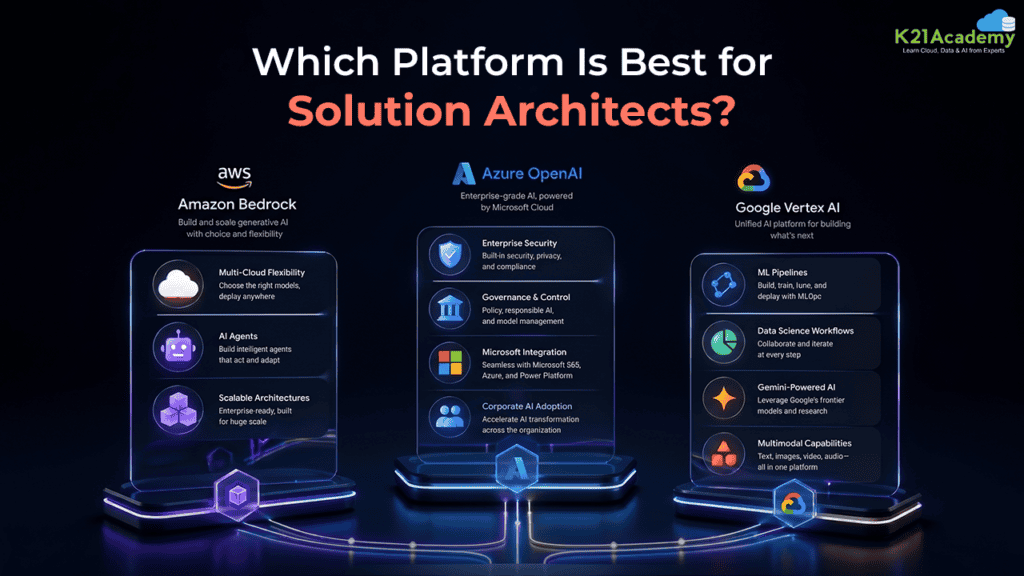
Bedrock
Best for:
- Multi-cloud flexibility
- Agentic AI
- Future-proof architectures
Azure OpenAI
Best for:
- Enterprise governance
- Microsoft environments
- Corporate AI adoption
Vertex AI
Best for:
- Data-intensive architectures
- Advanced AI ecosystems
- Research-focused organizations
Related Readings:- 7 System Design Patterns Every Cloud AI Engineer Should know
Skills That Matter Regardless of Platform
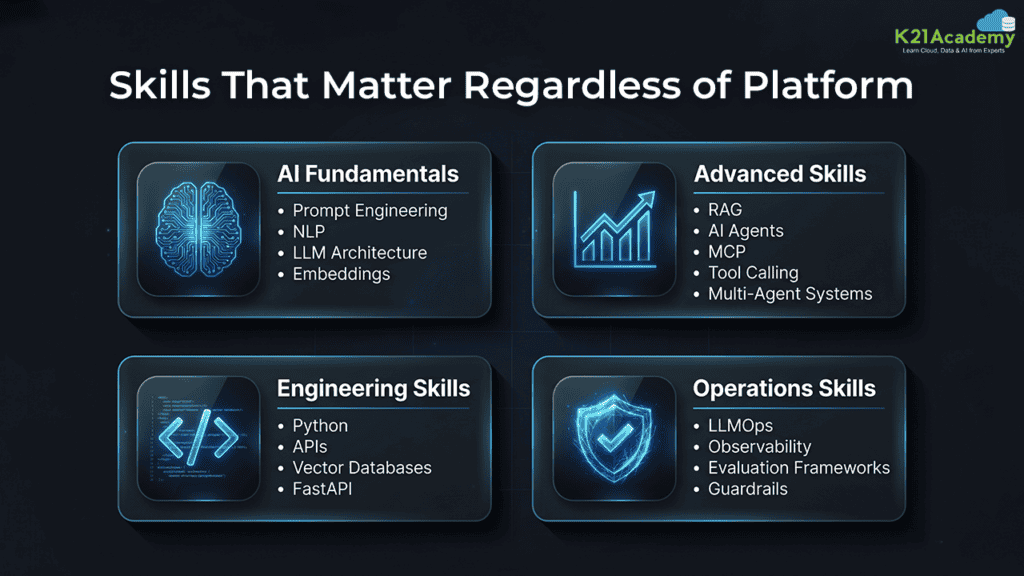
Certifications Worth Pursuing
AWS Professionals
Azure Professionals
Google Professionals
- Google Cloud Professional Machine Learning Engineer
- Vertex AI Specializations
Final Verdict
There is no universal winner.
The best platform depends on your goals.
Amazon Bedrock is currently the strongest choice for organizations building Agentic AI applications, AI agents, Claude-powered workflows, and multi-model enterprise solutions.
Azure OpenAI remains the leading platform for enterprise GPT deployments, Microsoft ecosystem integration, and large-scale RAG implementations.
Google Vertex AI excels in machine learning, multimodal AI, Gemini adoption, and advanced AI research workloads.
For most AI Engineers and Solution Architects in 2026, the most valuable strategy is not choosing one platform.
It is understanding all three.
The organizations hiring the highest-paid AI talent increasingly expect professionals who can design solutions across AWS, Azure, and Google Cloud while leveraging LLMs, RAG, MCP, AI Agents, LLMOps, and modern cloud-native architectures.