



AI Is No Longer Just About Chatbots. Can You Build Production AI Systems?
Thousands of professionals have learned how to use ChatGPT, Claude, Gemini, and Copilot.
But here’s the problem.
Most people know how to use AI.
Very few know how to build AI solutions that run in production.
Companies are no longer hiring professionals who can simply write prompts.
They’re hiring developers and engineers who can build scalable AI applications, deploy AI workloads on Azure, implement Retrieval-Augmented Generation (RAG), manage vector databases, secure AI systems, and integrate AI into enterprise applications.
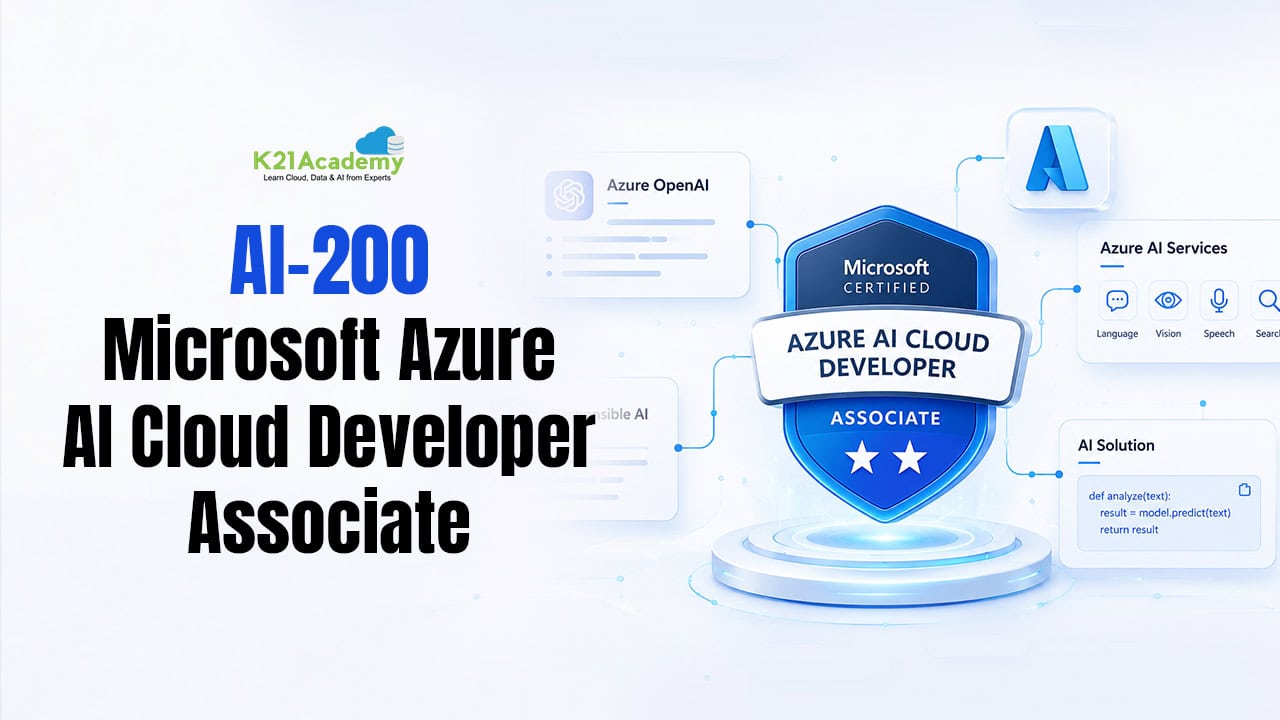
This is exactly why Microsoft introduced the AI-200: Microsoft Azure AI Cloud Developer Associate certification.
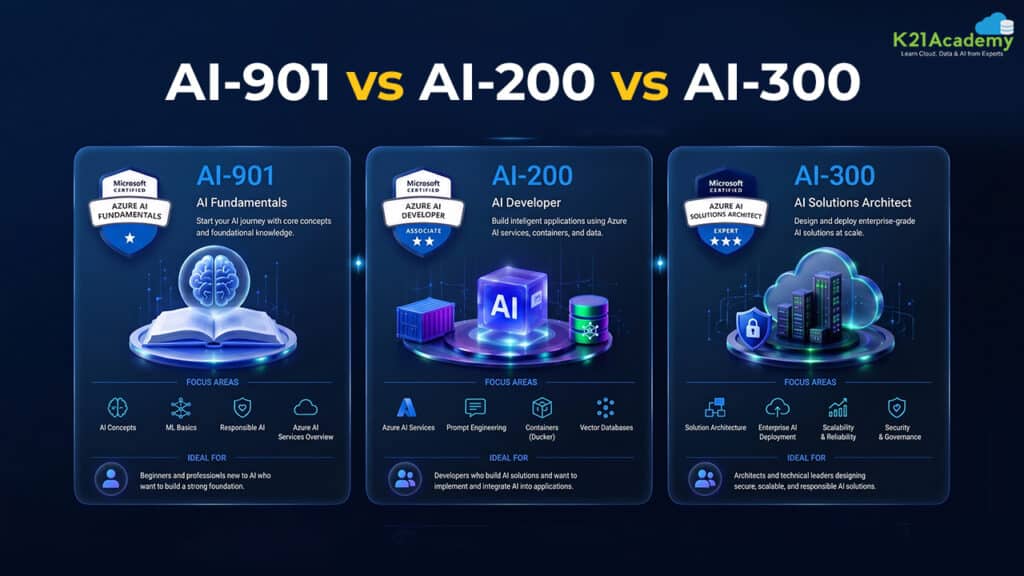
Unlike AI-901, which focuses on AI fundamentals, AI-200 is designed for developers who want to build, deploy, secure, monitor, and scale AI applications on Microsoft Azure.
If you want to become an AI Engineer, Cloud AI Developer, Solution Architect, or Agentic AI Developer, AI-200 could be one of the most valuable Azure certifications in 2026.

What is the AI-200: Microsoft Azure AI Cloud Developer Associate Certification?
The AI-200 certification validates your ability to design, build, deploy, monitor, and secure AI solutions on Microsoft Azure.
It focuses heavily on:
- AI application development
- Azure cloud services
- Containerized AI workloads
- Vector databases
- Retrieval-Augmented Generation (RAG)
- Azure Cosmos DB
- Azure Database for PostgreSQL
- Azure Kubernetes Service (AKS)
- Azure Container Apps
- Azure Functions
- Azure Service Bus
- Azure Event Grid
- Azure Managed Redis
- Azure Key Vault
- OpenTelemetry monitoring
Unlike AI-901, this certification is highly practical and developer-focused.
It validates that you can build real-world AI applications capable of serving thousands of users.
AI-200 Exam Overview
Certification Name: Microsoft Certified: Azure AI Cloud Developer Associate
Exam Code: AI-200
Level: Intermediate
Role: Developer
Duration: 120 Minutes
Passing Score: 700/1000
Language: English
Platform: Microsoft Azure
Focus Area: Building and managing AI cloud solutions
Who Should Take the AI-200 Exam?
AI-200 is designed for professionals who want to move beyond AI fundamentals and start building production-grade AI systems.
It is particularly valuable for:
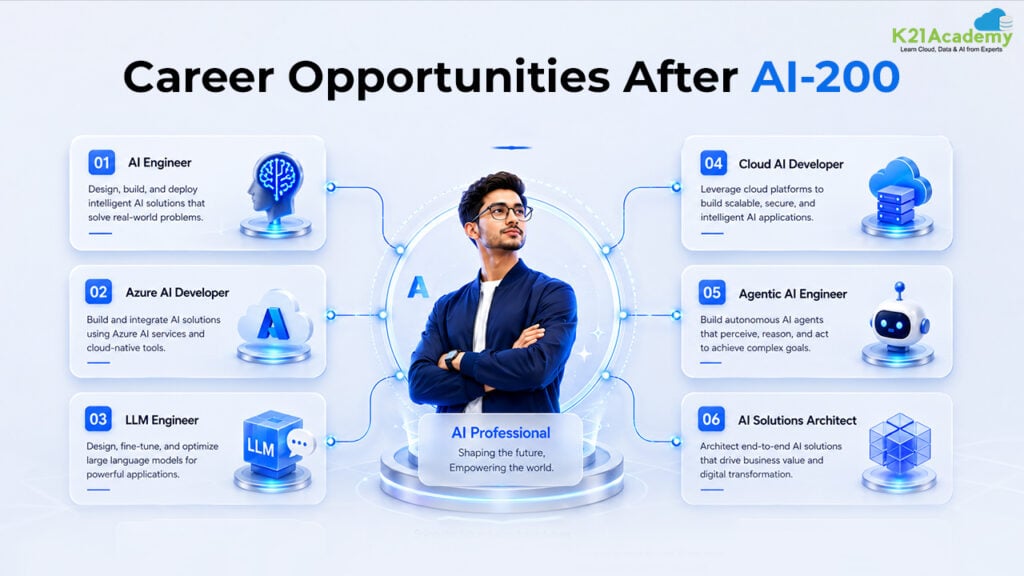
- AI Engineers
- Cloud Developers
- Python Developers
- Azure Developers
- Solution Architects
- Full Stack Developers
- Backend Developers
- Generative AI Engineers
- LLM Engineers
- Agentic AI Developers
If you’re already experimenting with ChatGPT, Claude Code, Azure AI Foundry, LangChain, or AI agents, AI-200 is a logical next step.
Prerequisites
Microsoft doesn’t require any mandatory certification before AI-200.
However, having the following knowledge will help significantly:
Recommended Skills
- Basic Azure knowledge
- Python programming
- REST APIs
- Cloud computing concepts
- AI fundamentals
- Generative AI basics
- RAG concepts
- Containers and Docker
- Vector databases
Many learners start with:
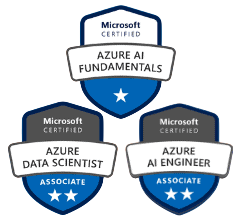
AI-901 → AI-200 → AI-300
which creates a strong Azure AI learning path.
Key Skills Measured in AI-200: Microsoft Azure AI Cloud Developer Associate Certification
The AI-200 certification focuses on four major skill domains.
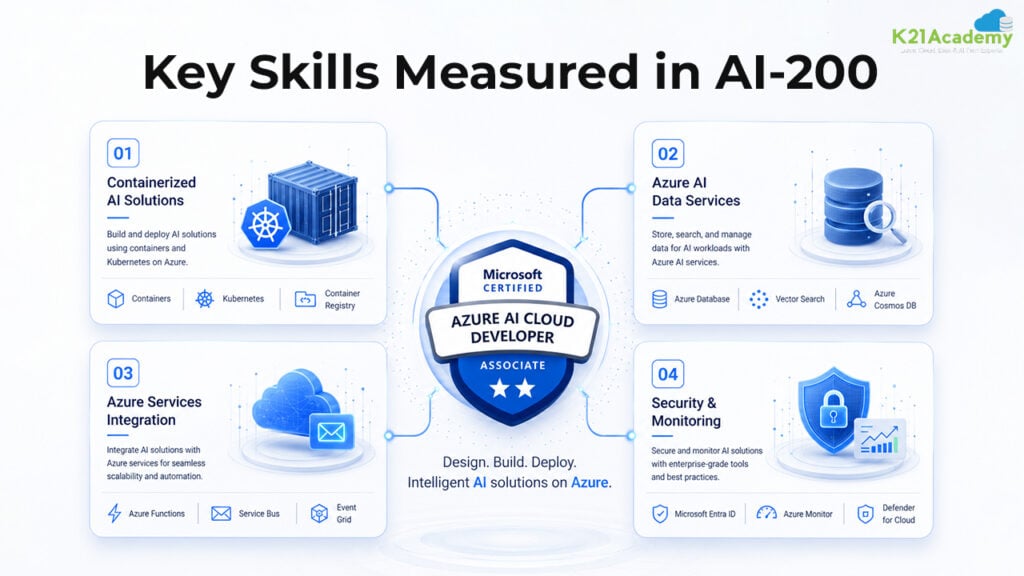
1. Develop Containerized Solutions on Azure (20–25%)
Modern AI applications rarely run on a single virtual machine.
Instead, they run in containers orchestrated across cloud environments.
Topics include:
- Azure Container Registry (ACR)
- Container image management
- Azure Container Apps
- Kubernetes Event-Driven Autoscaling (KEDA)
- Azure Kubernetes Service (AKS)
- Environment variables and secrets
- Application deployment
- Monitoring container workloads
- Troubleshooting AI applications
These skills are essential for deploying AI agents, LLM applications, and scalable APIs.
Related Readings:- Claude Code Career Roadmap: Skills Developers and AI Engineers Need in 2026
2. Develop AI Solutions Using Azure Data Management Services (25–30%)
This is one of the most important sections of the exam.
Modern AI systems rely heavily on vector databases and semantic search.
Topics include:
Azure Cosmos DB
- SDK integration
- Query optimization
- Consistency levels
- Indexing policies
- Change feed processing
- Vector similarity search
- Embedding storage
Azure Database for PostgreSQL
- pgvector
- Semantic search
- RAG implementations
- Metadata filtering
- Performance optimization
Azure Managed Redis
- Caching
- Vector indexing
- Similarity search
- Low-latency AI retrieval
This section directly supports AI Engineer and LLM Engineer roles.
Related Readings:- Claude Code for AI/ML Engineers: Should You Invest the Time? Honest 2026 Worth-It Breakdown
3. Connect to and Consume Azure Services (20–25%)
AI applications don’t operate in isolation.
They must communicate with multiple systems.
Topics include:
Azure Service Bus
- Topics
- Queues
- Dead-letter queues
- Messaging patterns
Azure Event Grid
- Event-driven architectures
- Custom events
- Event routing
- Retry policies
Azure Functions
- Serverless AI applications
- Triggers
- Bindings
- Function deployment
These technologies help developers build event-driven AI solutions and AI agent workflows.
Related Readings: Top 10 Claude Code Use Cases Every Developer Should Know
4. Secure, Monitor, and Troubleshoot Azure Solutions (20–25%)
Production AI systems require enterprise-grade security and monitoring.
Topics include:
Azure Key Vault
- Secret management
- Key rotation
- Secure access
Azure App Configuration
- Centralized configuration
- Feature management
OpenTelemetry
- Distributed tracing
- Monitoring AI systems
- Observability
Kusto Query Language (KQL)
- Log analysis
- Performance monitoring
- Troubleshooting
These skills are becoming increasingly important as organizations adopt Agentic AI and autonomous systems.
Related Readings:- How to Use Claude AI in Your CI/CD Pipeline
Why AI-200 Matters in 2026 ?
The AI job market is evolving rapidly.
Three years ago, companies primarily sought:
- Data Scientists
- Machine Learning Engineers
Today, companies are actively hiring:
- AI Engineers
- Generative AI Developers
- Agentic AI Developers
- LLM Engineers
- AI Solution Architects
These roles require more than understanding AI concepts.
They require building production-ready AI applications.
AI-200 validates exactly those skills.
Related Readings:- Comparing the Best AI Chatbots for Your Business: What’s Best for You?
AI-200 and Generative AI
One reason AI-200 is attracting attention is its relevance to Generative AI.
Many of the skills covered are directly applicable to:
- ChatGPT applications
- Azure OpenAI Service
- AI Foundry
- Claude integrations
- RAG systems
- AI agents
- MCP-enabled applications
- Enterprise copilots
The certification aligns closely with how organizations are deploying AI today.
Career Opportunities After AI-200
Average Salary After AI-200 Certification
While certification alone doesn’t guarantee salary increases, it validates skills that are in high demand.
India
- ₹8 LPA – ₹30 LPA+
United States
- $100,000 – $180,000+
Europe
- €60,000 – €130,000+
Remote AI Roles
- $90,000 – $200,000+
Professionals who combine AI-200 with Python, Azure AI Foundry, RAG, AI Agents, Claude Code, and LLMOps often command even higher salaries.
AI-200 vs AI-901 vs AI-300
Skills You Gain with AI-200
Preparing for AI-200 helps you develop expertise in:
- Azure Container Apps
- Azure Kubernetes Service (AKS)
- Azure Cosmos DB
- PostgreSQL Vector Search
- Azure Managed Redis
- Azure Service Bus
- Azure Event Grid
- Azure Functions
- Azure Key Vault
- OpenTelemetry
- KQL
- Python Programming
- RAG Architecture
- Vector Databases
- Generative AI Applications
- AI Agent Infrastructure
These are among the most in-demand skills in today’s AI market.
Your Azure AI Certification Path
A recommended roadmap for most professionals is:
Step 1
Learn AI basics and Azure AI services.
Step 2
AI-200: Azure AI Cloud Developer Associate
Build AI applications and cloud-native AI solutions.
Step 3
Design and deploy enterprise-scale AI systems.
Step 4
Specialize in:
- Agentic AI
- Claude Code
- RAG
- Azure AI Foundry
- LLMOps
- AI Architecture
- MCP
This progression prepares you for high-paying AI engineering and architecture roles.
How to Prepare for AI-200
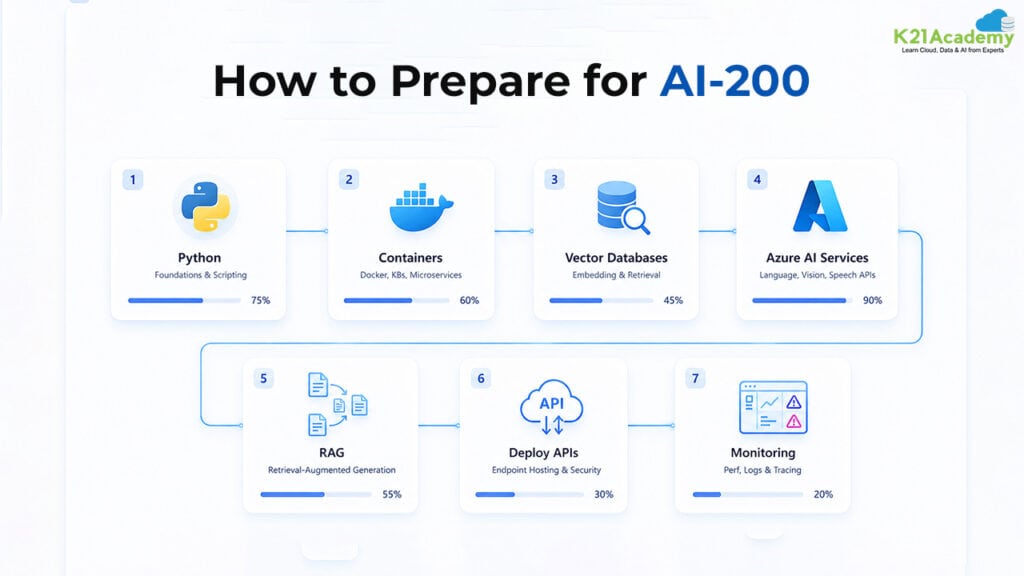
Microsoft recommends hands-on experience with:
- Azure Container Apps
- AKS
- Azure Cosmos DB
- PostgreSQL
- Redis
- Azure Functions
- Service Bus
- Event Grid
- Key Vault
- OpenTelemetry
The more hands-on practice you get, the easier the exam becomes.
Related Readings:- 7 System Design Patterns Every Cloud AI Engineer Should know
Final Thoughts
The AI industry is moving beyond experimentation.
Organizations are now deploying AI systems into production environments where scalability, security, monitoring, observability, and reliability matter.
The AI-200: Microsoft Azure AI Cloud Developer Associate certification is Microsoft’s answer to this shift.
It bridges the gap between AI concepts and real-world implementation.
If AI-901 teaches you what AI is, AI-200 teaches you how to build AI systems that businesses can actually use.
For developers, cloud engineers, AI engineers, and aspiring solution architects, AI-200 is one of the most relevant Azure certifications available in 2026.
The future belongs to professionals who can build AI Agents or AI applications, not just use it.
And AI-200 is designed to help you become one of them.
Frequently Asked Questions
Q1. Is AI-200 harder than AI-901?
Yes. AI-901 focuses on AI fundamentals, while AI-200 is a developer-level certification requiring hands-on experience with Azure services, containers, databases, and AI application development.
Q2. Do I need coding experience for AI-200?
Yes. Microsoft recommends proficiency in Python programming, Azure SDKs, APIs, and cloud development concepts.
Q3. Is AI-200 useful for AI Engineers?
Absolutely. The certification covers many technologies used by modern AI Engineers, including vector databases, RAG architectures, containerized deployments, and Azure AI services.
Q4. Can AI-200 help me become an AI Solution Architect?
AI-200 is an excellent stepping stone. Many professionals complete AI-200 before moving toward AI-300 and advanced architecture-focused certifications.
Q5. Should I learn Claude Code and AI Agents alongside AI-200?
Yes. While not directly covered in the exam, Claude Code, AI Agents, MCP, RAG, and LLMOps are becoming essential skills for modern AI Engineers and Solution Architects.