




Generative AI is transitioning quickly from an experimental stage to the realm of business. As companies integrate AI assistants agents retrieval-augmented generation (RAG), and AI-enabled developer workflows, practitioners require more than general AI expertise; they require an arsenal of live operational skills to effectively utilize, construct, and design Claude-based solutions.
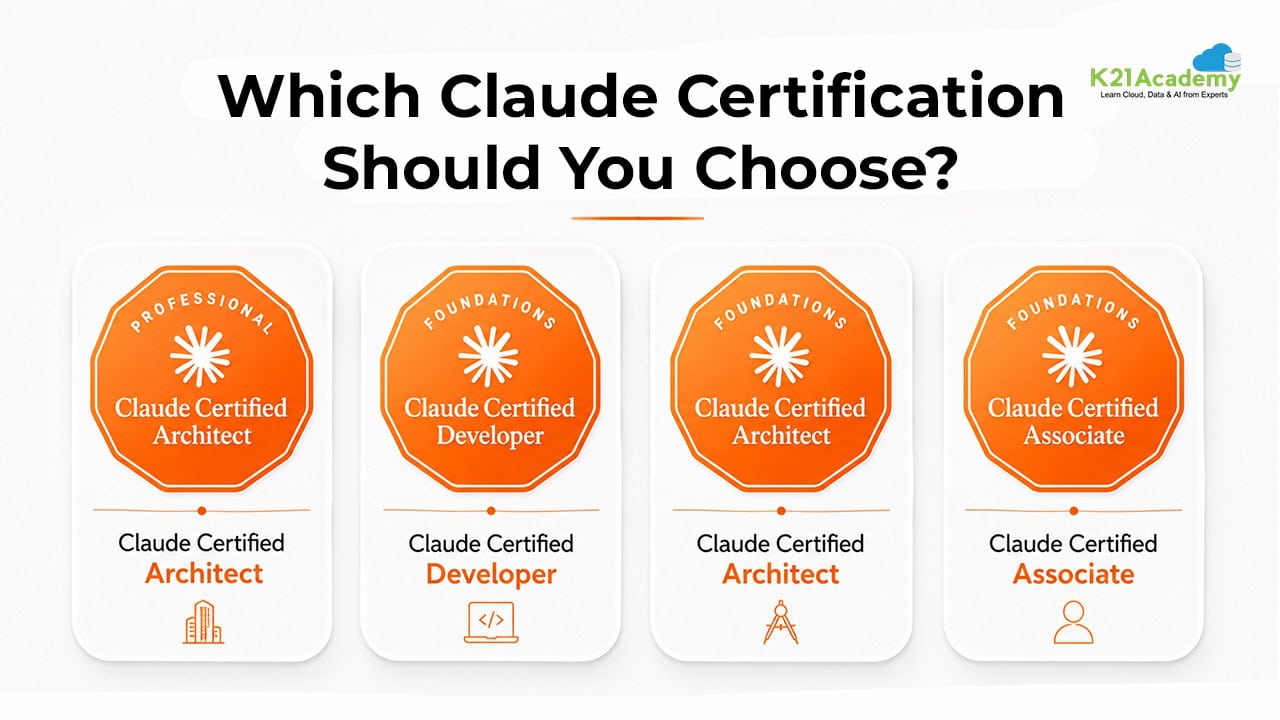
The Claude Certification Program from anthropic has introduced four certifications based on various levels of responsibility: Claude Certified Associate – Foundations, Claude Certified Developer – Foundations, Claude Certified Architect – Foundations, and Claude Certified Architect – Professional. These certifications extend from usage of Claude for hands-on work to production-ready AI architecture.
These certifications have a common 720 passing threshold, on a 100-1,000 scale, take 2 hours, and expire in 12 months. But they are markedly different in target audience, level of difficulty, exam content, and fee.
This guide will lead you through the entire Claude certification path, provide you with insights into the tangible benefits of each certification, and help you leverage these certifications to forge a lucrative career in Artificial Intelligence. Starting from your initial engagement with Claude AI to aspiring for the highest levels of mastery, this article is your compass to navigate through the certification landscape seamlessly.
What Are the Four Claude Certifications?
The four certifications can be viewed as a progression:
Associate → Developer → Architect Foundations → Architect Professional
In simple terms:
- Associate: Use Claude effectively
- Developer: Build applications with Claude
- Architect Foundations: Design Claude-powered systems
- Architect Professional: Architect and govern production-grade Claude solutions
The official program lists four certifications: Associate at $99, Developer – Foundations at $125, Architect – Foundations at $125, and Architect – Professional at $175.
Related Readings:- Claude Code vs GitHub Copilot vs Cursor: Which AI Coding Assistant Should You Learn?
Claude Certifications at a Glance
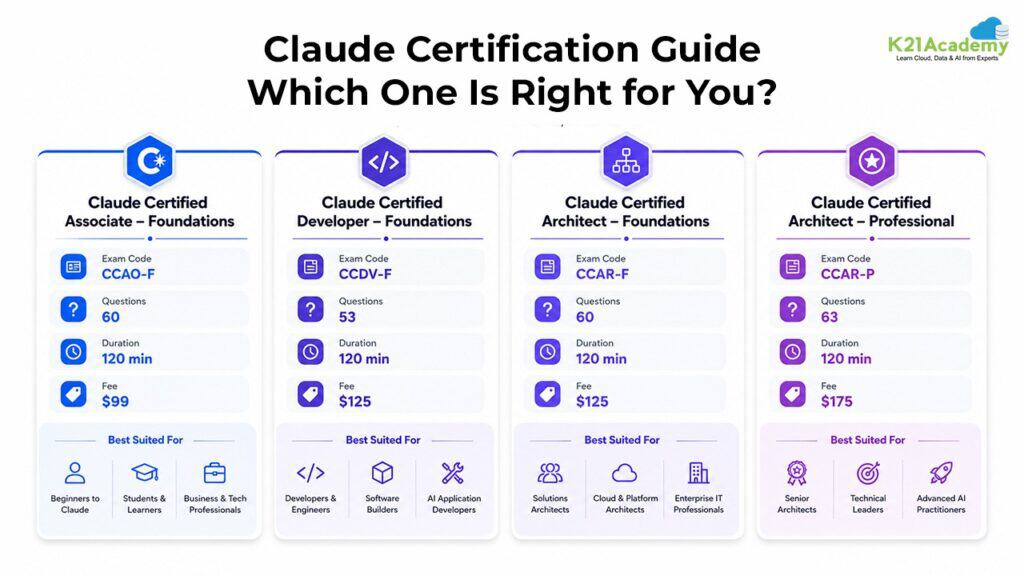 All four exams use multiple-choice and multiple-response questions, with the number of responses to select specified in each question. The passing score is 720/1,000, and credentials are valid for 12 months.
1. Claude Certified Associate – Foundations
The Claude Certified Associate – Foundations certification is the most accessible of the four. It focuses on using Claude effectively in professional workflows rather than developing Claude-powered applications.
It does not require software development or API experience. Recommended experience includes regular hands-on use of Claude, structured problem-solving, workflow design, and an understanding of AI limitations such as hallucinations, context constraints, and data sensitivity.
Exam Domains
| Domain | Weight |
|---|---|
| Prompting and Task Execution | 14% |
| Output Evaluation and Validation | 21% |
| Product and Model Selection | 12% |
| Workflow Integration and Solution Design | 16% |
| Configuration and Knowledge Management | 12% |
| Governance, Risk, and Responsible Use | 15% |
| Troubleshooting and Optimization | 10% |
The largest domain is Output Evaluation and Validation, which covers evaluating Claude responses, identifying hallucinations and inconsistencies, fact-checking, and determining when human review is necessary.
Who Should Choose Associate?
Choose Claude Certified Associate – Foundations if you are:
- A business analyst
- Project manager
- Consultant
- Marketing or communications professional
- HR or education professional
- Knowledge worker
- A professional who uses Claude but does not build AI applications
Best choice: Professionals who want to demonstrate practical Claude proficiency without needing software-development skills.
2. Claude Certified Developer – Foundations
The Claude Certified Developer – Foundations certification is designed for professionals who actually build applications and workflows using Claude.
It goes much deeper into APIs, development of ai agents, software engineering, tools, MCP, security, model selection, and application integration.
Exam Domains
| Domain | Weight |
|---|---|
| Agents and Workflows | 14.7% |
| Applications and Integration | 33.1% |
| Claude Code | 3.1% |
| Eval, Testing, and Debugging | 2.6% |
| Model Selection and Optimization | 16.8% |
| Prompt and Context Engineering | 11.0% |
| Security and Safety | 8.1% |
| Tools and MCPs | 10.6% |
The largest area is Applications and Integration at 33.1%. The guide covers Claude API mechanics, Messages API, streaming, vision, thinking, caching, batch API usage, REST APIs, JSON, asynchronous programming, software engineering, and Claude application design.
The exam also tests practical security and integration decisions, such as protecting systems from prompt injection and using MCP servers to expose reusable internal capabilities.
Who Should Choose Developer – Foundations?
Choose this certification if you are:
- Software developer
- AI engineer
- ML engineer
- Backend developer
- Application developer
- Claude API developer
- Developer building agents or MCP-based integrations
Best choice: If you want to build with Claude rather than simply use Claude, this is the most relevant starting point.
3. Claude Certified Architect – Foundations
The Claude Certified Architect – Foundations certification moves from application development toward system architecture.
Its focus is on designing Claude-powered agentic systems, orchestration, tools, MCP, Claude Code, prompt engineering, structured output, and context management.
Exam Domains
| Domain | Weight |
|---|---|
| Agentic Architecture & Orchestration | 27% |
| Tool Design & MCP Integration | 18% |
| Claude Code Configuration & Workflows | 20% |
| Prompt Engineering & Structured Output | 20% |
| Context Management & Reliability | 15% |
The exam uses scenario-based questions. Six scenarios are defined in the guide, with four selected for the actual exam. They include customer support agents, Claude Code, multi-agent systems, developer productivity, CI/CD, and structured data extraction.
Who Should Choose Architect – Foundations?
Choose this certification if you are:
- AI architect
- Solution architect
- Technical architect
- AI/ML engineer moving toward architecture
- Senior developer designing agentic systems
- Technical consultant working with Claude
Best choice: If your role involves deciding how Claude agents, tools, MCP servers, workflows, and context should work together, this is a strong fit.
4. Claude Certified Architect – Professional
The Claude Certified Architect – Professional certification is the highest-level certification among the four.
It is aimed at mid- to senior-level professionals who design, build, and deliver production-grade AI solutions using Claude.
The recommended candidate profile includes software engineering fundamentals, 3+ years of systems architecture or platform engineering experience, and 6+ months of hands-on experience with Claude or comparable LLM-based systems in production. These are recommended rather than mandatory prerequisites.
Exam Domains
| Domain | Weight |
|---|---|
| Solution Design & Architecture | 17% |
| Claude Models, Prompting & Context Engineering | 13% |
| Integration | 19% |
| Evaluation, Testing & Optimization | 16% |
| Governance, Safety & Risk Management | 14% |
| Stakeholder Communication & Lifecycle Management | 14% |
| Developer Productivity & Operational Enablement | 7% |
The largest domain is Integration (19%), followed by Solution Design & Architecture (17%) and Evaluation, Testing & Optimization (16%).
The certification covers production considerations including RAG, integration protocols, authentication and authorization, observability, evaluation metrics, testing, cost/latency optimization, governance, compliance, stakeholder communication, and lifecycle management.
Who Should Choose Architect – Professional?
Choose this certification if you are:
- Solution architect
- AI architect
- AI/ML engineer with production experience
- Senior software engineer
- Technical lead
- Enterprise AI consultant
- Platform engineer
Best choice: Professionals responsible for end-to-end production AI architecture and enterprise-scale Claude deployments.
Related Readings:- Is Claude Code Worth Learning for Cloud Engineers? Salary Impact, Time-to-ROI, and Best Resources
Which Claude Certification Should You Choose?
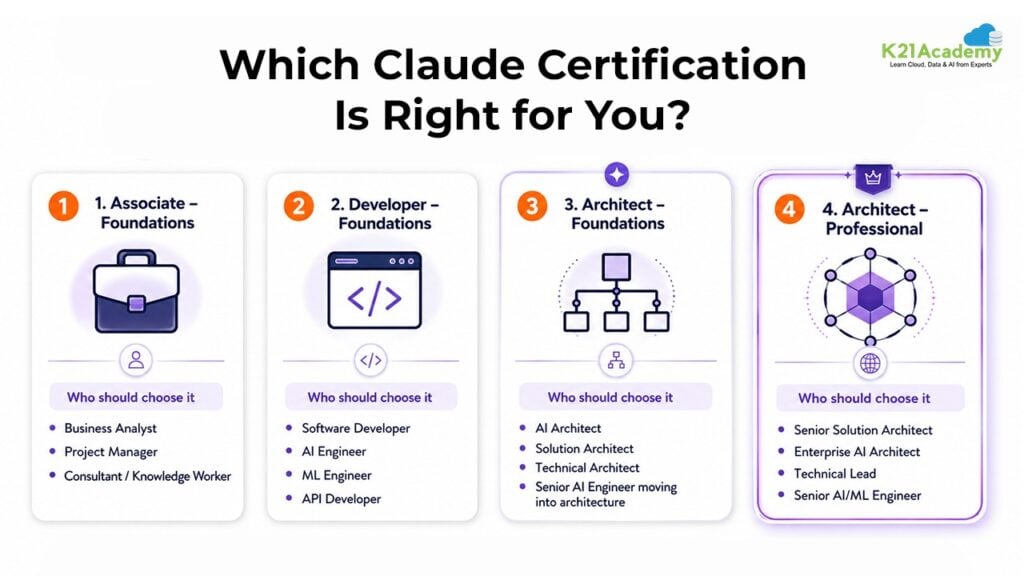
The important point is that you don’t necessarily have to complete all four. The certifications are separate credentials, and the program does not require Foundations to be automatically upgraded to Professional.
Related Readings: Top 10 Claude Code Use Cases Every Developer Should Know
Claude Certification Career and Salary Outlook
One important clarification is necessary here.
There is currently no reliable salary dataset showing that a person earns a specific amount simply because they hold one of these Claude certifications. The certifications are new, so salary outcomes specifically attributable to each credential are not yet established.
Therefore, it is more accurate to discuss the salary potential of the roles associated with each certification rather than claim “this certification guarantees X salary.”
Related Readings:- Claude Code for AI/ML Engineers: Should You Invest the Time? Honest 2026 Worth-It Breakdown
AI Architect/Engineer Salary Benchmark
Current 2026 market data provides a useful reference point.
In the United States, Indeed reports an average AI Architect/Engineer base salary of about $150,874 per year, with reported salaries ranging from approximately $89,373 to $254,696.
In India, Indeed reports an average AI Architect/Engineer salary of approximately ₹2.63 lakh per month, while Glassdoor’s July 2026 data reports an average of approximately ₹35 lakh per year, with a typical range of roughly ₹20.75 lakh–₹47.75 lakh.
In Canada, Indeed reports an average AI Architect/Engineer salary of approximately CAD $113,933 per year.
Indicative Salary by Career Level
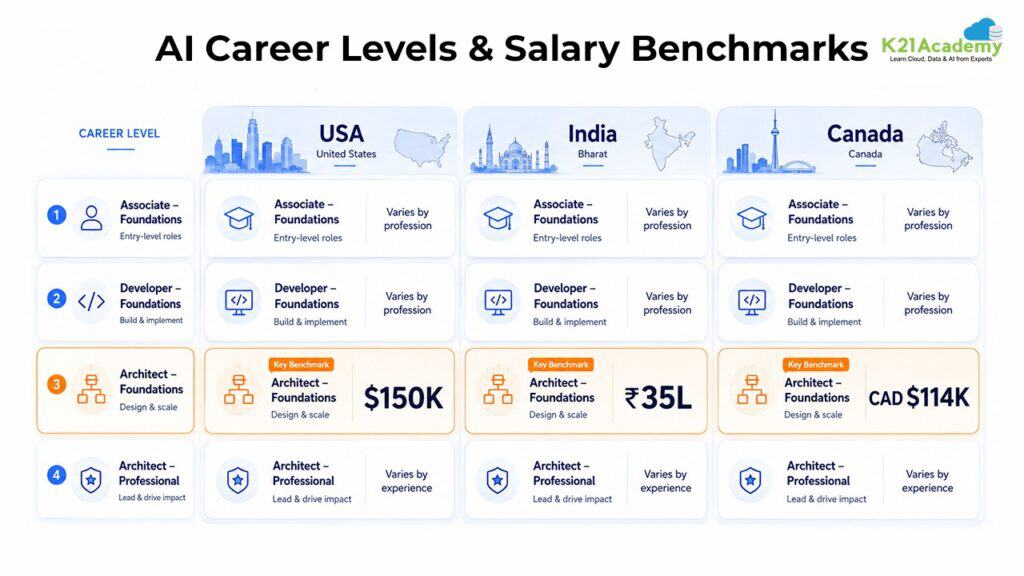 The figures are role-market benchmarks, not certification-specific salaries. Experience, location, company, technical depth, industry, and production experience can have a much larger effect on compensation than the certification itself.
Related Readings:- Claude Code Career Roadmap: Skills Developers and AI Engineers Need in 2026
Does a Claude Certification Increase Your Salary?
A certification can strengthen your professional profile, but certification alone should not be viewed as a guaranteed salary increase.
The strongest combination is:
Certification + Hands-on Claude Experience + AI Projects + Software Engineering + Cloud/Infrastructure Knowledge
For example, a Developer certification becomes more valuable when you can demonstrate that you have actually built a Claude application using APIs, agents, tools, or MCP.
Similarly, an Architect certification becomes more meaningful when you can demonstrate that you have designed and operated a production AI system involving architecture, RAG, evaluation, observability, security, and governance.
Related Readings:- How to Use Claude AI in Your CI/CD Pipeline
Claude Certification Career Path
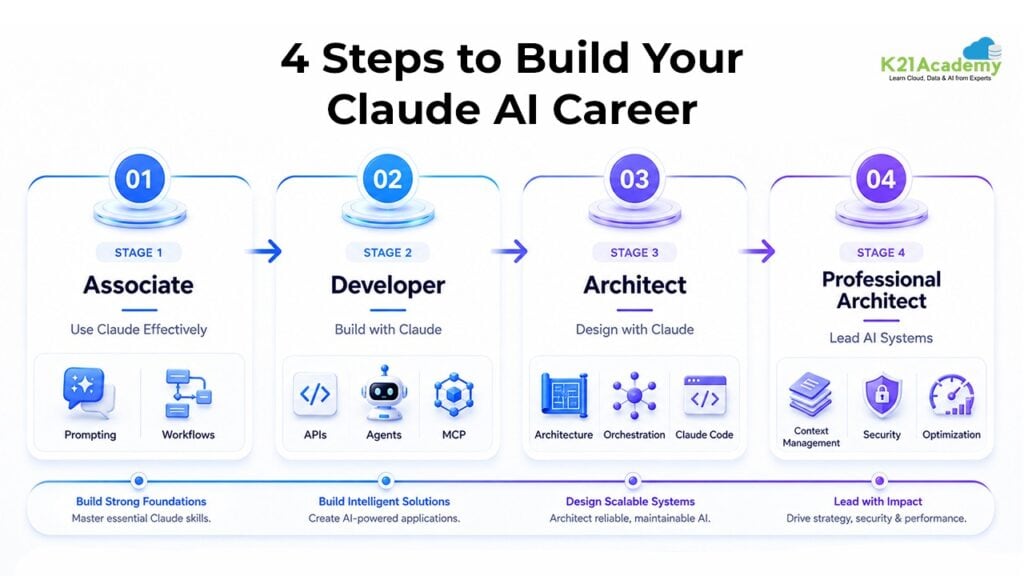
A practical progression could look like this:
Step 1: Start with Associate
If you’re a business professional or knowledge worker, begin with:
Claude Certified Associate – Foundations
Build confidence with prompting, evaluating outputs, workflows, configuration, and responsible AI use.
Step 2: Move into Development
If you want to build AI applications:
Claude Certified Developer – Foundations
Focus on APIs, applications, agents, integrations, tools, MCP, security, and optimization.
Step 3: Move into Architecture
If you’re designing agentic Claude systems:
Claude Certified Architect – Foundations
Focus on agentic architecture, orchestration, MCP, Claude Code, structured output, and context management.
Step 4: Move into Professional Architecture
For senior practitioners:
Claude Certified Architect – Professional
Focus on production architecture, integration, RAG, evaluation, optimization, governance, security, stakeholders, and lifecycle management.
Final Thoughts
The four Claude certifications are designed for different stages of AI and Agentic AI adoption and levels of technical responsibility.
If you primarily use Claude to improve your professional workflows, consider Claude Certified Associate – Foundations.
If you build applications and integrations with Claude, Claude Certified Developer – Foundations is the more appropriate choice.
If you design Claude-powered ai agents and systems, consider Claude Certified Architect – Foundations.
And if you already work at a senior architecture level and are responsible for production-grade, enterprise Claude solutions, Claude Certified Architect – Professional is the most advanced fit.
The best certification is therefore not necessarily the most advanced one. It is the one that matches what you actually do, or the role you are preparing to take next.
Use Claude → Build with Claude → Design with Claude → Architect Claude at enterprise scale.
Next Step: Level Up with Claude Code
Ready to go beyond basics?
Join our Claude Code free class to learn how to build, debug, and optimise code using Claude Code with real examples and expert guidance. Take this opportunity to learn from industry experts and advance your AI career.