






Machine learning is transforming every major industry in 2026, from healthcare and finance to cybersecurity, manufacturing, and Generative AI, machine learning adoption has accelerated rapidly across industries. According to McKinsey’s 2025 State of AI report, 88% of organizations now use AI in at least one business function, highlighting how machine learning models have become a core part of modern enterprise operations. However, many AI projects still fail because organizations choose the wrong machine learning algorithms for their data, business goals, or infrastructure constraints.
Machine learning algorithms are the core engines behind modern AI systems, GenAI, Agentic AI. They help businesses automate decision-making, identify patterns in massive datasets, predict future outcomes, personalize customer experiences, detect fraud, optimize operations, and power intelligent applications like ChatGPT, recommendation engines, and autonomous systems.
Machine learning algorithms are mathematical models that learn patterns from data to make predictions or decisions automatically.
The four major categories of machine learning algorithms are:
- Supervised Learning
- Unsupervised Learning
- Reinforcement Learning
- Deep Learning
The best ML algorithm depends on:
- the type of data,
- business objective,
- accuracy requirements,
- interpretability needs,
- and compute budget.
By the end of this guide, you will:
- Understand the most important machine learning algorithms used in 2026
- Learn real-world machine learning use cases across industries
- Compare ML algorithms based on accuracy, complexity, and scalability
- Discover how machine learning integrates with LLMs and Generative AI

What Are Machine Learning Algorithms? (Types & Main Purpose)
A machine learning algorithm is a mathematical method that learns patterns from data and uses those patterns to make predictions or decisions without being explicitly programmed.
Unlike traditional software systems that rely on fixed rules, machine learning models improve automatically as they process more data over time.
The main purpose of machine learning algorithms is to:
- Automate pattern recognition
- Predict future outcomes
- Classify data into categories
- Detect anomalies and fraud
- Extract trends from data
- Personalize user experiences
Machine learning algorithms are now widely used in:
- fraud detection,
- recommendation systems,
- healthcare diagnostics,
- predictive analytics,
- autonomous vehicles,
- cybersecurity,
- and Generative AI systems.
Related Readings:- Claude Code for AI/ML Engineers: Should You Invest the Time? Honest 2026 Worth-It Breakdown
Types of Machine Learning Algorithms
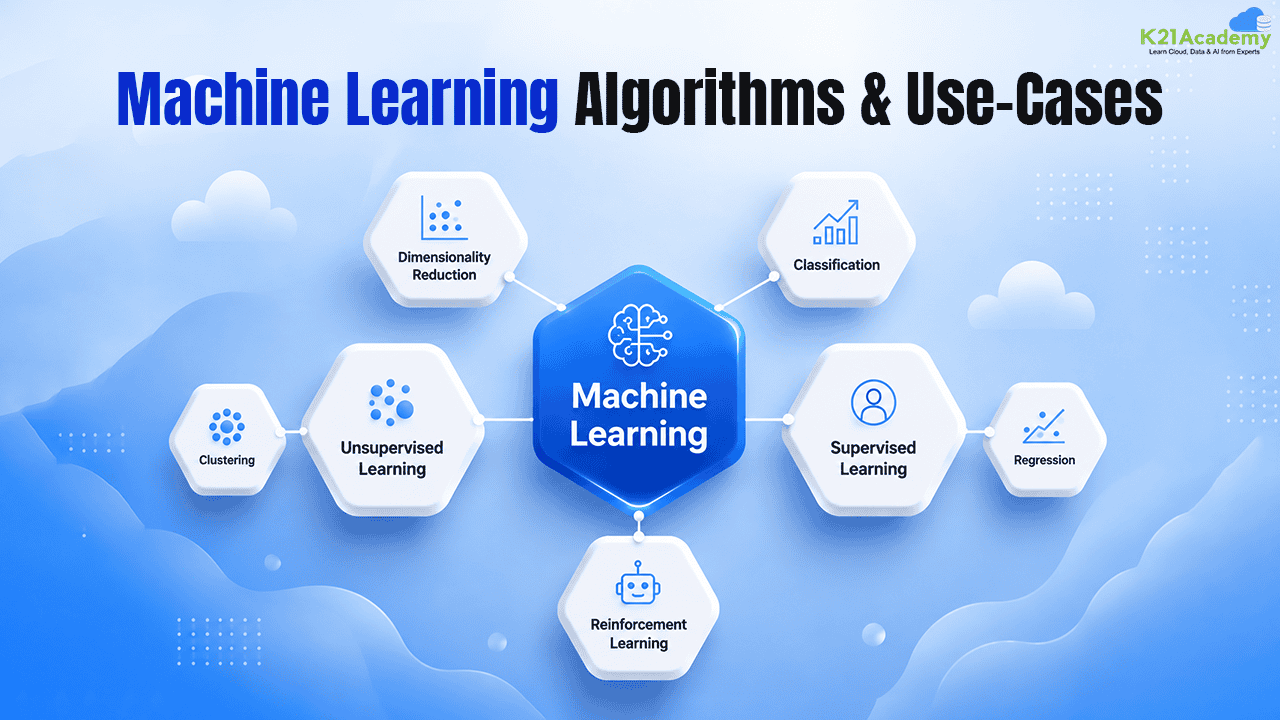
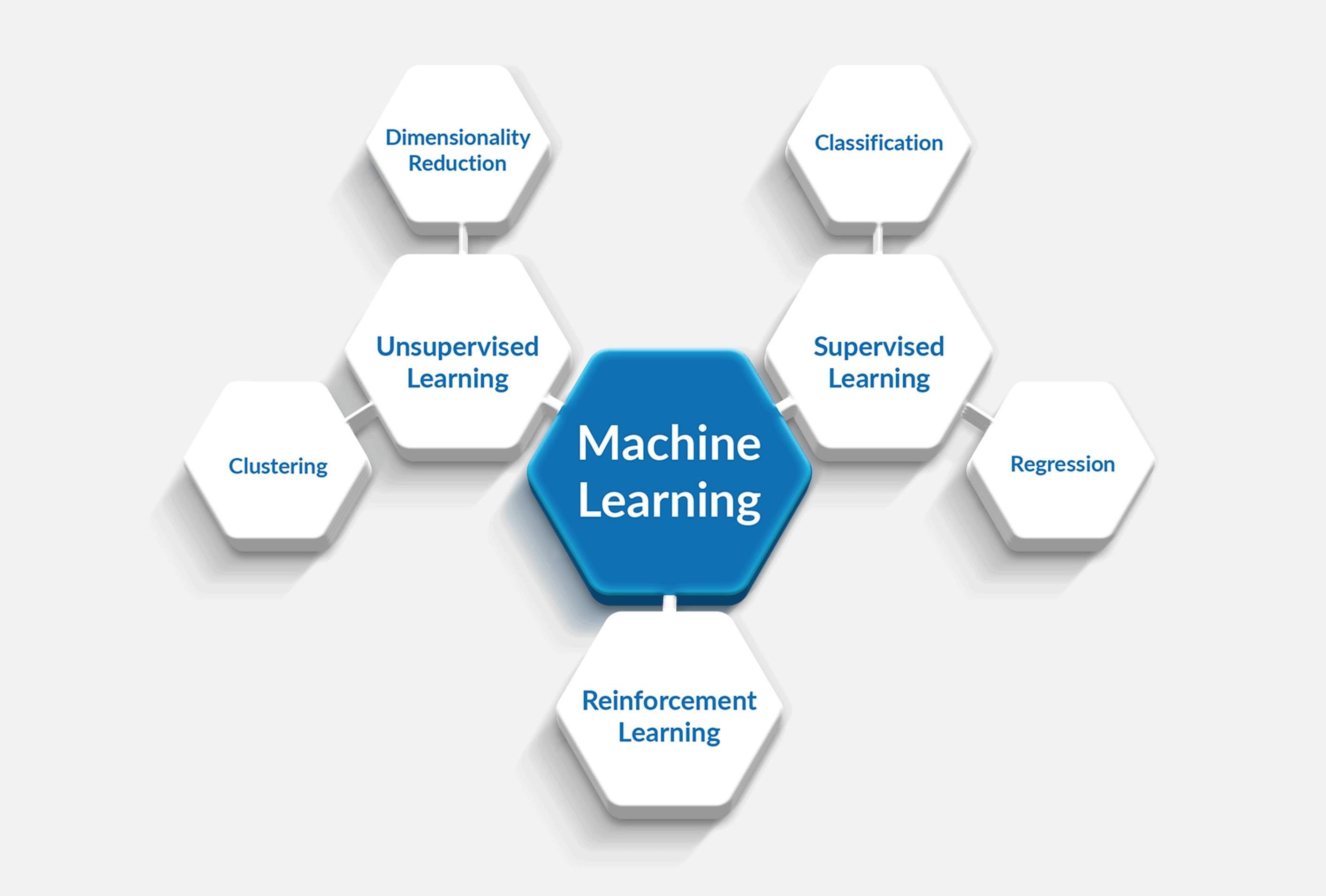
Machine learning algorithms are generally divided into four categories:
| Type | Description | Examples |
|---|---|---|
| Supervised Learning | Learns using labeled datasets | Linear Regression, Random Forest |
| Unsupervised Learning | Finds hidden patterns in unlabeled data | K-Means, PCA |
| Reinforcement Learning | Learns through rewards and penalties | Q-Learning, DQN |
| Deep Learning | Uses multi-layer neural networks | CNNs, Transformers |
Complete List of ML Algorithms in 2026
Machine learning algorithms continue to evolve rapidly in 2026. Modern AI systems combine classical ML models, deep learning architectures, reinforcement learning, and foundation models to solve increasingly complex problems.
Below are the most important ML algorithms used today.
Supervised Learning Algorithms
Supervised learning algorithms train using labeled data where the correct answer is already known. These algorithms are commonly used for prediction, classification, fraud detection, forecasting, and recommendation systems.
Popular Supervised Learning Algorithms
| Algorithm | Best For | Compute Cost |
|---|---|---|
| Linear Regression | Predicting continuous values | Low |
| Logistic Regression | Binary classification | Low |
| Decision Trees | Interpretable decision-making | Low |
| Random Forest | High-accuracy structured data | Medium |
| XGBoost | Enterprise-grade prediction | Medium |
| LightGBM | Large-scale datasets | Medium |
| Support Vector Machine (SVM) | Small-to-medium datasets | High |
| K-Nearest Neighbors (KNN) | Similarity-based classification | Medium |
| Naive Bayes | NLP and spam filtering | Low |
Common Use Cases
- Fraud detection
- Customer churn prediction
- Credit scoring
- Demand forecasting
- Email spam detection
Related Readings:- Claude Certified Architect Foundations
Image Classification
Image classification refers to the task of extracting data categories from a multiband formation image.
Classifies pictures with well-liked networks – Answers queries like: What will this image represent?
Image Classification |
|
|---|---|
| Algorithms | Why should we use |
| DenseNet | Because it has High accuracy and better efficiency. |
Regression
Regression may be a method utilized in finance, investing, and different disciplines that attempt to verify the strength and character of the link between one dependent variable (usually denoted by Y) and a series of other variables (known as independent variables).
Makes forecasts by estimating the relationship between values – Answers queries like, what quantity or however many?
Regression |
|
|---|---|
| Algorithms | Why should we use |
| Fast Forest Quantile Regression. | Predicts a distribution. |
| Poisson Regression. | Predicts event counts. |
| Linear Regression. | Fast training, linear model. |
| Bayesian Linear Regression | Linear model, small data sets. |
| Decision Forest Regression | Accurate, fast training times. |
| Neural Network Regression | Accurate, long training times. |
| Boosted Decision Tree Regression | Accurate, fast training times, large memory footprint. |
Two-Class Classification
It is a classification of two groups, i.e. classifies objects in at most two classes.
Answers simple two-choice questions, like yes or no, true or false – Answers questions like Is this A or B?
Two-Class Classification |
|
|---|---|
| Algorithms | Why should we use |
| Two-Class Support Vector Machine | Under 100 features, linear model. |
| Two-Class Averaged Perceptron | Fast training, linear model. |
| Two-Class Decision Forest | Accurate, fast training. |
| Two-Class Logistic Regression | Fast training, linear model. |
| Two-Class Boosted Decision Tree | Accurate, fast training, large memory footprint. |
| Two-Class Neural Network | Accurate, long training times. |
Multiclass Classification
There will be any range of categories in it, i.e., classify the item into quite 2 categories.
Answers complicated queries with multiple attainable answers – Answers queries like: Is that this A or B or C or D?
Multiclass Classification |
|
|---|---|
| Algorithms | Why should we use |
| Multiclass Logistic Regression | Fast training times, linear model. |
| Multiclass Neural Network | Accuracy, long training times. |
| Multiclass Decision Forest | Accuracy, fast training times. |
| One-vs-All Multiclass | Depends on the two-class classifier. |
| Multiclass Boosted Decision Tree | Non-parametric, fast training times, and scalable. |
Anomaly Detection
Anomaly detection is named the identification of things or events that don’t adjust to an expected pattern or different items gift in an exceeding dataset.
Identifies and predicts rare or uncommon information points – Answers the question: is that this weird?
Anomaly Detection |
|
|---|---|
| Algorithms | Why should we use |
| One Class SVM | Under 100 features, aggressive boundary. |
| PCA-Based Anomaly Detection | Fast training times. |
Related Readings: Best Data Science Interview Questions.
Unsupervised Learning
Unsupervised learning algorithms work with unlabeled data and identify hidden patterns, trends, or relationships automatically.
Popular Unsupervised Learning Algorithms
| Algorithm | Best For | Compute Cost |
|---|---|---|
| K-Means | Customer segmentation | Low |
| DBSCAN | Density-based clustering | Medium |
| Hierarchical Clustering | Relationship discovery | Medium |
| PCA | Dimensionality reduction | Low |
| Autoencoders | Anomaly detection | High |
Common Use Cases
- Customer segmentation
- Market basket analysis
- Trend discovery
- Data compression
- Anomaly detection
Related Readings: Claude Code vs GitHub Copilot vs Cursor: Which AI Coding Assistant Should You Learn?
Clustering
Clustering is the task of dividing the population or data points into a spread of groups such data points among identical groups are like completely different data points among identical clusters than those in numerous groups. In simple words, the aim is to segregate groups with similar traits and assign them into clusters.
Separates similar data points into intuitive teams – Answers queries like: however, is that this organized?
Clustering |
|
|---|---|
| Algorithms | Why should we use |
| K-Means | Unsupervised learning. |
Recommenders
Recommender systems are systems that are designed to suggest things to the user supported by many alternative factors. These systems predict the foremost doubtless product that the users are presumably to buy and are of interest to.
Predicts what somebody will be curious about – Answers the question: what’s going to they have an interest in?
Recommenders |
|
|---|---|
| Algorithms | Why should we use |
| SVD Recommender | Collaborative filtering, better performance with lower cost by reducing the dimensionality. |
Related Readings:- DevOps for Data Science.
Reinforcement Learning Algorithms
Reinforcement learning algorithms learn through rewards and penalties. These algorithms are widely used in robotics, gaming, autonomous systems, and AI agents.
Popular Reinforcement Learning Algorithms
| Algorithm | Best For | Compute Cost |
|---|---|---|
| Q-Learning | Decision optimization | Medium |
| Deep Q-Network (DQN) | Autonomous agents | High |
| Policy Gradient | Dynamic environments | High |
| Actor-Critic Models | Continuous action spaces | High |
Common Use Cases
- Self-driving cars
- Robotics
- AI game agents
- Dynamic pricing systems
- Smart resource allocation
Deep Learning Algorithms
Deep learning algorithms are a subset of machine learning that use multi-layer neural networks to process large and complex datasets.
Deep learning excels in image recognition, speech processing, natural language processing, and Generative AI.
Popular Deep Learning Algorithms
| Algorithm | Best For | Compute Cost |
|---|---|---|
| CNN (Convolutional Neural Networks) | Image recognition | High |
| RNN (Recurrent Neural Networks) | Sequential data | High |
| LSTM | Time-series forecasting | High |
| Transformers | NLP and LLMs | Very High |
| BERT | Search and language understanding | Very High |
| GPT Models | Generative AI applications | Extremely High |
Common Use Cases
- ChatGPT like applications
- Speech recognition
- Computer vision
- Language translation
- Autonomous systems
Real-World ML Use Cases by Industry
Machine learning use cases are expanding rapidly across industries as businesses adopt AI-powered systems for automation, prediction, and intelligent decision-making.
Financial Services
Machine learning algorithms are heavily used in banking and financial services.
Common ML Use Cases
- Fraud detection
- Credit scoring
- Anti-money laundering (AML)
- Algorithmic trading
- Risk analysis
Fraud detection systems often combine supervised learning algorithms like XGBoost with anomaly detection models to identify suspicious transactions in real time.
Industry Example
PayPal uses ensemble machine learning models to analyze billions of transactions annually and detect fraud within milliseconds.
Related Readings: Top 10 Claude Code Use Cases Every Developer Should Know
Healthcare
Healthcare organizations use machine learning for diagnostics, prediction, and personalized treatment planning.
Common ML Use Cases
- Medical imaging
- Disease prediction
- Drug discovery
- Patient readmission prediction
- Genomics analysis
CNN-based deep learning models are widely used in radiology for cancer detection and medical image analysis.
Industry Example
Hospitals use predictive analytics models to identify high-risk patients and reduce emergency readmission rates.
Retail & E-Commerce
Retail companies use ML algorithms to improve customer experience and optimize supply chains.
Common ML Use Cases
- Recommendation engines
- Dynamic pricing
- Inventory forecasting
- Customer segmentation
- Churn prediction
Recommendation systems often use matrix factorization combined with deep learning models.
Industry Example
Netflix uses recommendation algorithms powered by collaborative filtering and deep learning to personalize content for millions of users.
Related Readings: The Best Chatbot Development Tools
Manufacturing
Manufacturing industries use machine learning to improve operational efficiency and reduce downtime.
Common ML Use Cases
- Predictive maintenance
- Quality inspection
- Supply chain optimization
- Equipment failure prediction
- Demand forecasting
Anomaly detection algorithms help manufacturers identify defective products before shipment.
Technology & SaaS
Technology companies rely heavily on AI and ML algorithms.
Common ML Use Cases
- Spam filtering
- Search ranking
- AI assistants
- Content moderation
- Customer lifetime value prediction
Transformer-based models such as BERT are now commonly used in modern search engines and conversational AI systems.
Related Readings: Comparing the Best AI Chatbots for Your Business: What’s Best for You?
2026 ML Algorithms Comparison Table (Accuracy, Compute Cost, When to Use)
Choosing the right machine learning algorithm depends on data size, business goals, interpretability needs, and infrastructure constraints.
| Algorithm | Best For | Accuracy | Training Cost | Interpretability |
|---|---|---|---|---|
| Linear Regression | Forecasting | Medium | Low | High |
| Logistic Regression | Classification | Medium | Low | High |
| Decision Trees | Rule-based prediction | Medium | Low | High |
| Random Forest | Structured data | High | Medium | Medium |
| XGBoost | Enterprise prediction | Very High | Medium | Medium |
| SVM | Small datasets | High | High | Low |
| K-Means | Clustering | Medium | Low | Medium |
| CNN | Image recognition | Very High | High | Low |
| LSTM | Time-series forecasting | High | High | Low |
| Transformers | NLP & LLMs | Extremely High | Very High | Very Low |
Which ML Algorithm Should You Use?
Use Logistic Regression or Decision Trees when:
- interpretability matters,
- datasets are small,
- and training speed is important.
Use XGBoost or Random Forest when:
- working with structured business data,
- and accuracy is the top priority.
Use CNNs or Vision Transformers when:
- solving image classification problems.
Use Transformers or BERT when:
- working with NLP and Generative AI applications.
Use K-Means or DBSCAN when:
- working with unlabeled data and clustering problems.
Use ARIMA, Prophet, or LSTMs when:
- extracting trends from time-series data.
Related Readings:- 7 System Design Patterns Every Cloud AI Engineer Should know
How to Choose the Right ML Algorithm: A Decision Framework
Selecting the right machine learning algorithm requires balancing business goals, data quality, scalability, and infrastructure limitations.
Step 1: Define the Problem Type
Determine whether the problem involves:
- Classification
- Regression
- Clustering
- Recommendation
- Forecasting
- Anomaly detection
Step 2: Understand Your Data
Ask the following questions:
- Is the data labeled or unlabeled?
- Is the data structured or unstructured?
- How large is the dataset?
- Is the data balanced?
Related Readings:- Claude Code vs ChatGPT Plus
Step 3: Define Constraints
Important considerations include:
- latency requirements,
- compute budget,
- explainability,
- scalability,
- and deployment complexity.
Step 4: Shortlist Candidate Algorithms
Choose 2-3 algorithms based on:
- dataset size,
- problem complexity,
- and business requirements.
Step 5: Benchmark and Optimize
Train multiple models and compare:
- accuracy,
- inference speed,
- compute cost,
- and real-world performance.
The simplest algorithm that meets the business goal is often the best choice.
Related Readings: Generative AI vs Agentic AI: Key Differences
ML + GenAI: How Traditional Algorithms Integrate with LLMs, RAG & Foundation Models
Generative AI has not replaced traditional machine learning. Instead, modern AI systems combine LLMs, embeddings, retrieval systems, and classical ML algorithms into hybrid AI architectures.
In 2026, ML algorithms are deeply integrated into:
- Retrieval-Augmented Generation (RAG)
- AI agents
- vector databases
- recommendation systems
- and autonomous workflows.
How ML Integrates with LLMs
Embeddings
Transformer models convert text into vector embeddings for semantic search.
Vector Search
Machine learning powers similarity matching inside vector databases.
Re-ranking Models
Learning-to-rank algorithms improve search result relevance.
Tool-Calling AI Agents
LLMs now orchestrate specialized ML models as external tools.
Predictive Analytics
Traditional ML models still outperform LLMs on many structured business prediction tasks.
Modern AI applications now combine:
- deep learning,
- recommendation systems,
- vector retrieval,
- and predictive analytics models.
Related Readings: MLOps, AIOps and different -Ops frameworks
Common Mistakes & Anti-Patterns in ML Algorithm Selection
1. Using Deep Learning for Small Structured Data
Deep learning is not always the best option. For structured tabular datasets, XGBoost often outperforms neural networks with lower cost.
2. Ignoring Data Quality
Poor-quality data leads to poor model performance regardless of algorithm sophistication.
3. Overfitting Training Data
Models that memorize training data perform poorly in production environments.
4. Ignoring Inference Cost
Highly accurate models may become impractical if prediction latency is too high.
5. Ignoring Explainability
Industries like healthcare and finance often require interpretable ML models for compliance reasons.
6. Using LLMs for Simple Tasks
A lightweight classifier may solve a problem at 1/1000th the cost of a large language model.
7. Ignoring Data Drift
Machine learning models degrade over time as real-world data changes.
Related Readings:- How to Build Your Own AI Bot in 2026: A Complete Guide
ML Career Path: How to Master These Algorithms in 2026
Machine learning remains one of the highest-paying and fastest-growing technology fields.
Stage 1 (0–3 Months)
Learn:
- Python
- NumPy
- Pandas
- scikit-learn
- Linear Regression
- Decision Trees
- Random Forests
Practice using Kaggle datasets.
Stage 2 (3–6 Months)
Learn:
- PyTorch
- TensorFlow
- CNNs
- Transformers
- NLP
- Deep Learning
Build real-world AI projects.
Stage 3 (6–12 Months)
Learn:
- MLOps
- Azure Machine Learning
- AWS SageMaker
- Model deployment
- CI/CD for AI systems
- Vector databases
- LLMOps
Recommended certifications:
- Azure Data Scientist Associate
- AWS Certified Machine Learning Engineer
- Azure AI Engineer Associate
Join K21 Academy’s AI/ML training programs for hands-on labs, cloud projects, and certification preparation.
Related Readings:- The Future of AI Agents
Machine Learning Algorithms List
In machine learning, various algorithms are used to handle diverse data and solve different problems. Some popular algorithms include Linear Regression, which models relationships between variables; Logistic Regression for binary classification tasks; and Decision Trees, which create branches for each decision path. Random Forests, a collection of decision trees, improve accuracy by reducing overfitting. Support Vector Machines (SVM) are effective for classification by finding the best boundary between data points. K-Nearest Neighbors (KNN) relies on data proximity for predictions, while K-Means Clustering groups data into clusters. Finally, Neural Networks mimic human brain functions, excelling in tasks like image and speech recognition.
Related Readings:- Learn about conversational bot
Machine Learning Algorithms For Prediction
Machine learning algorithms for prediction empower data-driven insights by identifying patterns within large datasets. Common predictive algorithms include linear regression, which models relationships between variables for straightforward predictions, and decision trees, which split data into branches to make decisions based on specific criteria. Random forests combine multiple decision trees to improve accuracy, while support vector machines (SVMs) classify data by finding optimal boundaries between classes. Neural networks, especially deep learning models, excel at complex pattern recognition in unstructured data like images or text. By selecting the right algorithm, businesses can predict trends, customer behaviors, and potential outcomes, enhancing decision-making processes.
Frequently Asked Questions (FAQs)
What is the main purpose of machine learning algorithms?
The main purpose of machine learning algorithms is to automate pattern recognition, make predictions, classify data, detect anomalies, and extract insights from large datasets. ML algorithms help businesses automate decisions and improve efficiency without manually programming every rule.
What are the four main types of machine learning algorithms?
The four major types of machine learning algorithms are Supervised Learning, Unsupervised Learning, Reinforcement Learning, and Deep Learning. Each type solves different business and technical problems.
Which machine learning algorithms extract trends from data?
Time-series forecasting algorithms such as ARIMA, Prophet, LSTM, and Transformer-based forecasting models are commonly used to extract trends from data.
What are the most important machine learning algorithms to learn in 2026?
The most important machine learning algorithms to learn in 2026 include Linear Regression, Logistic Regression, Random Forest, XGBoost, K-Means, CNNs, Transformers, BERT, and GPT Models.
What is the difference between machine learning and deep learning?
Deep learning is a subset of machine learning that uses multi-layer neural networks. Traditional machine learning works best for structured data, while deep learning excels at unstructured data like images, video, and text.
How do I choose the right machine learning algorithm?
Choose the right machine learning algorithm based on the data type, business goal, interpretability, scalability, and compute requirements. Start with simple algorithms before moving to complex deep learning systems.
What are common machine learning use cases?
Common machine learning use cases include fraud detection, recommendation systems, predictive maintenance, medical diagnostics, customer segmentation, chatbots, and autonomous systems.
How are machine learning algorithms used in Generative AI?
Machine learning powers embeddings, vector search, recommendation systems, and ranking models used inside Generative AI and RAG applications.
How does linear regression work?
Linear regression models the relationship between two variables by fitting a line through data points. It predicts an output by calculating a best-fit line while minimizing prediction errors.
What is a random forest?
A random forest is an ensemble machine learning method that builds multiple decision trees and combines their outputs for improved accuracy and robustness, making it effective for classification and regression tasks.
How does a decision tree work?
A decision tree works by splitting data into branches based on features, creating if-then conditions. Each split aims to improve prediction accuracy, leading to final leaf nodes with outcomes.
What are support vector machines (SVM), and how do they work?
Support Vector Machines (SVM) are supervised machine learning models used for classification and regression. They work by finding a hyperplane that best separates data points from different classes, maximizing the margin between them for improved accuracy and robustness.
How do decision trees work in machine learning?
Decision trees in machine learning split data into branches based on feature values, creating a structure that resembles a tree. Each branch decision narrows down possibilities, improving predictive accuracy.
How does hierarchical clustering differ from K-means clustering?
Hierarchical clustering builds a hierarchy of clusters by successively merging or splitting them, whereas K-means assigns data into a set number of clusters based on centroids, requiring predefined clusters.
Conclusion
Machine learning algorithms now power nearly every modern digital experience from fraud detection and recommendation engines to Generative AI, predictive analytics, and autonomous systems.
In 2026, successful AI systems combine:
- traditional machine learning,
- deep learning,
- vector search,
- reinforcement learning,
- and foundation models.
Understanding how to choose the right machine learning algorithm is now a critical skill for AI engineers, cloud professionals, data scientists, and business leaders.
Whether you are building forecasting systems, AI agents, recommendation engines, or LLM-powered applications, mastering machine learning algorithms remains foundational to modern AI success.
Next Task: Enhance Your Azure AI/ML Skills