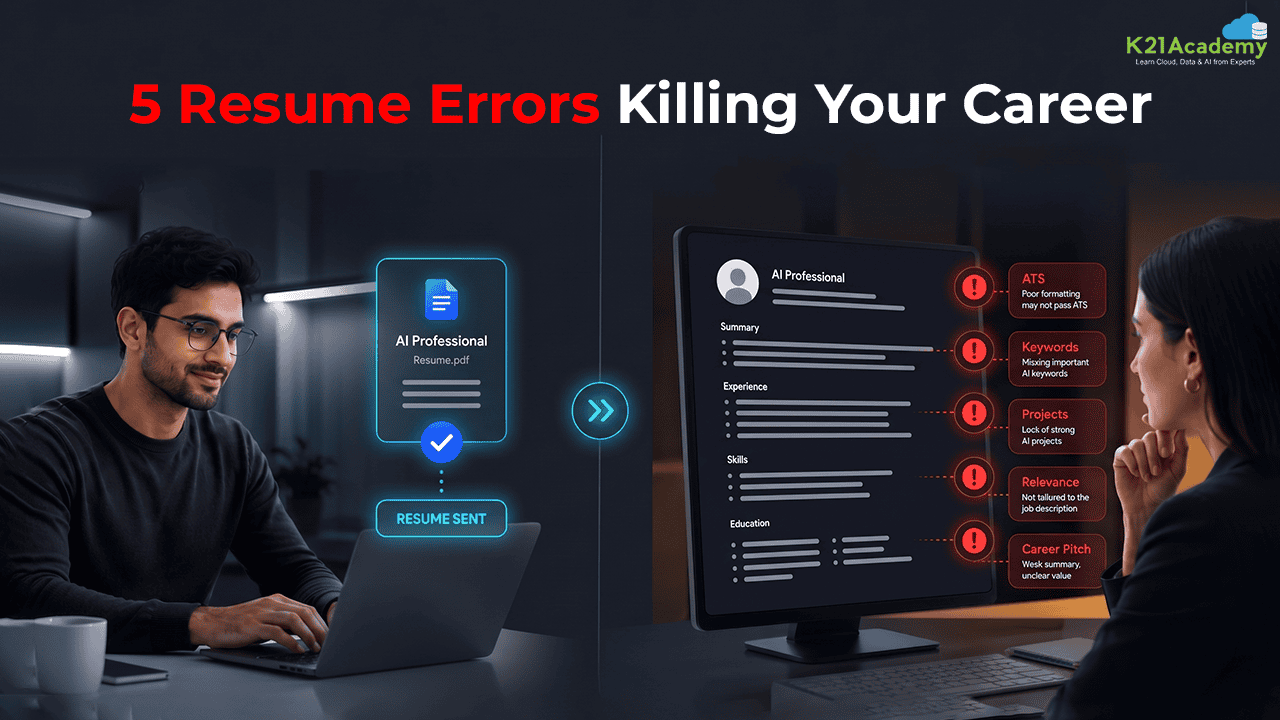



Struggling to Get Interview Calls for AI Roles? Your Resume Might Be the Problem
You have been applying. You have the certifications. You have gone through courses, built a few projects, and you know your way around Python, cloud platforms, and at least a handful of AI tools. But the callbacks are not coming.
This is one of the most common frustrations I hear from AI and machine learning professionals right now. The market for top AI jobs in 2026 is active. Companies are hiring for AI engineers, GenAI engineers, ML practitioners, cloud AI architects, and data science leads. High paying AI jobs across these specializations exist, and they are being filled. But many qualified professionals are being screened out before a single human hiring manager even reads their application.
Most of the time, the problem is not the experience. It is the resume.
A resume written the wrong way does two things that work against you. It fails the automated screening systems most companies use, and it fails to communicate your value clearly to the person reviewing it. Either outcome puts you out of the running before you get a chance to speak.
Here are 5 resume mistakes I see AI professionals make consistently, and exactly what to fix in each case:
Mistake 1: Listing Tools Instead of Outcomes
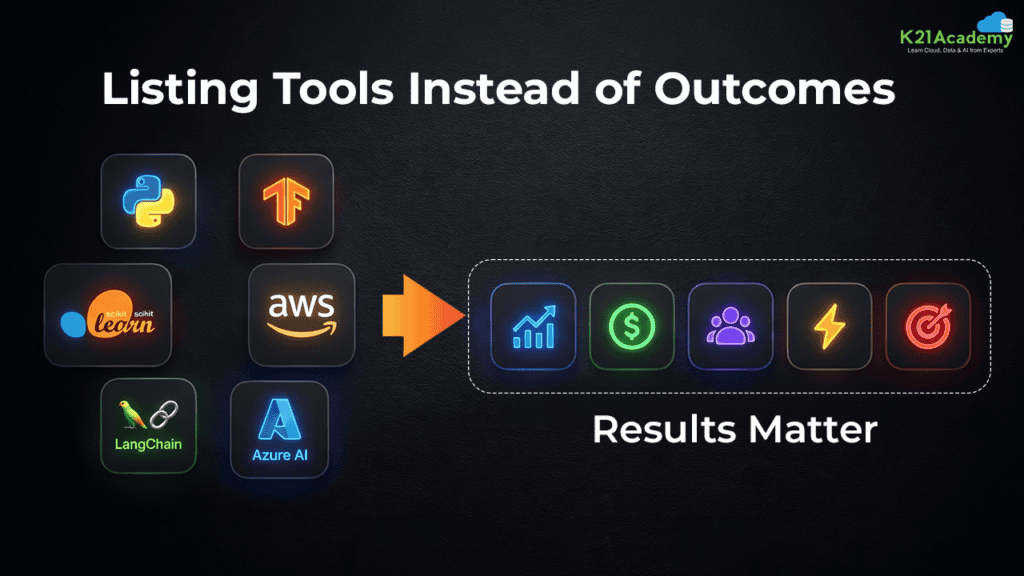
If your resume has bullet points that look like this:
- Used Python, TensorFlow, and Scikit-learn for machine learning projects
- Worked with AWS Bedrock and LangChain for GenAI development
- Experience with Azure AI Studio and OpenAI APIs
You are describing a toolkit. You are not making a case for why you should be hired.
From what I have seen in the industry, the professionals who consistently get called back for top paying AI jobs are not the ones with the longest tool lists. They are the ones who show what they did with those tools, and what the result was.
The fix is a simple structure for every bullet point: Action + Technology + Impact. What did you do, what did you use to do it, and what was the measurable result?
Compare these two versions of the same experience:
Weak: “Built machine learning models using XGBoost and Python.”
Strong: “Built a customer churn prediction model using XGBoost and Python that reduced attrition by 18% across 50,000 monthly active users, saving an estimated $2.3M in annual revenue.”
The second version tells a hiring manager exactly what problem you solved, how you solved it, and what it was worth. That is what gets a resume shortlisted.
If you do not have a clean metric for every project, use scale, scope, or qualitative outcome instead. “Reduced manual review time by roughly 40%”, “deployed to production serving 10,000 daily requests”, or “used by three cross-functional teams” are all meaningful context that a bare tool list cannot provide.
Related Readings:- Claude Code for AI/ML Engineers: Should You Invest the Time? Honest 2026 Worth-It Breakdown
Mistake 2: A Summary Section That Could Belong to Anyone
The top section of your resume, usually labeled “Summary” or “Professional Profile,” is the first thing a recruiter reads if they read anything at all. Most AI professionals write something like this:
“Experienced AI professional with a strong background in machine learning, deep learning, and data analysis. Passionate about solving complex problems with cutting-edge technology.”
That summary could describe hundreds of thousands of people. It tells a recruiter nothing specific and gives them no reason to keep reading.
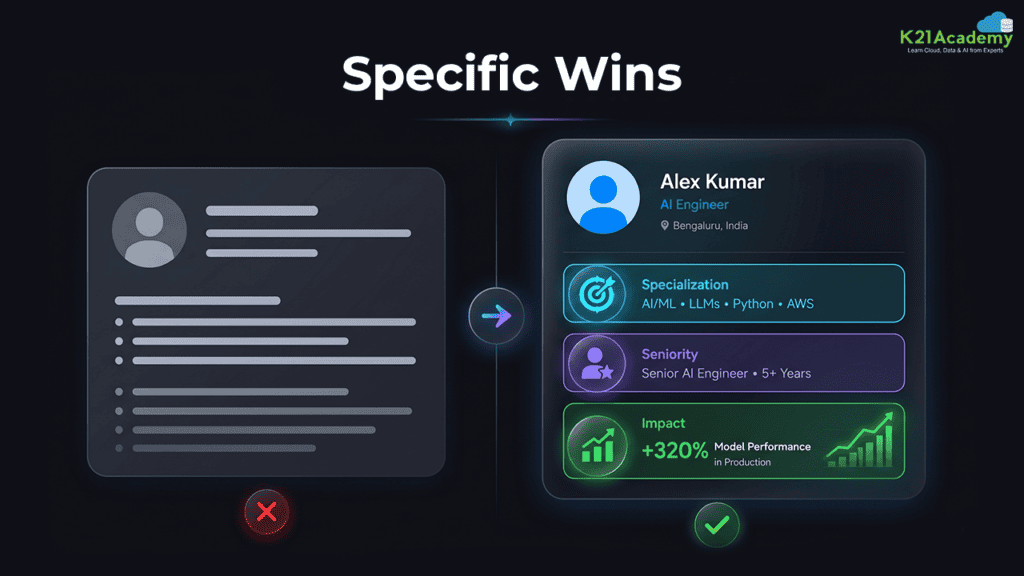
A strong AI resume summary does three things. It names your specific domain of expertise, it signals your seniority level, and it includes one concrete proof point.
Here is a practical structure to follow:-
- Specialization (what kind of AI work, specifically): NLP, computer vision, MLOps, RAG pipelines, Agentic AI, GenAI application development
- Seniority signal: mid-level, senior, lead, or principal
- One proof number or outcome: certifications earned, models deployed, team size led, measurable business result
A rewritten version of that generic summary might read: “Senior ML engineer specializing in NLP and Retrieval-Augmented Generation pipelines. Delivered production-ready AI applications for enterprise clients across three industries, with one project processing over 2 million documents monthly.”
A summary written this way is specific, verifiable, and tells a recruiter immediately whether your profile matches what they are looking for. This matters for the human reader. It also matters for ATS systems, which rank resumes higher when the summary contains role-specific language from the job description.
Related Readings:- Is Claude Code Worth Learning for Cloud Engineers? Salary Impact, Time-to-ROI, and Best Resources
Mistake 3: No Projects Section, or Projects Buried Too Deep
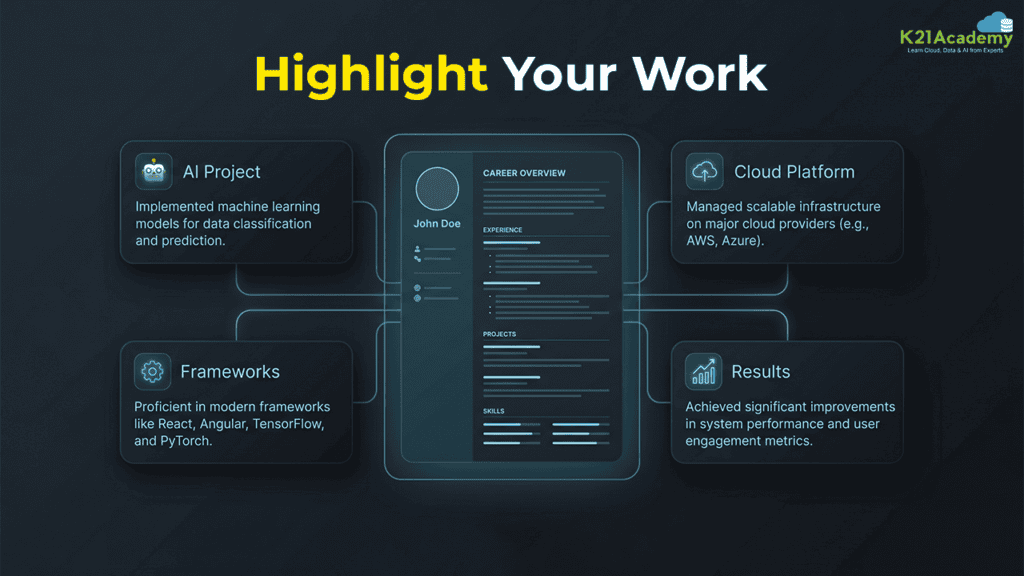
One of the most common questions I get from professionals is: “What qualifications are required for a GenAI job?” The honest answer is that technical qualifications matter, but so does evidence that you can apply them.
Certifications demonstrate that you understand a subject. Projects demonstrate that you can build with it. For AI and GenAI roles especially, hiring managers want both. A candidate who holds the AWS Certified AI Practitioner (AIF-C01) and has a deployed RAG application in their portfolio is a stronger profile than one with the same certification and no project evidence.
The mistake most professionals make is either skipping a projects section entirely, or burying it after work experience, education, and certifications, where many recruiters never scroll.
Where your projects section should sit:-
- Career changers pivoting into AI: place it directly below your summary, before work experience. Your projects are your most relevant recent evidence.
- Experienced professionals with AI roles already in their history: place it immediately after your work experience section.
What each project entry needs:-
- Project name and a one-line description of what it does
- Tools, platforms, and frameworks used (LangChain, Azure OpenAI, CrewAI, AWS Bedrock, etc.)
- The problem it solves and the user or business it serves
- One result, metric, or scale indicator
Real-world projects on a resume signal that you can build, not just study. In a field where hands-on capability is the key hiring signal, this section is not optional.
Related Readings:- Claude Code Career Roadmap: Skills Developers and AI Engineers Need in 2026
Mistake 4: Your Resume Keywords Do Not Match the Job Description
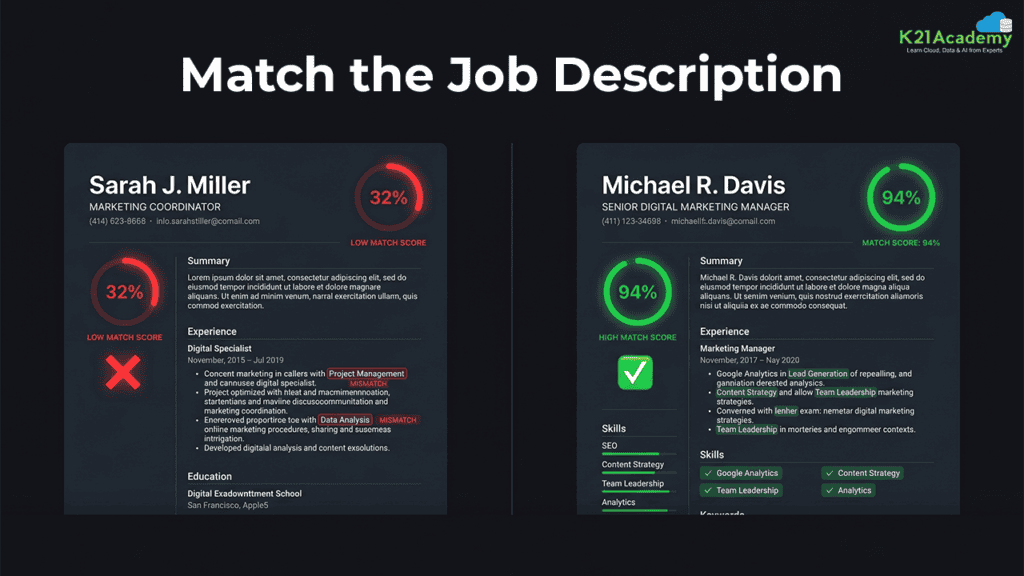
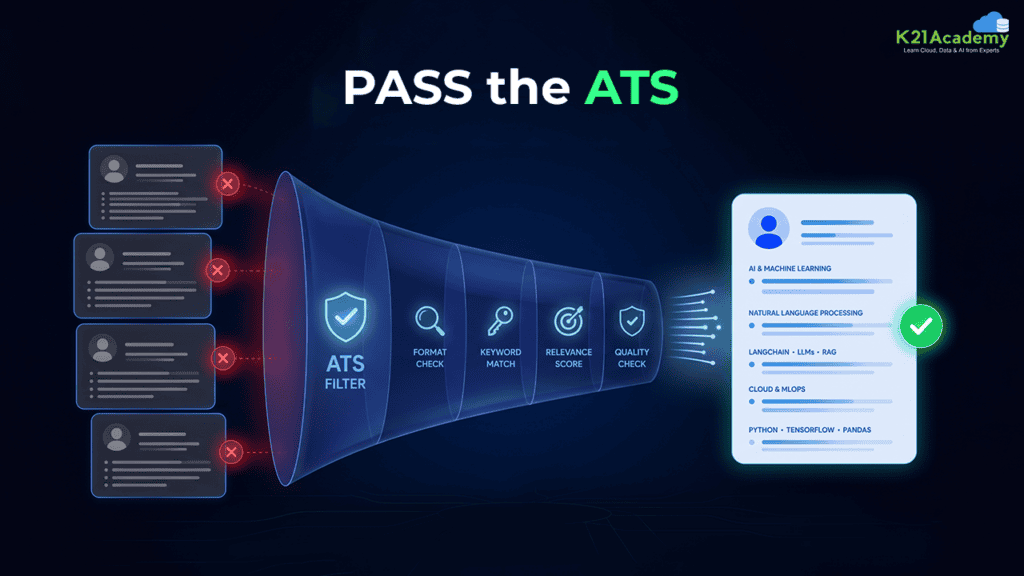
Most mid-to-large companies use Applicant Tracking Systems to filter and rank resumes before a human recruiter reviews them. These systems scan for specific keywords and score your application based on how closely your resume matches the language in the job description.
The problem is that AI professionals often use slightly different terminology than what appears in the job posting. A recruiter searching for “LLMs” may not find your resume if you wrote “Large Language Models.” A hiring system looking for “GenAI” may score your application lower if you wrote “Generative AI.” These are not meaningful differences to a human reader, but they can make a real difference to an automated filter.
The fix is straightforward. Before you submit any application, read the job description carefully and match its exact language in your resume. Do not rewrite the whole document, but mirror the specific terms, phrases, and acronyms the employer uses.
This is also where certifications listed by their exact names and codes become important. AI roles at companies hiring for high paying AI jobs frequently list specific credentials in their requirements. From what I have seen in the industry, these are the certifications that appear most often in AI job descriptions:-
- Azure AI Apps and Agents Developer Associate (AI-103) for Azure-based AI and GenAI development roles (note: AI-102 retires June 30, 2026; AI-103 is the current path)
- AWS Certified AI Practitioner (AIF-C01) for AWS GenAI and ML engineering roles
- AWS Certified Machine Learning Engineer or AWS Gen AI Specialty for senior ML positions
- Microsoft Azure AI-901 as a foundational credential for AI roles with cloud components
If you hold any of these, list them by their full name and exam code. Do not just write “Microsoft AI certification.” Write “Microsoft Certified: Azure AI Engineer Associate (AI-102).” The exam code is what ATS systems are often scanning for.
At the same time, avoid keyword stuffing. Adding every possible AI term to your resume in the hope of scoring higher will read as incoherent to a human reviewer and can flag your application in some systems. Aim for natural integration of 8 to 12 role-relevant keywords in the appropriate sections.
Related Readings:- Generative AI vs Agentic AI
Mistake 5: Treating the Resume as a Job History Instead of a Career Pitch
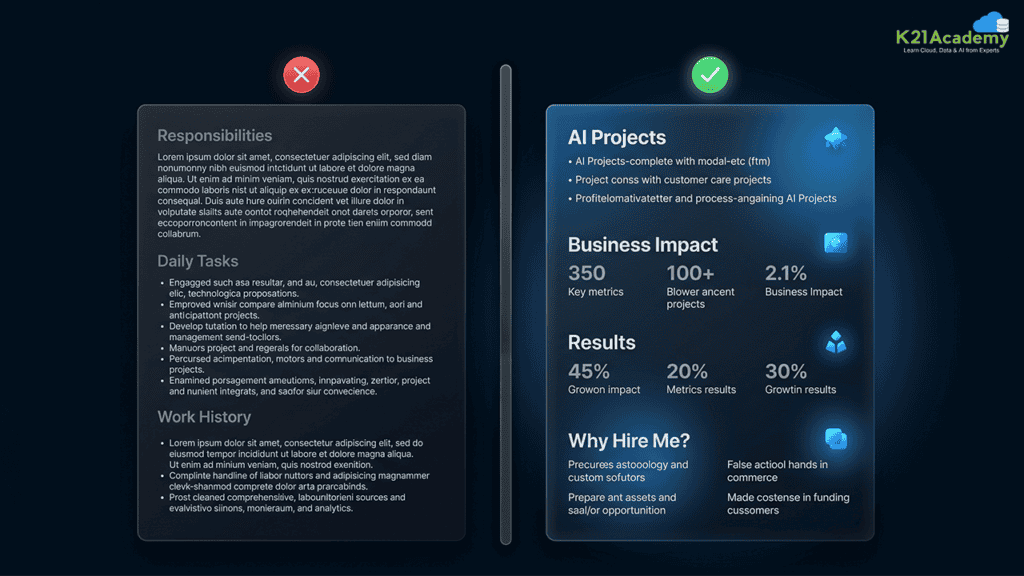
This is the most important shift, and it is not about formatting or keywords. It is about how you think about what a resume is for.
A job history answers the question: “What have you done?” A career pitch answers the question: “Why should we hire you for this specific role?”
Most AI professionals write job histories. They list every responsibility from every position in chronological order, give each role roughly equal space, and include tasks that are not relevant to the role they are applying for. The result is a document that is technically accurate but strategically weak.
Here is a practical way to audit your own resume. For each bullet point, ask: “Would this matter to someone hiring for the role I am applying for right now?” If the answer is no, either remove it or move it lower in the document. The goal is to make the most relevant AI experience visible immediately, not buried under a long list of general responsibilities.
For professionals who are pivoting into AI from a different background, this matters even more. You may not have AI engineer or AI architect in your job title yet, but you may have solved real-world problems with data, built automation workflows, or worked closely with technical teams on AI deployments. That experience is relevant. The mistake is leaving it described in the language of your previous role rather than translating it into the language of the role you are targeting.
A career changer’s resume should answer: “How does my background make me a strong candidate for an AI role?” not “Here is my complete work history.”
The same principle applies to the structure of the whole document. Lead with your most relevant AI experience and qualifications. Put what matters most to the hiring manager first, not what came first chronologically.
Related Readings:- AI Agents vs Agentic AI
Wrapping Up
The AI job market is active, and the demand for qualified professionals across GenAI, ML engineering, and cloud AI is real. Being qualified is only part of what gets you an interview call. How you present those qualifications on paper is equally important.
To answer the question professionals ask most often, what qualifications are required for a GenAI job: it is a combination of domain-specific technical skills, relevant certifications, real-world project evidence, and a resume that communicates all of it clearly and specifically. The five mistakes above are the most common reasons a strong candidate does not get the callback their profile deserves.
At K21 Academy, we work with professionals at exactly this stage, where the skills and certifications are in place but the positioning and career strategy need work. Our live mentoring sessions, hands-on project labs, and AI career coaching have helped 46,000+ professionals across 30+ countries get job-ready and land the role. One of our students, Nazif, joined K21 in June and received his job offer in late September, after working through exactly the kind of resume positioning and interview preparation covered in this article.
Check out our free AI Career Masterclass to see how we approach it:- Free AI Career Masterclass
What part of your AI resume do you find hardest to get right? Is it quantifying your project outcomes, writing a focused summary, or something else entirely? Share your experience in the comments below. I would love to hear what has and has not worked for you.
Related Readings:- The Best Chatbot Development Tools
FAQ’s:
Question: What qualifications are required for a GenAI job?
Answer: GenAI roles typically require proficiency in Python, experience with LLMs and prompt engineering, familiarity with frameworks like LangChain or LlamaIndex, cloud AI platform knowledge (AWS Bedrock, Azure OpenAI), and at least one relevant certification such as AIF-C01 or AI-103. Real-world project experience with deployed GenAI applications is increasingly expected alongside formal credentials.
Question: How do I write a resume for AI jobs?
Answer: Structure each bullet point as Action + Technology + Impact. Include a dedicated projects section with deployed or portfolio-ready AI builds. Match the exact terminology and certification codes from the job description. Lead your summary with your AI specialization, seniority level, and one proof point.
Question: What AI certifications should I list on my resume?
Answer: List certifications by their full name and exam code. The most recognized for AI roles include Azure AI Apps and Agents Developer Associate (AI-103), AWS Certified AI Practitioner (AIF-C01), AWS Gen AI Specialty, and Microsoft Azure AI Fundamentals (AI-901). Always mirror the exact credential names used in the job description you are applying to.