


The Harsh Reality in 2026 (And Why This Claude Certified Architect Certification Exists)
AI is no longer a “future skill.” It’s already replacing traditional workflows.
What’s actually happening in the industry right now?
- Developers who only know coding are struggling
- Cloud engineers without AI knowledge are being sidelined
- Architects who don’t understand LLMs and agentic ai systems are losing relevance
Meanwhile…
A new category of professionals is emerging, AI Architects who can design intelligent systems, not just infrastructure.
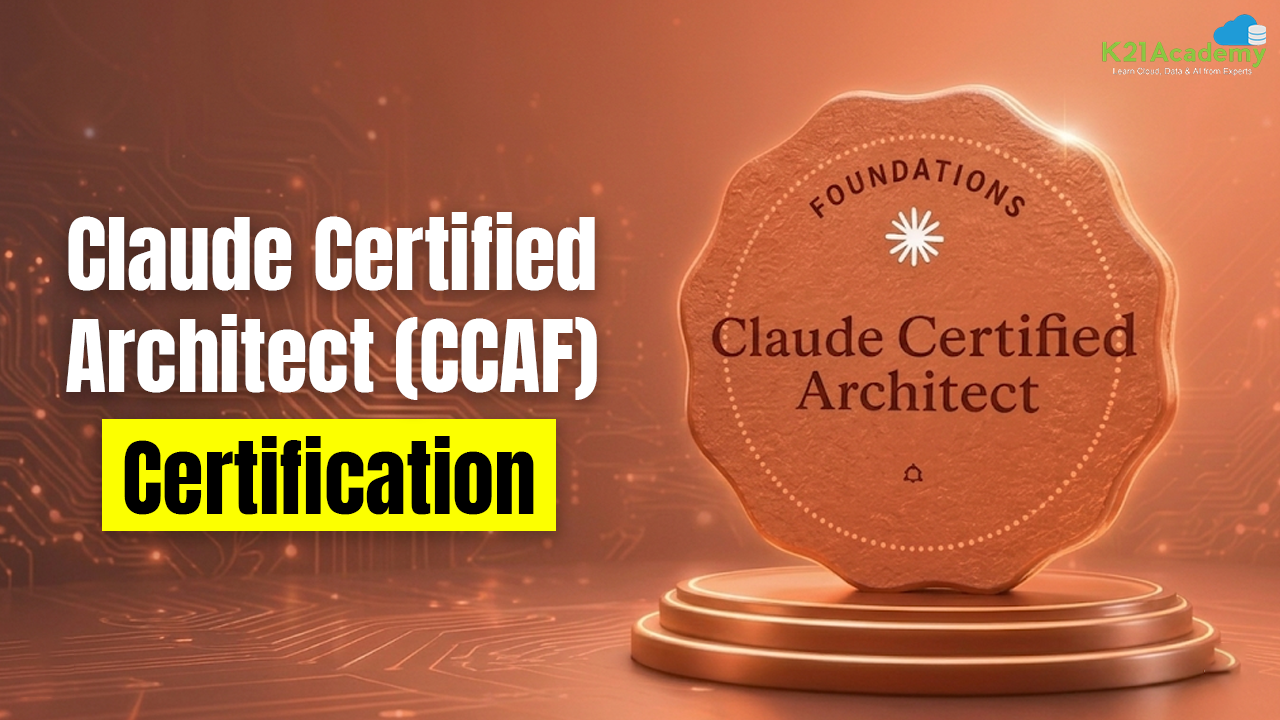
And this is exactly where the Claude Certified Architect (CCAF) certification comes in.
What is Claude Certified Architect (CCAF)?
The Claude Certified Architect (CCAF) is an advanced-level certification focused on designing AI-native systems using modern concepts like:
- Large Language Models (LLMs)
- MCP (Model Context Protocol)
- Agentic AI systems
- AI workflows and orchestration
- Context & Prompt Engineering
Unlike traditional certifications that focus on theory or tools, CCAF is built around real-world AI architecture design.
In simple terms:
It’s not about using AI, it’s about designing systems powered by AI.

Why is CCAF Getting Attention in 2026 ?
The industry is shifting from:
- Writing code → Designing intelligent systems
- Building apps → Building AI agents
- APIs → Autonomous workflows
Organizations now want professionals who can:
- Architect AI solutions end-to-end
- Design multi-agent systems
- Integrate LLMs into business workflows
- Build scalable AI pipelines
This demand is exactly what makes CCAF relevant.
Related Readings: Claude Code vs GitHub Copilot vs Cursor: Which AI Coding Assistant Should You Learn?
What You Learn in CCAF (Core Skills) ?
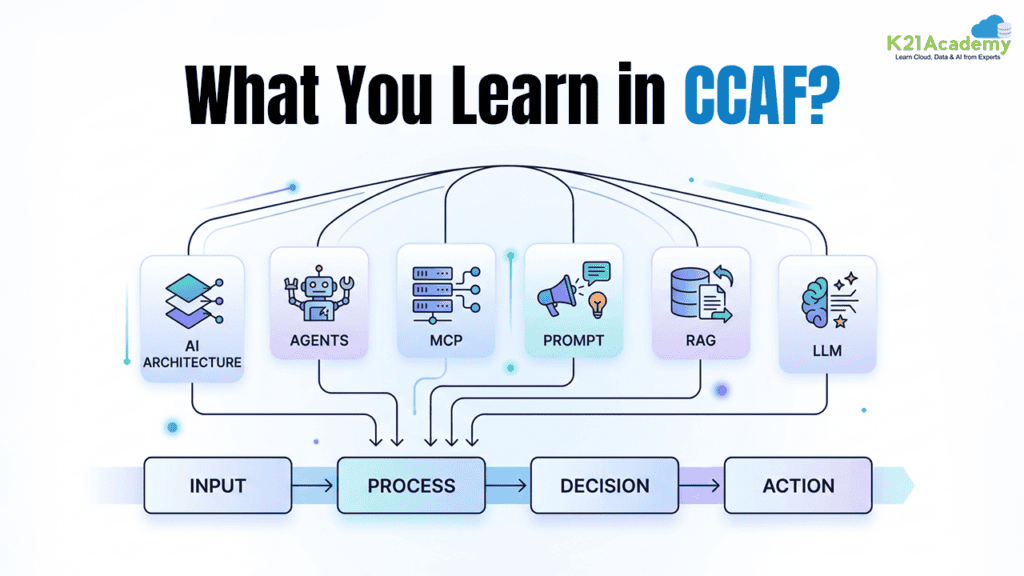
The certification focuses on practical, high-impact skills:
1. AI System Architecture
Designing scalable systems using LLMs, APIs, and cloud platforms like AWS/Azure.
2. Agentic AI Design
Creating intelligent agents that can:
- Reason
- Use tools
- Take actions
3. MCP (Model Context Protocol)
Understanding how AI systems:
- Maintain memory
- Interact with tools
- Manage context across workflows
Related Readings: What is Natural Language Processing (NLP)?
4. Context & Prompt Engineering
Not just writing prompts, but:
- Structuring prompts as reusable components
- Designing context pipelines
5. RAG (Retrieval-Augmented Generation)
With the help of RAG, Building systems that:
- Fetch real data
- Generate accurate responses
- Reduce hallucination
6. AI Workflows & Automation
Designing end-to-end pipelines:
- Input → Processing → Decision → Action
Related Readings: Top 10 Claude Code Use Cases Every Developer Should Know
Who Should Take CCAF?
This certification is not for everyone, and that’s actually a good thing.
Ideal for:
- AI Engineers working with LLMs
- Solution Architects(AWS/Azure) designing cloud systems
- Developers building AI applications
- Professionals already familiar with Python, APIs, and cloud
Not Ideal for:
- Complete beginners in AI
- People who haven’t worked with APIs or coding
- Those looking for basic AI theory
If you’re still at fundamentals → start with beginner certifications first.
If you’re already building things → CCAF is your next leap.
Related Readings: What is Claude Code? A Complete Beginner’s Guide for Developers in 2026
CCAF vs Traditional Certifications
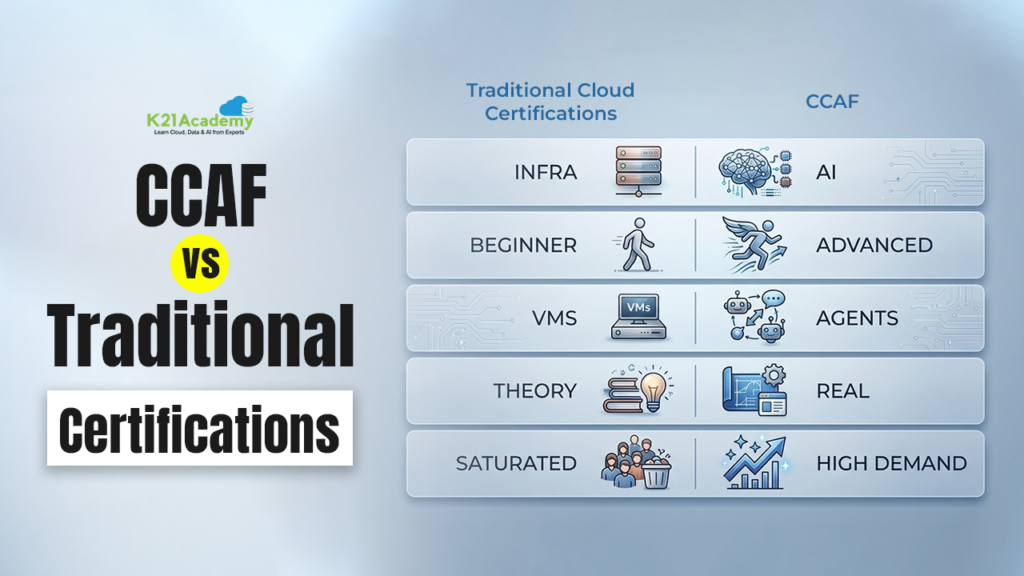
Key Insight:
Traditional certifications teach you how systems run
CCAF teaches you how intelligent systems think
Related Readings: The Best Chatbot Development Tools
Salary Impact of CCAF in 2026
Professionals with AI architecture skills are among the highest-paid in tech today.
India
- AI Architect: ₹20 LPA – ₹45+ LPA
- Senior AI Engineer: ₹15 LPA – ₹35 LPA
Global
- AI Architect: $130,000 – $200,000
- AI Engineer: $110,000 – $160,000
Why such high salaries?
Because companies are not just hiring developers anymore, they are hiring people who can design AI-driven business systems.

Real Industry Advantage
What separates CCAF-certified professionals?
They can:
- Design multi-agent systems
- Build production-ready AI workflows
- Integrate LLMs into real business use cases
- Think beyond code into system design
This is where most developers struggle.
Related Readings: Comparing the Best AI Chatbots for Your Business: What’s Best for You?
Productivity Impact (Real Talk)
Let’s be honest.
An average developer:
- Takes weeks to build AI features
- Struggles with architecture decisions
An AI architect (CCAF-level):
- Designs systems in days
- Reuses modular components
- Ships faster with better scalability
That’s a 5x–10x productivity difference.
The Catch (Honest Review)
No certification is perfect, let’s be real.
Challenges with CCAF:
- Requires strong fundamentals (not beginner-friendly)
- Needs hands-on practice (not just theory)
- Rapidly evolving field (you must keep learning)
If you just “watch videos” this certification won’t help
If you actually build systems, it becomes extremely valuable
Related Readings:- What is Generative AI & How It Works?
Is CCAF Worth It in 2026?
YES, If:
- You want to move into AI architecture roles
- You already have coding/cloud computing experience
- You want high-paying, future-proof skills
NO, If:
- You are just starting with AI
- You are not ready for hands-on learning
- You want quick results without effort
Related Readings: Generative AI vs Agentic AI: Key Differences
Final Verdict
The biggest shift in tech is happening right now:
From Developers → AI Engineers
From Engineers → AI Architect
And CCAF sits exactly at that transition point.
It’s not just a certification, it’s a career positioning strategy.
If you learn it properly, you don’t just stay relevant… you move ahead of the curve.
In 2026, the question is no longer:
“Do you know about AI?”
The real question is:
“Can you design AI systems that actually work in production?”
If your answer is not yet, CCAF might be the step that changes that.
Related Readings:- How to Build Your Own AI Bot in 2026: A Complete Guide
Frequently Asked Questions
Q1. Will I become irrelevant if I don’t learn AI architecture in 2026?
Not instantly, but the gap is growing fast. As companies adopt AI systems, professionals without architecture-level understanding may find fewer high-impact opportunities.
Q2. Is Claude Certified Architect (CCAF) too advanced for me right now?
If you’re not comfortable with APIs, coding, or cloud basics, yes, it can feel overwhelming. Jumping in too early may lead to frustration instead of growth.
Q3. What if I invest time in Claude Certified Architect (CCAF) and the tech changes?
That’s a real risk. AI evolves quickly. However, Claude Certified Architect (CCAF) focuses on core design patterns like LLMs, workflows, and agents, which are more durable than specific tools.
Q4. Am I already too late to move into AI architecture?
No, but waiting longer makes it harder. Early adopters are already gaining experience, and catching up later will require more effort.
Q5. What if I fail the Claude Certified Architect (CCAF) certification?
Failure is possible, especially without hands-on practice. But the bigger issue isn’t failing, it’s not building real skills alongside preparation.
Q6. Will Claude Certified Architect (CCAF) guarantee me a high salary?
No certification guarantees salary. It improves your positioning, but actual outcomes depend on your ability to design and deliver real systems.
Q7. What if I complete Claude Certified Architect (CCAF) but still can’t build real AI systems?
That can happen if you rely only on theory. Without projects, experimentation, and real-world problem solving, the certification alone won’t help much.
Q8. Is AI going to replace my current role completely?
In most cases, it won’t replace you outright, but it will change expectations. Roles are shifting toward people who can work with AI systems effectively.
Q9. What if I don’t enjoy working with AI systems?
Then forcing this path may not be ideal. AI architecture is demanding and requires continuous learning, interest matters more than trends.
Q10. Is Claude Certified Architect (CCAF) just another hype certification that will fade away?
It could lose hype, but the underlying shift toward AI system design is real. Focus on the skills, not just the certification label.



![AWS DevOps [DOP-C02] Professional Step By Step Activity Guides (Hands-On Labs)](https://k21academy.com/wp-content/uploads/2023/02/DOP-C02-1.png)


