



What if for many years you have been perfecting a profession that is fading away without your even noticing?
Nowadays, projects are not only about timetables, expenditures, and outputs. They are being led by intelligent automation, AI agents, autonomous workflows, predictive analytics, and self-learning systems that can figure out, carry out, and enhance tasks with very little human intervention.
The bitter reality is that businesses don’t only seek traditional project managers anymore, they want AI-enabled project managers who understand how to collaborate with Agentic AI, design AI-driven workflows, make data-based decisions, and lead teams where humans and AI work as partners.
Since you plan on only mastering traditional project management skills, it won’t be AI itself replacing you, it will be the professionals who understand how to use AI to produce results in a faster, smarter and more efficient way.
It’s no longer, “Should you learn AI?”
It is ‘How quickly can you switch before the lag gets to be too much?
What Changes When You Move Into AI Project Management?
At its core, project management remains about delivering value. But in AI-driven environments, the definition of “value” changes.
Traditional Project World:
- Fixed requirements
- Predictable outputs
- Linear execution
AI Project World:
- Evolving requirements (models improve over time)
- Probabilistic outputs (not always 100% accurate)
- Iterative experimentation
An AI Project Manager must be comfortable operating in uncertainty, experimentation, and continuous improvement.
Related Readings:- AI Project Manager vs AI Product Manager
Understanding AI Projects: The Real Difference
Unlike traditional software, AI systems depend heavily on data quality and model behavior.
Typical AI Project Lifecycle:
1. Problem Framing
Define the business problem in a way AI can solve.
2. Data Collection & Preparation
Gather and clean data (often the most time-consuming step).
3. Model Development
Data scientists train models.
4. Evaluation
Measure performance using accuracy, precision, recall.
5. Deployment
Integrate into applications via APIs or services.
6. Monitoring & Improvement
Track model drift, retrain, optimize.
As an AI PM, your role is to orchestrate this lifecycle, not execute each step.
Related Readings: Claude Code vs GitHub Copilot vs Cursor: Which AI Coding Assistant Should You Learn?
Skills You Already Have (And Why They Matter)
You’re not starting from zero.
Your current skills are still valuable:
- Stakeholder communication
- Risk management
- Timeline planning
- Resource allocation
- Conflict resolution
What Changes?
You apply these skills to:
- Data pipelines instead of features
- Model performance instead of bug counts
- Experiment cycles instead of fixed sprints
Related Readings: Top 10 Claude Code Use Cases Every Developer Should Know
New Skills You Must Build
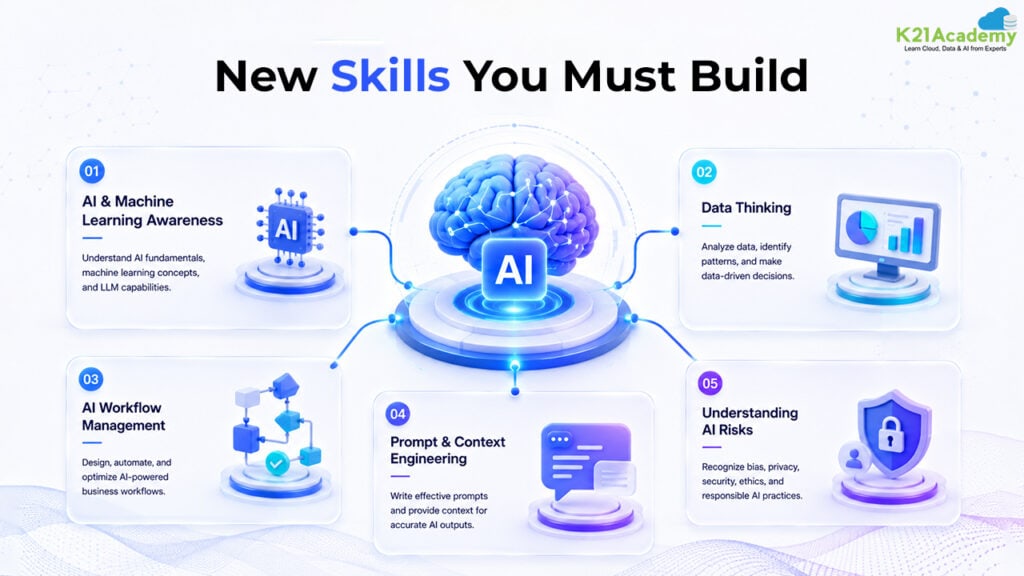
1. AI & Machine Learning Awareness
You don’t need to code complex models, but you must understand:
- What is machine learning vs deep learning
- What are LLMs (Large Language Models)
- How generative AI works
- What are AI agents and workflows
2. Data Thinking
AI projects are data-first, not feature-first.
You need to understand:
- Structured vs unstructured data
- Data quality and bias
- Data pipelines
- Labeling and preprocessing
3. AI Workflow Management
Instead of tracking only tasks, you’ll manage:
- Model training cycles
- Experiment tracking
- Feedback loops
- Continuous improvement
4. Prompt & Context Engineering (New-Age Skill)
Modern AI systems (like chatbots) depend heavily on:
- Prompt engineering
- Context injection
- Retrieval systems (RAG)
This is where AI PMs differentiate themselves.
5. Understanding AI Risks
AI introduces risks traditional PMs never dealt with:
- Bias in models
- Ethical concerns
- Hallucinations in LLMs
- Data privacy issues
You are responsible for managing these risks at a project level.

Transition Roadmap (Practical and Realistic)
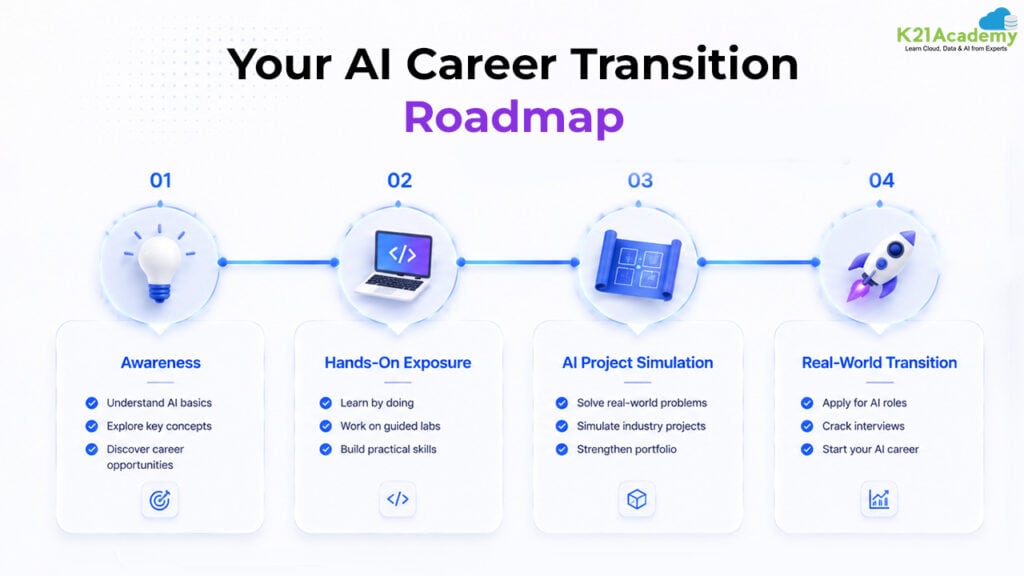
Phase 1: Awareness (Weeks 1-4)
- Learn AIML fundamentals
- Draft the understanding of important terms
- Explore basic use cases
Focus: Concept clarity
Phase 2: Hands-On Exposure (Weeks 5-8)
- Employ AI techniques (chat bots, automation tools)
- Try to build simple workflows
- Experiment with prompts
Focus: Practical understanding
Phase 3: AI Project Simulation (Weeks 9-12)
- Practical experience through mock AI projects
- Define problem statements
- Make project plans for AI systems
Focus: Application
Phase 4: Real-World Transition (3-6 Months)
- Volunteer to undertake small projects around AI
- Work with data teams
- Own your AI: Make yourself responsible about the AI initiatives, and drives these initiatives
Focus: Experience

Tools You Should Start Using
Project & Collaboration:
- Jira, Trello (with AI integrations)
AI Tools:
- Chat-based AI systems like Claude Code or ChatGPT
- Prompt engineering tools
Data & Visualization:
- Power BI
- Tableau
Cloud Platforms:
You don’t need mastery just working familiarity.
5 Real-World AI Projects You’ll Handle
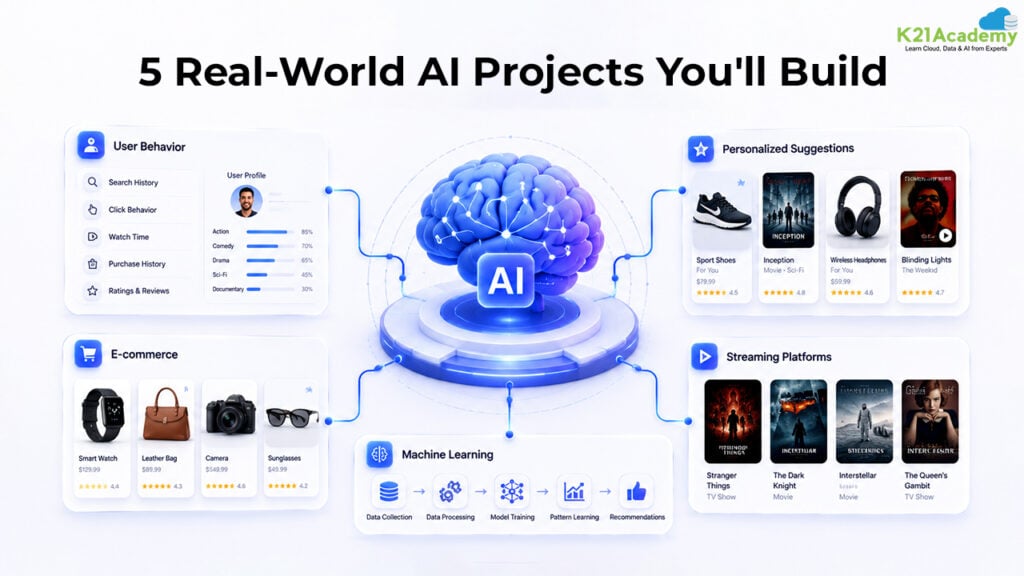
Once transitioned, you may manage:
1. AI Chatbots
Customer support automation using LLMs
2. Recommendation Systems
Used in e-commerce and streaming platforms
3. Document Processing
Extracting insights from PDFs, invoices
4. Predictive Analytics
Forecasting demand, churn, or risk
5. AI Assistants
Internal productivity tools powered by AI
Related Readings:- How to Build Your Own AI Bot in 2026: A Complete Guide
Productivity Shift: Traditional vs AI PM
Traditional PM:
- Plans once, executes
- Measures success by delivery
- Works in predictable environments
AI PM:
- Iterates continuously
- Measures success by outcomes
- Works in experimental environments
Result: Faster innovation cycles and smarter products.
Related Readings:- Claude Code for AI/ML Engineers: Should You Invest the Time? Honest 2026 Worth-It Breakdown
Challenges You Will Face (And How to Handle Them)
- I am Not Technical Enough
Reality: You don’t have to be a developer.
Solution: Concentrate on understanding workflows and don’t worry about coding.
- Rapidly Changing AI Landscape
Reality: Tools change so quickly.
Solution: Learn concepts, not just tools.
- Communication Gap with AI Teams
Reality: Data scientists speak a new language.
Solution: Familiarise with terminology and measures.
- Managing Uncertainty
Reality: AI outputs never behave predictably.
Solution: Change attitude from control experimentation.
Related Readings: The Best Chatbot Development Tools
Certifications That Support Your Transition
If you want structured validation and career credibility, professional certifications can help.
Core Certifications
- Certified Associate in Project Management (CAPM)®
- Project Management Professional (PMP)®
- Program Management Professional (PgMP)®
- Portfolio Management Professional (PfMP)®
These build your foundation in project leadership
Specialized Certifications
- PMI Construction Professional (PMI-CP)™
- PMI Agile Certified Practitioner (PMI-ACP)®
- PMI Risk Management Professional (PMI-RMP)®
- PMI PMO Certified Professional (PMI-PMOCP)™
- PMI Professional in Business Analysis (PMI-PBA)®
- PMI Scheduling Professional (PMI-SP)®
- PMI Certified Professional in Managing AI (PMI-CPMAI)™
- Green Project Manager–Basic (GPM-b)™
These help you specialize, especially:
- PMI-CPMAI™ → Direct relevance to AI project management
- PMI-ACP® → Agile practices for iterative AI projects
- PMI-RMP® → Managing AI risks
Certification Resources
- Celebrate Your Certification
- Maintain & Renew Your Certification
- Check a Certification
- Certification FAQs
- PMI Official Mobile App
Certifications are not mandatory, but they accelerate credibility and career growth.
Related Readings:- How to Become an Agentic AI Expert
Salary Growth After Transition
India:
- Traditional PM: ₹8 – 18 LPA
- AI Project Manager: ₹15 – 35+ LPA
Global:
- Traditional PM: $70K – $110K
- AI PM: $100K – $160K+
The gap will continue to widen as AI adoption increases.
Related Readings:- Learn about conversational bot
The Mindset Shift (Most Important Part)
This transition is not just about skills, it’s about mindset.
From:
- Control → Adaptability
- Planning → Experimentation
- Delivery → Intelligence
To:
- Continuous learning
- Data-driven decisions
- Outcome-focused execution
How Long Will It Take?
- Basic understanding: 1-2 months
- Hands-on exposure: 2-3 months
- Job-ready transition: 4-6 months
Faster if you already work in tech environments.
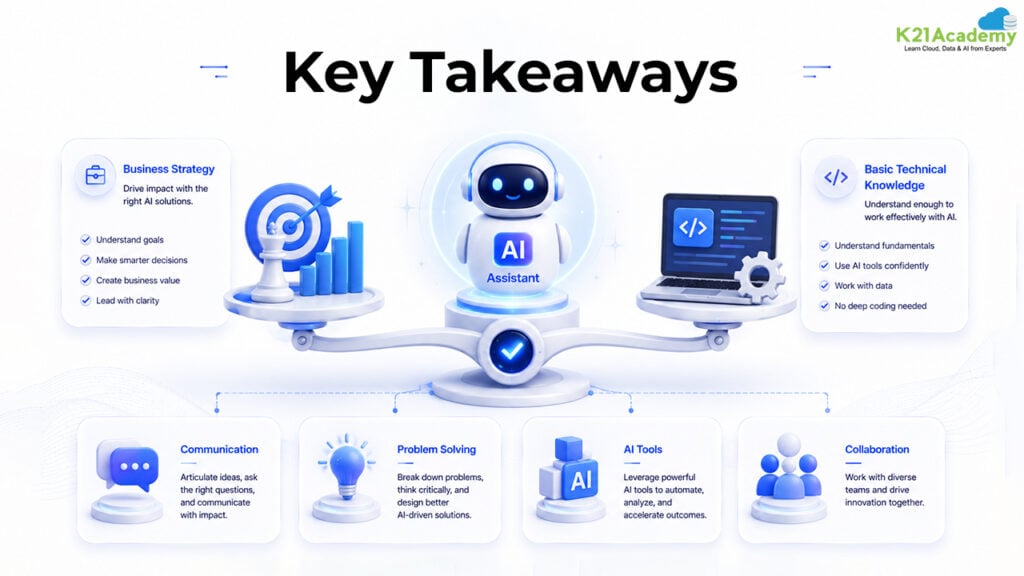
Key Takeaways
Final Thoughts
The future of project management, It is not about managing tasks, but managing intelligent systems.
Organizations require leaders who:
- Understand AI capabilities
- Align them with business goals
- deliver real-world impact
Starting now, you’re not just an AI project manager.
And in a world very rapidly being revolutionized by AI at the forefront, that transition could be the defining moment of the trajectory of your career.
Next Task For You
Get started with your journey of earning the PMI-CPMAI certification & getting started in the field of AI Project Management.