



AWS Introduces New AWS Certified GenAI Developer Certification – The AWS Generative AI Developer – Professional credential is a timely and high-value certification for professionals who want to specialize in generative AI development on the AWS cloud. It helps you demonstrate you can go beyond proof of concept into building scalable, secure, cost-efficient, production-ready Gen AI solutions.
This blog will cover everything you need to know about the AWS Generative AI Developer certification.
What is the AWS Generative AI Developer – Professional certification [AIP-C01]?

This certification is a professional-level credential from AWS designed to validate advanced technical skills in building, deploying, and operating production-ready generative AI solutions on the AWS platform.
- Designed for developers/engineers who have experience with AWS and want to work with generative AI (Gen AI) solutions (foundation models, retrieval-augmented generation, agents, etc.).
- The certification assists businesses in finding experts who can deploy generative AI in production while addressing issues related to cost, security, governance, and scalability.
- This credential indicates that you can work with AWS’s Gen AI services (such as Amazon Bedrock, SDKs, model invocation, deployment, and observability) and create genuine business value, which is important given the growing importance of generative AI in enterprise applications.
Who is a “Generative AI Developer”?
Before diving into the certification, it helps to define what is meant by “Generative AI Developer”.
A specialist in generative AI development is someone who:
- comprehends, handles, and applies foundation models – such as large language models, vision, and multimodal models, in applications.
- creates and implements generative-AI applications, such as conversational agents, business workflows, RAG (retrieval-augmented generation) systems, and content generation (text, images, and code).
- incorporates generative models into production pipelines and uses quick engineering or fine-tuning/adapter approaches as needed.
- deploys models at scale (via cloud services, APIs, and containers) and manages Gen AI system security and governance, observability, cost optimisation, and monitoring.
- interactions with the infrastructure (computing, storage, networking), user interfaces (chatbots, embedded stores, knowledge bases), application logic, and data pipelines.
In an AWS context, a Gen AI developer would likely use services such as Amazon Bedrock, Amazon SageMaker, Amazon Q (developer assistant), storage (S3), compute (EC2/Lambda/Fargate), orchestration (Step Functions/EventBridge), embedding/knowledge base services, and apply prompt/agent patterns.
Related Readings: Amazon Web Services
Who Should Take the AWS Generative AI Developer Professional Certification?
This certification is ideal for experienced developers, machine learning engineers, and cloud architects who have at least two years of hands-on AWS experience and some exposure to generative AI solutions. This certification is ideal for experienced developers, machine learning engineers, and cloud architects who have at least two years of hands-on AWS experience and some exposure to generative AI solutions.
- It is intended for professionals who wish to use services like Amazon Bedrock, SageMaker, and AWS Lambda to develop, implement, and oversee production-grade Gen AI systems.
- This certification is ideal if you’re already creating AI-driven chatbots, RAG-based systems, or automated content creation tools, and you’re prepared to expand your knowledge of foundation models and AI architecture.
- It’s also a great fit for those in charge of AI projects in businesses trying to safely and effectively expand their generative AI capabilities. If you’re exploring ways to enhance your AI journey, you should also check out the best AI tools for web developers, a collection of powerful, time-saving platforms that can make your AI and development workflow smarter, faster, and more innovative.
What Certifications Should You Earn Before Taking This Exam?
Although there are no official prerequisites for the AWS Certified Generative AI Developer – Professional test, holding foundational or associate-level AWS credentials will greatly facilitate your preparation.
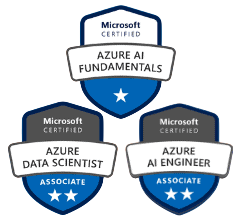
You can develop a strong grasp of AWS services, AI/ML principles, and deployment procedures by obtaining certifications such as the AWS Certified Cloud Practitioner, AWS Certified AI Practitioner, or AWS Certified Machine Learning Engineer – Associate. Prior to taking on the challenging, scenario-based questions of the Professional-level Gen AI exam, these certificates educate you on the fundamental cloud and AI principles. To put it briefly, consider these your stepping stones to becoming an expert in AWS generative AI programming.
AWS Generative AI Developer Certification: Exam Overview
| Format | Multiple-choice and multiple-response questions only |
| Type | Professional |
| Delivery method | Pearson VUE testing center or online proctored exam |
| Number of questions | 85 |
| Time | 204 minutes |
| Cost | 150 USD |
| Language | English and Japanese |
AWS AIP-C01 Exam Domains
The AWS Generative AI Developer certification exam includes a complete list of exam domains, task statements, and knowledge areas.
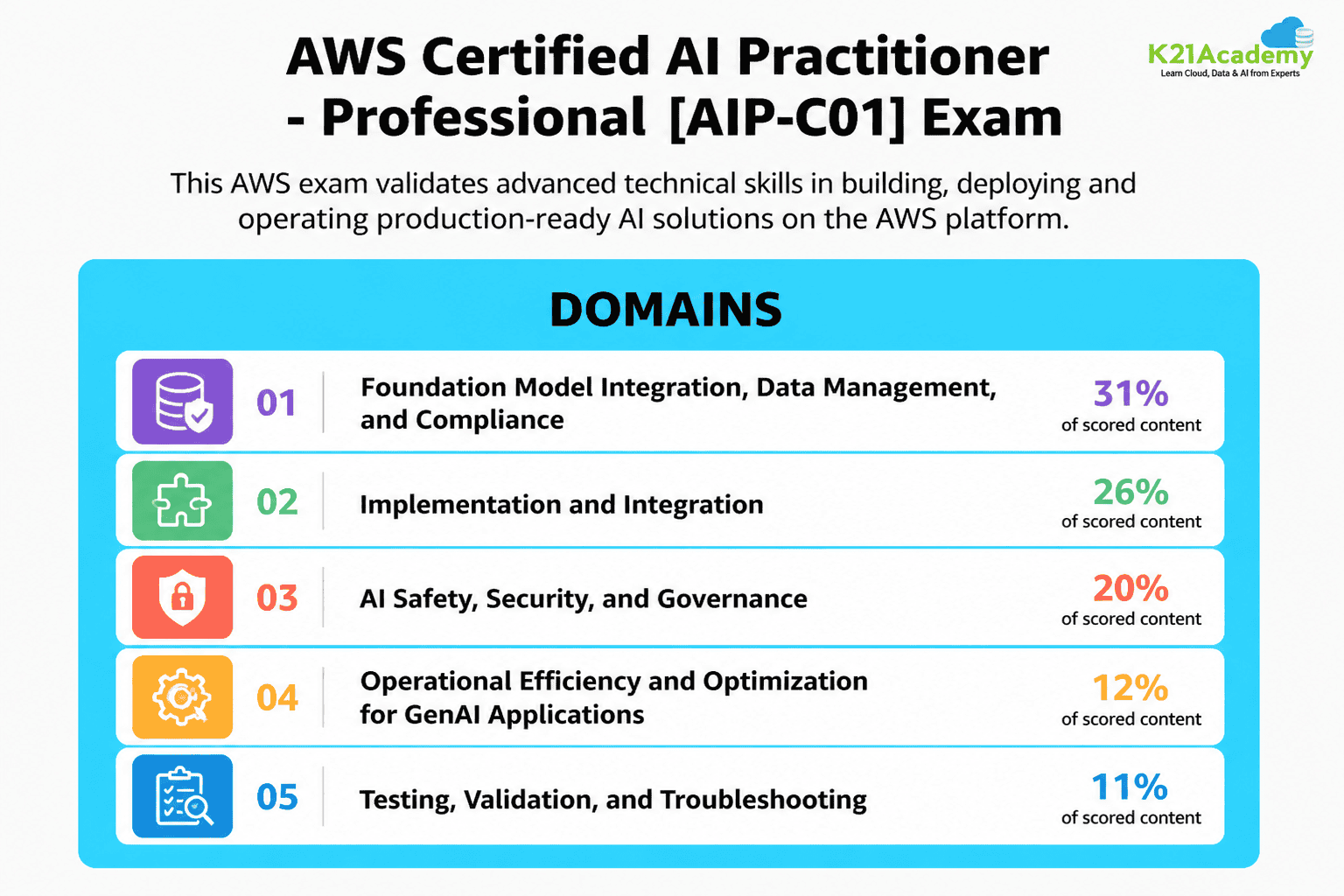
Domain 1: Foundation Model Integration, Data Management, and Compliance
This domain focuses on:
-
- Foundation Model (FM) integration: Understanding how to integrate Foundation Models (FMs) and Large Language Models (LLMs) into existing business workflows and applications.
- Data management: Best practices for managing large datasets required for training and fine-tuning FMs. This includes data collection, preprocessing, storage, and organization in cloud environments like AWS.
- Compliance and ethics: Exploring the legal, ethical, and compliance considerations when working with generative AI. This includes adhering to data privacy regulations such as GDPR and ensuring transparency and fairness in AI model outputs.
- Techniques for ensuring the data integrity, security, and privacy of data used in generative AI applications, particularly in highly regulated industries.
Related Readings: What is the Foundation Model in AI?
Domain 2: Implementation and Integration
This domain focuses on:
- Implementing generative AI solutions using Amazon Bedrock, Amazon SageMaker, and other AWS services for model deployment and integration into production environments.
- Building end-to-end AI applications: Detailed steps on developing, deploying, and maintaining generative AI solutions with Amazon Q Developer, SageMaker, and Lambda.
- Integration strategies for combining AI models with other AWS services to improve productivity and provide smarter, more responsive applications.
- Real-world scenarios for integrating Foundation Models into existing business applications, including chatbots, recommendation engines, and predictive analytics tools.
- Version control and CI/CD pipelines for continuous model deployment and updates in real-world applications.
Related Readings: Enable foundation models in AWS Bedrock
Domain 3: AI Safety, Security, and Governance
This domain focuses on:
- AI safety and risk mitigation: Strategies to ensure that generative AI systems behave as intended and do not introduce unexpected risks or biases.
- Security in AI applications: Ensuring that AI models are deployed securely and that access to AI services and data is controlled using IAM roles and policies, VPCs, and encryption techniques.
- AI governance: Establishing governance frameworks for the responsible use of AI, including establishing guidelines for ethical model usage and decision-making.
- Bias detection and fairness: Methods for ensuring that generative AI models do not reinforce harmful biases and providing fairness in model predictions.
- Implementing audit logs and model explainability to enhance trust in AI systems.
Related Readings: Develop & Manage Generative AI Applications on AWS with Bedrock and LangChain
Domain 4: Operational Efficiency and Optimization for GenAI Applications
This domain focuses on:
- Optimizing AI models for operational efficiency by reducing compute costs and improving the responsiveness of generative AI applications.
- Advanced model tuning and fine-tuning strategies to optimize Foundation Models for specific use cases while balancing performance and cost.
- AI workflow automation: Automating common AI tasks using services like Amazon Bedrock Flows and Amazon Q Developer to streamline repetitive tasks.
- Scalability of generative AI systems to handle large-scale deployments efficiently, ensuring high performance across different environments.
- Cost optimization strategies for deploying generative AI models at scale, including optimizing AWS resource usage such as EC2 instances, Lambda functions, and S3 storage.
Related Reading: Develop & Manage Generative AI Applications on AWS with Bedrock and LangChain
Domain 5: Testing, Validation, and Troubleshooting
This domain focuses on:
- Testing generative AI systems to ensure they meet business requirements and function correctly. This includes developing test cases for AI model outputs and validating their accuracy, relevance, and context.
- Validation techniques for ensuring that AI models are performing according to established criteria, using benchmark datasets and cross-validation.
- Troubleshooting generative AI models: Diagnosing common issues that may arise during model training, deployment, and real-world usage, such as performance degradation, inaccurate outputs, or system integration failures.
- Techniques for model performance evaluation and monitoring to ensure models continue to operate effectively over time and meet evolving business needs.
- Using Amazon CloudWatch and AWS Cloud Trail to monitor AI workloads and troubleshoot any potential bottlenecks or failures.
Conclusion
For developers who want to focus on next-generation AI applications, earning the AWS Generative AI Developer Professional Certification is a significant accomplishment. This certification attests to your ability to develop, implement, and scale practical generative AI solutions on AWS as generative AI transforms a variety of industries, from intelligent assistants to content automation.
In essence, this certification bridges the gap between AI innovation and enterprise implementation. Earning it positions you at the forefront of the AI revolution—equipped to design intelligent solutions that go beyond prototypes and deliver true business impact.
Next Task For You
Don’t miss our EXCLUSIVE Free Masterclass on Generative AI on AWS Cloud! This session is perfect for those planning to pursue the AWS Certified Generative AI Developer Professional certification. Explore AI, ML, DL, & Generative AI in this interactive session.