

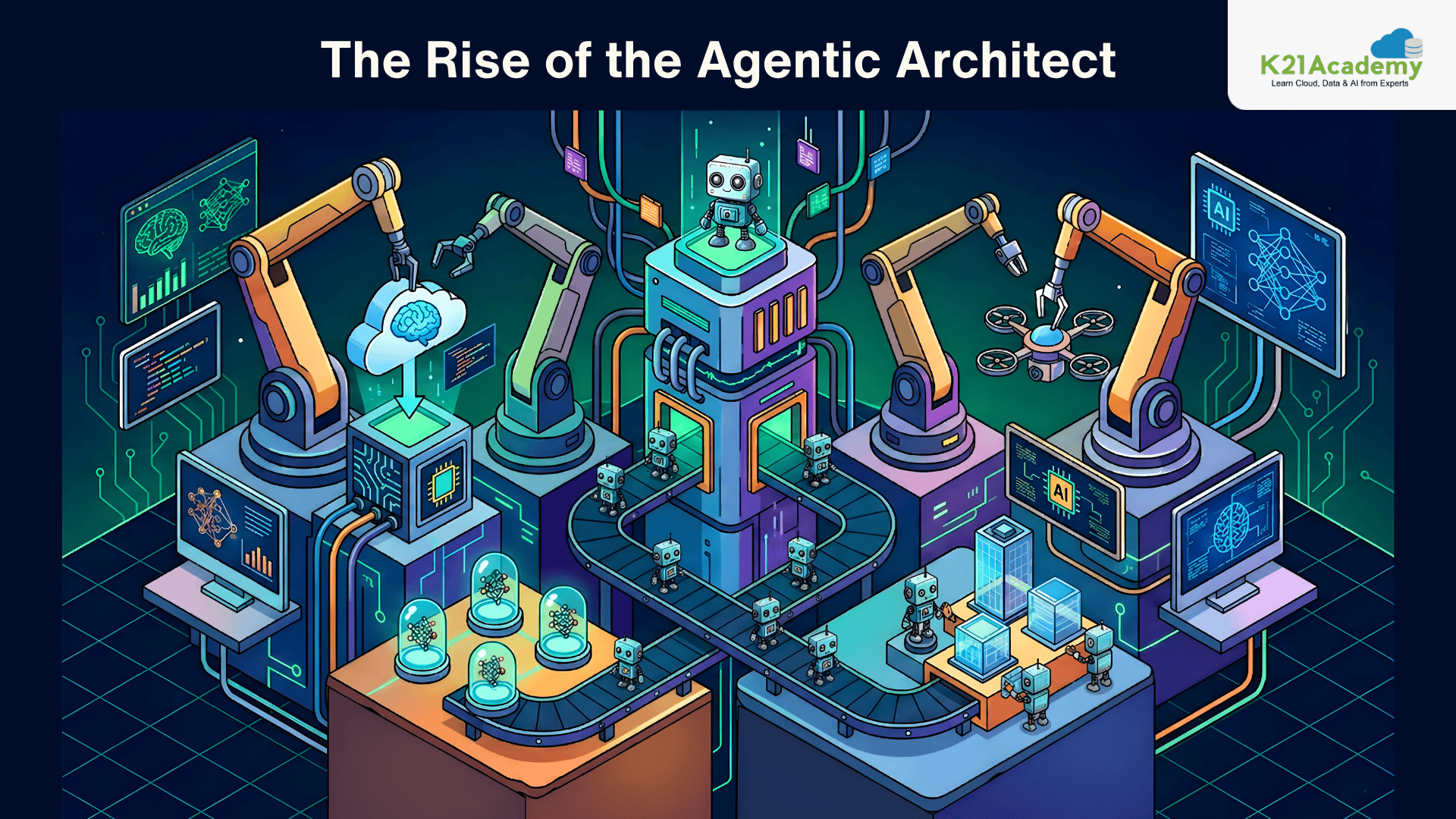




The field of artificial intelligence is developing quickly. What began with data pipelines and machine learning models has evolved into autonomous AI systems that can think, plan, and act. These intelligent systems, often known as AI agents, are revolutionising the way businesses develop and use technology & this has led to the emergence of a new position in the technology industry: the Agentic Architect.
In this blog we will learn more about this new role, career opportunities, key skills & much more. So let’s dive in.

Understanding the Shift: From AI Models to AI Agents
In the past, AI systems were primarily focused on prediction. Machine learning models analyzed historical data and generated outputs such as recommendations, classifications, or forecasts. But today, AI systems are evolving into agents that can perform tasks autonomously. These AI agents can:
- Understand natural language instruction
- Break down complex tasks into smaller steps
- Access tools, APIs, and databases
- Make decisions based on context
- Execute workflows across enterprise systems
AI systems are now doing tasks rather than simply replying to queries. An AI agent in a business setting might, for instance:
- Examine consumer information
- Produce insights
- Make reports
- Trigger business application workflows
It takes a combination of knowledge of cloud infrastructure, system architecture, and artificial intelligence to design such systems. This is where the Agentic Architect comes in.
Related Readings: The Future of AI Agents: Autonomous Decision-Making with AI
What is an Agentic Architect?
An Agentic Architect is a technologist who designs, builds, and orchestrates autonomous AI-driven systems on cloud platforms. Unlike traditional software architects who focus on static services and data flows, Agentic Architects design systems capable of:
- Perceiving their environment (using sensors, data streams, and models)
- Reasoning and making decisions (via AI models and orchestration logic)
- Acting autonomously (triggering workflows, external APIs, or responses)
- Adapting over time (learning and optimizing behavior)
This role blends cloud engineering, AI/ML expertise, systems thinking, and automation design — a combination that’s now highly sought after.
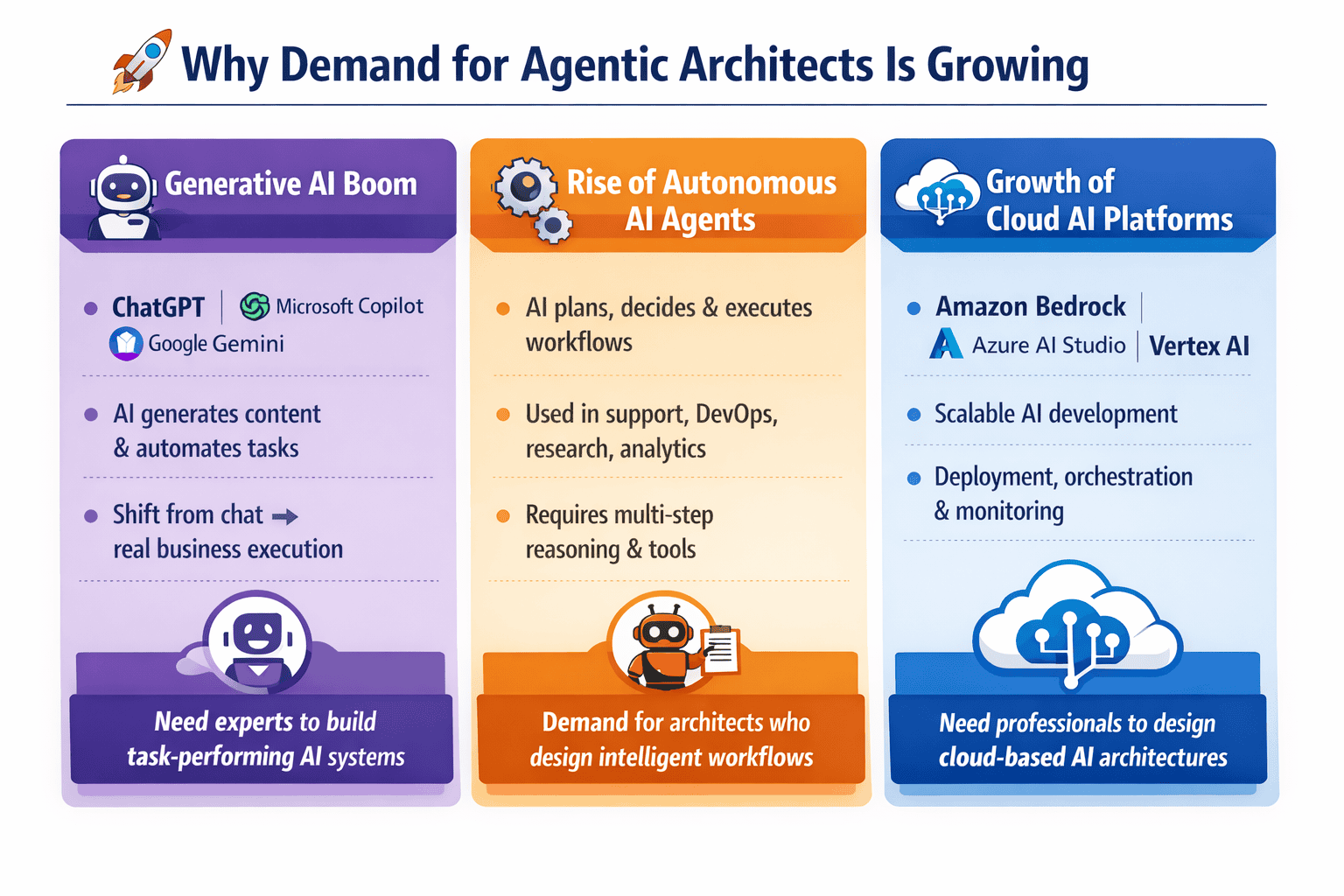
Why Demand for Agentic Architects Is Growing
Several major technology shifts are driving the demand for this new role.
This is being accelerated by three trends: firms are shifting from AI applications using a single model to multi-stage autonomous processes across multiple systems; cloud vendors are releasing agent-orchestration technology (Bedrock Agents, Azure AI Studio, Vertex AI Agent Builder) quicker than the talent required for them can be hired; and the expense of operating agents is such that you require someone who knows about the reasoning layer of AI and cloud economics.
Key Skills Required to Become an Agentic Architect
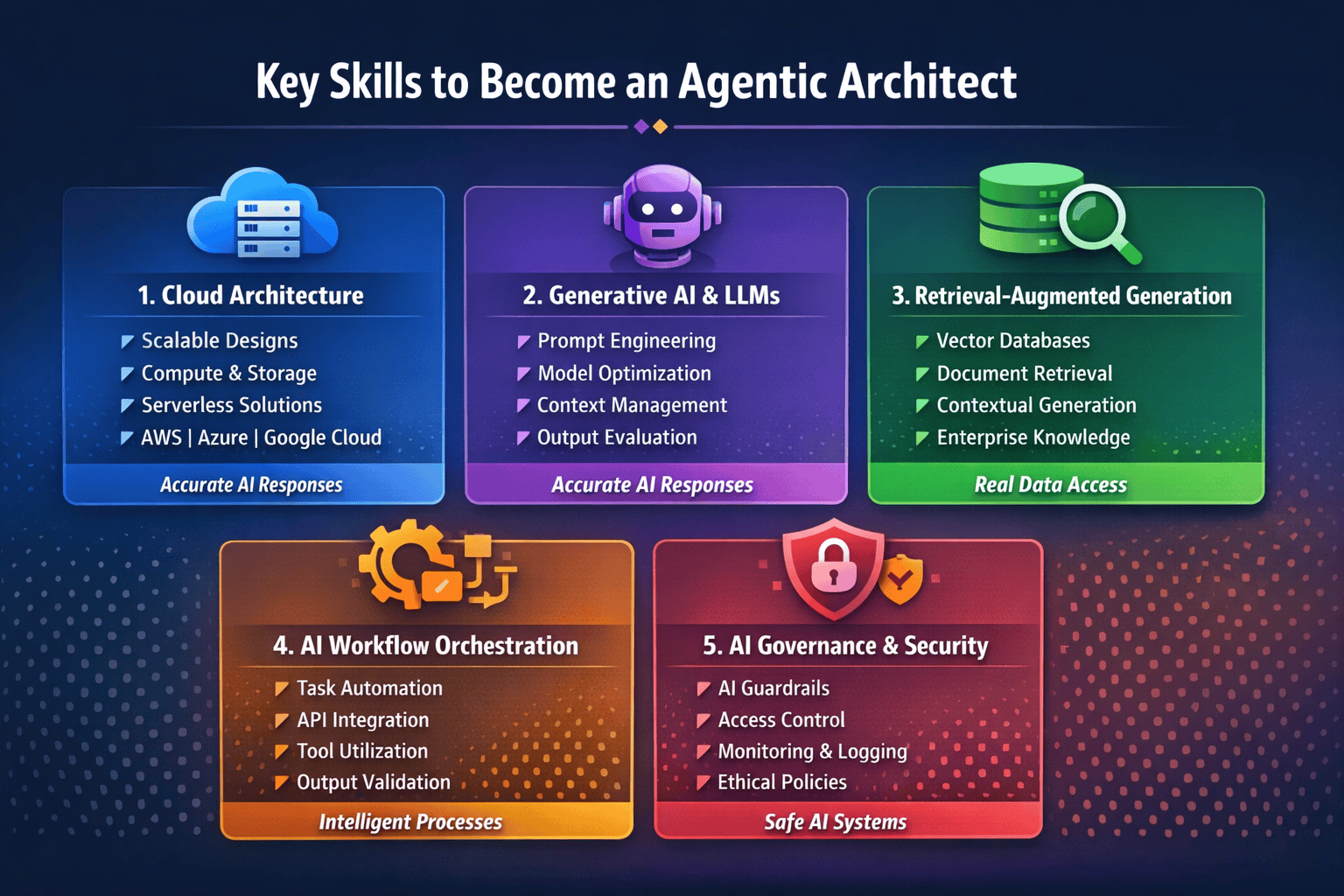
To succeed in this role, professionals need a combination of AI, cloud, and architectural skills.
1) Cloud Architecture
This is the foundation of all modern AI systems. You need to know how to design scalable and reliable cloud-based solutions, manage compute/storage, and build event-driven or serverless systems. Experience with platforms like Amazon Web Services, Microsoft Azure, and Google Cloud helps you deploy and scale AI applications efficiently.
2) Generative AI and LLMs
Agentic systems depend on large language models. You should understand how to interact with and optimize these models including writing effective prompts, choosing the right model, managing tokens, and evaluating outputs.
These skills ensure your AI systems are accurate, efficient, and reliable.
3) Retrieval-Augmented Generation (RAG)
RAG allows an agent to access live, current, or proprietary information in its reasoning rather than just using what the AI learned during its training process. In the case of agentic systems, RAG is not simply a retrieval task but a process of determining whether it should retrieve information, where to retrieve it, and how to weight the retrieved context in its reasoning.
Designing the vector databases and embeddings that facilitate this decision point requires different skills from merely retrieving information.
4) AI Workflow Orchestration
Agentic AI involves multiple steps and tools working together. You must design workflows where AI can plan tasks, interact with APIs, and execute actions automatically. This ensures AI systems can handle complex, real-world business processes end-to-end.
5) AI Governance and Security
As AI becomes more autonomous, controlling its behavior is critical. You need to implement guardrails, access controls, monitoring, and ethical policies. This ensures AI systems are secure, compliant, and trustworthy in enterprise environments.
Related Readings: Why Responsible AI is a Game-Changer for Your Career and Certifications?
Career Opportunities for Agentic Architects
The rise of agentic AI is creating new career paths in the technology industry. Some emerging roles include:
- AI Solutions Architect
- Agentic Systems Architect
- AI Platform Architect
- Generative AI Engineer
- AI Infrastructure Architect
Companies across industries—including finance, healthcare, retail, and technology—are actively investing in AI-driven automation and intelligent systems. As a result, professionals with Cloud AI expertise are in extremely high demand.
How to Start Your Journey Toward Becoming an Agentic Architect
If you want to build a career in this space, here are the recommended steps.
1. Build Strong Cloud Foundations: Learn core cloud services such as compute, storage, networking, and serverless architectures.
2. Understand AI and Machine Learning Concepts: Gain familiarity with machine learning workflows, data pipelines, and model deployment.
3. Learn Generative AI Platform: Explore modern AI platforms like Amazon Bedrock, Azure AI Studio, and Vertex AI.
4. Practice Building AI Applications: Hands-on experience is essential. Build small projects such as AI chatbots, Document analysis systems, AI research assistants & Automated reporting agents
5. Learn AI Architecture Patterns: Study design patterns used in modern AI systems like Retrieval-Augmented Generation (RAG), Multi-agent systems, AI orchestration frameworks
Traditional Architect vs Agentic Architect
| Aspect | Traditional Architect | Agentic Architect |
|---|---|---|
| Core Focus | Designs software & infrastructure systems | Designs intelligent, AI-driven systems |
| Primary Goal | Stability, scalability, performance | Autonomy, reasoning, and decision-making |
| Technology Stack | Cloud, networking, databases | Cloud + AI/LLMs + agent frameworks |
| Workflows | Static, predefined workflows | Dynamic, autonomous, adaptive workflows |
| System Behavior | Rule-based execution | Context-aware, reasoning-based execution |
| Data Usage | Structured data processing | Structured + unstructured + real-time context |
| AI Involvement | Minimal or optional | Core component of system design |
| Decision Making | Human-driven | AI-assisted or AI-driven |
| Tools & Integration | APIs, microservices | APIs + AI tools + orchestration frameworks |
| End Output | Reliable, scalable applications and infrastructure | Intelligent systems that can act & automate tasks |
Conclusion
A new stage of artificial intelligence is emerging, one in which algorithms are no longer restricted to chat responses and forecasts. Rather, AI is evolving into an agentic system that can think, plan, and act. The Agentic Architect is a brand-new, extremely valuable position in the technology ecosystem that is being created by this change.
The next generation of intelligent systems will be designed by experts who mix their knowledge of cloud architecture with artificial intelligence. Today, learning Cloud AI is a strategic career move that will help you get ready for the future of enterprise technology, not merely a technical upgrade. The need for Agentic Architects will only increase as more businesses implement autonomous AI systems.