




Building Generative AI apps on AWS lets developers make tools for writing text, chat bots, reading documents and handling business tasks. They do this with AI models and cloud services.
AWS makes this work easier with services like Amazon Bedrock. Bedrock gives you access to made Foundation Models (FMs). You can also plug in frameworks like LangChain. That way your apps can link AI models to data and tools.
You will need skills like writing and Retrieval-Augmented Generation (RAG). You also need to connect models and roll them out at scale. AWS gives you the infrastructure and services to do all of this.
In this guide, we will look at how to plan, build and run Generative AI Applications on AWS. We will use Amazon Bedrock, LangChain and common design patterns.
Related Reading: Introduction to Generative AI and Its Mechanisms

For a clearer understanding of the differences between AI, ML, DL, and Generative AI, check out this informative video:
What Are Generative AI Applications on AWS?
Generative AI Applications on AWS are intelligent solutions that use Foundation Models (FMs) and AWS cloud services to create content, answer questions, analyze documents, and simplify business tasks.
AWS provides services such as Amazon Bedrock, allowing developers to access pre-trained Foundation Models without building them from scratch. Developers can combine these models with data sources, APIs, and frameworks like LangChain to build applications that meet specific business requirements.
Key Benefits of Building Generative AI Applications on AWS
- Faster Development: Amazon Bedrock provides access to pre-trained models, reducing the time required to build AI applications.
- Scalability: AWS cloud infrastructure supports applications with changing workloads and user demands.
- Security: AWS provides identity management, encryption, and monitoring capabilities to help protect applications and business data.
- Flexibility: Developers can choose from supported Foundation Models and customize applications using prompt engineering, Retrieval-Augmented Generation (RAG), or fine-tuning when needed.
Related Reading: Introduction To Amazon SageMaker Built-in Algorithms
Common Generative AI Applications on AWS
- AI Chatbots: Build conversational assistants for customer support and internal knowledge management.
- Document Analysis: Extract information, summarize documents, and answer questions using business data.
- Content Generation: Generate text, product descriptions, and marketing content.
- Business Automation: Integrate AI models with applications and workflows to automate repetitive tasks.
By combining Amazon Bedrock, AWS infrastructure, and development frameworks, organizations can build Generative AI Applications on AWS that solve real-world business problems.
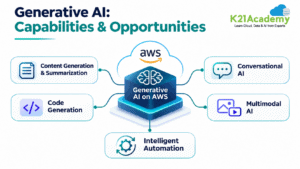
Generative AI: Capabilities and Opportunities
Generative AI enables applications to create content, analyze data, and perform tasks using Foundation Models.
Unlike traditional machine learning systems that primarily focus on prediction and classification, Generative AI can generate text, images, code, and other outputs based on user instructions.
AWS provides services such as Amazon Bedrock, allowing developers to integrate these capabilities into business applications without training Foundation Models from scratch.
Key Capabilities of Generative AI
- Text Generation and Summarization: Create articles, reports, product descriptions, and summaries from user prompts or documents.
- Conversational AI: Build chatbots and virtual assistants that answer questions, support customers, and retrieve relevant information.
- Code Generation: Help developers write, explain, debug, and improve code using AI-powered tools such as Amazon Q Developer.
- Multimodal AI: Process different types of information, including text, images, audio, and video, depending on the capabilities of the selected Foundation Model.
- Intelligent Automation: Combine Generative AI with APIs, business applications, and workflows to automate tasks and support decision-making.
Related Reading: Mastering Generative Adversarial Networks (GANs)
Opportunities for Businesses Using AWS
Organizations can use Amazon Bedrock to develop customer support assistants, knowledge management systems, content generation tools, and document processing applications.
By combining Foundation Models with AWS services and frameworks such as LangChain, developers can build AI solutions that access business data, interact with external tools, and support complex workflows.
These Generative AI capabilities create opportunities to improve productivity, enhance customer experiences, and develop innovative applications across different industries.
To explore this concept further, click here for more insights on Generative AI.
Generative AI: Capabilities and Opportunities
Generative AI enables applications to create content, analyze data, and perform tasks using Foundation Models.
Unlike traditional machine learning systems that primarily focus on prediction and classification, Generative AI can generate text, images, code, and other outputs based on user instructions.
AWS provides services such as Amazon Bedrock, allowing developers to integrate these capabilities into business applications without training Foundation Models from scratch.
Key Capabilities of Generative AI
- Text Generation and Summarization: Create articles, reports, product descriptions, and summaries from user prompts or documents.
- Conversational AI: Build chatbots and virtual assistants that answer questions, support customers, and retrieve relevant information.
- Code Generation: Help developers write, explain, debug, and improve code using AI-powered tools such as Amazon Q Developer.
- Multimodal AI: Process different types of information, including text, images, audio, and video, depending on the capabilities of the selected Foundation Model.
- Intelligent Automation: Combine Generative AI with APIs, business applications, and workflows to automate tasks and support decision-making.
Opportunities for Businesses Using AWS
Organizations can use Amazon Bedrock to build customer support assistants, knowledge management systems, content generation tools, and document processing applications.
By combining Foundation Models with AWS services and frameworks such as LangChain, developers can develop AI solutions that access business data, interact with external tools, and support complex workflows.
These Generative AI capabilities create opportunities to improve productivity, enhance customer experiences, and develop innovative applications across different industries.

Getting Started with Amazon Bedrock
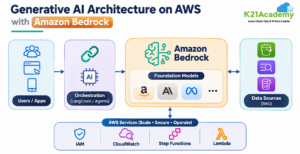
Amazon Bedrock is a fully managed AWS service that provides access to Foundation Models (FMs) for building Generative AI applications. Developers can use it to generate text, analyze documents, create images, and develop AI-powered tools without managing the underlying model infrastructure.
Steps to Get Started with Amazon Bedrock
- Set Up Your AWS Environment: Sign in to the AWS Management Console, open Amazon Bedrock in a supported Region, and configure the required IAM permissions and model access.
- Select a Foundation Model: Explore the models available in Amazon Bedrock and choose one based on your application requirements, such as text generation, summarization, or multimodal processing.
- Test the Model: Use the Amazon Bedrock playgrounds to experiment with prompts, review responses, and adjust model settings.
- Integrate the Model into Your Application: Use Amazon Bedrock APIs or AWS SDKs, such as Boto3 for Python, to connect the model to your application.
- Add Data and Security Controls: Use Amazon Bedrock Knowledge Bases for supported Retrieval-Augmented Generation (RAG) workflows and Amazon Bedrock Guardrails to implement appropriate safeguards.
Amazon Bedrock also offers model customization options for supported models, allowing developers to adapt AI solutions to specific business requirements.
By following these steps, developers can move from experimenting with Foundation Models to building practical Generative AI applications on AWS.
For practical examples and detailed information, click here to access our blog on Amazon Bedrock.
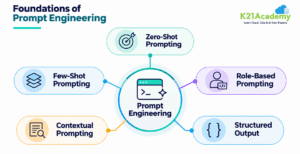
Foundations of Prompt Engineering
Prompt Engineering is the process of designing clear and well-structured instructions that guide Foundation Models to generate relevant and accurate responses. It plays an important role in building Generative AI applications on AWS, helping developers improve output quality without retraining models.
Key Prompt Engineering Techniques
- Zero-Shot Prompting: The model receives instructions without any examples. For instance, asking a model to summarize a customer review directly.
- Few-Shot Prompting: The prompt includes a few examples to help the model understand the expected response format or task.
- Role-Based Prompting: Assigning a specific role or context to the model, such as a customer support assistant or technical advisor.
- Contextual Prompting: Providing relevant background information, documents, or instructions to generate more context-aware responses.
- Structured Output Prompting: Defining the required response format, such as JSON, tables, or step-by-step instructions, to make outputs easier to integrate into applications.
Related Reading: The Essentials of Prompt Engineering
Prompt Engineering with Amazon Bedrock
Amazon Bedrock allows developers to experiment with prompts using supported Foundation Models through its playgrounds and APIs.
Developers can refine instructions, adjust model settings, and test different prompting techniques to improve response relevance and consistency.
For applications requiring business-specific information, Prompt Engineering can be combined with Retrieval-Augmented Generation (RAG) to provide relevant context from external knowledge sources.
By applying effective Prompt Engineering techniques, developers can build Generative AI applications that produce more useful, consistent, and task-specific responses.
To explore this concept further, click here for more insights on Prompt Engineering.
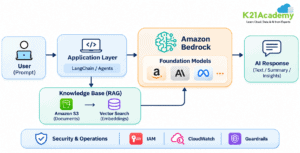
Key Components of a Generative AI Application
Building Generative AI applications on AWS involves combining Foundation Models, data sources, application logic, and cloud services to generate relevant responses and perform tasks.
Each component plays an important role in ensuring the application operates efficiently, securely, and reliably.
1. Foundation Models (FMs)
Foundation Models serve as the core AI component responsible for processing user prompts and generating responses.
Amazon Bedrock provides access to supported Foundation Models for tasks such as text generation, summarization, question answering, and multimodal processing.
2. Data Sources and Knowledge Bases
Generative AI applications often require information from business documents, databases, and other external sources.
Amazon S3 can store documents, while Amazon Bedrock Knowledge Bases supports Retrieval-Augmented Generation (RAG) by retrieving relevant information to provide context for model responses.
3. Embeddings and Vector Search
Embedding models convert text and other supported data into numerical representations called vectors.
Vector search helps applications identify and retrieve information based on semantic similarity, making it useful for document search and RAG applications.
4. Prompt Engineering and Application Logic
Prompt Engineering guides Foundation Models by providing clear instructions and relevant context.
Frameworks such as LangChain help developers connect models with prompts, external tools, and data retrieval workflows. AWS Lambda can also be used to execute application logic.
5. Security and Monitoring
Security controls help protect sensitive information and manage access to Generative AI applications.
AWS Identity and Access Management (IAM), Amazon Bedrock Guardrails, and Amazon CloudWatch provide capabilities for access control, safeguards, and operational monitoring.
By combining these components, developers can build Generative AI applications on AWS that integrate Foundation Models with business data and real-world workflows.
Foundation Models Available in Amazon Bedrock
Amazon Bedrock provides access to pre-trained Foundation Models (FMs) from Amazon and other AI providers. These models support Generative AI tasks such as text generation, document analysis, image creation, and multimodal processing.
Developers can select a Foundation Model based on its capabilities, performance, response time, cost, and application requirements.
1. Amazon Nova Models
Amazon Nova is a family of Foundation Models developed by AWS. Depending on the model, Nova supports text generation, multimodal understanding, and other AI capabilities.
These models can help developers build intelligent assistants, document processing systems, and content generation applications.
Related Reading: Exploring Large Language Models (LLMs)
2. Amazon Titan Models
Amazon Titan offers Foundation Models for tasks such as text embeddings and image generation.
Titan Embeddings models convert information into numerical representations called vectors, making them useful for semantic search, document retrieval, and Retrieval-Augmented Generation (RAG).
3. Third-Party Foundation Models
Amazon Bedrock also provides access to supported Foundation Models from AI providers such as Anthropic, Meta, and Mistral AI.
These models offer capabilities for text generation, reasoning, code development, and conversational AI. Model availability varies depending on the AWS Region and provider.
4. Model Customization and Evaluation
Amazon Bedrock supports customization options for selected Foundation Models, allowing developers to adapt them to specific business requirements.
Developers can evaluate supported models based on response quality, accuracy, safety, latency, and other application-specific criteria.
5. Integrating Foundation Models into Applications
Developers can access supported Foundation Models through Amazon Bedrock APIs and AWS SDKs.
These models can be integrated with AWS Lambda, Amazon API Gateway, and Amazon Bedrock Knowledge Bases to build AI chatbots, document search systems, and automated business workflows.
By selecting the right Foundation Model and combining it with AWS services, developers can build Generative AI applications that meet their performance, cost, and business requirements.
For a deeper dive into this topic, click here to read our detailed blog on Foundation Models
Integrating LangChain with AWS
LangChain is an open-source framework that helps developers build applications powered by Large Language Models (LLMs). It provides tools to connect Foundation Models with prompts, external data sources, APIs, and application workflows.
By integrating LangChain with Amazon Bedrock, developers can build Generative AI applications on AWS without managing the underlying model infrastructure.
Key Features of LangChain with AWS
- Foundation Model Integration: LangChain connects with supported Amazon Bedrock models, allowing developers to generate text, answer questions, and process information using AWS.
- Prompt Management: Developers can use prompt templates to create structured instructions, manage input variables, and maintain consistent interactions with Foundation Models.
- Retrieval-Augmented Generation (RAG): LangChain supports document loading, text splitting, embeddings, and retrieval workflows. This helps applications generate responses using external knowledge sources.
- Tool Integration: LangChain enables models to interact with external APIs, databases, and other tools, supporting advanced application workflows.
- Workflow Orchestration: Developers can combine model calls, retrieval steps, and application logic to build multi-step Generative AI workflows.
How LangChain Works with Amazon Bedrock
Developers can integrate LangChain with Amazon Bedrock using Python and the appropriate AWS integrations.
The process typically involves selecting a supported Foundation Model, configuring AWS credentials and permissions, connecting the model through LangChain, and creating prompts or retrieval workflows.
For example, a business chatbot can use LangChain with Amazon Bedrock to retrieve relevant information from company documents and generate context-aware responses.
By combining LangChain with AWS services, developers can build Generative AI applications for customer support, document analysis, knowledge retrieval, and business automation.

To gain a better understanding, click here for an in-depth explanation of LangChain
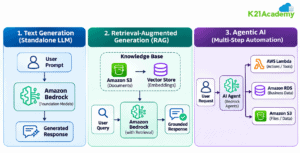
Architecture Patterns for Generative AI on AWS
Architecture patterns define how Foundation Models, data sources, APIs, and AWS services work together to build Generative AI applications. Choosing the right pattern helps developers improve application performance, scalability, and reliability.
AWS supports different Generative AI architecture patterns using services such as Amazon Bedrock, AWS Lambda, Amazon S3, and Amazon Bedrock Knowledge Bases.
1. Direct Model Invocation
This pattern connects an application directly to a Foundation Model through Amazon Bedrock APIs.
It works well for tasks such as text generation, summarization, content creation, and question answering that do not require external knowledge retrieval.
The model generates responses based on its training and the information provided in the prompt.
2. Retrieval-Augmented Generation (RAG)
RAG combines Foundation Models with external knowledge sources to generate more relevant and context-aware responses.
For example, an application can store documents in Amazon S3 and use Amazon Bedrock Knowledge Bases to retrieve relevant information before generating a response.
This allows the model to answer questions using information from business documents.
The pattern is useful for enterprise search, document analysis, and internal knowledge assistants.
3. Conversational AI Architecture
Conversational AI applications allow users to interact with Foundation Models through chat interfaces.
Developers can combine Amazon Bedrock with AWS Lambda and Amazon API Gateway to process user requests, manage application logic, and generate responses.
Conversation history and session context can be maintained using appropriate application storage and state management systems.
This helps applications support consistent interactions across multiple conversation turns.
4. Agent-Based Architecture
Agent-based applications use Foundation Models to select tools, interact with APIs, and coordinate multi-step tasks.
Amazon Bedrock Agents can help orchestrate workflows involving knowledge retrieval, API calls, and actions across connected systems.
These architectures are useful for customer service automation, business process management, and intelligent assistants.
5. Event-Driven Generative AI Architecture
Event-driven applications trigger Generative AI processing when specific events occur.
For example, uploading a document to Amazon S3 can trigger AWS Lambda to process the document and invoke Amazon Bedrock for summarization or information extraction.
This pattern supports automated document processing, content analysis, and workflows that operate without direct user interaction.
By selecting the appropriate architecture pattern, developers can build Generative AI applications on AWS that meet business requirements while maintaining performance, reliability, and scalability.
Real-World Use Cases of Generative AI on AWS
Generative AI applications on AWS help organizations automate tasks, improve customer experiences, and gain valuable insights from business data. By combining Amazon Bedrock with other AWS services, developers can build intelligent solutions for different industries and business requirements.
1. AI-Powered Customer Support
Organizations can build intelligent chatbots that answer customer questions, provide product information, and assist with common support requests.
Amazon Bedrock generates responses, while Amazon Bedrock Knowledge Bases can retrieve relevant information from company documents to provide context-aware answers.
Related Reading: Demystifying Natural Language Processing (NLP)
2. Intelligent Document Processing
Generative AI can help organizations summarize documents, extract important information, and answer questions about business reports.
Developers can combine Amazon S3, Amazon Textract, and Amazon Bedrock to process documents and generate useful insights from their contents.
3. Enterprise Search and Knowledge Management
Businesses can develop AI-powered search applications that help employees find relevant information across internal documents and knowledge sources.
Amazon Bedrock Knowledge Bases supports Retrieval-Augmented Generation (RAG), allowing applications to retrieve relevant information before generating responses.
4. Content Creation and Marketing
Generative AI applications can assist with creating product descriptions, marketing content, email drafts, and social media posts.
Developers can use supported Foundation Models through Amazon Bedrock to generate content based on user instructions and business requirements.
5. Software Development Assistance
Generative AI helps developers write code, explain technical concepts, troubleshoot errors, and improve development workflows.
Amazon Q Developer provides AI-powered coding assistance and AWS-related technical guidance, helping development teams work more efficiently.
Related Reading: Generative AI for Kubernetes: K8sGPT Insights
6. Business Process Automation
Organizations can combine Generative AI with APIs and business applications to automate repetitive workflows.
Amazon Bedrock Agents and AWS Lambda can support workflows involving information retrieval, API interactions, and automated task execution.
These real-world use cases demonstrate how Generative AI applications on AWS can improve productivity, streamline operations, and support intelligent business solutions.
Conclusion
Building Generative AI applications on AWS enables organizations to develop intelligent solutions for customer support, content creation, document analysis, and business automation. Services such as Amazon Bedrock provide access to Foundation Models, while frameworks like LangChain help developers connect AI with external data sources and application workflows.
By combining Prompt Engineering, Retrieval-Augmented Generation (RAG), and appropriate architecture patterns, developers can build Generative AI applications that deliver relevant responses and meet specific business requirements.
AWS also provides tools for security, monitoring, and scalability, helping organizations deploy and manage AI applications effectively. Understanding these technologies allows developers to create reliable, efficient, and scalable Generative AI solutions.
To learn more about setting up and using Amazon Bedrock, refer to the official Amazon Bedrock documentation.
Frequently Asked Questions
Ans: Amazon Bedrock is a fully managed AWS service that provides access to supported Foundation Models without requiring developers to manage the underlying model infrastructure. It integrates with AWS services and supports features such as model customization, knowledge bases, and guardrails. The best platform depends on application requirements, model availability, cost, and security needs.
Ans: Prompt Engineering helps developers create clear instructions that guide Foundation Models to generate relevant responses. Techniques such as zero-shot prompting, few-shot prompting, and contextual prompting can improve output quality. Developers can test and refine prompts using supported models in Amazon Bedrock, although prompt design alone cannot guarantee accurate responses.
Ans: Developers can build customer support chatbots, document summarization tools, enterprise search systems, content generation applications, and automated business workflows. Amazon Bedrock provides access to Foundation Models, while services such as AWS Lambda, Amazon S3, and Amazon Bedrock Knowledge Bases support application integration and data retrieval.
Ans: Developers can use AWS Identity and Access Management (IAM) for access control, encryption to protect sensitive data, Amazon Bedrock Guardrails for supported safeguards, and Amazon CloudWatch for monitoring. Regular model evaluation, output validation, and security testing are also important because these tools cannot eliminate every risk.
Ans: Advanced machine learning expertise is not required to start experimenting with Amazon Bedrock because it provides access to pre-trained Foundation Models. Basic knowledge of AWS, APIs, Python, and Prompt Engineering can help developers build simple applications. More advanced projects may require experience with RAG, application architecture, security, and model evaluation. Q1) Why use Amazon Bedrock to build Generative AI applications on AWS?
Q2) How does Prompt Engineering improve Generative AI applications on AWS?
Q3) What real-world Generative AI applications can I build on AWS?
Q4) How can I improve security and reliability in Generative AI applications on AWS?
Q5) Do I need advanced AI or machine learning knowledge to use Amazon Bedrock?
Next Task For You
Join our EXCLUSIVE Free Session and start your journey toward earning the AWS Certified AI Practitioner certification.
In this interactive session, you’ll gain insights into AI, ML, DL, and Generative AI, all guided by experienced professionals. Whether you’re new to the field or enhancing your skills, this session offers valuable knowledge on the latest AWS AI technologies.
Click the image below to secure your spot today!