

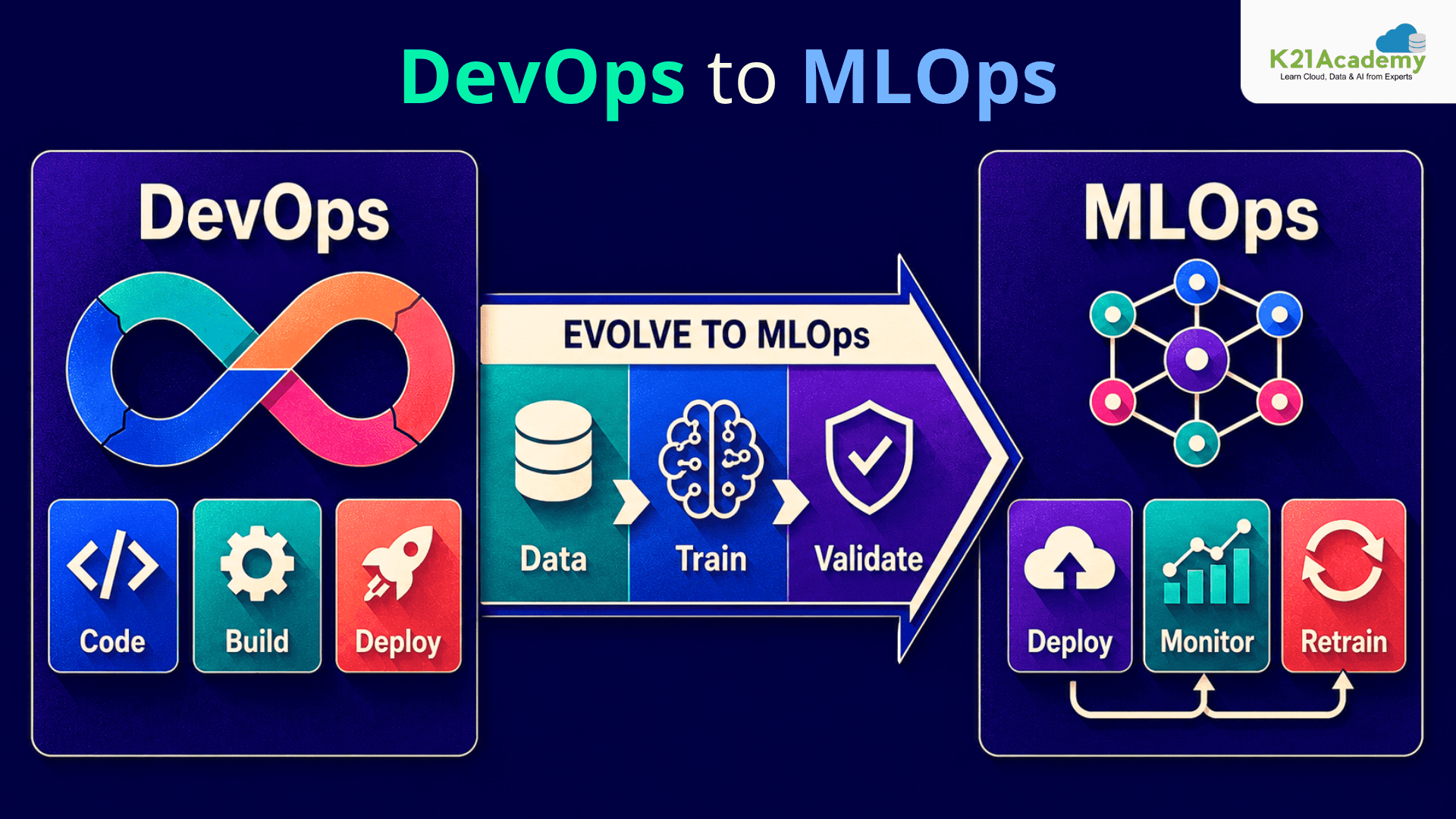




In 2026, switching from DevOps to MLOps is turning up to be one of the best career choices. Businesses need experts who can deploy, automate, monitor, and scale machine learning models in production, not just create them as they quickly adopt AI and machine learning.
The good news? You have a significant advantage if you are already a DevOps engineer. The core competencies of contemporary MLOps are cloud computing, Kubernetes, Docker, CI/CD, Infrastructure as Code (IaC), and automation.
In this guide, you’ll learn the exact DevOps to MLOps career transition path, including the skills to learn, recommended certifications, salary expectations, and a practical roadmap to help you become an MLOps Engineer in 2026.
What Is MLOps?
MLOps combines:
- Machine Learning
- DevOps
- Data Engineering
- Cloud Computing
- Automation
The goal is to manage the complete lifecycle of machine learning systems. Instead of only deploying applications, MLOps engineers deploy and manage AI models throughout production. Typical responsibilities include:
- Constructing ML pipelines
- Automating the deployment of models
- Tracking the performance of the model
- Keeping track of model versions
- Managing data drift
- Scaling AI workloads
- Maintaining AI infrastructure
Why DevOps Engineers Have a Huge Advantage
Many professionals believe that in order to work in MLOps, they must first become data scientists. That is not correct. Instead of creating complex neural networks from scratch, the majority of organisations want experts who can operationalise machine learning.
As a DevOps engineer, you already understand:
- CI/CD pipelines
- Infrastructure as Code
- Kubernetes
- Docker
- Cloud Platforms
- Monitoring & Observability
- Automation
- Security & Governance
These skills represent nearly 70% of an MLOps role. What remains is learning the machine learning side of the equation.
DevOps vs MLOps: What’s Different?
The fundamental ideas are still the same. Managing data and machine learning models as production assets is the largest addition.
| Area | DevOps | MLOps |
|---|---|---|
| Main Focus | Applications | ML Models |
| Deployment | Software Releases | Model Releases |
| Version Control | Code | Code + Models + Data |
| Monitoring | System Health | System + Model Performance |
| Testing | Functional Testing | Model Validation |
| CI/CD | Application Pipelines | ML Pipelines |
| Infrastructure | Cloud Resources | AI Infrastructure |
Skills You Already Have as a DevOps Engineer
You already have a number of production-ready skills, which is one of the main reasons the DevOps to MLOps transfer is simpler than many other AI career pathways. Although MLOps introduces machine learning concepts, DevOps engineers’ daily technologies play a major role in the operational aspect of the profession.
You will primarily be extending your current expertise into AI workflows rather than learning everything from the beginning. Some of the skills you can immediately leverage include:
- Infrastructure as Code (IaC): Terraform, CloudFormation, and Ansible are widely used to provision AI infrastructure.
- Containerization: Docker and Kubernetes remain the preferred technologies for packaging and deploying machine learning applications.
- CI/CD Automation: Jenkins, GitHub Actions, GitLab CI/CD, and Azure DevOps are commonly used to automate model training and deployment pipelines.
- Monitoring & Observability: Experience with Prometheus, Grafana, ELK Stack, or Datadog helps monitor not only infrastructure but also AI services running in production.
New Skills You Must Learn
Although you have a solid basis from your DevOps expertise, switching from DevOps to MLOps necessitates a grasp of how machine learning systems are developed, implemented, and maintained over the course of their lifecycle. Fortunately, you don’t have to work as an AI researcher or data scientist. Rather, you want to become proficient in machine learning so that you can confidently manage and automate production AI systems.
Concentrate on developing one level of knowledge at a time rather than attempting to master everything at once. Employers most frequently seek out MLOps engineers with the following competencies.
1. Machine Learning Fundamentals
Start by learning the basics of how machine learning models work, how they’re trained, and how their performance is measured. You don’t need advanced mathematics, just enough to understand the ML lifecycle.
Focus on:
- Supervised & Unsupervised Learning
- Classification & Regression
- Feature Engineering
- Model Evaluation
Related Readings: Machine Learning Algorithms & its Use Cases
2. Python for Machine Learning
Python is the primary programming language used in MLOps. Familiarize yourself with the core libraries used for data processing and model development.
Key libraries:
- NumPy
- Pandas
- Scikit-learn
- TensorFlow or PyTorch
3. Data Pipelines
Machine learning relies on clean and reliable data. Understanding how data flows from source to model is an important part of MLOps.
Learn:
- ETL/ELT concepts
- Workflow orchestration
- Data validation
4. Model Tracking & Versioning
Machine learning models are updated regularly, making version control essential. Learn how to track experiments, compare models, and manage model versions.
5. Model Monitoring
After deployment, models need continuous monitoring to detect performance issues, data drift, or changing user behavior.
Focus on monitoring:
- Model performance
- Data drift
- Prediction latency
- Data quality
Recommended Certifications for DevOps Professionals
Certifications aren’t mandatory, but they help validate your expertise and make your resume stand out—especially if you’re transitioning into AI for the first time. Rather than collecting multiple certifications, choose one that aligns with the cloud platform you work with most frequently.
AWS Certified Machine Learning Engineer
A great choice for professionals working in AWS environments. AWS Certified ML Engineer certification focuses on building, deploying, and monitoring machine learning solutions using AWS services such as Amazon SageMaker.
Key Skills Covered
- Amazon SageMaker
- ML Pipelines
- Model Deployment
- Monitoring & Security
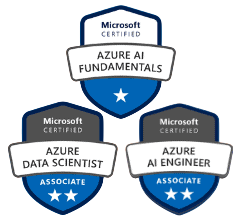
Microsoft Azure AI Engineer Associate
Ideal for professionals working with Microsoft technologies. Microsoft Azure AI Engineer Associate certification covers developing, deploying, and managing AI solutions using Azure AI and Azure Machine Learning.
Key Skills Covered
- Azure Machine Learning
- AI Deployment
- Responsible AI
- Monitoring
Google Professional Machine Learning Engineer
Designed for engineers building production-ready ML systems on Google Cloud. Google Professional Machine Learning Engineer certification emphasizes scalable model deployment using Vertex AI and modern MLOps practices.
Key Skills Covered
- Vertex AI
- Model Deployment
- Data Pipelines
- Production AI
Databricks Machine Learning Associate
A good option for professionals interested in data engineering and collaborative machine learning workflows. It focuses on building, managing, and deploying ML models using the Databricks platform.
Key Skills Covered
- MLflow
- Spark ML
- Feature Engineering
- Model Management
Step-by-Step DevOps to MLOps Roadmap
It takes time to move from DevOps to MLOps. Develop your abilities gradually rather than all at once, from grasping the principles of machine learning to implementing and overseeing AI models in real-world settings.
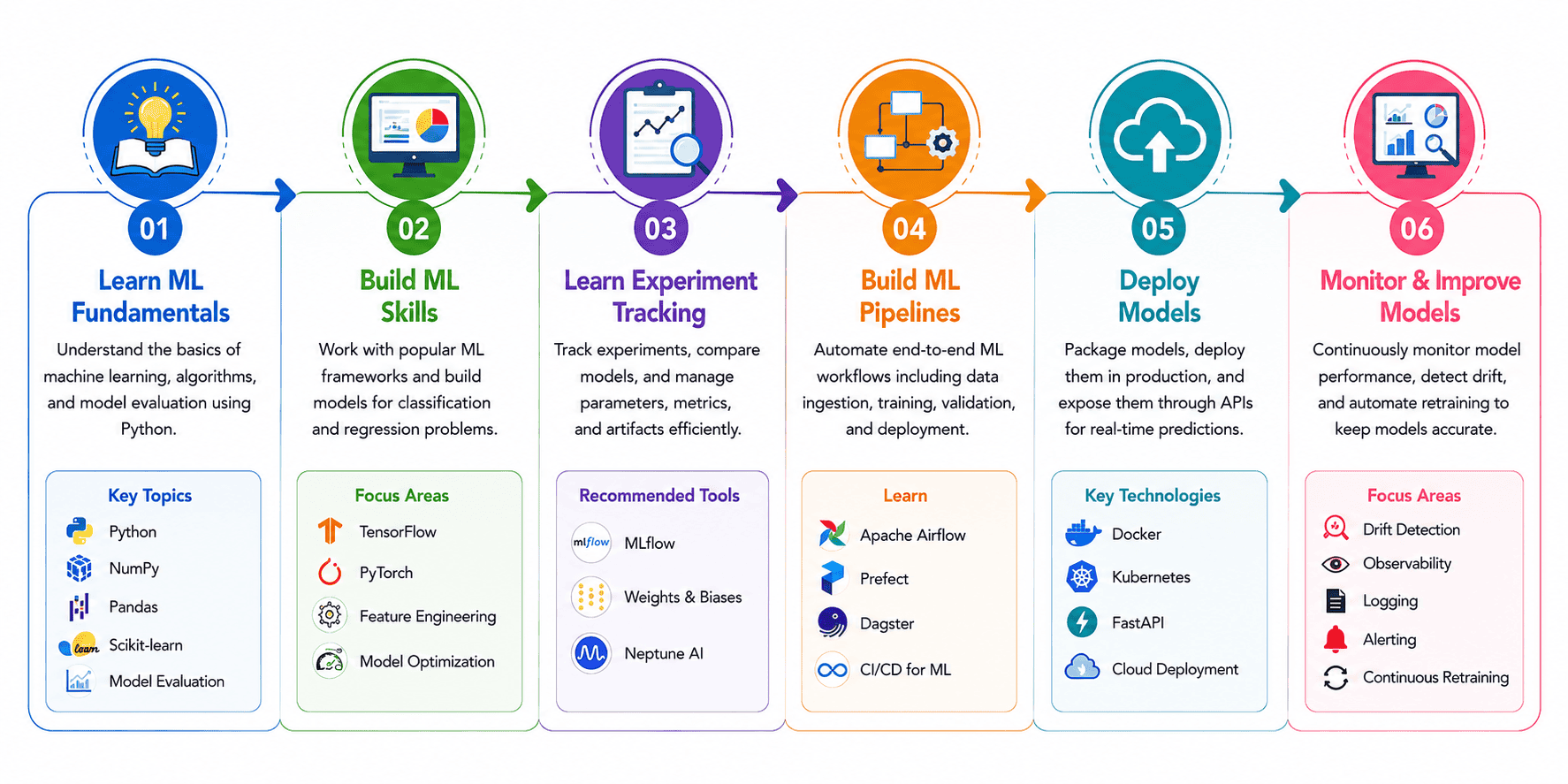
Step 1: Learn Machine Learning Fundamentals
Start by understanding how machine learning models are trained, evaluated, and used to solve real-world problems. This foundation will help you understand the rest of the MLOps lifecycle.
Key Topics
- Python
- NumPy
- Pandas
- Scikit-learn
- Model Evaluation
Step 2: Build Machine Learning Skills
Once you’re familiar with the basics, start building simple ML projects using popular frameworks. This will give you hands-on experience with model development and optimization.
Focus Areas
- TensorFlow
- PyTorch
- Feature Engineering
- Model Optimization
Step 3: Learn Experiment Tracking
Machine learning involves testing multiple models and configurations. Learn how to track experiments, manage model versions, and compare results efficiently.
Recommended Tools
- MLflow
- Weights & Biases
- Neptune AI
Step 4: Build ML Pipelines
Automate the complete ML workflow from data preparation to model deploymen using orchestration tools. This is where your DevOps automation skills become highly valuable.
Learn
- Apache Airflow
- Prefect
- Dagster
- CI/CD for ML
Related Readings: Top 20 MLOps Tools to Learn | K21Academy
Step 5: Deploy Models
Package trained models into containers and deploy them on cloud platforms or Kubernetes clusters, making them available for real-time predictions.
Key Technologies
- Docker
- Kubernetes
- FastAPI
- Cloud Deployment
Related Readings: How to Select ML Models in MLOps: A Practical Guide for AI Engineers
Step 6: Monitor and Improve Models
After deployment, continuously monitor model performance, detect data drift, and retrain models when needed to keep predictions accurate over time.
Focus Areas
- Drift Detection
- Observability
- Logging
- Alerting
- Continuous Retraining
DevOps to MLOps Salary in 2026
One of the biggest reasons professionals are making the DevOps to MLOps transition is the growing demand for engineers who can operationalize AI systems. Because MLOps combines cloud engineering, automation, and machine learning, organizations are willing to pay a premium for professionals with this unique skill set.
| Role | Average Salary (US) |
|---|---|
| DevOps Engineer | $110,000–$150,000 |
| Senior DevOps Engineer | $140,000–$190,000 |
| MLOps Engineer | $140,000–$220,000 |
| Senior MLOps Engineer | $180,000–$280,000+ |
| AI Platform Engineer | $200,000–$320,000+ |
In India, experienced MLOps engineers also command higher compensation than many traditional DevOps roles, particularly within AI-focused startups, cloud consulting firms, and large enterprises investing heavily in machine learning initiatives.
Go through our MLOps interview question guide thoroughly for better interview preparations.
Is DevOps to MLOps Worth It in 2026?
For most DevOps professionals, the answer is a resounding yes. Engineers that can bridge the gap between machine learning development and production operations are in high demand due to the fast deployment of AI. DevOps engineers are in a great position to close this gap with comparatively minimal further training because they already have experience with cloud platforms, automation, containerisation, CI/CD, and monitoring.
You may uncover intriguing career opportunities in one of the fastest-growing areas of technology by mastering a few key MLOps tools, studying machine learning foundations, and developing a portfolio of real-world projects.
Making the switch from DevOps to MLOps doesn’t require you to start from scratch; rather, it requires you to build on your current talents and apply them to the upcoming generation of intelligent software systems.
Next Task For You
Don’t miss our EXCLUSIVE Free Training on MLOps!  This session is ideal for aspiring Machine Learning Engineers, Data Scientists, and DevOps Professionals looking to master the art of operationalizing machine learning workflows. Dive into the world of MLOps with hands-on insights on CI/CD pipelines, ML model versioning, containerization, and monitoring.