

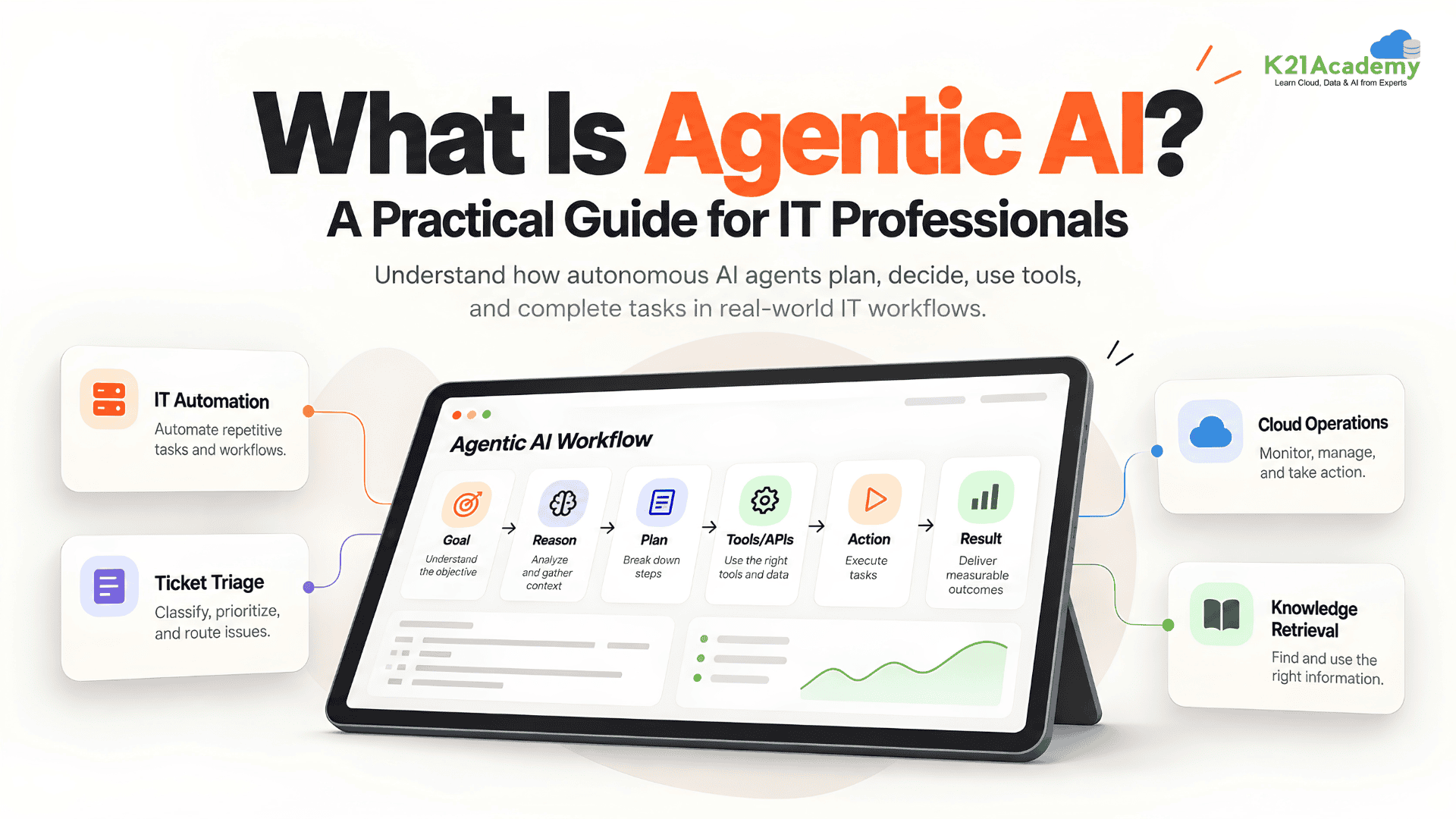



AI is evolving beyond simple question-answering chatbots. These days, an AI system can be linked to your codebase, cloud environment, databases, monitoring tools, and business apps. It can do tasks independently rather than waiting for instructions at every stage.
Imagine telling an AI:
“Find out why the latest production deployment failed.”
It checks the deployment logs, reviews recent code changes, looks at monitoring data, connects the findings, and suggests what should happen next. That is where Agentic AI comes in.
But what is Agentic AI really? Is it just another name for Generative AI? How is it different from traditional automation or RAG? And more importantly, how does it actually fit into the real systems IT professionals build and manage?
This guide breaks down Agentic AI in practical terms, using familiar software, cloud, and DevOps scenarios rather than abstract AI concepts.
What Is Agentic AI?
Today, the majority of AI applications are designed to respond. After you submit a query and give some background information, the AI responds. However, what happens if you want the AI to accomplish something rather than only provide a response?
For example:
“Find out why our production deployment failed and suggest what we should do next.”
An Agentic AI system can examine logs, examine recent deployments, examine monitoring data, evaluate the findings, and determine what it should look into next rather than merely explaining typical deployment errors.
That is the simplest way to understand what is Agentic AI.
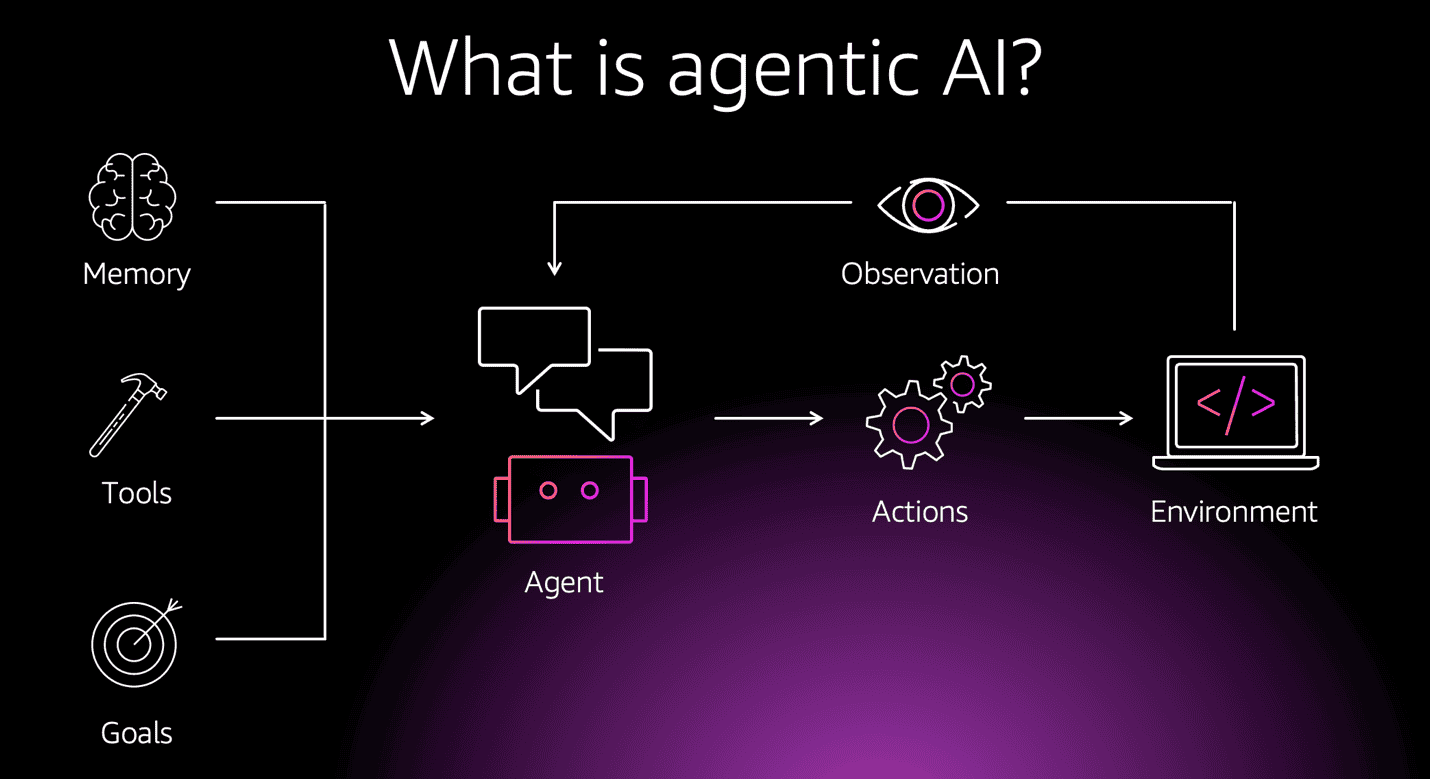
AI systems that can reason, use tools, observe outcomes, and take the next proper action in order to achieve a goal are referred to as agentic AI.
Because agents may communicate with the technologies you already use, like APIs, cloud platforms, CI/CD tools, databases, monitoring systems, and internal applications, which becomes very helpful for IT workers.
Related Readings: 8 Best Agentic AI Courses for 2026: Pricing, Curriculum & Career Outcomes
How Does Agentic AI Work?
Think of an AI agent as a continuous loop:
Goal → Reason → Act → Observe → Decide → Act Again
Consider a simple DevOps example.
You tell an agent:
“Investigate the increase in API errors.”
The agent could:
- Check application metrics
- Look up recent logs
- Review the latest deployment
- Look for configuration changes
- Compare when the errors started
- Determine a probable reason
- Recommend a remediation
- Check the outcome following the activity
The important part is that the agent isn’t following only one predefined instruction. It uses the result of one step to determine what to do next.
What Is Agentic AI Compared With Generative AI?
This is where many people get confused. Generative AI is primarily focused on creating a response whereas Agentic AI is focused on achieving an outcome.
| Technology | How It Works | Simple Example |
|---|---|---|
| Generative AI | Generates content based on a prompt | “Explain why a Kubernetes deployment failed.” |
| RAG | Retrieves relevant information and uses it to generate a response | “Check our runbook and tell me how to handle this deployment failure.” |
| Agentic AI | Works toward a goal by reasoning, using tools, and taking multiple actions | “Investigate this deployment failure and recommend the next action.” |
For example:
Generative AI:
“Explain why a Kubernetes deployment might fail.”
RAG:
“According to our internal runbook, what should I check when a Kubernetes deployment fails?”
Agentic AI:
“Investigate this Kubernetes deployment failure.”
The agent could retrieve the runbook, inspect the deployment, check logs, analyse the results, and recommend the next action.
RAG can therefore be part of an Agentic AI system, but RAG itself isn’t an agent.
Related Readings: Generative AI vs Agentic AI: Complete Career Guide for IT Professionals
A Practical Agentic AI Example for IT
Let’s take something familiar to software and DevOps teams: a failed production deployment.
Normally, an engineer might need to:
- Check Jenkins or another CI/CD platform.
- Read deployment logs.
- Check application monitoring.
- Review recent Git changes.
- Search internal documentation.
- Determine the likely cause.
- Decide what to do next.
An agentic system could coordinate much of this process.
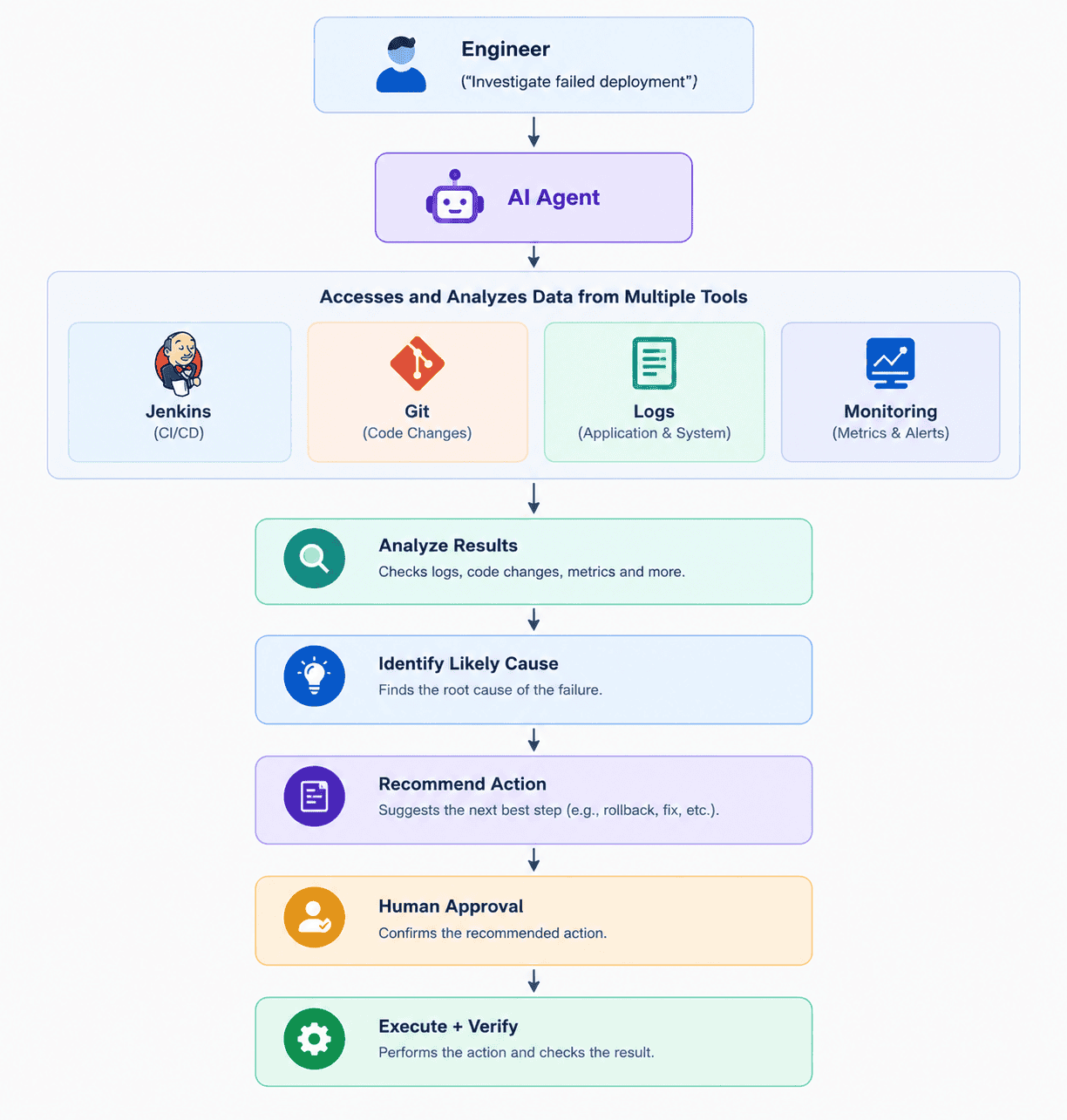
Jenkins, Git, and your monitoring tools don’t need to be replaced by the agent. It can serve as a layer of intelligence connecting them. In an industry setting, that is one of the most useful ways to conceptualise Agentic AI.
Agentic AI vs Traditional Automation
Agentic AI and automation are related, but they aren’t the same.
Traditional automation usually follows predefined logic:
If deployment fails → rollback deployment.
An agentic workflow can handle a less predictable situation:
Deployment failed → investigate what happened → determine the appropriate next step.
It might decide to:
- Check the logs first
- Investigate a recent code change
- Compare infrastructure metrics
- Search a runbook
- Ask for human approval before making a change
This makes Agentic AI useful for tasks where the exact path isn’t always known beforehand. But that doesn’t mean agents should have unlimited access.
Where Is Agentic AI Being Used?
The most effective use cases aren’t always eye-catching. Agentic AI is especially helpful when a task involves several processes, several systems, and some decision-making.
Software Engineering
Agents can help with:
- Bug investigation
- Code analysis
- Test generation
- Test failure analysis
- Pull-request workflows
DevOps and SRE
Common applications include:
- Incident investigation
- Deployment troubleshooting
- Log analysis
- Infrastructure diagnostics
- Release management
Cloud Operations
Agents can assist with:
- Resource analysis
- Cost optimization
- Configuration checks
- Cloud troubleshooting
IT Support
An agent can:
- Investigate tickets
- Search internal documentation
- Perform approved troubleshooting
- Update tickets
- Escalate issues
Give the agent a goal, provide the right tools, and define what it is allowed to do.
What an Agentic AI Architecture Looks Like?
A basic enterprise agent doesn’t need to be mysterious. At a high level:
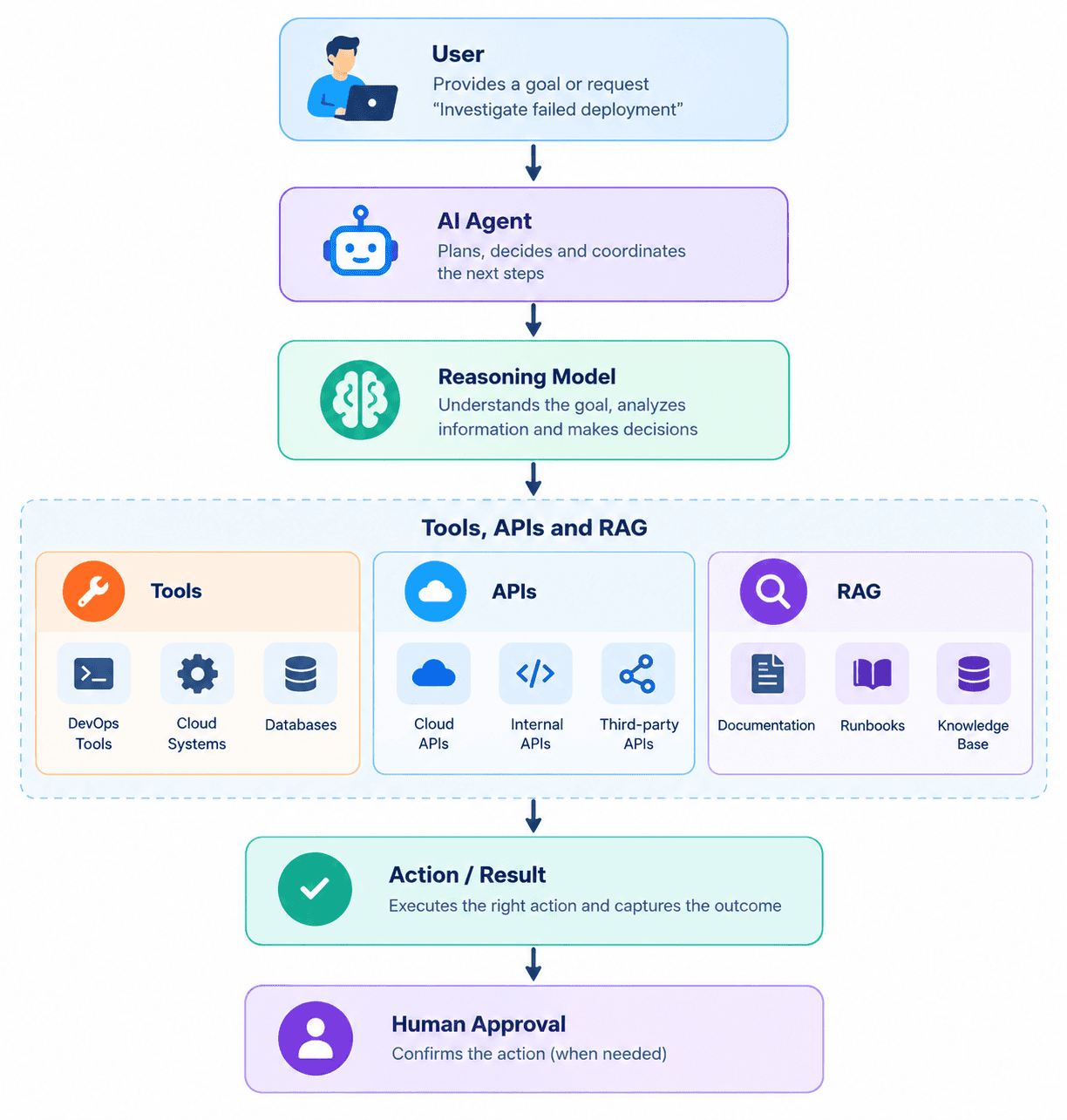
The LLM is only one part of the architecture. The surrounding engineering determines what the agent can actually access and do. That means concepts such as APIs, authentication, permissions, state management, logging, monitoring, and error handling still matter.
What Skills Do IT Professionals Need for Agentic AI?
You don’t have to start from scratch if you are currently an architect, software engineer, cloud engineer, or DevOps specialist. A large portion of the foundation is provided by your current engineering skills.
You should focus on understanding:
- LLM fundamentals
- Prompting and context
- Tool/function calling
- RAG
- Agent orchestration
- APIs and integrations
- Python or TypeScript
- Cloud platforms
- AI security and guardrails
- Agent evaluation and observability
Frameworks such as LangGraph, LangChain, AutoGen, and CrewAI can help you build agentic workflows. But don’t focus only on frameworks. Understanding how an agent makes decisions, interacts with tools, maintains state, and handles failures is more valuable for building production systems.
The Real Question: How Much Should an Agent Be Allowed to Do?
When discussing what is Agentic AI, autonomy is an important part of the conversation.
The question isn’t simply:
“Can an AI agent perform this action?”
It’s:
“Should the agent be allowed to perform this action automatically?”
For example:
| Action | Typical Control |
|---|---|
| Read application logs | Automatic |
| Analyze monitoring data | Automatic |
| Create an incident ticket | Limited permission |
| Restart a test service | Automatic or approval |
| Roll back production | Human approval |
| Delete production infrastructure | Strict authorization |
This is why enterprise Agentic AI typically combines AI reasoning with deterministic automation and human oversight.
What Is the Future of Agentic AI for IT Professionals?
It’s not only that models are becoming better at producing text that makes Agentic AI intriguing. The reason for this is that AI is starting to be able to communicate with the systems where real IT work is done.
A future workflow might look like this:
Engineer → AI Agent → Enterprise Tools → Automation → Verification
Instead of asking an AI:
“How do I troubleshoot this issue?”
you may increasingly ask:
“Investigate this issue and prepare the next action.”
The AI can then gather information, work across multiple systems, and bring the task closer to completion. For IT professionals, that creates opportunities in AI engineering, AI infrastructure, agent orchestration, AI DevOps, AI architecture, security, and enterprise automation.
Related Readings: How to Become an Agentic AI Expert in 2026?
Conclusion
So, what is Agentic AI?
In simple terms, agentic AI is AI that can work toward a goal by making decisions, utilising tools, learning from outcomes, and taking the next step.
Replacing current engineering systems isn’t really valuable to IT experts. Git, Jenkins, Kubernetes, cloud platforms, databases, APIs, monitoring tools, and corporate apps are just a few of the technologies you already use. The idea is to add an intelligent layer to them. Agentic AI is especially pertinent to those who create and manage real-world systems because of this.