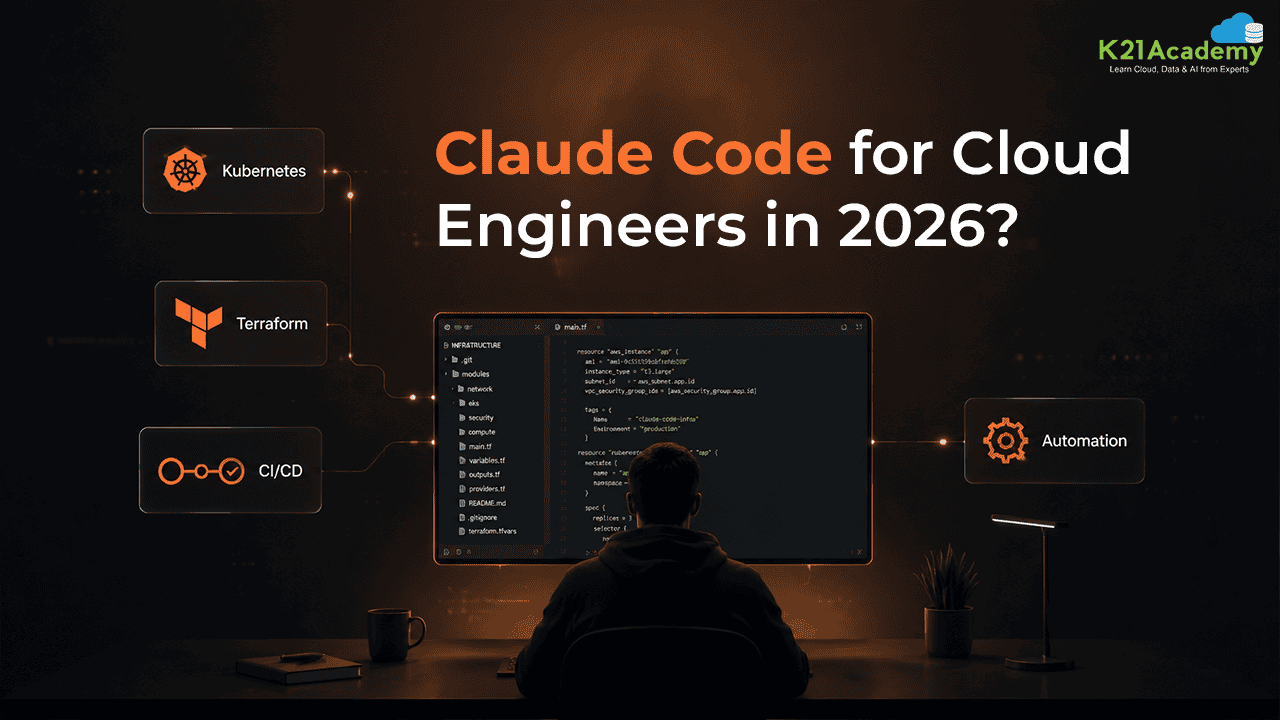





A major shift is quietly happening in cloud engineering right now.
For years, cloud engineers were judged mostly on certifications, infrastructure knowledge, and deployment experience.
But in 2026, something else is starting to separate high-paying engineers from everyone else:
AI-assisted infrastructure engineering.
The cloud industry is changing faster than many engineers expected. Companies are no longer hiring only for basic AWS, Azure, or Kubernetes knowledge. They now want engineers who can move faster, automate aggressively, manage AI workloads, and work effectively with AI coding agents.
That is exactly why Claude Code has become such a hot topic among cloud engineers.
Some people believe learning Claude Code is one of the smartest career investments you can make in 2026.
Others think it is mostly hype and another temporary AI trend.
So what is the truth?
Is Claude Code actually worth learning for cloud engineers?
More importantly:
- Will it increase your salary?
- Does it provide real ROI?
- Or is it just another tool that sounds impressive on social media?
The answer is surprisingly practical.

What Exactly Is Claude Code?
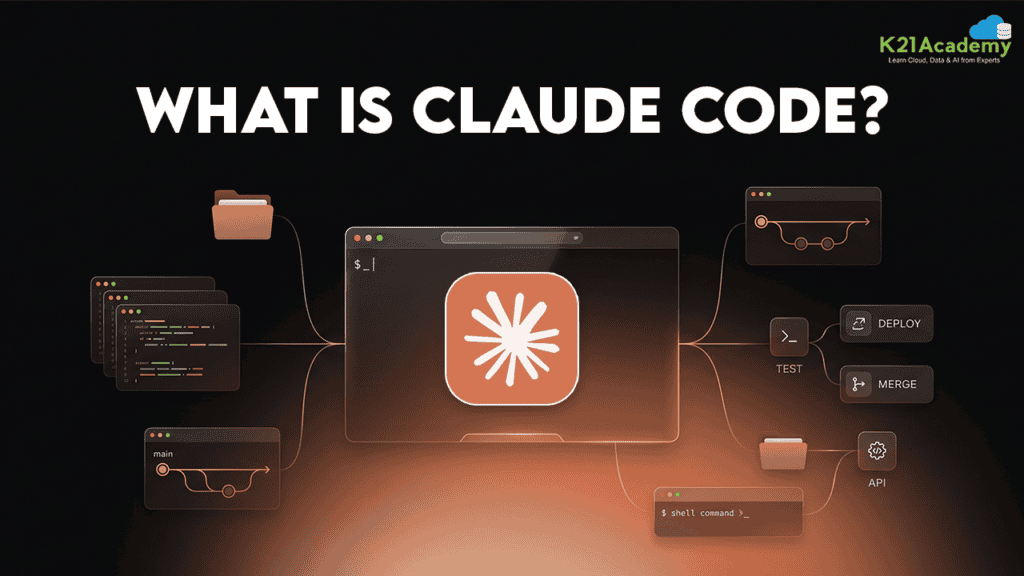
Claude Code is Anthropic’s AI-powered coding agent built for real engineering workflows.
Unlike older AI coding assistants that mainly autocomplete snippets, Claude Code can:
- inspect repositories,
- execute terminal commands,
- refactor projects,
- debug infrastructure,
- edit multiple files,
- automate workflows,
- assist with deployment tasks.
For cloud engineers, this becomes especially useful because modern infrastructure work is incredibly repetitive and complex.
A typical cloud workflow may involve:
- Terraform,
- Kubernetes,
- CI/CD pipelines,
- IAM policies,
- observability stacks,
- Docker,
- cloud APIs,
- serverless systems.
Managing all of that manually consumes huge amounts of engineering time.
Claude Code attempts to reduce that operational burden by acting more like an intelligent infrastructure assistant than a traditional chatbot.
And honestly, that is why companies are paying attention.
If you really want to master Claude you can also prepare for this official certification: Claude Certified Architect Foundations.
Why Cloud Engineers Are Suddenly Paying Attention?
Cloud engineering is no longer just “server management.”
In 2026, cloud teams are expected to:
- manage AI infrastructure,
- optimize inference workloads,
- automate deployments,
- reduce cloud spend,
- improve reliability,
- accelerate release cycles.
At the same time, infrastructure complexity keeps increasing.
This creates enormous pressure on engineering teams.
Cloud engineers now spend large portions of their day dealing with:
- debugging deployment issues,
- updating IaC templates,
- fixing pipelines,
- reviewing configs,
- managing Kubernetes clusters,
- handling monitoring systems.
Claude Code helps automate parts of that engineering overhead.
That productivity improvement matters because companies increasingly reward engineers who can operate infrastructure at higher speed and scale.
And according to multiple salary discussions in 2026, AI infrastructure and automation skills are becoming major compensation differentiators for cloud engineers.
Related Readings:- Claude Code for AI/ML Engineers: Should You Invest the Time? Honest 2026 Worth-It Breakdown
What Makes Claude Code Different for Cloud Work?
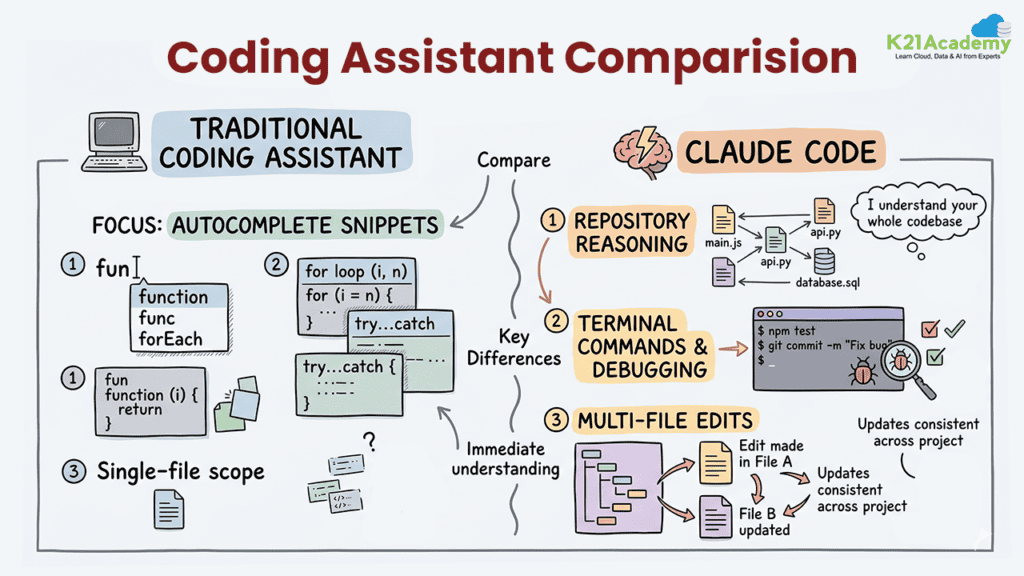
The biggest difference is context understanding.
Cloud systems are rarely isolated.
A single infrastructure change may affect:
- networking,
- security policies,
- deployment pipelines,
- autoscaling,
- monitoring systems,
- permissions.
Traditional coding assistants often fail when workflows become too large or interconnected.
Claude Code performs better in larger engineering contexts because it can reason across multiple files, repositories, and infrastructure relationships more effectively.
That makes it useful for:
- infrastructure debugging,
- Terraform refactoring,
- Kubernetes troubleshooting,
- deployment automation,
- repository-wide updates.
Instead of manually tracing configurations across dozens of files, engineers can delegate part of that investigation process to the AI system.
That changes productivity dramatically.
Related Readings: Claude Code vs GitHub Copilot vs Cursor: Which AI Coding Assistant Should You Learn?
The Biggest Advantage: Large Context Infrastructure Reasoning
This is probably the most underrated benefit for cloud engineers.
Infrastructure repositories become massive very quickly.
Especially inside enterprise environments.
A cloud engineering repo may include:
- Terraform modules,
- Kubernetes manifests,
- Helm charts,
- CI/CD workflows,
- monitoring configs,
- policy files,
- deployment scripts.
Most GenAI assistants lose coherence once the project becomes too large.
Claude Code’s larger-context reasoning helps it maintain better awareness across complicated infrastructure systems.
That means cloud engineers spend less time repeatedly explaining:
- architecture,
- deployment structure,
- dependency relationships,
- repository conventions.
For infrastructure-heavy environments, this becomes genuinely valuable.
Related Readings: Top 10 Claude Code Use Cases Every Developer Should Know
Where Claude Code Is Surprisingly Useful for Cloud Engineers?
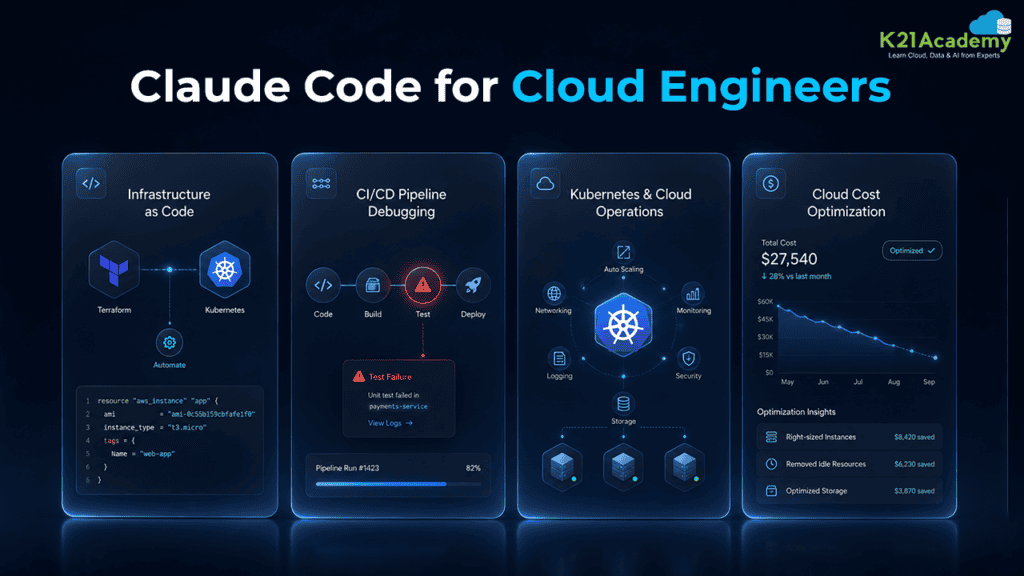
Most people assume Claude Code is only useful for software developers.
That is not true anymore.
Some of its strongest use cases are actually infrastructure-related.
1. Infrastructure as Code (IaC)
This is probably one of the best real-world use cases.
Claude Code performs surprisingly well with:
- Terraform,
- Pulumi,
- Kubernetes YAML,
- deployment automation,
- configuration cleanup.
It can help:
- restructure IaC modules,
- identify duplicated logic,
- improve configuration consistency,
- automate repetitive infrastructure tasks.
For engineers managing large cloud environments, that can save enormous amounts of time.
2. CI/CD Pipeline Debugging
Cloud engineers spend huge amounts of time debugging pipelines.
Sometimes failures are caused by:
- environment mismatches,
- permissions,
- secrets,
- deployment timing,
- dependency conflicts.
Claude Code can inspect logs, trace workflows, and help identify pipeline issues much faster than manual investigation alone.
That workflow acceleration becomes extremely valuable in fast-moving DevOps teams.
3. Kubernetes and Cloud Operations
Kubernetes complexity continues to overwhelm many teams.
Claude Code helps simplify parts of that operational burden by assisting with:
- manifest analysis,
- deployment troubleshooting,
- configuration review,
- autoscaling logic,
- infrastructure documentation.
It is not replacing SRE expertise.
But it absolutely reduces repetitive operational work.
4. Cloud Cost Optimization
This is becoming a massive area in 2026.
Cloud costs are exploding due to:
- AI workloads,
- GPU usage,
- inference scaling,
- multi-cloud deployments.
Claude Code can help engineers analyze infrastructure patterns and optimize deployment logic more efficiently.
That matters because businesses increasingly care about engineers who reduce operational costs, not just maintain systems.
Related Readings: The Best Chatbot Development Tools
The Hype Problem Nobody Talks About
Now let’s discuss reality.
Social media exaggerates AI coding tools massively.
Some posts make it sound like cloud engineers will soon become unnecessary.
That is simply false.
Claude Code still struggles with:
- ambiguous infrastructure requirements,
- edge cases,
- architecture tradeoffs,
- security-critical decisions,
- production reliability.
Research into AI coding systems also shows recurring problems involving configuration errors, command failures, and integration issues.

This becomes especially dangerous in cloud engineering because infrastructure mistakes can create:
- downtime,
- security vulnerabilities,
- deployment failures,
- cost overruns.
AI-generated infrastructure code still requires careful review.
And experienced engineers know that infrastructure mistakes are often far more expensive than application bugs.
Related Readings: Comparing the Best AI Chatbots for Your Business: What’s Best for You?
The Learning Curve Nobody Talks About
This is important.
Claude Code is not a beginner shortcut.
The engineers getting the biggest productivity gains are usually:
- already experienced,
- strong in infrastructure fundamentals,
- good at system design,
- disciplined with workflows.
Claude amplifies engineering capability.
It does not magically create expertise.
To use it effectively, cloud engineers still need:
- architecture knowledge,
- networking fundamentals,
- security awareness,
- debugging ability,
- operational judgment.
Without that foundation, AI-generated infrastructure quickly becomes dangerous.
Ironically, the better the engineer, the more useful Claude Code becomes.
Related Readings:- 7 System Design Patterns Every Cloud AI Engineer Should know
Is It Better Than ChatGPT for Cloud Engineers?
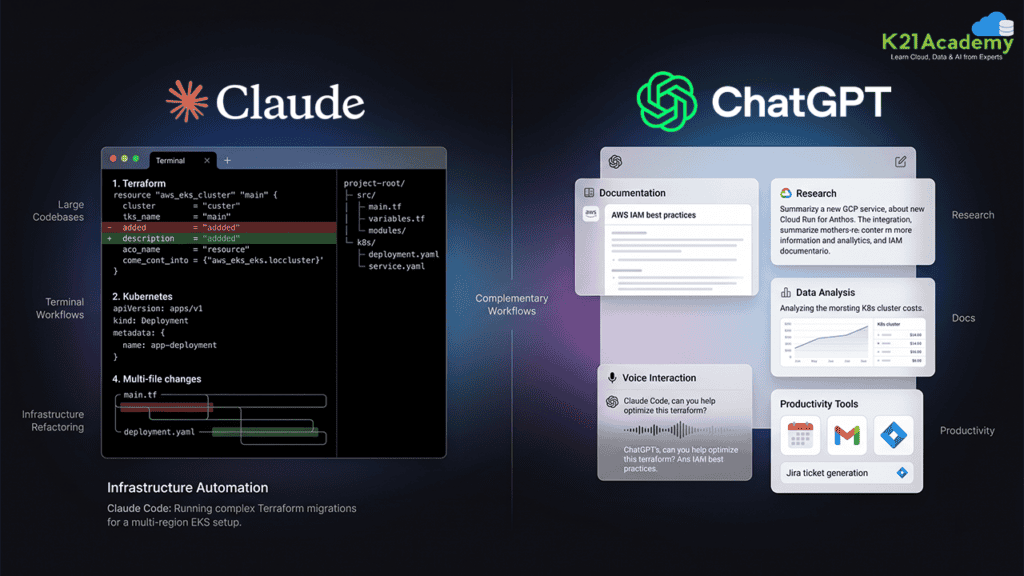
This depends on your workflow.
Claude Code is generally stronger for:
- repository reasoning,
- infrastructure refactoring,
- large-context engineering,
- terminal-based workflows,
- multi-file changes.
But ChatGPT still performs better for:
- broader productivity tasks,
- multimodal workflows,
- documentation generation,
- data analysis,
- voice interaction,
- general research.
A lot of cloud engineers are now combining both tools:
- Claude for infrastructure and engineering workflows,
- ChatGPT for research, automation ideas, documentation, and productivity.
The tools are increasingly complementary rather than direct competitors.
Related Readings:- Claude Code vs ChatGPT Plus
Salary Impact: Does Claude Code Actually Increase Pay?
This is the question most engineers actually care about.
And honestly?
Yes, AI-assisted engineering skills are starting to influence salaries.
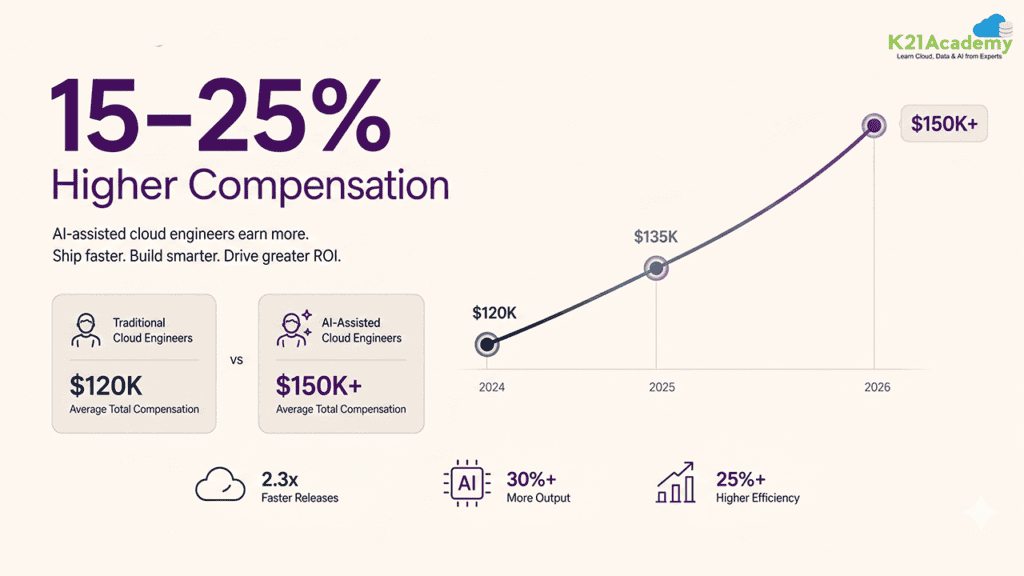
According to salary guides and industry discussions, engineers with agentic ai, coding and AI-assisted workflow experience are increasingly receiving higher compensation compared to equivalent profiles without those skills.
One 2026 salary guide estimated:
- 15–25% higher compensation for developers skilled in Claude Code workflows.
Cloud engineering specifically is also seeing large salary gaps emerging between:
- general infrastructure admins,
- AI infrastructure specialists,
- automation-focused platform engineers.
Companies increasingly value engineers who can:
- automate aggressively,
- manage AI infrastructure,
- reduce deployment friction,
- improve engineering velocity.
That trend is becoming difficult to ignore.
The Cost Question: Is the ROI Real?
For serious cloud engineers, the ROI can become obvious surprisingly quickly.
Claude Code reduces time spent on:
- repetitive configuration work,
- debugging,
- documentation,
- infrastructure boilerplate,
- deployment troubleshooting.
Some reports estimate extremely high productivity returns for engineering teams using Claude Code effectively.
However, there is an important caveat.
AI usage costs are also increasing rapidly as organizations scale these tools.
The good news?
Even with rising AI tooling costs, many businesses still consider the productivity gains cheaper than additional engineering hires.
For individual engineers, the time-to-ROI is often measured in months rather than years if the tool significantly improves workflow speed.
Related Readings: Generative AI vs Agentic AI: Key Differences
Salary Comparison: Traditional Cloud Engineers vs AI-Enabled Cloud Engineers (2026)
| Region | Traditional Cloud Engineer | Cloud Engineer with Claude Code & Agentic AI Skills | Senior AI Platform / AI Infrastructure Engineer |
|---|---|---|---|
| 🇮🇳 India | ₹10–20 LPA | ₹20–40 LPA | ₹40–70+ LPA |
| 🇺🇸 United States | $120K–$150K | $170K–$230K+ | $220K–$300K+ |
| 🇬🇧 United Kingdom | £65K–£90K | £90K–£130K+ | £120K–£170K+ |
| Global (Remote AI Companies) | $100K–$160K | $170K–$250K+ | $250K–$350K+ |
Note: Salary ranges are indicative estimates based on LinkedIn job postings, AI hiring trends, public compensation reports, and industry salary benchmarks (July 2026). Actual compensation varies by experience, location, company size, equity, and responsibilities.
Estimated Salary Growth After Learning Claude Code
| Experience Level | Before AI Skills | After Claude Code + Agentic AI + Cloud Automation |
|---|---|---|
| Entry-Level Cloud Engineer | ₹8–12 LPA / $90K–$120K | ₹12–20 LPA / $110K–$150K |
| Mid-Level Cloud Engineer | ₹15–25 LPA / $120K–$150K | ₹25–40 LPA / $170K–$230K |
| Senior Cloud / DevOps Engineer | ₹25–40 LPA / $150K–$190K | ₹40–70+ LPA / $220K–$300K+ |
| AI Platform / Infrastructure Engineer | ₹35–50 LPA / $180K–$250K | ₹50–80+ LPA / $250K–$350K+ |
Salary Growth Timeline
| Timeline | Expected Career Outcome |
|---|---|
| 0–3 Months | Learn Claude Code fundamentals, Prompt Engineering, Terraform, Kubernetes, GitHub Actions |
| 3–6 Months | Build real-world AI-assisted cloud projects and update your portfolio |
| 6–12 Months | Become eligible for AI-enabled Cloud Engineer, Platform Engineer, or DevOps roles with higher compensation |
| 12+ Months | Progress toward Senior AI Platform Engineer, AI Infrastructure Engineer, or Cloud AI Architect positions |
ROI Reality Check
| Investment | Estimated Value |
|---|---|
| Claude Pro | $20/month |
| Claude Max | $100/month |
| Annual Cost (Max Plan) | $1,200/year |
| Potential Salary Increase | $20K–$80K+ per year |
| Estimated Time to ROI | 6–12 months |
Even at $100/month, Claude Code costs around $1,200 per year, a small fraction of the compensation for AI-enabled cloud engineering roles. If mastering Claude Code helps you secure a position paying $20,000–$80,000 more annually, the subscription cost is minimal compared to the potential career return. Salary outcomes vary by experience, skills, and market conditions.
Best Resources to Learn Claude Code for Cloud Engineering
The best way to learn Claude Code is through real infrastructure work.
Not theory.
Focus on practical workflows like:
- Terraform automation,
- Kubernetes debugging,
- CI/CD pipelines,
- cloud scripting,
- infrastructure refactoring.
Useful resources include:
- K21 Academy
- Anthropic Claude Code Docs
- Claude Blog Engineering Trends
- Terraform Documentation
- Kubernetes Documentation
- GitHub infrastructure repositories
- Open-source DevOps projects
The fastest learning strategy is simple:
Use Claude Code during real engineering work instead of treating it like a separate subject to study.
That is where the biggest skill growth happens.
Related Readings: MLOps, AIOps and different -Ops frameworks
The Real Skill Shift Happening in 2026
The cloud industry is changing fundamentally.
The highest-value engineers are no longer just people who manually configure infrastructure faster than everyone else.
Now the valuable engineers or ai engineers are the ones who can:
- direct AI systems effectively,
- automate workflows intelligently,
- validate outputs carefully,
- manage large infrastructure systems strategically.
In other words, cloud engineering is slowly shifting from:
“manual implementation”
toward
“AI-assisted infrastructure orchestration.”
That shift is already happening.
And tools like Claude Code are accelerating it.
Related Readings:- How to Build Your Own AI Bot in 2026: A Complete Guide
Final Verdict
So, is Claude Code worth learning for cloud engineers in 2026?
Yes.
Especially for engineers who want to remain competitive in modern infrastructure environments.
But it is important to understand what Claude Code actually is.
It is not:
- a replacement for cloud expertise,
- an autonomous DevOps engineer,
- a magical infrastructure solution.
What it is:
- a productivity amplifier,
- an infrastructure assistant,
- a workflow accelerator,
- a powerful automation companion.
The engineers benefiting most from Claude Code are not blindly trusting AI.
They are combining:
- strong infrastructure knowledge,
- operational discipline,
- cloud expertise,
- AI-assisted workflows.
And honestly, that combination is quickly becoming one of the most valuable skill sets in cloud engineering today.
Next Task: Enhance Your Claude Code Skills