

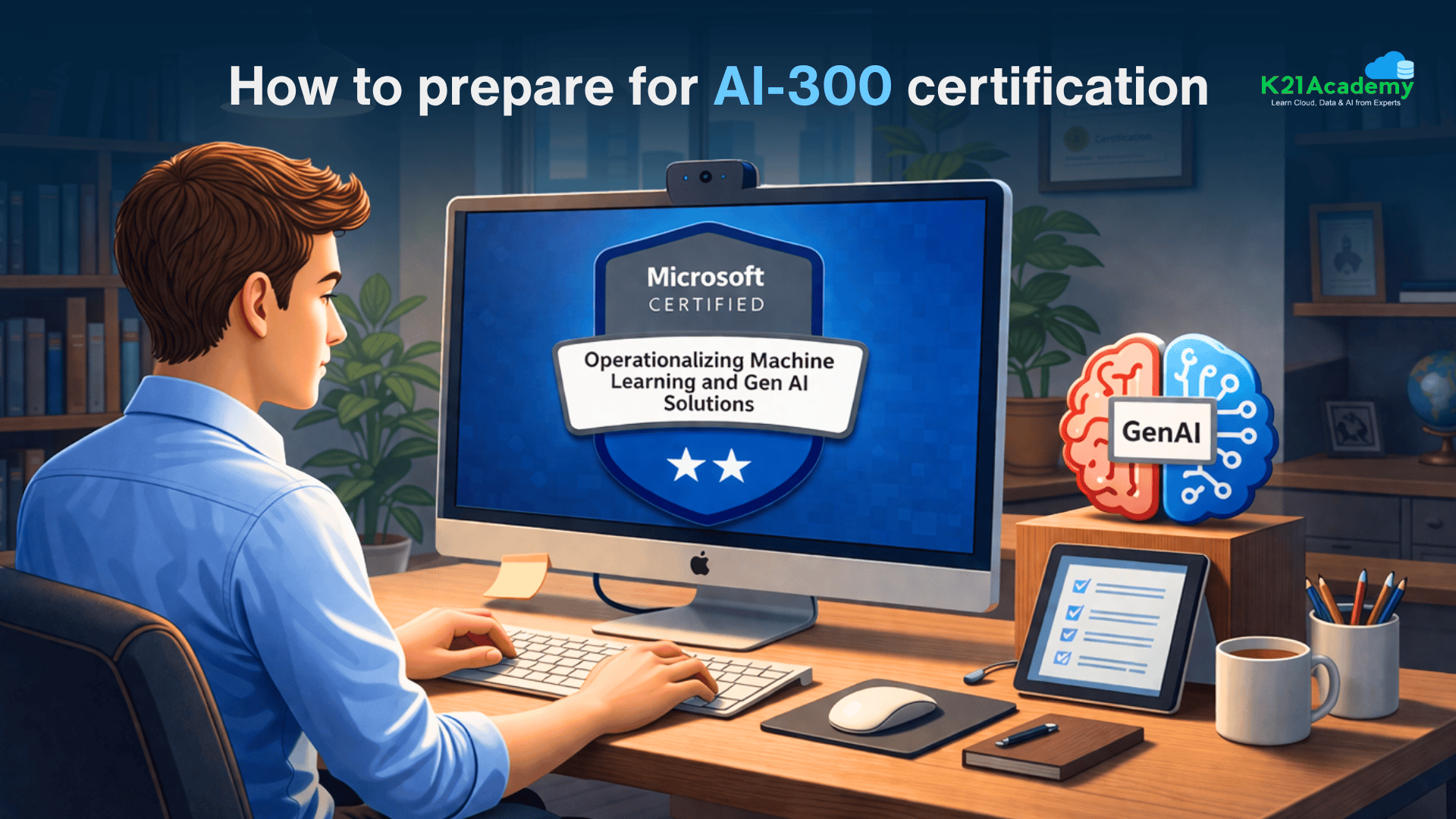


The Microsoft Certified Operationalizing Machine Learning and Generative AI Solutions (AI-300) certification is designed to validate your ability to implement MLOps and GenAIOps practices on Azure. The Microsoft AI-300 Certification helps professionals learn how to deploy, monitor, and optimise AI and generative AI solutions at scale.
The emphasis has moved from merely creating models to implementing, overseeing, and improving AI solutions in production as businesses use machine learning and generative AI more frequently. Professionals who know how to effectively operationalise AI systems are needed for this.

In this guide, we’ll explore the Microsoft AI-300 Certification, including exam details, skills measured, prerequisites, and preparation tips to help you succeed.
What is the Microsoft Certified Operationalizing Machine Learning and Generative AI Solutions [AI-300] Certification?
The Microsoft AI-300 Certification is designed for professionals who want to operationalize machine learning and generative AI workloads using Azure services. AI operations (AIOps), which encompasses both Machine Learning Operations (MLOps) and Generative AI Operations (GenAIOps), is the main emphasis of this certification. Professionals who obtain this certification exhibit proficiency in implementing, overseeing, optimising, and managing AI technologies in business settings.
The certification mostly makes use of services such as:
- Machine Learning with Azure
- The Microsoft AI Foundry
- Actions on GitHub
- Tools for Infrastructure as Code, such Azure CLI and Bicep
The Microsoft AI-300 Certification demonstrates that you can oversee AI models at every stage of their lifespan, from development to deployment and optimisation, given how quickly businesses are embracing generative AI solutions.
Related Readings: Azure AI Foundry vs. Azure Machine Learning: Key Differences Explained by K21 Academy
Who Should Take the Microsoft AI-300 Certification?
For workers working in cloud, AI, and machine learning environments, the Microsoft AI-300 Certification is perfect. This certification is appropriate for:
- Engineers in AI
- Engineers in Machine Learning
- Scientists of Data
- AI-related workloads for DevOps engineers
- ML pipeline management by cloud engineers
- Generative AI applications are being implemented by AI architects.
Applicants must have prior experience dealing with the following:
- Python programming
- Workflows for machine learning
- Azure AI services
- Automation pipelines and DevOps tools
The AI-300 Certification will be most helpful to professionals seeking positions involving AI implementation and lifecycle management.
Career Opportunities
The Microsoft AI-300 Certification can open doors to several high-demand roles like:
- AI Engineer
- Machine Learning Engineer
- MLOps Engineer
- AI Platform Engineer
- Cloud AI Architect
Why is this AI-300 certification important?
AI is no longer just for research labs; businesses increasingly require production-ready AI systems with governance, automation, and monitoring. Professionals can acquire the skills necessary to operationalise AI solutions at scale by earning the Microsoft AI-300 Certification.
-
Growing Demand for AI Operations: Organizations are deploying AI solutions at scale and need professionals who can manage MLOps and GenAIOps pipelines.
-
Production-Ready AI Skills: The Microsoft AI-300 Certification validates skills in deploying AI models, monitoring performance, and managing the complete model lifecycle.
-
Industry-Relevant Expertise: The certification focuses on real-world AI engineering practices such as CI/CD pipelines, observability, and AI performance optimization.
-
Azure AI Advantage: Since many enterprises use Azure AI services, this certification helps professionals build expertise in cloud-based AI development and operations.
AI-300 Exam Details
Here’s what to expect on the exam day:
| Delivery method | Online-proctored |
| Passing Score | 700 |
| Exam Level | Intermediate |
| Cost | 165 USD |
| Language | English |
Exam Domains
The Microsoft AI-300 Certification exam evaluates your knowledge across several key domains related to AI operations.
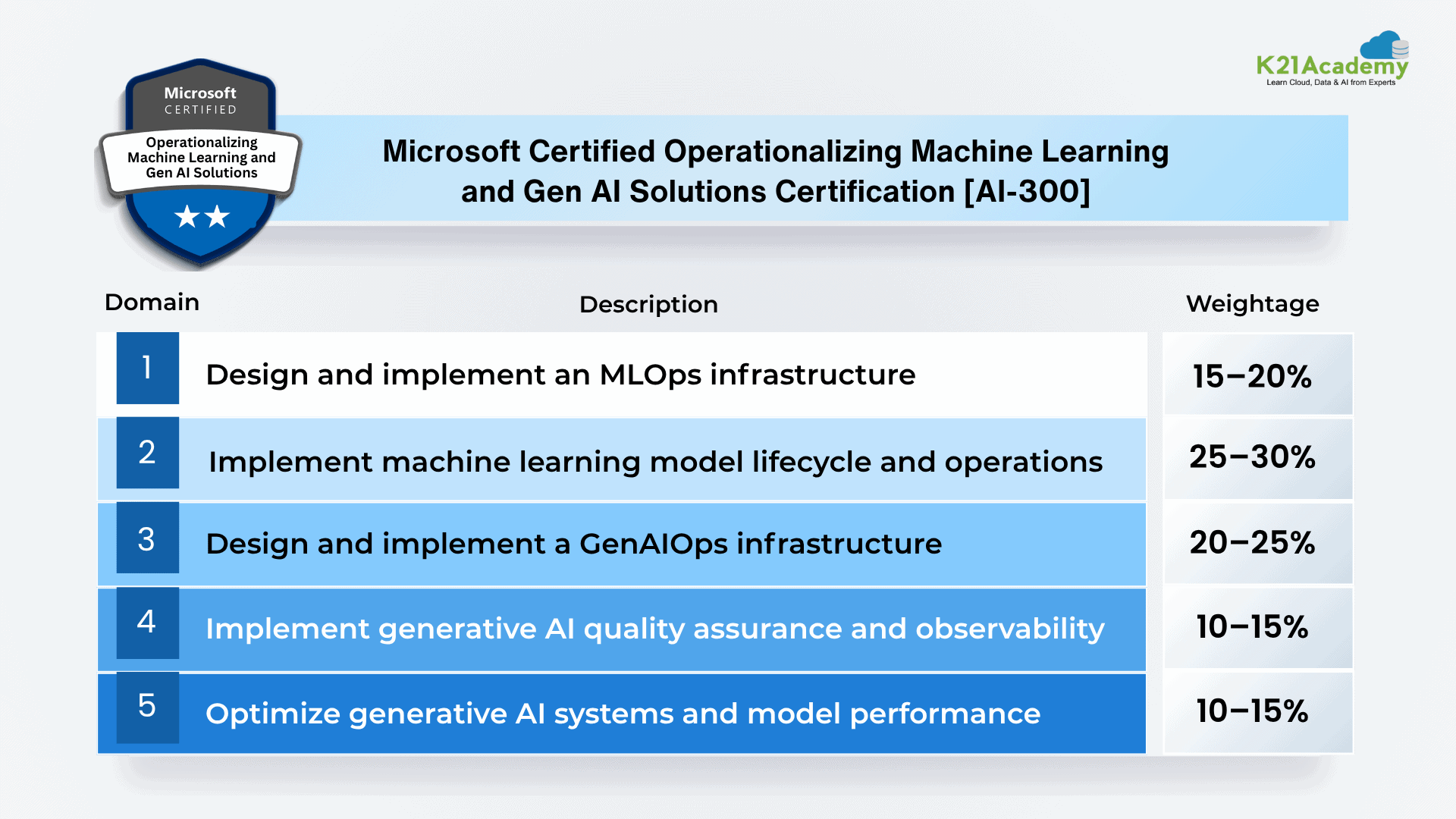
Domain 1: Design and implement an MLOps infrastructure (15–20%)
This section focuses on building infrastructure for machine learning workflows.
- Create and manage resources in a Machine Learning workspace
- Create and manage assets in a Machine Learning workspace
- Implement IaC for Machine Learning
Related Readings: Microsoft Azure Machine Learning Service Workflow: Overview for Beginners
Domain 2: Implement machine learning model lifecycle and operations (25–30%)
This section evaluates your ability to manage the complete lifecycle of machine learning models.
- Orchestrate model training
- Implement model registration and versioning
- Deploy machine learning models for production environments
- Monitor and maintain machine learning models in production
Domain 3: Design and implement a GenAIOps infrastructure (20–25%)
Generative AI applications require specialized infrastructure and monitoring.
- Implement Foundry environments and platform configuration
- Deploy and manage foundation models for production workloads
- Implement prompt versioning and management with source control
Domain 4: Implement generative AI quality assurance and observability (10–15%)
Ensuring the reliability and safety of generative AI solutions is a critical responsibility.
- Configure evaluation and validation for generative AI applications and agents.
- Implement observability for generative AI applications and agents
Domain 5: Optimize generative AI systems and model performance (10–15%)
This section focuses on improving performance and efficiency of AI solutions.
- Optimize retrieval-augmented generation (RAG) performance and accuracy
- Implement advanced fine-tuning and model customization
What Is GenAIOps? (And Why AI-300 Tests It)
GenAIOps (Generative AI Operations) is the practice of operating deploying monitoring, and optimizing Generative AI applications across their lifecycle.
Similar to how MLOps is applied to bring traditional ML models into production, GenAIOps tries to bring the LLMs, AI agents and Generative AI applications intoproduction while they are still safe scalable secure and reliable.
Contemporary Generative AI models; include foundation model, prompt engineering, retrieval system, vector database, AI agent, external tools, which are more advanced than classic machine learning models. All of above operations run on a management standard.
Key Components of GenAIOps
Prompt Management
- Versioning prompts
- Testing prompt changes
- Tracking prompt performance
Model Deployment
- Deploying foundation models
- Managing model updates
- Scaling AI workloads
Observability
- Monitoring latency and response quality
- Tracking token usage and costs
- Detecting failures and performance issues
Evaluation and Validation
- Measuring output quality
- Testing AI safety and reliability
- Evaluating model performance against benchmarks
Optimization
- Improving Retrieval-Augmented Generation (RAG) systems
- Fine-tuning models for specific use cases
- Reducing costs while maintaining performance
Why Does AI-300 Test GenAIOps?
Organizations are rapidly deploying Generative AI applications into production, and they need professionals who understand how to manage these systems effectively.
The AI-300 certification includes GenAIOps because production AI systems require much more than model development. Teams must ensure that applications remain accurate, secure, compliant, observable, and cost-efficient over time.
By testing GenAIOps concepts, AI-300 validates your ability to:
- Deploy Generative AI applications on Azure
- Manage AI model and prompt lifecycles
- Implement monitoring and observability
- Evaluate and improve AI system performance
- Operate enterprise-grade AI solutions at scale
As Generative AI adoption continues to grow, GenAIOps is becoming one of the most important skills for AI engineers and cloud professionals.
Is the AI-300 Certification Worth It?
The short answer is yes, but it really depends on what you want to do with it, i.e. I think it’s preferable if you want to use production AI systems rather than only develop models.
In companies leveraging on how to put machine learning and generative AI into production at scale, the need for professionals who can deploy monitor govern, and optimize such solutions in production is real. This is precisely where the AI-300 certification lays its strength.
Rather than most certifications stressing only the training of AI models, AI-300 tests your ability in over everything needed to run AI in production, from MLOps and GenAIOps, to automating deployments, monitoring models, etc.
Key Benefits of AI-300
- Demonstrates expertise in MLOps and GenAIOps practices
- Validates hands-on Azure AI and Azure Machine Learning skills
- Helps you build production-ready AI engineering capabilities
- Aligns with growing enterprise demand for AI operations professionals
- Enhances credibility for roles involving AI deployment and governance
Who Will Benefit Most?
The certification is particularly valuable for:
- AI Engineers
- Machine Learning Engineers
- MLOps Engineers
- Cloud Engineers working with AI workloads
- DevOps Engineers supporting AI applications
- AI Architects responsible for production deployments
As businesses continue investing in Generative AI, the ability to operationalize AI solutions has become a highly sought-after skill. AI-300 helps demonstrate that you can move beyond model development and successfully manage AI systems at scale.
AI-300 Sample Exam Questions & Answers
The best way to prepare for the Microsoft Certified: Operationalizing Machine Learning and Generative AI Solutions (AI-300) exam is to practice with realistic questions. Below are some sample questions that reflect the type of concepts you may encounter in the certification exam.
Question 1
Which Azure service is primarily used to manage the complete machine learning lifecycle, including training, deployment, and monitoring?
A. Azure App Service
B. Azure AI Foundry
C. Azure Machine Learning
D. Azure Virtual Machines
Answer: C. Azure Machine Learning
Explanation: Azure Machine Learning provides a comprehensive platform for building, training, deploying, and monitoring machine learning models throughout their lifecycle.
Question 2
What is the primary goal of MLOps?
A. Generate AI content automatically
B. Improve network performance
C. Automate and manage the machine learning lifecycle in production
D. Store large datasets
Answer: C. Automate and manage the machine learning lifecycle in production
Explanation: MLOps combines machine learning, DevOps, and automation practices to streamline model development, deployment, monitoring, and governance.
Question 3
Which practice helps ensure that infrastructure can be deployed consistently across environments?
A. OCR
B. Infrastructure as Code (IaC)
C. Sentiment Analysis
D. Prompt Engineering
Answer: B. Infrastructure as Code (IaC)
Explanation: Infrastructure as Code uses tools such as Bicep, ARM templates, or Terraform to automate infrastructure provisioning and maintain consistency across environments.
Want More Practice Questions?
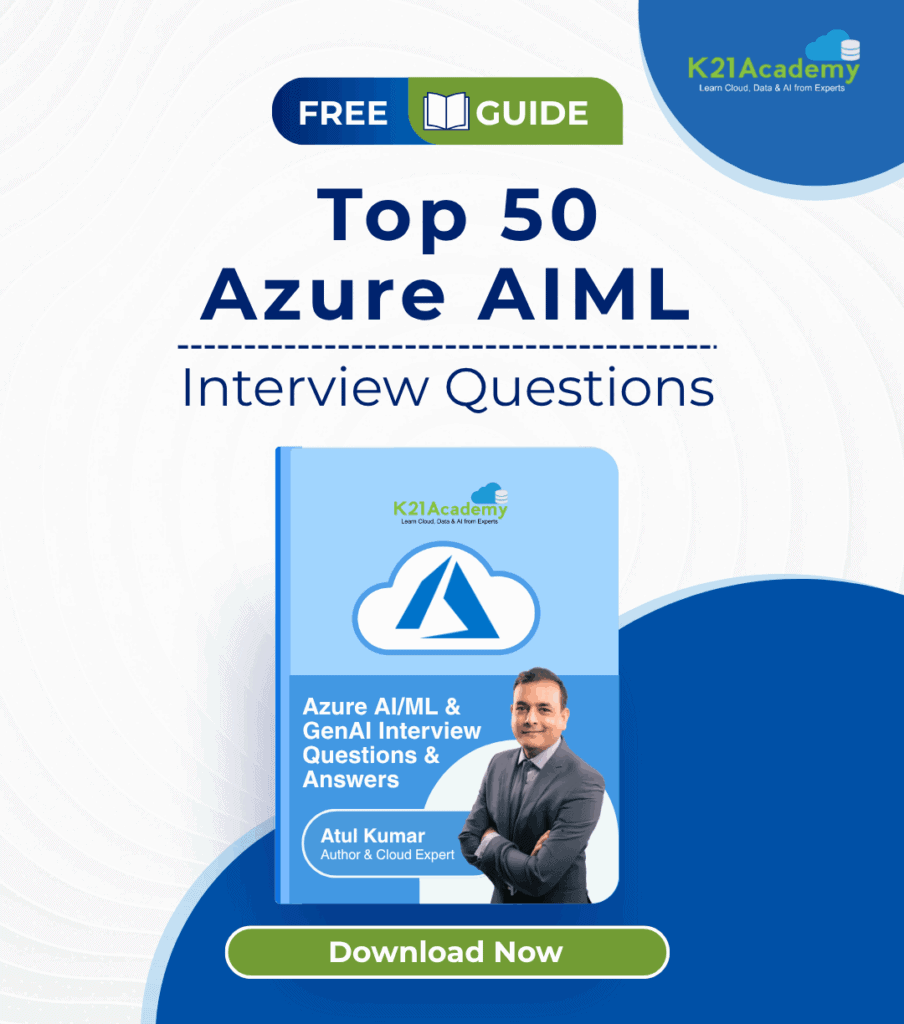
These sample questions provide a quick overview of the AI-300 exam format. To access a complete collection of practice questions, detailed explanations, and exam preparation tips, download our FREE AI-300 Exam Questions & Answers Guide today.
What’s Included?
✓ 30+ Practice Questions
✓ Detailed Answer Explanations
✓ Latest AI-300 Exam Topics
✓ MLOps & GenAIOps Coverage
✓ Azure Machine Learning Scenarios
✓ Model Deployment & Monitoring Questions
✓ RAG Optimization & Observability Concepts
✓ CI/CD and Infrastructure as Code Examples

Certification Prerequisites
Although there are no strict prerequisites, candidates are expected to have knowledge in several areas before attempting the Microsoft AI-300 Certification. Recommended experience includes:
- Python programming
- Machine learning fundamentals
- Azure Machine Learning platform
- DevOps concepts such as CI/CD
- Infrastructure as Code (IaC) tools
Having hands-on experience with AI model deployment and monitoring will significantly improve your chances of passing the exam.
How to Prepare for the Microsoft AI-300 Certification
Preparing for the Microsoft AI-300 Certification requires both theoretical knowledge and practical experience.
- Understand the Exam Skills Outline: Start by reviewing the official exam skills measured to understand the key domains.
- Learn Azure Machine Learning: Practice creating ML workspaces, training models, and deploying endpoints on Azure.
- Practise Hands-On Labs: Hands-on experience is critical. Work with real AI pipelines and deployment scenarios.
- Use Microsoft Learning Resources: Leverage training modules, documentation, and official learning paths from Microsoft.
Conclusion
Professionals that can operationalise AI systems are in more demand as businesses adopt generative AI and machine learning on a large scale.
Your ability to deploy MLOps and GenAIOps processes on Azure is validated by the Microsoft AI-300 Certification, which guarantees that AI models are dependable, scalable, and prepared for production.
Obtaining the Microsoft AI-300 Certification can greatly improve your employment prospects in the AI and cloud computing ecosystem if you wish to develop experience in AI implementation, monitoring, and optimisation.