




Modern cloud and AI projects are becoming increasingly sophisticated. A single enterprise solution may involve cloud infrastructure, containerized applications, machine learning models, AI Agents, data pipelines, APIs, identity management, monitoring platforms and multiple third party integrations. While building these systems requires strong technical expertise, documenting them clearly has become just as important as implementing them.
Technical documentation serves as the foundation for collaboration across engineering teams. Cloud Architects use it to communicate infrastructure designs, DevOps engineers rely on it during deployments, AI engineers document model workflows and IT teams refer to it when maintaining enterprise systems. Well structured documentation reduces misunderstandings, improves knowledge sharing and helps organisations manage complex environments more efficiently.
However, creating documentation that is both technically accurate and easy to understand is often challenging. Architecture diagrams, workflow illustrations, deployment overviews and system maps can take hours to prepare manually. As cloud environments evolve, these visuals also require frequent updates to reflect new services, integrations and infrastructure changes.
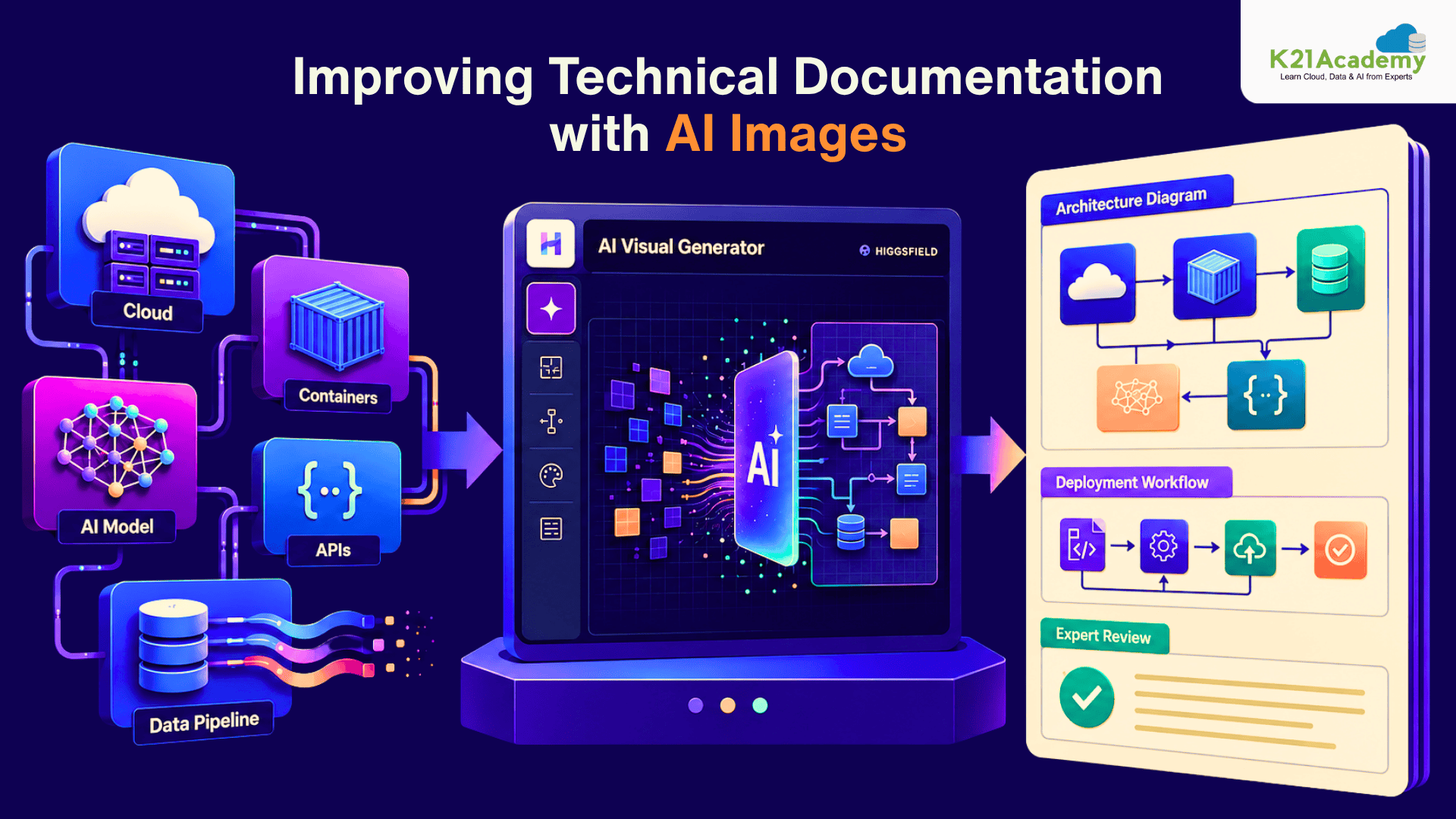
This is where an AI Image Generator begins to deliver real value. Instead of spending hours creating visuals from scratch, engineering teams can generate professional concepts that simplify technical communication and accelerate documentation. Higgsfield is designed to help Cloud and AI professionals create architecture concepts, workflow illustrations and technical visuals quickly, making it easier to document complex systems while retaining complete control over review, refinement and technical accuracy before every diagram is finalised.
In this article, we’ll explore how an AI Image Generator can improve technical documentation for Cloud and AI Engineers, practical enterprise use cases and best practices for integrating AI assisted visuals into professional engineering workflows.
Why Technical Documentation Matters in Cloud and AI Projects
Enterprise cloud environments involve far more than deploying applications. Modern solutions often include multiple cloud services, virtual networks, Kubernetes clusters, AI models, data storage platforms, CI/CD pipelines, monitoring tools and security controls working together across distributed environments. Understanding how these components interact requires documentation that is accurate, organised and accessible to both technical and non technical stakeholders.
Clear documentation helps engineering teams communicate complex infrastructure more effectively. Instead of relying entirely on lengthy technical explanations, visual diagrams can illustrate architecture layouts, data movement, service dependencies and deployment workflows in a way that is easier to understand during project planning and implementation.
Documentation also supports collaboration throughout the software lifecycle. Solution Architects use architecture diagrams to explain proposed designs, Cloud Engineers document infrastructure deployments, AI Engineers map model training and inference workflows, while DevOps teams rely on deployment documentation during releases and maintenance. When every team works from consistent documentation, projects become easier to manage and operational risks are reduced.
Another important benefit is knowledge transfer. Enterprise projects frequently involve multiple teams working across different locations and time zones. New engineers joining a project need to understand existing infrastructure quickly without relying solely on verbal explanations. Well structured documentation accelerates onboarding by providing a clear overview of how systems are designed and how different services interact.
As organisations continue adopting hybrid cloud, multi cloud and AI driven architectures, technical documentation has become an essential part of enterprise engineering rather than an afterthought.
Challenges Cloud and AI Engineers Face When Creating Documentation
Although documentation is critical, maintaining it is rarely straightforward. Many engineering teams face similar challenges as cloud environments become more dynamic and distributed.
One of the biggest difficulties is documenting complex architectures. Modern enterprise solutions may include dozens of cloud computing services, APIs, databases, AI models, messaging platforms and security components. Explaining these relationships through text alone often makes documentation difficult to interpret, particularly for stakeholders who are not directly involved in implementation.
Documentation also changes frequently. Infrastructure evolves as organisations migrate workloads, introduce new services, optimise cloud resources, or deploy updated AI models. Keeping diagrams synchronized with production environments can become a time consuming responsibility that competes with development priorities.
Cross functional collaboration can also make documentation more challenging, as Cloud Engineers, AI specialists, DevOps teams and business stakeholders require different levels of technical detail. Preparing architecture diagrams and workflow visuals manually often slows projects, while Higgsfield help teams create professional visual concepts more efficiently, making technical documentation easier to communicate and review.
An AI Image Generator helps address these challenges by accelerating the creation of visual concepts that support technical documentation. Rather than replacing engineering expertise, it enables teams to communicate cloud architectures, AI workflows and infrastructure designs more efficiently while allowing subject matter experts to validate every visual before it is shared across the organisation.
Related Readings:- Top 12 Prompt Engineering Tools for AI Projects in 2026 (Tested & Compared)
How an AI Image Generator Supports Technical Documentation Workflows
Creating technical documentation is not simply about recording infrastructure details. It is about communicating complex systems in a way that engineers, architects, operations teams and business stakeholders can understand quickly. Whether documenting a cloud migration, explaining an AI inference pipeline, or preparing deployment guides, visual communication often makes technical information far easier to interpret.
An AI Image Generator is becoming a practical addition to this process. Rather than replacing traditional diagramming tools or architectural documentation, it helps engineering teams create draft visual concepts more efficiently. Engineers can use AI generated visuals as a starting point for architecture overviews, workflow illustrations, cloud deployment concepts and technical presentations before refining them to accurately reflect their production environments.
As organisations adopt more distributed cloud architectures and AI powered applications, the amount of documentation required continues to grow. Teams are expected to maintain diagrams for infrastructure, networking, security, monitoring, data pipelines, APIs and application workflows throughout the lifecycle of every project. AI assisted visual generation helps reduce the time spent creating these initial documentation assets while allowing engineers to focus on validating technical accuracy.
Platforms such as Higgsfield are helping support this evolving workflow by providing AI powered creative technology that enables engineering teams to produce professional visual assets for technical communication. Instead of manually creating every illustration from the ground up, an AI Image Generator allows Cloud and AI professionals to explore different visual representations of their systems before refining them for documentation, knowledge sharing and project planning.
Related Readings:- Comparing the Best AI Chatbots for Your Business: What’s Best for You?
Enterprise Use Cases for an AI Image Generator
Cloud and AI projects involve documentation at nearly every stage of implementation. An AI Image Generator can support several practical use cases that improve communication without replacing engineering expertise.
Cloud Architecture Documentation
Enterprise cloud environments often include virtual networks, compute services, storage platforms, Kubernetes clusters, databases, security components and monitoring tools. Creating architecture overviews manually for every project can take considerable effort.
An AI Image Generator can help engineering teams quickly develop draft architecture visuals that illustrate how cloud services connect. These concepts can then be refined by Solution Architects to accurately represent AWS, Microsoft Azure, or Google Cloud deployments before becoming part of official documentation.
AI and Machine Learning Workflows
AI projects typically involve multiple stages, including data collection, preprocessing, model training, validation, deployment, inference, monitoring and continuous improvement. Explaining these workflows through text alone can make documentation difficult for new team members and stakeholders to follow.
Visual workflow diagrams provide a clearer understanding of how information moves through each stage of the AI lifecycle. Engineers can use an AI Image Generator to create draft workflow illustrations that support design discussions, internal documentation and training materials before technical review.
Related Readings:- Microsoft Azure Machine Learning Service Workflow: Overview for Beginners
Infrastructure Planning
Before deploying new environments, engineering teams often prepare planning documents for stakeholders, project managers and implementation teams. Infrastructure diagrams help communicate network layouts, service dependencies, scaling strategies and deployment approaches.
Instead of spending hours producing presentation ready visuals manually, AI assisted concept generation enables teams to prepare professional documentation more efficiently while maintaining engineering oversight.
Technical Training and Knowledge Sharing
Documentation is also essential for onboarding new engineers. Cloud platforms evolve rapidly and new team members must understand existing environments before contributing to active projects.
Architecture diagrams, deployment workflows and infrastructure maps generated with the support of an AI Image Generator can improve internal learning resources by presenting complex technical information in a more structured and accessible format.
Improving Collaboration Across Engineering Teams
Enterprise cloud projects involve multiple teams, including Cloud Architects, AI Engineers, DevOps specialists and Security Engineers. Clear visual documentation helps everyone understand system architecture, service dependencies and deployment workflows more efficiently. Higgsfield supports this process by enabling teams to create professional visual concepts that improve technical communication while allowing engineers to review and validate every diagram before it becomes part of official documentation.
An AI Image Generator can assist engineering teams by accelerating the preparation of these visual resources. Rather than replacing architecture documentation, it provides draft concepts that help teams communicate infrastructure more efficiently during design workshops, technical reviews and stakeholder presentations.
As organisations continue expanding their cloud and AI capabilities, documentation is becoming an increasingly collaborative process. AI assisted visual generation supports this evolution by helping teams prepare clearer technical resources while allowing engineering experts to verify every architecture, workflow and deployment diagram before it becomes part of enterprise documentation.
Related Readings:- AI Learning Path for IT Leaders and Managers (No Deep Coding Required)
Best Practices for Using an AI Image Generator in Enterprise Documentation
As AI assisted content creation becomes more common in enterprise environments, engineering teams should establish clear guidelines for how AI generated visuals are created, reviewed and maintained. While an AI Image Generator can accelerate documentation, technical accuracy must always remain the responsibility of cloud and AI professionals.
One of the most important practices is using AI generated visuals as draft documentation rather than final deliverables. Architecture diagrams, workflow illustrations and infrastructure overviews should always be reviewed by Solution Architects, Cloud Engineers, or AI Engineers to ensure they accurately represent the production environment.
Consistency is equally important. Enterprise documentation should follow standard diagram styles, naming conventions, icons and documentation templates across all projects. Maintaining a consistent visual language makes architecture documents easier to understand during onboarding, system upgrades, cloud migrations and cross functional collaboration.
Security should also remain a priority. AI generated documentation should never expose confidential infrastructure details, API keys, internal IP addresses, or sensitive deployment information. Documentation intended for external audiences should always comply with organisational security and governance policies.
Finally, documentation should evolve alongside the infrastructure itself. Cloud platforms and AI systems change frequently, making regular updates essential. Using an AI Image Generator to quickly produce revised visual concepts can help engineering teams keep documentation current without recreating diagrams from scratch.
Related Readings:- 5 Resume Mistakes That Stop AI Professionals From Getting Interview Calls
Common Mistakes to Avoid
Although AI assisted documentation can improve productivity, organisations should avoid relying on automatically generated visuals without proper technical validation.
One common mistake is treating AI generated diagrams as production ready documentation. Every architecture, workflow, or deployment illustration should be reviewed to verify that services, data flows and infrastructure relationships accurately reflect the real environment.
Another challenge is oversimplifying complex systems. Enterprise architectures often include networking, identity management, monitoring, disaster recovery, compliance controls and security layers that should not be omitted simply to make diagrams look cleaner. Documentation should balance clarity with technical completeness.
Engineering teams should also avoid inconsistent documentation practices. Using different diagram styles across departments can make enterprise documentation more difficult to maintain and understand. Establishing standard templates and review processes helps create documentation that remains useful throughout the project lifecycle.
Finally, GenAI or AI should complement, not replace engineering expertise. An AI Image Generator can accelerate concept creation, but architecture decisions, technical validation and documentation governance must continue to be handled by qualified professionals.
The Future of Technical Documentation for Cloud and AI Teams
As enterprise cloud adoption and AI implementation continue to grow, documentation will become an even more important part of engineering operations. Modern organisations are managing increasingly complex environments that span multiple cloud providers, container platforms, AI services, security frameworks and distributed applications. Communicating these systems clearly will require documentation that is both technically accurate and easy to maintain.
Agentic AI andAI assisted visual generation is expected to play a growing role in this evolution. Rather than replacing existing documentation tools, it can help engineering teams prepare architecture overviews, workflow illustrations, deployment concepts and technical presentations more efficiently. This allows teams to spend less time producing initial visuals and more time validating infrastructure, improving system design and supporting enterprise collaboration.
Higgsfield reflect this shift by providing AI powered creative technology that helps engineering teams create professional visual assets for architecture planning, technical documentation and knowledge sharing. An AI Image Generator enables engineers to communicate complex cloud and AI systems more effectively while maintaining full control over technical accuracy and organisational standards.
Related Readings: Top 10 Claude Code Use Cases Every Developer Should Know
Conclusion
Technical documentation is an essential component of successful cloud and AI projects. From architecture planning and infrastructure deployment to knowledge sharing and operational support, clear documentation helps engineering teams collaborate more effectively while reducing implementation risks.
An AI Image Generator enhances this process by making it easier to develop visual concepts that explain cloud architectures, AI workflows, infrastructure designs and enterprise systems. When combined with professional engineering expertise and structured review processes, AI assisted visuals improve communication without compromising technical accuracy.
As enterprise environments continue to evolve, organisations will increasingly combine AI powered documentation tools with established engineering practices. Solutions like Higgsfield demonstrate how an AI Image Generator can support faster documentation workflows, clearer technical communication and more efficient collaboration while ensuring that final documentation remains accurate, secure and aligned with enterprise standards.