

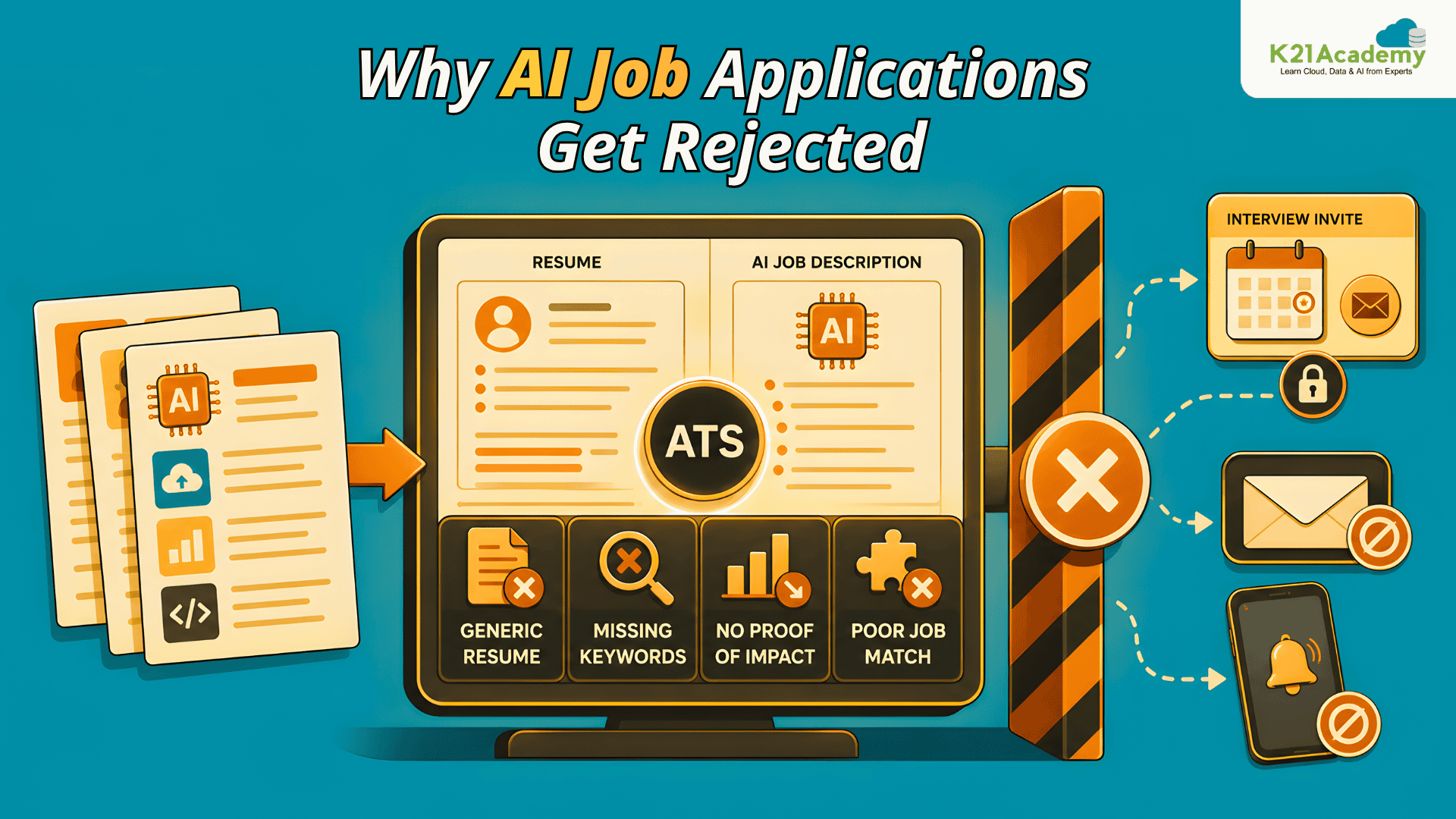




You studied AI for months. You built projects, earned AI certifications, and began submitting job applications.
But the AI job interview calls never come. No replies from recruiters. No invitations to interviews. Just one application after another vanishing into what seems to be a black hole.
The good news is that the issue is often not your technical ability. More commonly, it’s how you present your skills, projects, and experience to recruiters.
Let’s look at the biggest reasons candidates fail to receive AI job interview calls and how to fix them. You’re not alone if you’re having trouble getting calls for AI job interviews. The same problem confronts thousands of prospective AI engineers, machine learning engineers, data scientists, and generative AI specialists.
The Reality Behind AI Job Interview Calls in 2026
Although the AI sector is expanding quickly, competition has also intensified. For each AI position, companies are receiving hundreds of applications. Candidates must stand out right away because recruiters don’t have time to thoroughly analyse every application.
You need more than just technical expertise to increase your chances of getting called for AI job interviews. A solid professional profile that exhibits practical value is essential.
If you’re still building your foundation, following a structured AI Career Roadmap can help you develop the skills, projects, and experience employers actually look for.
Let’s take a look at some of the common mistakes we make & how to fix that.
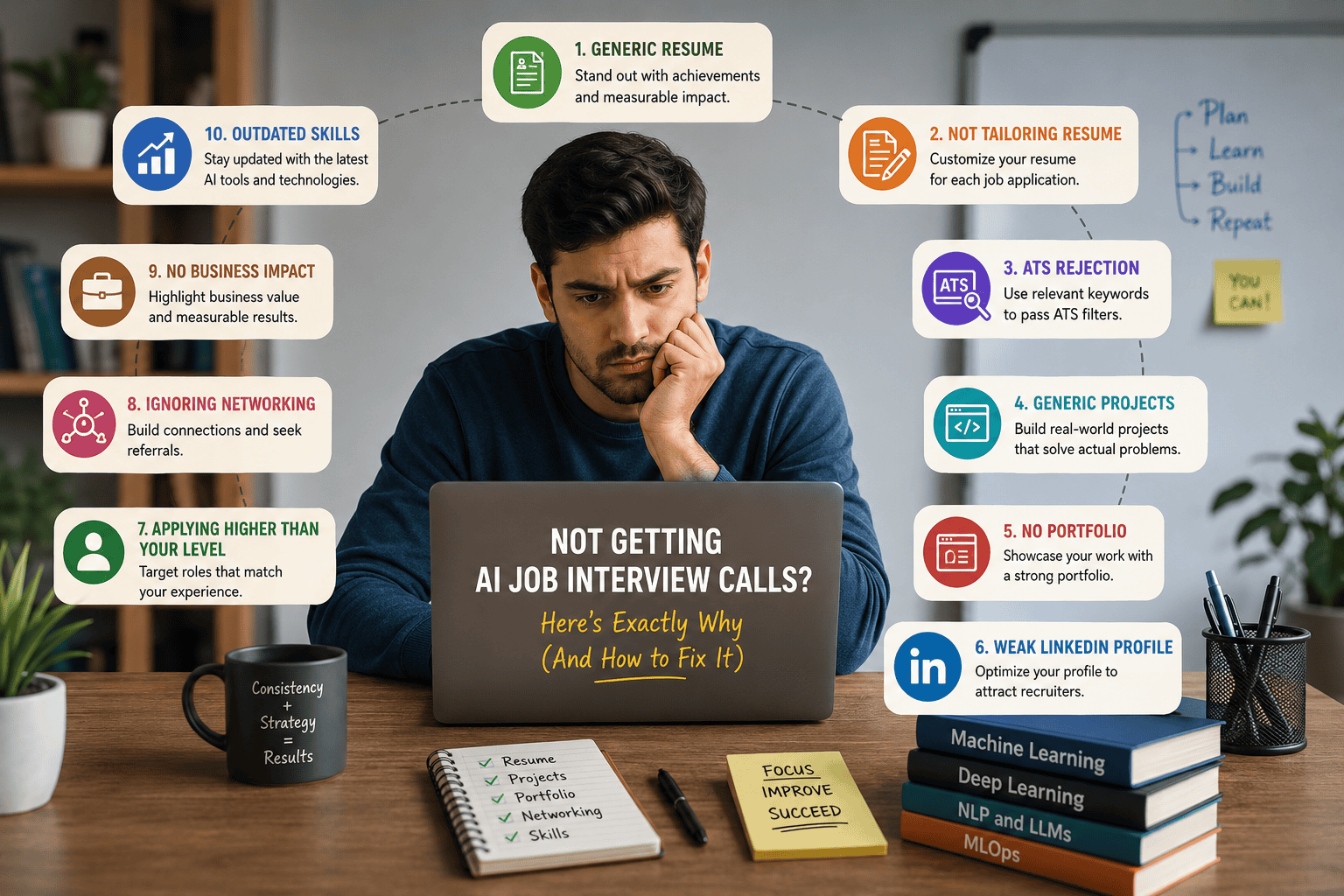
1) Your Resume Looks Like Everyone Else’s
One of the most common reasons candidates miss out on AI job interview calls is a generic résumé. The problem is that thousands of applicants list the same skills & technologies like:
- Python
- TensorFlow
- PyTorch
- Machine Learning
- Deep Learning
- NLP
How to Fix It
Focus on achievements rather than technologies.
Weak Example
“Built a sentiment analysis project using NLP.”
Strong Example
“Developed an NLP sentiment analysis model with 92% accuracy across 50,000 customer reviews, reducing manual review effort by 60%.”
Recruiters remember impact & not just tool names. Building AI projects that impress recruiters is often the difference between getting ignored and receiving interview calls.
Optimize Your Resume Today with Resume Tailor
2) You’re Sending the Same Resume Everywhere
A major mistake that reduces AI job interview calls is applying with the same resume for every position. Different AI roles require different skill sets.
How to Fix It
Customise your resume for each application. Align your:
- Skills
- Project descriptions
- Keywords
- Experience
with the job requirements. This improves both ATS performance and recruiter engagement.
3) You’re Getting Filtered by ATS Systems
Because their resumes don’t pass the Applicant Tracking System (ATS) screening, many applicants never get the AI job interview calls. Recruiters might never see your application if crucial keywords are missing.
How to Fix It
Include relevant keywords naturally throughout your resume:
- Generative AI
- Agentic AI
- RAG
- LangChain
- MLOps
- LLMs
- Vector Databases
- Python
- AWS
- Azure AI
Always ensure the skills accurately reflect your experience. Many recruiters also view industry-recognised AI certifications as a signal that a candidate is serious about learning and career growth.

4) Your Projects Are Too Generic
Projects play a huge role in securing AI job interview calls. Unfortunately, many candidates showcase projects recruiters have seen hundreds of times.
How to Fix It
Build projects that solve business problems.
Examples include:
- AI customer support assistants
- Enterprise RAG systems
- AI-powered document processing
- Sales copilots
- Healthcare AI applications
- Multi-agent business workflows
Recruiters today are far more interested in RAG and AI Agent projects than traditional academic machine learning demos.
Related Readings: Hands-On Project: Build an AI-Powered ATS Resume Scoring System on Azure
5) You Don’t Have a Portfolio
Recruiters frequently decide whether to proceed with your application based on your portfolio. They have no evidence of your ability without one.
How to Fix It
Create a professional portfolio containing:
- GitHub repositories
- Project documentation
- Architecture diagrams
- Demo videos
- Deployment links
Think of your portfolio as evidence that you can build solutions & not just complete courses.
6) Your LinkedIn Profile Isn’t Optimized
Before setting up interviews, recruiters usually check LinkedIn. Potential AI job interview calls may be avoided with a bad profile.
How to Fix It
Improve your profile by adding:
- Professional headline
- AI-focused summary
- Featured projects
- Certifications
- Technical skills
- Industry-related content
The more visible and credible your profile appears, the more recruiter interest you’ll generate.
7) You’re Applying Above Your Experience Level
Despite having limited expertise, many applicants only apply for senior roles. This lessens the possibility of getting calls for AI job interviews.
How to Fix It
Target opportunities aligned with your current experience level:
- AI Intern
- Junior AI Engineer
- Associate Data Scientist
- AI Analyst
- Entry-Level Machine Learning Engineer
Landing your first role creates momentum for future career growth. Understanding different AI career paths can also help you identify roles that best match your strengths and experience.
8) You’re Ignoring Networking
One of the quickest strategies to boost AI job interview calls is still networking. Instead of applying online, a lot of professionals get interviews through referrals.
How to Fix It
Participate in:
- LinkedIn communities
- AI meetups
- Conferences
- Hackathons
- Open-source projects
Relationships often create opportunities that applications alone cannot. Engaging in AI community events and structured learning programs can also help you connect with industry professionals and hiring managers.
9) You’re Focusing Only on Technology
Many applicants talk about algorithms but don’t provide an explanation of their business value. Results are important to hiring managers.
How to Fix It
When describing projects, always explain:
- The problem
- The solution
- The business impact
- The measurable results
For example:
Instead of saying:
“I built a chatbot.”
Say:
“I developed an AI chatbot that reduced customer response time by 70% and improved support efficiency.”
This approach dramatically improves your chances of receiving AI job interview calls.
10) Your Skills Aren’t Keeping Up With the Market
The field of AI is changing quickly. Traditional machine learning is still the sole focus of many resumes.
How to Fix It
Develop expertise in modern areas such as:
- Generative AI
- Agentic AI
- RAG
- MCP
- AI Agents
- MLOps
- LLM Fine-Tuning
- AI Governance
Related Readings: Why Responsible AI is a Game-Changer for Your Career and Certifications?
Employers increasingly prioritize candidates with the latest AI skills employers are hiring for, especially in enterprise AI deployments.
What Recruiters Look For Before Scheduling an Interview
To receive more AI job interview calls, your application should answer four questions:
Can you solve real-world problems?
Demonstrated through projects and practical experience.
Can you create business value?
Demonstrated through measurable outcomes.
Can you learn continuously?
Demonstrated through certifications, projects, and upskilling.
Can you communicate effectively?
Demonstrated through your resume, LinkedIn profile, and portfolio.
If recruiters can quickly answer “yes” to all four questions, your chances of receiving AI job interview calls increase significantly.
Related Readings: 5 Resume Mistakes That Stop AI Professionals From Getting Interview Calls
Don’t Apply to More Jobs but instead become a Stronger Candidate
Applying for more positions isn’t always the answer if you’re having trouble getting calls for AI job interviews.
Rather, concentrate on strengthening your candidature. Build practical projects. Obtain certificates accepted by the industry. Gain knowledge of MLOps, RAG, Agentic AI, and Generative AI. Make a portfolio that exhibits usefulness.
Your confidence and employability can both be greatly enhanced by an organised study path.
Conclusion
Don’t think you don’t have what it takes to succeed if you aren’t receiving calls for AI job interviews.
In many cases, the issue lies in how your experience is presented to recruiters and hiring managers.
You may significantly raise your chances of getting calls for AI job interviews by optimising your resume, developing stronger projects, constructing a professional portfolio, enhancing your LinkedIn presence, and effectively networking.
Every year, the AI sector continues to provide new prospects. You’ll be far more likely to go from applicant to interview candidate if you properly position yourself and show your practical value.
Recall that employers hire people because they can utilise AI to address actual business challenges, not because they are familiar with AI.