





In today’s world, AI advancements have created a lot of opportunities for businesses to transform customer support automation and productivity improvement while handling repetitive tasks. However, it is always a problem for the companies where to begin when building an AI bot. Choosing the right tools, understanding which technology is necessary, and designing a system capable of scaling are several points that many teams face with difficulty.
Artificial Intelligence is changing the way organizations work, interact with clients, and streamline business operations. The emergence of AI-powered bots has been the most visible change due to this transformation. These smart assistants can provide answers, automate tasks, process information, and even lend support for complicated decision-making.

Generative AI is one of the factors that the work on creating bots with the help of AI is now quite well accessible as compared to several years back. Today, businesses of all types and sizes are creating AI-enabled personal assistants as a way to boost effectiveness and provide better customer experiences. AI bots cover a wide range starting from customer service chatbots to internal sole assistants and are a chief component of the modern digital transformation strategy.
Most of the modern conversational agents operate on the basis of very sophisticated language generation models like ChatGPT which can grasp the context of the discussion, come up with responses that are very similar to those of a human, and do a variety of different things.
With this handbook, we’re going to discuss the way to create your own AI bot in 2026, the kinds of technologies you would have, the developmental procedures, and the different resources that are the facilitators of the whole process.
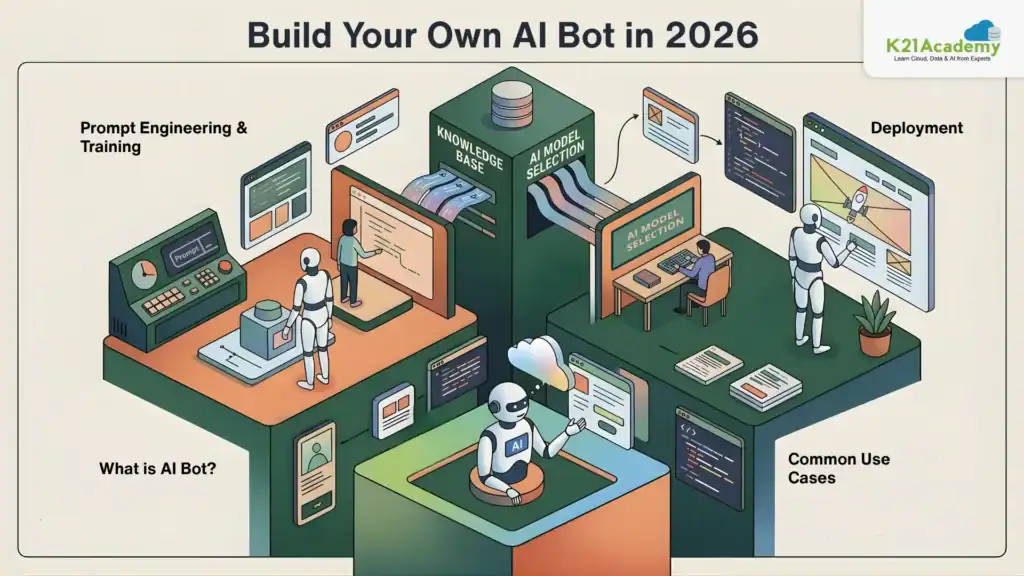
What Is an AI Bot?
AI bot is a software program that interacts with a user or system through artificial intelligence. To understand and respond to user queries in a dynamic manner, modern AI bots use machine learning and natural language processing and do not depend on predefined scripts only like traditional chatbots.
Basically, these bots can be embedded in websites, messaging platforms, mobile apps, or even enterprise systems. Mainly, they intend to automate the tasks that normally need human intervention.
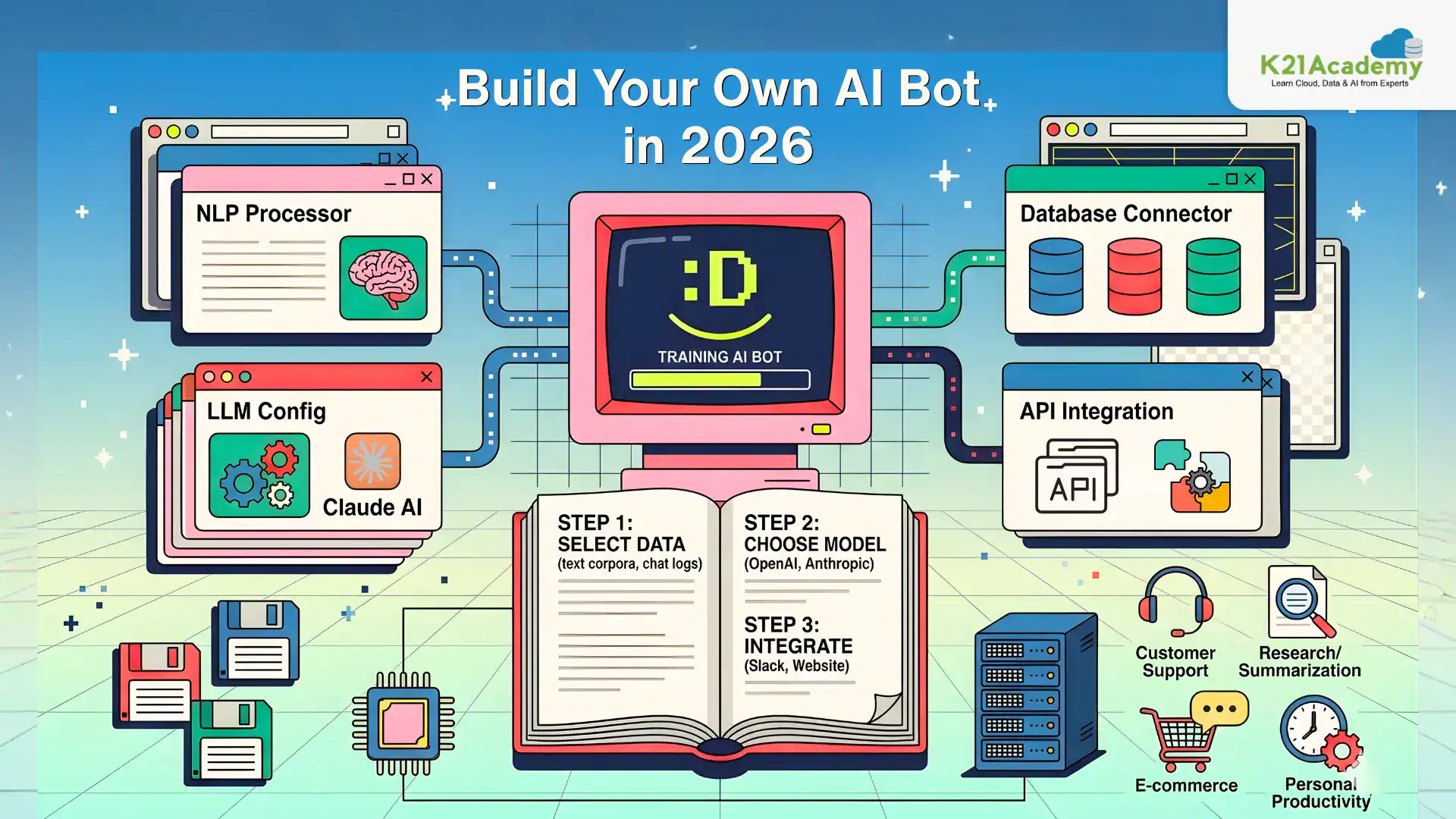
Common examples of AI bots include:
- Customer support assistants that answer user questions
- AI research assistants that summarize information
- Virtual sales assistants for e-commerce platforms
- Personal productivity assistants that manage tasks and schedules
- Coding assistants that help developers write and debug code
As AI models become more powerful, bots are capable of performing increasingly sophisticated tasks.
Related Readings:- The Future of AI Agents

Core Technologies Behind AI Bots
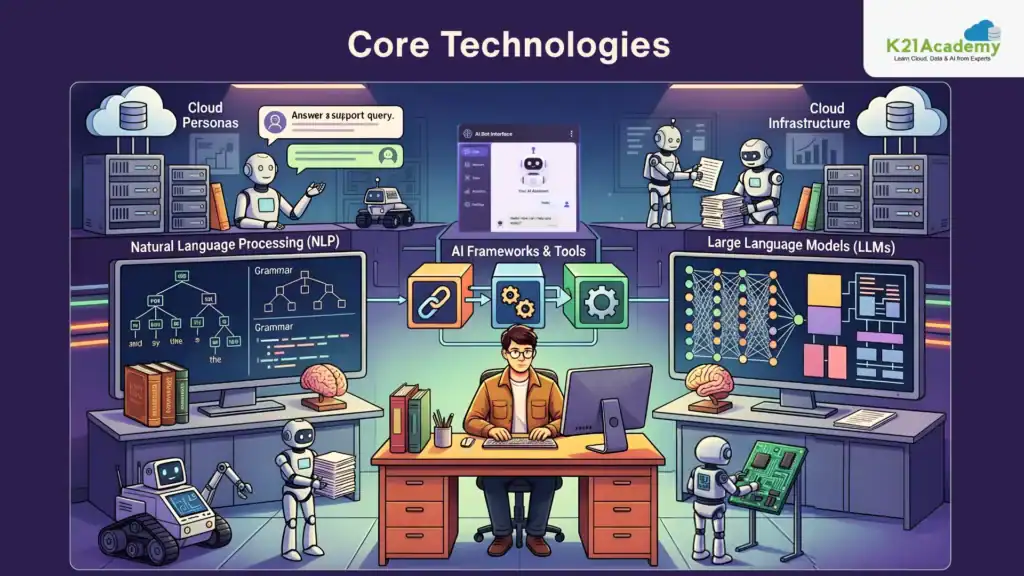
Building an AI bot requires integrating a number of technologies that equip the system with language comprehension, data processing, and interaction with external instruments capabilities.
1. Natural Language Processing
Natural Language Processing (NLP) is a technology that makes it possible for AI bots to comprehend human language. With the help of NLP, bots can recognize text or voice input, determine the user’s intention, and create appropriate responses.
In the absence of NLP, bots would not be capable of understanding the context or meaning of user inquiries.
2. Large Language Models
Contemporary AI bots are to a large extent dependent on large language models capable of producing text and understanding complicated instructions. These models are capable of answering questions, producing summaries of documents, and even writing code.
Works the same as GPT-4 and similar models have greatly enhanced the functionalities of AI assistants.
3. AI Frameworks and Development Tools
Developers use various frameworks to help integrate AI models with applications and even other external systems. For instance, LangChain is a tool developers use to create a series of steps in a workflow where AI models can fetch data, talk to APIs, and carry out multi-step tasks.
These frameworks not only make the development work easier but they also significantly help in building complex AI bots.
4. Cloud Infrastructure
The reasons why AI bots are mostly hosted on cloud platforms are many, one being their demand for scalable computing resources. This is where cloud infrastructure steps in, enabling the bots to cater to large numbers of users at the same time, alongside giving the assurance of reliability and good performance.
What’s more, cloud platforms come with storage facilities, databases, and various security components which are absolutely necessary for the production systems.
Step-by-Step Guide to Building an AI Bot
Step 1: Define the Purpose of the Bot
The first step in building an AI bot is identifying the problem you want it to solve. A clear objective helps determine what data, tools, and technologies you will need.
Some common use cases include:
- Customer support automation
- AI-powered research assistants
- Automated help desk systems
- Content generation tools
- Internal knowledge assistants for companies
Clearly defining the purpose of the bot helps you design the right architecture and workflow.
Related Readings:- Learn about conversational bot
Step 2: Choose an AI Model
The next step is selecting the AI model that will power your bot. The model should be capable of understanding user queries and generating useful responses.
Popular options include:
- ChatGPT
- Claude
- Google Gemini
Each model has different strengths, such as handling long documents, generating code, or integrating with specific ecosystems.
Related Readings:- Claude Code vs GitHub Copilot vs Cursor: Which AI Coding Assistant Should You Learn?
Step 3: Design the Bot Architecture
An AI bot typically consists of several components that work together to process user requests.
A common architecture includes:
- User interface (website, chat app, or mobile app)
- Backend server for processing requests
- AI model for understanding and generating responses
- Database for storing conversation history and data
- APIs that connect the bot to external systems
Designing a clear architecture ensures the bot can scale and handle complex tasks.
Related Readings: Generative AI vs Agentic AI: Key Differences
Step 4: Add Tools and Integrations
Modern AI bots are more powerful when they can interact with other systems. Integrating tools allows bots to perform real actions rather than simply answering questions.
Examples of integrations include:
- Databases for retrieving company knowledge
- CRM systems for accessing customer information
- Email platforms for sending notifications
- Payment systems for processing transactions
These integrations transform a basic chatbot into a fully functional digital assistant.
Step 5: Customize the Bot with Data
Although AI models are already trained on large datasets, customizing them with specific information improves their performance for particular use cases.
Customization can include:
- Adding a company knowledge base
- Training on domain-specific documents
- Implementing prompt engineering strategies
- Creating memory systems for conversation context
This step ensures the bot provides more accurate and relevant responses.
Related Readings:- Comparing Copilot (Azure) Vs Amazon Q Vs Gemini
Step 6: Test the Bot Thoroughly
Testing is a critical stage before deploying your AI bot. During testing, developers evaluate the bot’s ability to understand queries and generate appropriate responses.
Testing should focus on:
- Response accuracy
- Conversation flow and user experience
- Error handling and fallback responses
- Security and privacy considerations
Continuous testing helps improve the reliability and performance of the system.
Related Readings: MLOps, AIOps and different -Ops frameworks
Step 7: Deploy and Scale the Bot
Once testing is complete, the bot can be deployed to platforms where users interact with it.
Common deployment options include:
- Websites and web applications
- Messaging platforms like Slack or WhatsApp
- Mobile applications
- Enterprise productivity tools
Using cloud services makes it easier to scale the bot as usage increases.
Popular Tools for Building AI Bots in 2026
Developers got a shore of tools to leverage for building AI bots with ease.
Some of those very popular tools are:
- LangChain a framework to build AI-based workflows
- AutoGPT a framework for autonomous AI agent
- CrewAI a multi-agent collaboration system
- OpenAI API getting access to advanced language models
Developers can use these instruments to build bots capable of handling intricate tasks and automating workflows.
Challenges When Building AI Bots
Despite the rapid advancement of AI agent tools, building reliable AI bots still comes with challenges.
Some common challenges include:
- Managing incorrect or hallucinated responses
- Protecting sensitive data and maintaining privacy
- Handling complex multi-step tasks reliably
- Monitoring system performance and errors
Addressing these challenges requires careful system design and continuous monitoring.
The Future of AI Bots
The fate of AI bots is intimately connected to the emergence of Agentic AI capable of independently planning task execution, interacting with other agents, and carrying out complex workflows.
AI bots might transition from being mere helpers to intelligent representatives in charge of whole business processes. They are expected to coordinate with other AI systems, scrutinize data on the spot, and provide strategic advice.
With the progression of these technological innovations, AI bots will be central to determining the evolution of business operations and the way people engage with digital environments. Here is the in depth comparison of Best AI Chatbots for Your Business.
Final Thoughts
Building your own AI agent bot in 2026 is very possible. With AI models that have great power, frameworks that offer flexibility, and cloud facilities that one can increase or decrease, both individual developers and organizations can make intelligent assistants that are capable of doing a variety of tasks and boosting productivity.
Firstly, I recommend you to decide a precise usage scenario, then pick a suitable AI model & ML algorithm, after that connect the helpful tools and eventually keep on refining the system. At that point, you will be able to create an AI bot that really works to help users.
The more artificial intelligence develops, the more valuable it will be to learn how to design and manage AI bots. It will be particularly a great skill for developers, entrepreneurs, and other technology professionals who want to keep on the lead in the AI-oriented world.
Frequently Asked Questions (FAQ’s)
1. What if my AI bot gives completely wrong answers and damages my business reputation?
AI bots powered by advanced models can still produce incorrect or misleading responses. If not monitored properly, this can frustrate users and harm your brand credibility. To reduce this risk, businesses should implement validation layers, use trusted data sources, and continuously test and refine the bot’s responses.
2. Can my AI bot accidentally expose confidential customer or company data?
Yes, this is a serious concern. Without proper security controls, AI bots may access or reveal sensitive information. To prevent this, companies must enforce strict data governance, limit access permissions, and use secure cloud infrastructure with encryption and compliance standards.
3. What if I invest in building an AI bot but it fails to deliver ROI?
Many AI projects fail due to unclear goals or poor implementation. If you don’t define a strong use case or choose the right tools, your investment may not generate value. Starting with a focused problem, testing early, and scaling gradually can help ensure a better return on investment.
4. Will my AI bot break or fail when handling complex user requests?
AI bots can struggle with multi-step or complex workflows if not properly designed. Without structured logic, integrations, and fallback mechanisms, they may produce inconsistent or incomplete results. Proper architecture, testing, and workflow design are essential to avoid these failures.
5. What if users don’t trust or adopt my AI bot at all?
Even a well-built AI bot can fail if users don’t trust it. Poor responses, lack of transparency, or no human fallback option can discourage usage. Building trust requires accurate responses, clear communication, and a seamless option to connect with human support when needed.