

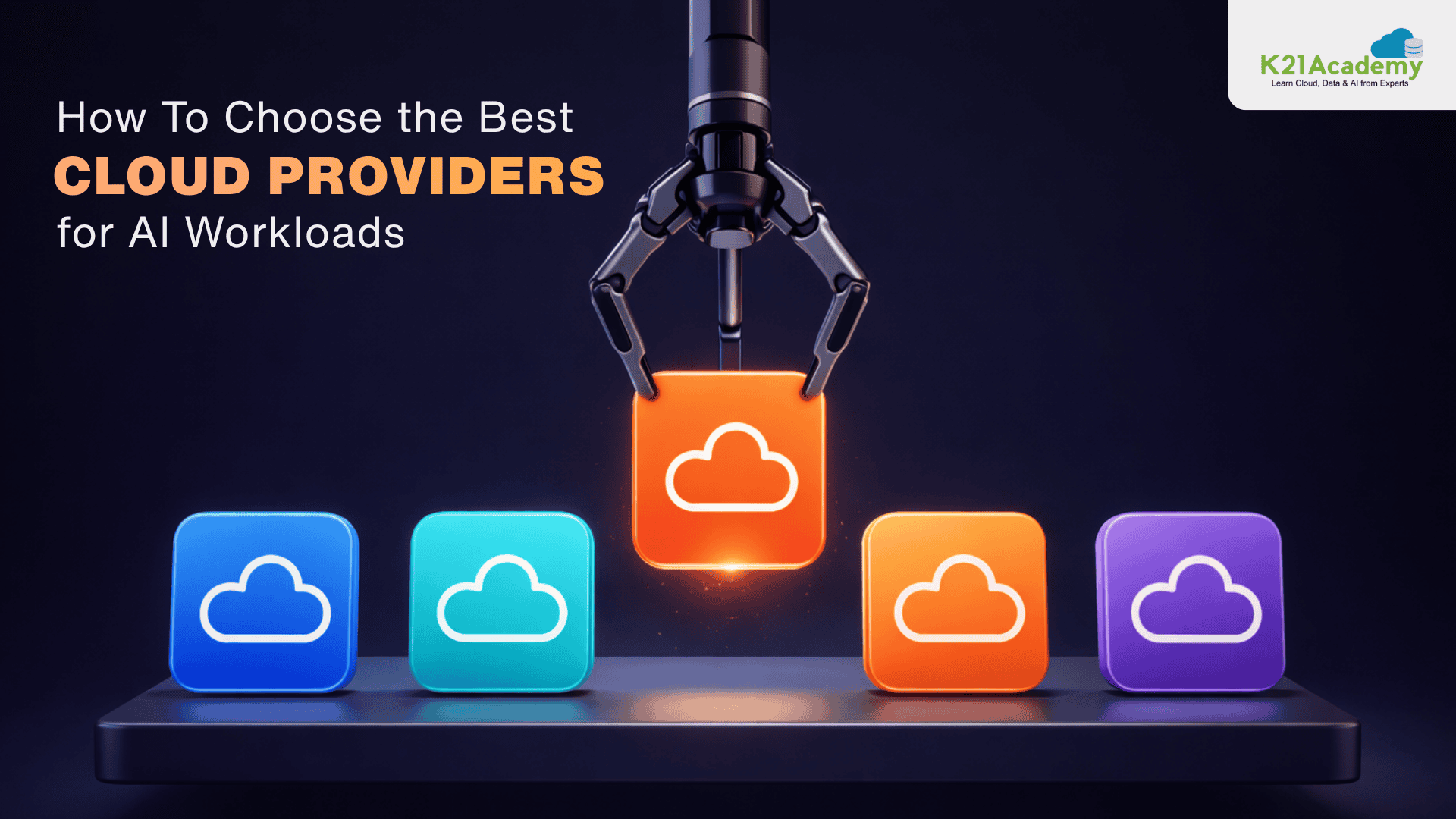





Artificial intelligence is now essential infrastructure, not only an experimental project within businesses. AI workloads are increasingly mission-critical, ranging from autonomous workflows and predictive analytics to generative AI copilots.
But here’s the real question: With cost, performance, compliance, and long-term innovation at stake, how are businesses selecting the best cloud providers for AI workloads?
This blog offers a decision-first framework of how CIOs, AI executives, and architectural teams truly assess cloud platforms instead of a general feature comparison.
Step 1: Define the AI Workload Type
Businesses first categorize their AI ambitions before comparing vendors. Different cloud providers have strengths in particular areas, and not all AI workloads are created equal.
Generative AI Applications
These consist of enterprise assistants, copilots, chatbots, and content creation tools. Key requirements include:
- Managed foundation models
- Scalable inference endpoints
- Built-in guardrails
- API-driven deployment
Managed LLM services and model marketplaces are given top priority by businesses choosing cloud providers for AI workloads in this area.
Related Readings: What is a large language model (LLM)?
Large Scale Model Training
Training large models requires the following:
- High-end GPU/TPU clusters
- Distributed training frameworks
- Fast networking (InfiniBand, high-bandwidth interconnects)
- Optimized storage pipelines
Here, cloud providers for AI workloads are evaluated based on raw compute power and cluster availability.
Real-Time Inference Systems
Examples include fraud detection, recommendation engines, and real-time personalization. Enterprises analyze:
- Latency performance
- Auto-scaling capabilities
- Edge deployment options
- Cost per inference
For inference-heavy workloads, cloud providers for AI workloads must balance speed with operational efficiency.
Data-Centric ML Pipelines
These workloads integrate analytics, data warehousing, and machine learning. Enterprises look for:
- Native integration between data platforms and ML tools
- Built-in feature engineering capabilities
- Strong MLOps pipelines
This is where ecosystem maturity plays a major role in choosing cloud providers for AI workloads.
Related Readings: What is MLOps? – Everything You Need to Know
Step 2: Infrastructure Strength: GPU & AI Hardware Strategy
Workloads involving AI are costly and computationally demanding. Businesses carefully consider the availability of infrastructure before choosing providers of AI Cloud Solutions for AI applications. Key evaluation factors are:
GPU Variety & Availability
Is the provider offering:
- Multiple GPU generations?
- Regional availability?
- Capacity guarantees?
Limited GPU supply can delay AI projects.
Custom AI Silicon
Some cloud providers for AI workloads invest in proprietary chips that can reduce cost or improve efficiency.
- Custom AI accelerators
- Specialized inference hardware
- Energy-efficient architecture
This is becoming a competitive differentiator in 2026.
Networking & Storage
AI training requires the following:
- High-throughput networking
- Low-latency data pipelines
- Parallel file systems
Infrastructure maturity heavily influences enterprise decisions.
Step 3: AI Platform & Tooling Ecosystem
When choosing cloud providers for AI workloads, businesses look at more than just technology.
Managed AI Services
These reduce time-to-market significantly.
- Foundation model access
- AutoML capabilities
- Pre-built AI APIs
MLOps & Governance
Enterprises require:
- Model versioning
- Experiment tracking
- Monitoring and observability
- Responsible AI guardrails
Cloud providers for AI workloads must support full model lifecycle management.
Enterprise Integration
Can AI services integrate with the following?
- ERP systems
- CRM platform
- Identity management
- DevOps pipelines
Seamless integration often determines enterprise preference.
Step 4: Cost Intelligence
Many businesses underestimate the complexity of AI costs. Finance and architecture teams look at the following when assessing cloud providers for AI workloads:
- GPU hourly pricing: High-performance GPUs cost significantly depending on region and demand.
- Data egress charges: Moving training data across regions increases costs.
- Inference scaling: Real-time generative AI workloads can multiply inference expenses quickly.
Increasingly, AI FinOps practices guide the selection of cloud providers for AI workloads.
Step 5: Compliance & Data Sovereignty
Compliance is a must for sectors like government, healthcare, and banking. Businesses consider the following factors when selecting cloud providers for AI workloads:
- Regional data centers
- Data residency assurances
- Certifications in the industry
- Management of keys and encryption
- Offerings from Sovereign Cloud
Before technical comparisons even start, provider alternatives are frequently limited by compliance restrictions.
Step 6: Multi-Cloud Strategy—Risk Mitigation Over Loyalty
Businesses are no longer committed to just a single provider. Rather, they divide up AI workloads among several cloud providers so that companies can:
- Steer clear of vendor lock-in
- Boost your negotiating power
- Boost your resilience
- Place the burden as efficiently as possible.
For instance:
- Training on a single cloud
- Inference in another
- Third-party enterprise apps
Multi-cloud, however, necessitates robust governance and adds operational complexity.
Step 7: AI Workload Comparison
Enterprises evaluate these factors against their internal AI roadmap before selecting cloud providers for AI workloads.
| Feature | AWS | Azure | Google Cloud |
|---|---|---|---|
| GPU Variety | Extensive | Strong | Strong |
| Custom AI Hardware | Moderate | Moderate | Advanced (TPUs) |
| Managed AI Services | Mature | Enterprise-focused | AI-native |
| Enterprise Integration | Strong | Very Strong | Moderate |
| Data & Analytics Integration | Strong | Strong | Advanced |
| Global Reach | Very Wide | Wide | Wide |
| Best Fit | Flexible scaling | Enterprise AI transformation | AI innovation & research |
Related Readings: How AI Integration is Transforming Cloud Computing
Step 8: Real Enterprise Decision Flow
The actual process for evaluating cloud providers for AI workloads in an enterprise setting is as follows:
- Determine the category of AI use cases.
- Determine the infrastructure needs.
- Calculate the projected costs for the next three years.
- Verify the limitations of compliance.
- Assess the ecosystem’s fit.
- Choose between a single and multi-cloud approach.
This methodical framework lowers risk and synchronises AI infrastructure with corporate objectives.
Conclusion
A strategic choice that affects scalability, cost control, innovation capabilities, and regulatory compliance is choosing the best cloud providers for AI workloads. There isn’t a single “best” supplier. The actual query that businesses pose is:
“Which cloud service providers for AI workloads fit our long-term digital strategy, financial model, and AI vision?”
Businesses that make careful, data-driven cloud decisions will have a long-lasting competitive advantage as AI continues to transform industries.
Frequently Asked Questions
What are the best cloud providers for AI workloads in 2026?
The best Cloud Providers for AI Workloads depend on your use case. AWS offers flexibility, Azure excels in enterprise integration, and Google Cloud is strong in AI-native innovation.
What is the biggest cost factor in AI cloud deployments?
The biggest cost drivers across Cloud Providers for AI Workloads are GPU usage, inference scaling, and data transfer fees.
Why is compliance important when selecting AI cloud providers?
Compliance and data residency rules often limit which Cloud Providers for AI Workloads an enterprise can use, especially in regulated industries.