





AI is evolving faster than most professionals expected.
With the launch of the Claude Certified Architect – Foundations certification, one thing is becoming clear:
The future will belong to people who can design, orchestrate, and deploy AI systems, not just use AI tools.
Meanwhile, many professionals are still asking:
“How do I even get started?”
At the same time, others are already building advanced AI workflows, multi-agent systems, and production-ready ML applications.
That gap will only widen.
Here’s the reality:
AI is not slowing down to wait for anyone.
But here’s the opportunity:
You do not need to become a world-class researcher to stay relevant.
You need to understand how modern AI systems are structured, integrated, and applied to real-world problems.
That is exactly what the Claude Certified Architect – Foundations program is designed to teach:
- AI system design
- Agent workflows
- LLM architecture
- Enterprise AI implementation
- Practical AI problem-solving
The next wave of innovation will be led by people who know how to architect AI systems, not just experiment with prompts.

What is the Claude Certified Architect – Foundations Certification?
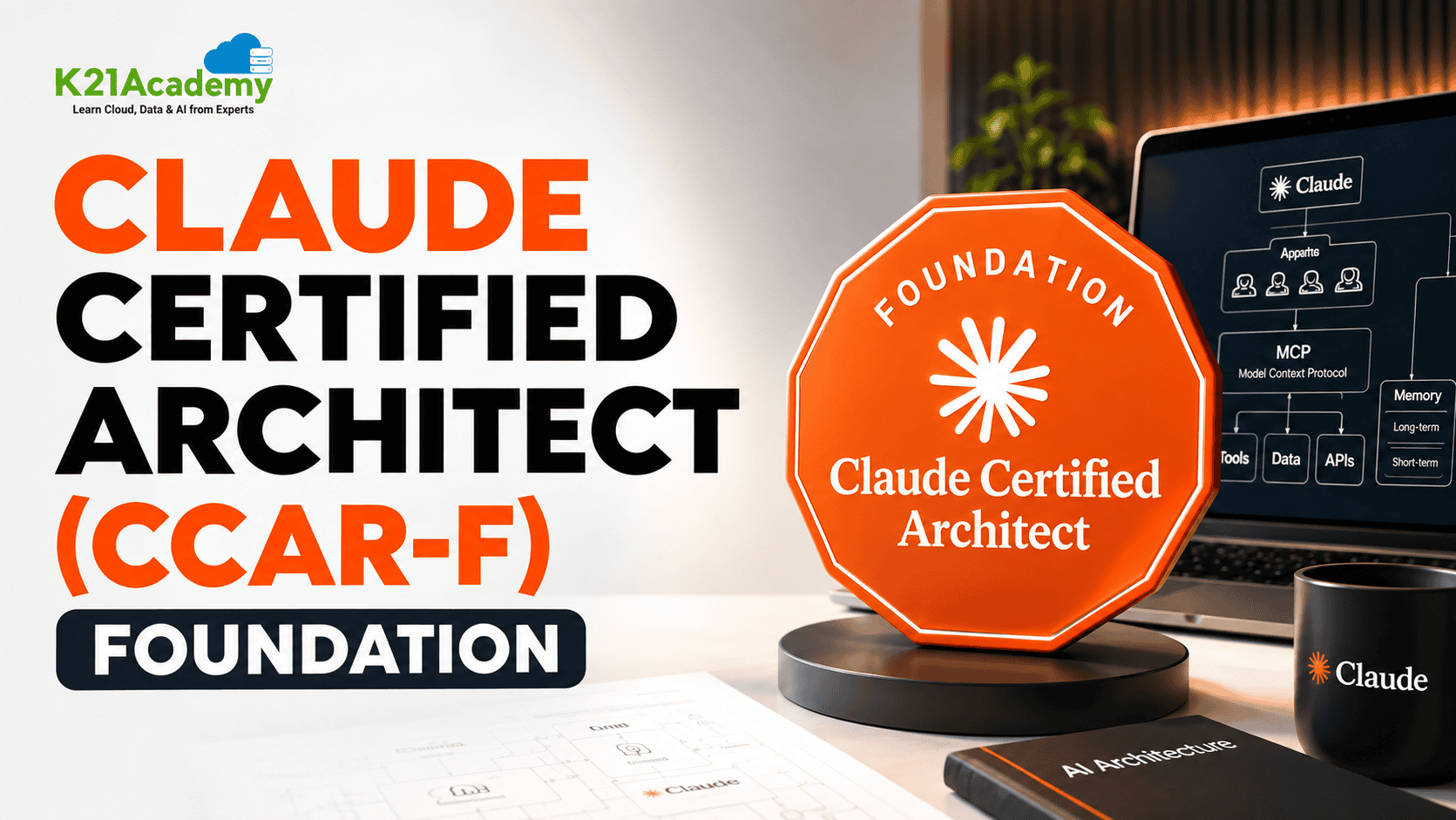
The Claude Certified Architect – Foundations (CCAR-F) is part of Anthropic’s Claude Certification Program and validates the ability to design and build production-ready solutions using Claude.
The certification is positioned at the Foundations level of the Architect track. Rather than focusing only on Claude features or API concepts, the exam evaluates how well you can make practical architectural decisions involving agents, tools, Claude Code, MCP, prompts, structured outputs, context management, and reliability.
Anthropic’s Claude Certification Program now spans four credentials across three roles:
| Credential | Code | Who It’s For |
|---|---|---|
| Claude Certified Associate – Foundations | CCAO-F | Non-technical operators, consultants, and business users |
| Claude Certified Developer – Foundations | CCDV-F | Developers building applications with Claude |
| Claude Certified Architect – Foundations | CCAR-F | Architects designing and implementing production Claude solutions |
| Claude Certified Architect – Professional | CCAR-P | Advanced and senior architects working on enterprise-scale Claude solutions |
This makes CCAR-F the entry point to Anthropic’s Architect certification track, sitting alongside the Associate and Developer Foundations credentials and ahead of the Professional Architect credential.
The certification focuses on practical architecture skills, including:
- Designing agentic and multi-agent workflows
- Integrating tools and services through MCP
- Configuring Claude Code for development workflows
- Engineering reliable prompts and structured outputs
- Managing context across complex AI workflows
- Designing systems for reliability, escalation, and production use
In short, CCAR-F is designed for professionals who want to demonstrate that they can move beyond simply using Claude and make sound architectural decisions when building real-world Claude-powered systems.
Exam Details at a Glance
| Item | Detail |
|---|---|
| Credential | Claude Certified Architect – Foundations |
| Exam code | CCAR-F |
| Number of questions | 60 items |
| Question format | Multiple-choice and multiple-response (each item states how many to select) |
| Exam structure | 4 scenarios presented, drawn at random from a bank of 6 |
| Time limit | 120 minutes |
| Passing score | 720 on a scaled range of 100–1,000 |
| Exam fee | $125 USD (per attempt) |
| Delivery | Pearson VUE, online proctored or at a test centre |
| Validity | 12 months from the date awarded |
| Result reporting | Pass/fail with scaled score, plus percent-correct by domain |
| Guide version | v1.0, effective July 2026 (subject to change – confirm on Anthropic’s page) |
CCAR-F Registration, Scheduling, Retakes, and Recertification
How to Register and Schedule the CCAR-F Exam
Registration for the Claude Certified Architect – Foundations exam is handled through the Anthropic Partner Academy. After registering for the certification, candidates are directed to Pearson VUE to schedule the examination.
Candidates can choose between:
- Online proctored delivery
- A Pearson VUE test centre
The current listed price for CCAR-F is $125 USD, before any applicable partner-tier discount. The exam is 60 questions with a 120-minute testing period, with approximately 135 minutes of total seat time including check-in and other exam procedures.
Important: Certification access is currently limited to people at organizations in the Claude Partner Network. Registration requires a recognized company-domain partner email; personal email addresses are not accepted. Because eligibility and pricing can change, candidates should confirm the current requirements in Anthropic Partner Academy before registering.
Cancellation and Rescheduling Policy
Candidates can cancel or reschedule their Pearson VUE appointment without forfeiting the exam fee when the change is made at least 24 hours before the scheduled appointment.
Changes made less than 24 hours before the appointment, as well as a no-show, result in forfeiture of the exam fee.
CCAR-F Retake Policy
If you do not pass the exam, you can retake it after the applicable waiting period:
| Failed Attempt | Required Waiting Period |
|---|---|
| First failed attempt | 14 days |
| Second failed attempt | 30 days |
| Third failed attempt | 90 days |
Candidates can attempt the same certification up to four times within a rolling 12-month period. The applicable exam fee is charged for each attempt, although partner-tier discounts may apply.
If you fail, use the domain-level percentage breakdown on your score report to identify where additional preparation is needed before scheduling another attempt.
CCAR-F Credential Validity and Recertification
The CCAR-F credential is valid for 12 months from the date it is awarded.
Candidates who renew their certification before it expires can complete a free, non-proctored assessment through the Anthropic Partner Academy. If the credential expires, the candidate must retake the full certification exam and pay the applicable exam fee to regain certified status.
This makes it important to treat certification as an ongoing learning credential rather than a one-time achievement. Claude’s tools, APIs, and recommended architecture patterns continue to evolve, so maintaining the credential also provides a reason to stay current.
How Is the CCAR-F Exam Scored?
The CCAR-F exam uses a scaled score from 100 to 1,000, with 720 as the minimum passing score. The exam is criterion-referenced, meaning your performance is measured against a defined standard rather than against the performance of other candidates.
Your score report includes:
- Overall pass/fail result
- Overall scaled score
- Percentage of questions answered correctly in each exam section
The section-level percentages are useful for identifying strengths and weaknesses, but they do not independently determine whether you pass or fail. The overall scaled score is used to determine the result.
In other words, you do not need to achieve a particular percentage in every individual domain. Your objective is to achieve the required overall scaled score of 720 or higher.
Who Should Take This Certification?
Regardless of whether you have prior experience or not, this program is intended for those who want to get started in the field of AI.
Ideal for:
- Developers & Software Engineers
- IT Professionals transitioning into AI
- AI Engineers & Technical Leads
- Solution Architects
- AI Engineers
- Career switchers into AI
- QA, Backend, and Full-Stack Engineers
Prerequisites:
Comfortable with Python and the command line; some exposure to LLM APIs / prompt engineering helpful. Anthropic recommends roughly 6+ months of hands-on experience with Claude (API, Agent SDK, Claude Code, MCP) before sitting the exam, the K21 program is designed to build you to that level
Key Skills You Will Learn
Upon completing the program, you will be capable of:-
- Creating agentic AI systems by utilizing the Agent SDK
- Construct multi-agent architectures such as hub-and-spoke systems
- Connect tools with the help of MCP servers
- Customize development workflows by configuring Claude Code
- Develop top-notch prompts that can be structured for outputs
- Keep track of context in lengthy AI workflows
- Develop dependable, large-scale AI systems
Related Readings: Claude Code vs GitHub Copilot vs Cursor: Which AI Coding Assistant Should You Learn?
Exam Domains Breakdown
The certification covers 5 core domains:
1. Agentic Architecture & Orchestration (27%)
- Agentic loop lifecycle & correct stop_reason handling (tool_use vs end_turn)
- Coordinator–subagent (hub-and-spoke) orchestration & task decomposition
- Subagent invocation & explicit context passing (the Task tool)
- Multi-step workflows with programmatic enforcement / hooks (e.g. PostToolUse)
- Task-decomposition strategies (prompt chaining vs adaptive)
- Session state, resumption (–resume) and forking (fork_session)
2. Tool Design & MCP Integration (18%)
- Writing clear, differentiated tool interfaces & descriptions
- Structured MCP error responses (isError, errorCategory, isRetryable)
- Distributing tools across agents & configuring tool_choice (auto / any / forced)
- MCP server config: project (.mcp.json) vs user scope; env-var expansion
- Built-in tools: Read, Write, Edit, Bash, Grep, Glob
3. Claude Code Configuration & Workflows (20%)
- CLAUDE.md hierarchy & modular organisation (@import, .claude/rules/)
- Custom slash commands & skills (context: fork, allowed-tools, argument-hint)
- Path-specific rules with glob patterns
- Plan mode vs direct execution
- Iterative refinement (examples, test-driven, interview pattern)
- CI/CD integration (-p/–print, –output-format json, –json-schema)
4. Prompt Engineering & Structured Output (20%)
- Explicit criteria to improve precision / reduce false positives
- Few-shot prompting for consistency and ambiguous cases
- Structured output via tool_use + JSON schemas
- Validation, retry and feedback loops
- Batch processing (Message Batches API – 50% cost, up to 24h, no latency SLA)
- Multi-instance / multi-pass review architectures
5. Context Management & Reliability (15%)
- Preserving critical info across long interactions (case-facts blocks, trimming tool output)
- Escalation & ambiguity-resolution patterns
- Error propagation across multi-agent systems
- Context management in large-codebase exploration (scratchpads, /compact)
- Human-review workflows & confidence calibration
- Information provenance in multi-source synthesis
Related Readings: Top 10 Claude Code Use Cases Every Developer Should Know
Capstone Project (Your Portfolio Asset)
You will build a Customer Support Resolution Agent that includes:
- Agentic loop with proper termination
- Multi-agent system
- MCP tool integrations
- Escalation system
- Context management system
- Structured output validation
This project proves you can:
- Design
- Build
- Deploy
Real production AI systems

Career Opportunities After Certification
This certification opens doors to high-demand roles such as:
- AI Architect
- AI Engineer
- Generative AI Engineer
- Machine Learning Engineer
- AI Platform Engineer
- Solution Architect (AI Systems)
Career and Salary Impact After Claude Certified Architect – Foundations Certification
The demand for AI professionals is shifting from people who can simply use AI tools to professionals who can design, integrate, and manage AI-powered systems.
The Claude Certified Architect – Foundations certification helps professionals build practical skills in AI architecture, agent-based workflows, automation, and enterprise AI implementation. These skills align with some of the fastest-growing technology roles in 2026.
While salaries vary based on experience, location, industry, and technical background, professionals with AI system design skills are increasingly positioned for higher-value roles.
Career Opportunities and Expected Salary Impact
| Role | What You Will Do | Average Salary Range (Global Estimate) |
|---|---|---|
| AI Engineer | Build and deploy AI applications, agent workflows, and LLM-based solutions | $100,000 – $180,000+ |
| Generative AI Engineer | Develop AI applications using LLMs, RAG systems, agents, and automation frameworks | $110,000 – $200,000+ |
| AI Architect | Design enterprise AI systems, architecture patterns, security, and scalability strategies | $140,000 – $250,000+ |
| Machine Learning Engineer | Develop, optimize, and productionize machine learning and AI models | $120,000 – $220,000+ |
| AI Platform Engineer | Build infrastructure, tooling, and platforms for AI development teams | $120,000 – $210,000+ |
| Solution Architect (AI Systems) | Help organizations adopt and integrate AI solutions into business workflows | $130,000 – $230,000+ |
| Software Engineer with AI Skills | Enhance traditional software development using AI agents and automation | $90,000 – $170,000+ |
Salary ranges are approximate and vary significantly by country, company, experience level, and specialization.
Global AI Career Salary Comparison
| Role | United States | Europe | India | Canada | United Kingdom | Global Average Range |
|---|---|---|---|---|---|---|
| AI Engineer | $120K – $200K | €70K – €140K | ₹8L – ₹35L | CAD $90K – $170K | £60K – £130K | $80K – $180K |
| Generative AI Engineer | $130K – $220K | €80K – €150K | ₹10L – ₹45L | CAD $100K – $180K | £70K – £140K | $90K – $200K |
| AI Architect | $150K – $250K+ | €100K – €180K | ₹20L – ₹70L+ | CAD $130K – $220K | £90K – £170K | $120K – $250K+ |
| Machine Learning Engineer | $120K – $220K | €70K – €150K | ₹10L – ₹50L | CAD $100K – $190K | £65K – £150K | $90K – $200K |
| AI Platform Engineer | $130K – $230K | €90K – €160K | ₹15L – ₹55L | CAD $110K – $200K | £75K – £160K | $100K – $210K |
| AI Solution Architect | $140K – $260K+ | €100K – €190K | ₹20L – ₹80L+ | CAD $130K – $230K | £90K – £180K | $120K – $260K+ |
| Software Engineer with AI Skills | $100K – $180K | €60K – €130K | ₹6L – ₹30L | CAD $80K – $160K | £50K – £120K | $70K – $160K |
Salary ranges are approximate annual compensation estimates based on global market trends. Actual salaries may differ depending on experience level, location, company, and technical specialization.
Salary Growth Potential by Experience Level
| Experience Level | Typical Roles | Global Salary Range |
| Beginner (0–2 years) | AI Developer, Junior AI Engineer, Software Engineer with AI Skills | $50K – $100K |
| Mid-Level (3–6 years) | AI Engineer, Generative AI Engineer, ML Engineer | $90K – $180K |
| Senior (7+ years) | AI Architect, AI Platform Engineer, Technical Lead | $150K – $300K+ |
| Expert/Principal Level | Principal AI Architect, AI Strategy Lead, Enterprise AI Consultant | $200K – $500K+ |
How to Prepare for the CCAR-F Exam: Official Guidance + Hands-On Practice
Reading documentation alone is not enough for the Claude Certified Architect – Foundations exam. The certification is designed around practical architecture decisions, so candidates should combine conceptual study with hands-on implementation.
Anthropic provides preparation resources through the Anthropic Partner Academy, including the exam guide and preparation courses. The official exam information recommends becoming familiar with the technologies, domains, and scenarios covered by the assessment.
Four Hands-On Exercises to Practice
The following exercises are particularly useful because they mirror the types of architecture decisions covered by the exam.
1. Build an Agent with the Claude Agent SDK
Create an agent that can call multiple tools, handle errors, maintain session state, and determine when it should stop or escalate.
Practice:
- Building a complete agentic loop
- Calling and selecting tools
- Handling tool errors
- Managing sessions
- Passing context to subagents
- Adding escalation logic
- Testing how the agent behaves when information is missing or ambiguous
The goal is not simply to make an agent work. You should understand why you would choose a particular orchestration pattern and how the system behaves when something goes wrong.
2. Configure Claude Code for a Team
Create a realistic team development environment using Claude Code.
Practice:
- Creating a project-level
CLAUDE.md - Organizing reusable instructions
- Using path-specific rules
- Creating custom slash commands or skills
- Configuring MCP servers
- Controlling which tools are available
- Comparing plan mode with direct execution
This exercise helps you understand how Claude Code configuration affects consistency, safety, and developer productivity.
3. Build a Structured Data Extraction Pipeline
Create a pipeline that extracts information from unstructured documents and returns validated structured data.
Practice:
- Designing JSON schemas
- Defining required, optional, and nullable fields
- Using structured output
- Adding validation
- Implementing retry and correction loops
- Handling missing information without allowing the system to invent values
- Processing multiple documents
- Routing uncertain results to human review
Pay particular attention to the difference between a formatting/validation error that can be corrected and information that simply does not exist in the source document.
4. Design and Debug a Multi-Agent Research Pipeline
Build a coordinator that delegates research tasks to specialized subagents.
Practice:
- Breaking a research problem into independent tasks
- Passing explicit context to subagents
- Running independent tasks in parallel
- Combining subagent results
- Handling failed or incomplete subagent responses
- Preserving citations and source provenance
- Producing a final structured research report
A Practical Preparation Strategy
Use the hands-on exercises alongside the five exam domains rather than studying the domains in isolation.
A strong preparation sequence is:
- Read the official CCAR-F exam guide.
- Understand the five exam domains and their weightings.
- Study all six exam scenarios.
- Complete the four hands-on exercises.
- Build at least one small Claude-powered project from scratch.
- Practice making architecture decisions under constraints such as cost, reliability, latency, context limits, and human-review requirements.
- Take practice questions and review why each incorrect option is wrong.
- Use your weakest domains and scenarios to guide your final revision.
The most important mindset shift is to prepare for architectural judgment rather than feature memorization. When you see an exam question, ask:
What constraint is the question emphasizing, and which architecture best satisfies that constraint?
That approach is much more useful than trying to memorize every Claude feature individually.
Recommended Study Path: Claude Certified Architect – Foundations (8 Weeks)
A structured learning plan helps beginners and experienced professionals gradually move from AI fundamentals to production-ready AI architecture.
Weeks 1–2: AI and Claude Foundations
Goal: Understand the fundamentals of Claude and modern AI application development.
Topics Covered:
- Introduction to Claude and LLM-based applications
- Understanding AI system components
- Working with Claude APIs
- Building your first AI agent
- Basic prompt engineering principles
- Understanding AI workflows and automation
Hands-on Practice:
- Create simple AI assistants
- Experiment with different prompts
- Build your first Claude-powered application
Weeks 3–4: Agentic Systems and AI Architecture
Goal: Learn how to design intelligent systems using agents and tools.
Topics Covered:
- Agent loops and reasoning workflows
- Multi-agent system architecture
- Hub-and-spoke agent patterns
- Tool calling concepts
- MCP (Model Context Protocol) fundamentals
- Connecting external tools and services
Hands-on Practice:
- Build a multi-agent workflow
- Create MCP-based tool integrations
- Design an AI automation system
Weeks 5–6: Advanced AI Engineering
Goal: Build reliable and scalable AI applications.
Topics Covered:
- Advanced prompt engineering
- Few-shot prompting techniques
- Structured outputs
- JSON schema validation
- Context management strategies
- Error handling and reliability patterns
- Production AI workflow optimization
Hands-on Practice:
- Improve agent accuracy
- Implement validation workflows
- Manage long AI conversations effectively
Week 7: Capstone Project Development
Goal: Apply all learned concepts to a real-world AI system.
Build:
Customer Support Resolution Agent
Project Components:
- Agentic workflow with termination logic
- Multi-agent architecture
- MCP tool integrations
- Customer escalation workflow
- Context management system
- Structured output validation
Outcome:
A portfolio-ready AI system demonstrating your ability to design, build, and deploy production-level AI solutions.
Week 8: Certification Exam Preparation
Goal: Prepare for the Claude Certified Architect – Foundations exam.
Activities:
- Review all certification domains
- Complete practice exams
- Solve scenario-based architecture questions
- Review AI system design patterns
- Improve weak areas through hands-on labs
Final Preparation Checklist:
✓ Understand agent architecture
✓ Build and integrate tools using MCP
✓ Configure Claude Code workflows
✓ Design reliable AI applications
✓ Apply prompt engineering techniques
✓ Manage context and AI reliability challenges
By following this 8-week roadmap, learners can progress from understanding AI fundamentals to confidently designing and implementing production-ready AI systems.
The Six CCAR-F Exam Scenarios
The Claude Certified Architect – Foundations exam is scenario-based, which means the questions are presented in the context of realistic Claude implementation and architecture problems.
The exam contains 60 questions, and 4 of the 6 published scenarios are selected at random for each exam attempt. Because you will not know which scenarios you will receive, it is important to prepare for all six rather than focusing only on one or two areas.
Here is an overview of the six scenarios candidates should be familiar with:
Scenario 1 – Customer Support Resolution Agent
This scenario focuses on building an AI-powered customer support agent using the Claude Agent SDK and MCP tools.
The agent may need to handle customer requests such as returns, billing issues, account questions, order lookups, and refunds. It must also recognize situations where a request is ambiguous or outside its authority and escalate the case to a human.
Key areas to understand include:
- Agent SDK and agentic loop design
- MCP tool integration
- Tool selection and tool descriptions
- Escalation and human-in-the-loop workflows
- Error handling and reliability
- Achieving a high first-contact resolution rate without sacrificing safety
Scenario 2 – Code Generation with Claude Code
This scenario examines how Claude Code can be configured and used as a development partner for software engineering tasks.
You should understand how to use Claude Code for activities such as code generation, refactoring, debugging, and documentation, as well as how configuration affects the development workflow.
Important concepts include:
CLAUDE.mdconfiguration- Custom slash commands
- Claude Code workflows
- Plan mode versus direct execution
- Iterative code refinement
- Choosing the right workflow for the complexity of a development task
Scenario 3 – Multi-Agent Research System
This scenario involves designing a multi-agent research workflow in which a coordinator delegates tasks to specialized subagents.
For example, different agents may be responsible for web research, document analysis, fact gathering, synthesis, or report generation. The final system needs to combine those outputs into a comprehensive and properly cited report.
Key concepts include:
- Coordinator and subagent architecture
- Task decomposition
- Parallel subagent execution
- Explicit context passing
- Context isolation
- Error propagation
- Combining and validating results from multiple agents
- Maintaining source attribution and provenance
Scenario 4 – Developer Productivity with Claude
This scenario focuses on using Claude to improve developer productivity when working with unfamiliar or complex codebases.
The system may need to explore existing code, understand relationships between components, generate boilerplate, or help developers complete engineering tasks using Claude’s built-in tools and MCP integrations.
Topics to review include:
- Codebase exploration
- Built-in Claude Code tools
- Read, Write, Edit, Bash, Grep, and Glob
- MCP integrations
- Tool selection
- Managing context when working with large codebases
- Designing efficient developer workflows
Scenario 5 – Claude Code for Continuous Integration
This scenario examines how Claude Code can be incorporated into a CI/CD pipeline to automate activities such as code reviews, test generation, and pull-request feedback.
The challenge is not simply to automate code review, but to design a workflow that produces useful and actionable feedback while minimizing false positives and unnecessary developer interruptions.
Important concepts include:
- Claude Code in CI/CD workflows
- Automated code review
- Test generation
- Pull-request feedback
- Structured output
- JSON-based integration
- Prompt design for reducing false positives
- Batch processing and asynchronous workflows where appropriate
Scenario 6 – Structured Data Extraction
This scenario focuses on extracting reliable structured information from unstructured documents.
The system must transform source material into structured data while handling missing information, ambiguous fields, validation errors, and downstream integration requirements.
Key areas include:
- JSON Schema design
- Structured output with
tool_use - Required, optional, and nullable fields
- Validation and retry workflows
- Handling edge cases
- Distinguishing correctable errors from information that is simply missing
- Batch processing
- Human review for low-confidence results
Why You Should Study All Six Scenarios
Although only four scenarios appear on an individual exam attempt, all six are worth preparing for.
The scenarios are designed to test the same underlying architectural judgment from different angles. A question may ask you to choose between multiple technically possible approaches, so memorizing definitions is not enough.
When preparing, focus on understanding why one architectural choice is better than another under a specific constraint, such as reliability, context limits, tool safety, cost, accuracy, maintainability, or the need for human escalation.
A good preparation strategy is therefore to build or design a small implementation for each scenario and identify the trade-offs involved. This approach complements the five exam domains and makes it easier to apply the concepts when the scenario changes.
Why This Certification Matters in 2026
AI used to be about only models.
What’s the real issue then?
- Constructing dependable, scalable AI systems
- That’s fortunately what this certification centers on.
Companies are very much searching for experts who have the ability to:-
- Conceptualize AI frameworks
- Implement actual systems
- Maintain reliability and performance
Consequently, Claude Architects are very much appreciated.
What You Get at the End
- Claude Certified Architect certification
- A portfolio-grade AI system
- 30 hands-on labs completed
- 3 full exam simulations
- Real-world AI architecture skills
Final Thoughts
In case you are working toward making a profession in AI,
To learn system architecture is far more valuable than learning tools.
This certification is not only about AI.
It paves a way for you to build AI that really runs in production.
And this is what companies really ask for.
Learn from the Best
In case you really want to master this certification and gain hands-on skills, a well-structured guide could be very significant.
K21 Academy is a famous training platform that concentrates on Cloud, AI, and DevOps career transformation, providing:
- Hands-on labs and real-world projects
- Step-by-step learning paths (beginner → advanced)
- Live sessions with industry experts
- 1:1 career guidance and mentorship
- Job-oriented programs across AI, Azure, AWS, and DevOps
They have supported tens of thousands of learners worldwide to move into cloud and AI jobs by equipping them with practical, job-ready skills.
If you are looking for more than just a certificate and desire real career results, this type of structured learning can speed up your path.
Frequently Asked Questions
Q1. Do you think AI architects will completely replace traditional developers and engineers?
Not really people's jobs are just being reshaped rapidly. Those developers who will not make use of AI systems will be marginalized. The good news is that developing skills such as AI architecture actually secures your job in the future rather than taking it away.
Q2. It feels like I am already late to AI. Is it even worth starting now?
It is a very common fear though a misconception. Most workers are still novices in AI. In fact, starting now, especially with systems like Claude Architect, actually might put you on the front foot when most of the people are still hesitating.
Q3. What if I don't get all the complicated AI things or fail the certificate exam?
You are not required to know everything right away. The feature of this course is that even a novice can be taught gradually. In case you have some difficulties at the start, you will be able to rely on the lab sessions and the practice tests to really gain confidence before the final exam.
Q4. What if I spend time on this and it still does not help my career?
It is a reasonable question to ask. However, this certificate is oriented towards actual, hands-on skills like making AI systems, not just theoretical ones. Even without the certificate, the portfolio project is a great way to promote yourself.
Q5. The use of AI seems very technical and so overwhelming. How am I going to start?
That's precisely why beginner-to-architect pathways were created. Instead of learning everything haphazardly, this program provides you with a step-by-step plan of your learning starting with your first API call and ending with building full AI systems, thus making your learning journey manageable and very clear.