



Artificial Intelligence and Machine Learning are no longer optional skills in 2026, they are becoming core requirements across cloud, data, and DevOps roles. As organizations rapidly adopt Microsoft Azure for AI-powered solutions, professionals are actively searching for high-quality azure ai ml training programs that combine real-world implementation with certification-focused learning.
Whether you are preparing through hands-on azure ml labs, exploring enterprise AI use cases, or planning your azure ai certification prep, understanding the right learning path can significantly accelerate your career growth. From building machine learning models to deploying AI solutions on Azure, the demand for practical cloud AI expertise continues to rise across industries.
In this article, you will learn about the best Azure AI and ML training approaches, essential labs and practical exercises, certification preparation strategies, career opportunities, and the skills needed to stay competitive in 2026. Let’s explore how to build strong Azure AI expertise step by step.

Course Overview & Learning Path
An azure ai ml course is a structured training program designed to help learners build practical skills in Artificial Intelligence and Machine Learning using Microsoft Azure services. A well-designed azure ml learning path typically progresses from AI fundamentals to model development, deployment, automation, and certification preparation.
As businesses increasingly integrate AI into cloud operations, organizations are prioritizing professionals who can work with scalable AI and ML solutions on Azure. This makes following a clear azure ai training roadmap essential for learners aiming to gain hands-on experience, industry-recognized certifications, and real-world implementation skills.
Key Features of an Azure AI ML Learning Path
-
Starts with Azure AI and Machine Learning fundamentals before moving into advanced implementation concepts.
-
Includes hands-on azure ml labs to provide practical exposure to model training, deployment, and monitoring.
-
Follows a structured azure ml learning path covering data preparation, AI services, automation, and MLOps concepts.
-
Aligns with certification goals such as Azure AI Engineer and Azure Data Scientist certifications.
-
Combines theory, real-world use cases, and project-based learning within a complete azure ai training roadmap.
How It Differs from Other AI Learning Paths
Unlike generic AI courses that focus mainly on theory or coding concepts, an azure ai ml course emphasizes cloud-based AI implementation using Microsoft Azure tools and services. It focuses heavily on deployment, scalability, enterprise integration, and hands-on cloud labs, making it more practical for real-world business and production environments.
A typical progression in the learning path includes:
-
AI & ML Fundamentals
-
Azure AI Services & Tools
-
Machine Learning Model Development
-
Azure ML Labs & Real-World Projects
-
Model Deployment & MLOps
-
Azure AI Certification Preparation
1. Azure AI Fundamentals Labs
Hands-on practice is one of the most important parts of learning azure ai fundamentals. Practical labs help learners understand core AI concepts, work with Azure services in real environments, and prepare effectively for certification exams like AI-901. These beginner-friendly projects are designed to strengthen azure basics while building confidence with real Microsoft Azure AI tools.
Below are some essential ai-901 labs mapped to important exam domains and real-world AI implementation scenarios.
Lab 1: Explore Azure AI Services
Objective:
Learn how to create and manage Azure AI services using the Azure portal.
Tools Needed:
-
Azure Portal
-
Azure AI Services Resource
-
Web Browser
Estimated Time: 30–45 Minutes
Difficulty Level: Beginner
Skills You Will Build:
-
Understanding Azure AI service categories
-
Resource deployment basics
-
Cloud AI environment setup
-
Navigation of Azure AI tools
AI-901 Exam Domain Mapping:
AI Concepts and Capabilities – Understanding Azure AI services and AI workloads.
Step-by-Step Instructions
-
Sign in to the Azure Portal.
-
Create a new Azure AI Services resource.
-
Configure subscription, region, and pricing tier.
-
Deploy the service and review available APIs and endpoints.
-
Explore available AI capabilities like vision, speech, and language services.
Expected Output Example:
You should successfully deploy an Azure AI resource and view service keys, endpoints, and supported AI services from the dashboard.
Lab 2: Image Classification with Computer Vision
Objective:
Use Azure Computer Vision to analyze and classify images.
Tools Needed:
-
Azure AI Vision Service
-
Sample Images
-
Azure Portal
Estimated Time: 45–60 Minutes
Difficulty Level: Beginner to Intermediate
Skills You Will Build:
-
Image analysis concepts
-
Computer vision basics
-
AI model interaction using Azure APIs
-
Understanding object detection and tagging
AI-901 Exam Domain Mapping:
Implement AI Solutions Using Microsoft Foundry – Computer vision services and image analysis.
Step-by-Step Instructions
-
Create a Computer Vision resource in Azure.
-
Upload sample images for analysis.
-
Run image tagging and object detection features.
-
Review generated labels, confidence scores, and image descriptions.
-
Compare results across different image types.
Expected Output Example:
The AI service should return image tags such as “person,” “laptop,” or “outdoor,” along with confidence percentages.
Lab 3: Sentiment Analysis Using Azure Language Studio
Objective:
Analyze customer feedback using Natural Language Processing (NLP).
Tools Needed:
-
Azure Language Studio
-
Sample customer reviews
-
Azure AI Language Service
Estimated Time: 40–50 Minutes
Difficulty Level: Beginner
Skills You Will Build:
-
Text analytics fundamentals
-
Sentiment analysis implementation
-
NLP concepts in Azure
-
AI-powered customer feedback analysis
AI-901 Exam Domain Mapping:
AI Concepts and Capabilities – Natural Language Processing and text analytics.
Step-by-Step Instructions
-
Open Azure Language Studio.
-
Create or connect an Azure Language resource.
-
Paste sample customer review text.
-
Run sentiment analysis.
-
Review positive, negative, and neutral scoring outputs.
Expected Output Example:
The system should generate sentiment scores and classify reviews into positive, neutral, or negative categories.
Lab 4: Build a Simple AI Chatbot
Objective:
Create a basic conversational AI bot using Azure Bot Services.
Tools Needed:
-
Azure AI Services
-
Azure AI Language Service
-
Azure AI Foundry
Estimated Time: 60–90 Minutes
Difficulty Level: Intermediate
Skills You Will Build:
-
Conversational AI fundamentals
-
Intent recognition
-
Bot workflow creation
-
AI-powered customer interaction basics
AI-901 Exam Domain Mapping:
Implement AI Solutions Using Microsoft Foundry – Conversational AI and bot services.
Step-by-Step Instructions
-
Create an Azure Bot resource.
-
Configure bot settings and language understanding.
-
Add predefined intents and sample responses.
-
Test the chatbot using the web chat interface.
-
Modify responses and retrain intents.
Expected Output Example:
The chatbot should respond to basic user queries such as greetings, FAQs, or support-related questions.
Why These AI-901 Labs Matter
These ai-901 labs help learners move beyond theory and develop practical Azure AI implementation skills. By completing these exercises, learners gain hands-on exposure to cloud AI services, improve confidence with Azure tools, and prepare more effectively for real-world AI projects and Microsoft certification exams.
For best results, learners should document screenshots after each lab completion, including:
-
Azure resource deployment pages
-
AI output results
-
Sentiment analysis dashboards
-
Chatbot testing screens
-
Computer vision tagging outputs
These screenshots can also serve as portfolio evidence during job interviews and certification preparation.
2. Generative AI & Large Language Model Labs
Generative AI and Large Language Models (LLMs) have become some of the most in-demand skills in cloud and AI engineering roles in 2026. Hands-on labs help learners move beyond theory and understand how real-world AI applications such as chatbots, copilots, AI assistants, document summarization, and prompt engineering are built using Azure AI services.
These labs are especially valuable for learners preparing for Azure AI certifications, enterprise AI projects, and modern AI engineering roles involving OpenAI and Azure AI Foundry.
Lab 1: Build an AI Chatbot with Azure OpenAI
Objective
Create a conversational AI chatbot using Azure OpenAI and deploy it for basic question-answering tasks.
Tools Needed
-
Azure OpenAI Service
-
Azure AI Foundry
-
GPT Model Deployment
Estimated Time
60–90 Minutes
Difficulty Level
Intermediate
Skills You Will Build
-
Prompt engineering fundamentals
-
Azure OpenAI deployment
-
Conversational AI implementation
-
API-based AI interaction
-
AI application architecture basics
Certification & Real-World Mapping
-
Azure AI Engineer Associate preparation
-
Real-world customer support chatbot development
-
Enterprise AI assistant implementation
Step-by-Step Instructions
-
Create an Azure OpenAI resource in Azure Portal.
-
Deploy a GPT model using Azure AI Foundry.
-
Configure chatbot prompts and system instructions.
-
Test user interactions using the playground interface.
-
Modify prompts to improve response quality and tone.
-
Deploy the chatbot endpoint for application integration.
Expected Output Example
The chatbot should respond naturally to user questions such as:
-
“Explain Azure Machine Learning.”
-
“What are the benefits of cloud AI?”
-
“Summarize this paragraph.”
Lab 2: Prompt Engineering & AI Content Generation
Objective
Learn how prompt design impacts AI-generated responses using Large Language Models.
Tools Needed
-
Azure OpenAI Playground
-
GPT Model
-
Azure AI Foundry
Estimated Time
45–60 Minutes
Difficulty Level
Beginner to Intermediate
Skills You Will Build
-
Prompt engineering techniques
-
Response optimization
-
AI instruction design
-
Content generation workflows
-
Responsible AI practices
Certification & Real-World Mapping
-
Essential skill for modern AI engineering roles
-
Useful for AI-powered content automation and copilots
-
Supports Azure AI certification preparation
Step-by-Step Instructions
-
Open Azure AI Foundry playground.
-
Enter different prompts for content generation.
-
Experiment with tone, context, and instruction clarity.
-
Compare outputs across multiple prompt styles.
-
Optimize prompts for accuracy and consistency.
Expected Output Example
The AI should generate:
-
Blog summaries
-
Technical explanations
-
Email drafts
-
Code explanations
-
Marketing content
Lab 3: Document Summarization with Azure OpenAI
Objective
Build an AI workflow that summarizes long documents using LLMs.
Tools Needed
-
Azure OpenAI Service
-
Azure Blob Storage
-
Azure AI Foundry
Estimated Time
60 Minutes
Difficulty Level
Intermediate
Skills You Will Build
-
Text summarization workflows
-
AI automation concepts
-
Enterprise document processing
-
LLM integration skills
Certification & Real-World Mapping
-
Enterprise knowledge management systems
-
AI document processing applications
-
Business productivity automation
Step-by-Step Instructions
-
Upload sample documents or reports.
-
Connect documents to Azure OpenAI.
-
Create summarization prompts.
-
Generate concise AI summaries.
-
Compare summarized output with original documents.
Expected Output Example
The system should generate short executive summaries highlighting:
-
Key insights
-
Important decisions
-
Action items
-
Business recommendations
Lab 4: Create an AI-Powered Copilot
Objective
Develop a simple AI copilot that assists users with task automation and intelligent recommendations.
Tools Needed
-
Azure AI Foundry
-
Azure OpenAI
-
Azure Functions (Optional)
Estimated Time
90–120 Minutes
Difficulty Level
Advanced
Skills You Will Build
-
AI assistant development
-
Workflow automation
-
Multi-step prompt orchestration
-
Enterprise AI integration concepts
Certification & Real-World Mapping
-
Modern enterprise AI implementation
-
Copilot and automation development
-
Advanced Azure AI engineering skills
Step-by-Step Instructions
-
Configure Azure OpenAI deployment.
-
Create AI assistant instructions and workflows.
-
Integrate user input handling.
-
Add recommendation or automation logic.
-
Test copilot responses across scenarios.
Expected Output Example
The AI copilot should:
-
Answer workplace queries
-
Generate task summaries
-
Recommend next actions
-
Automate repetitive responses
Why These Generative AI Labs Matter
Generative AI and LLM-based projects are currently among the highest-demand skills in the AI industry. These labs help learners gain practical exposure to real enterprise AI workflows instead of only theoretical knowledge.
By completing these labs, learners develop:
-
Prompt engineering expertise
-
Azure OpenAI implementation skills
-
AI automation knowledge
-
Conversational AI development experience
-
Real-world portfolio projects for interviews and certifications
These projects are especially valuable for learners targeting:
-
Azure AI Engineer roles
-
AI Solution Architect positions
-
Generative AI Developer careers
-
Enterprise AI implementation projects
-
Modern AI certification pathways in 2026
3. NLP & Computer Vision Labs
Natural Language Processing (NLP) and Computer Vision are two of the most widely used AI capabilities in modern enterprise applications. Through hands-on azure nlp labs, azure computer vision projects, and practical Azure AI Services labs, learners can build real-world AI implementation skills while preparing for Microsoft AI certifications such as AI-102.
These labs focus on core Azure AI services used in chatbots, document analysis, image recognition, speech applications, and intelligent automation systems.
Lab 1: Sentiment Analysis with Azure NLP Services
Objective
Analyze customer feedback and determine sentiment using Azure AI Language Services.
Tools Needed
-
Azure AI Language Service
-
Azure Language Studio
-
Sample Customer Reviews
-
Azure Portal
Estimated Time
45–60 Minutes
Difficulty Level
Beginner
Skills You Will Build
-
Natural Language Processing fundamentals
-
Sentiment analysis implementation
-
Text analytics workflows
-
Customer feedback analysis
AI-103 Exam Domain Mapping
Implement Text Analysis Solutions – Sentiment analysis and NLP workflows.
Step-by-Step Instructions
-
Create an Azure AI Language resource.
-
Open Azure Language Studio.
-
Upload or paste customer review text.
-
Run sentiment analysis on sample data.
-
Review sentiment scores and confidence levels.
-
Compare outputs for positive, neutral, and negative text.
Expected Output Example
The system should classify customer reviews into:
-
Positive
-
Neutral
-
Negative
It should also generate confidence scores for each category.
Lab 2: Entity Recognition with Azure NLP
Objective
Extract names, locations, organizations, and important information from text using Azure NLP capabilities.
Tools Needed
-
Azure AI Language Service
-
Azure Portal
-
Sample Documents
Estimated Time
40–50 Minutes
Difficulty Level
Intermediate
Skills You Will Build
-
Named Entity Recognition (NER)
-
Information extraction
-
Text processing automation
-
AI-driven document analysis
AI-103 Exam Domain Mapping
Implement Text Analysis Solutions – Named Entity Recognition and information extraction.
Step-by-Step Instructions
-
Create or connect an Azure Language resource.
-
Upload sample business documents or text files.
-
Run entity recognition analysis.
-
Review extracted entities such as names, dates, locations, and companies.
-
Test with multiple document types.
Expected Output Example
The AI service should identify:
-
Person names
-
Company names
-
Dates
-
Locations
-
Financial terms
Lab 3: Image Analysis with Azure Computer Vision
Objective
Use azure computer vision services to analyze and classify images automatically.
Tools Needed
-
Azure AI Vision Service
-
Azure Portal
-
Sample Images
Estimated Time
45–60 Minutes
Difficulty Level
Beginner to Intermediate
Skills You Will Build
-
Image tagging and classification
-
Object detection
-
OCR and visual recognition basics
-
AI image processing workflows
AI-103 Exam Domain Mapping
Implement Computer Vision Solutions – Image analysis and object detection.
Step-by-Step Instructions
-
Create an Azure Computer Vision resource.
-
Upload sample images into the Vision Studio.
-
Run image analysis features.
-
Review detected objects, tags, and image descriptions.
-
Compare results across different image categories.
Expected Output Example
The system should generate:
-
Image captions
-
Object tags
-
Confidence percentages
-
Detected visual elements
Lab 4: OCR & Document Reading with Azure AI Services
Objective
Extract printed and handwritten text from images and scanned documents using Azure OCR services.
Tools Needed
-
Azure AI Vision Service
-
OCR API
-
Sample PDF or Image Files
Estimated Time
50–70 Minutes
Difficulty Level
Intermediate
Skills You Will Build
-
Optical Character Recognition (OCR)
-
Intelligent document processing
-
Data extraction automation
-
AI-powered document digitization
AI-103 Exam Domain Mapping
Implement Information Extraction Solutions – OCR and intelligent document processing.
Step-by-Step Instructions
-
Create an Azure Vision resource.
-
Upload scanned documents or handwritten images.
-
Run OCR text extraction services.
-
Review extracted text accuracy.
-
Export results for further processing.
Expected Output Example
The system should:
-
Detect printed text
-
Extract handwritten notes
-
Convert images into readable text output
Lab 5: Face Detection & Image Recognition
Objective
Build an AI solution capable of detecting faces and analyzing visual attributes in images.
Tools Needed
-
Azure Face API
-
Azure Vision Studio
-
Sample Face Images
Estimated Time
45–60 Minutes
Difficulty Level
Intermediate
Skills You Will Build
-
Facial recognition basics
-
Image analytics
-
AI-powered identity analysis
-
Real-time visual AI concepts
AI-103 Exam Domain Mapping
Implement Computer Vision Solutions – Face detection and visual AI analysis.
Step-by-Step Instructions
-
Create an Azure Face API resource.
-
Upload sample images containing faces.
-
Run face detection analysis.
-
Review detected face boundaries and attributes.
-
Compare outputs across different image scenarios.
Expected Output Example
The AI service should identify:
-
Number of faces
-
Face coordinates
-
Facial attributes
-
Image analysis confidence levels
Why These Azure AI Services Labs Matter
These Azure AI Services labs provide practical exposure to some of the most widely used Azure AI services in enterprise environments. Learners gain hands-on experience with NLP, OCR, computer vision, and intelligent document processing systems that are commonly used in healthcare, finance, retail, customer support, and automation platforms.
Completing these labs helps learners:
- Prepare effectively for AI-103 certification
-
Build portfolio-ready AI projects
-
Understand real-world Azure AI workflows
-
Develop practical cloud AI engineering skills
-
Gain experience with enterprise-grade AI services in 2026
Model Training, Deployment & MLOps
Model Training, Deployment, and MLOps are critical stages in the machine learning lifecycle that help organizations move AI models from experimentation into real-world production environments. In Microsoft Azure, these processes are managed using tools like Azure Machine Learning, automated pipelines, cloud compute resources, and monitoring systems.
As enterprise AI adoption continues to grow in 2026, companies are increasingly investing in azure mlops practices to improve model reliability, scalability, and deployment speed. According to industry reports, a large percentage of AI projects fail to reach production due to poor deployment workflows, lack of monitoring, and inefficient collaboration between data science and engineering teams. This is why understanding model training azure workflows and automated model deployment azure ml pipelines has become an essential skill for modern AI engineers and AI-300 certification candidates.
What is Azure MLOps?
Azure MLOps refers to the practice of applying DevOps principles to machine learning workflows using Microsoft Azure services. It combines automation, version control, CI/CD pipelines, monitoring, and collaboration tools to streamline the entire ML lifecycle.
MLOps helps teams:
-
Train machine learning models faster
-
Deploy models reliably into production
-
Monitor model performance continuously
-
Automate retraining workflows
-
Improve collaboration between data scientists and engineers
Key Concepts in Model Training, Deployment & MLOps
| Concept | Description | Azure Tools Used |
|---|---|---|
| Model Training | Building and training ML models using datasets and algorithms | Azure Machine Learning, Compute Instances |
| Experiment Tracking | Monitoring model runs, parameters, and performance metrics | MLflow, Azure Machine Learning |
| Model Deployment | Deploying trained models as APIs or endpoints | Azure Kubernetes Service (AKS), Managed Endpoints |
| CI/CD for ML | Automating testing and deployment workflows | GitHub Actions, Azure DevOps |
| Model Monitoring | Tracking model accuracy and production drift | Azure Monitor, Application Insights |
| Retraining Pipelines | Automatically retraining models with new data | Azure ML Pipelines |
Lab 1: Train a Machine Learning Model in Azure ML
Objective
Learn how to build and train a machine learning model using Azure Machine Learning Studio.
Tools Needed
-
Azure Machine Learning Workspace
-
Azure Machine Learning
-
Compute Instance
-
Sample Dataset
Estimated Time
60–90 Minutes
Difficulty Level
Intermediate
Skills You Will Build
-
Dataset preparation
-
Machine learning experimentation
-
Hyperparameter tuning
-
Training job management
AI-300 Exam Mapping
Implement Machine Learning Model Lifecycle and Operations – Model training and orchestration.
Step-by-Step Instructions
-
Create an Azure Machine Learning Workspace.
-
Upload a dataset into Azure Machine Learning.
-
Configure compute resources for training.
-
Create and run a training experiment.
-
Monitor model metrics such as accuracy and loss.
-
Register the trained model.
Expected Output Example
The system should generate:
-
Training accuracy metrics
-
Experiment run history
-
Registered ML model artifact
Lab 2: Model Deployment Using Azure ML Endpoints
Objective
Deploy a trained machine learning model as a real-time API endpoint.
Tools Needed
-
Azure Machine Learning
-
Managed Online Endpoints
-
Azure Kubernetes Service (Optional)
Estimated Time
60 Minutes
Difficulty Level
Intermediate to Advanced
Skills You Will Build
-
Real-time model deployment
-
Endpoint configuration
-
API testing
-
Production ML workflows
AI-300 Exam Mapping
Implement Machine Learning Model Lifecycle and Operations – Model deployment and endpoints.
Step-by-Step Instructions
-
Select a registered model in Azure Machine Learning.
-
Create a managed online endpoint.
-
Configure compute and scaling settings.
-
Deploy the model as an API service.
-
Test endpoint responses using sample requests.
-
Monitor deployment logs and performance.
Expected Output Example
The deployed API should:
-
Accept prediction requests
-
Return inference outputs in real time
-
Scale based on traffic demand
Lab 3: Build an Azure MLOps Pipeline
Objective
Create an automated ML workflow using CI/CD and pipeline orchestration tools.
Tools Needed
-
Azure Machine Learning
-
GitHub Actions or Azure DevOps
-
ML Pipelines
-
Source Control Repository
Estimated Time
90–120 Minutes
Difficulty Level
Advanced
Skills You Will Build
-
CI/CD pipeline automation
-
Workflow orchestration
-
Model lifecycle management
-
Team collaboration practices
AI-300 Exam Mapping
Design and Implement an MLOps Infrastructure – CI/CD pipeline automation and workflow orchestration.
Step-by-Step Instructions
-
Connect Azure ML with GitHub or Azure DevOps.
-
Create a machine learning pipeline workflow.
-
Automate model training and validation stages.
-
Configure automated deployment triggers.
-
Test pipeline execution.
-
Monitor workflow performance and logs.
Expected Output Example
The pipeline should:
-
Automatically train models
-
Validate model performance
-
Deploy updated models into production
Lab 4: Monitor & Retrain Models with Azure MLOps
Objective
Track model performance in production and automate retraining workflows.
Tools Needed
-
Azure Monitor
-
Azure Machine Learning
-
Application Insights
Estimated Time
60–75 Minutes
Difficulty Level
Advanced
Skills You Will Build
-
Model monitoring
-
Drift detection
-
Automated retraining workflows
-
Production AI maintenance
AI-300 Exam Mapping
Implement Generative AI Quality Assurance and Observability – Model monitoring, drift detection, and retraining.
Step-by-Step Instructions
-
Deploy a trained model into production.
-
Enable monitoring and logging services.
-
Track prediction accuracy and latency.
-
Detect performance drift over time.
-
Configure automated retraining pipelines.
-
Validate updated model versions.
Expected Output Example
The system should:
-
Generate monitoring dashboards
-
Detect model drift alerts
-
Trigger retraining workflows automatically
Screenshot Suggestions
-
Azure Monitor dashboard
-
Drift detection alerts
-
Retraining pipeline execution
-
Performance metrics reports
Why Azure MLOps Skills Matter in 2026
Modern AI systems require far more than just model creation. Organizations now prioritize engineers who can manage the complete machine learning lifecycle, including deployment automation, monitoring, scalability, governance, and retraining.
Mastering azure mlops helps learners:
- Prepare for AI-300 certification
-
Build production-ready AI systems
-
Reduce deployment failures
-
Improve model reliability and scalability
-
Gain practical enterprise AI engineering experience
These advanced labs are especially valuable for:
- MLOps Engineers
- Machine Learning Engineers
- AI Operations Engineers
- DevOps Engineers Transitioning into AI
- Cloud AI Architects
Real-World Projects
Building practical azure ai projects and hands-on azure ml projects is one of the best ways to develop industry-ready AI skills in 2026. Real-world implementations not only strengthen technical understanding but also help learners create strong portfolios for certifications, internships, and AI engineering roles.
Below are some high-impact real world ai projects that demonstrate how Azure AI and Machine Learning services are being used across industries.
AI Customer Support Chatbot
Many companies struggle with handling thousands of customer queries daily, leading to slower response times and increased support costs. Using Azure OpenAI, Azure Bot Services, and NLP capabilities, businesses can create intelligent AI chatbots capable of automating customer interactions and resolving common issues instantly.
A mid-sized e-commerce company handling over 50,000 monthly support tickets can reduce response times by up to 70% using AI-powered conversational systems. This project is highly valuable for portfolios because it demonstrates prompt engineering, conversational AI, API integration, and real-time deployment skills.
AI-Powered Document Processing System
Organizations often spend significant time manually extracting information from invoices, contracts, and reports. By combining Azure AI Services, and document intelligence tools, learners can build automated document processing solutions that extract and organize information accurately.
For example, a finance company processing thousands of invoices monthly could reduce manual data entry efforts by nearly 80% through AI-driven document automation. This type of azure ai project showcases enterprise automation skills and aligns strongly with real-world AI implementation requirements.
Retail Demand Forecasting with Azure ML
Retail businesses frequently face inventory management challenges due to inaccurate sales predictions. Using Azure Machine Learning, data pipelines, and forecasting models, learners can build predictive analytics systems that estimate future product demand based on historical sales data.
A retail chain with hundreds of products can improve inventory planning accuracy and reduce stock shortages significantly through AI forecasting models. This project demonstrates practical model training azure workflows, time-series analysis, and cloud-based ML deployment skills.
Medical Image Analysis with Azure Computer Vision
Healthcare organizations increasingly use AI systems to assist with medical imaging analysis and early disease detection. Using azure computer vision services and image classification models, learners can create AI solutions capable of identifying patterns in X-rays, scans, or medical reports.
Hospitals and diagnostic centers processing large volumes of medical images can use AI-assisted systems to improve screening efficiency and reduce analysis time. This project highlights advanced AI capabilities while demonstrating responsible AI and healthcare-focused implementation concepts.
Fraud Detection System Using Azure ML
Financial institutions process millions of transactions daily, making fraud detection one of the most important AI applications in banking and fintech. Using anomaly detection models, Azure Machine Learning, and automated monitoring workflows, learners can develop systems capable of identifying suspicious transaction patterns in real time.
A digital payment platform serving thousands of users can significantly reduce fraudulent transaction losses using AI-based risk analysis models. These azure ml projects are especially valuable for demonstrating classification models, monitoring systems, and production-ready AI pipelines.
Enterprise AI Copilot for Productivity Automation
Modern enterprises are increasingly investing in AI copilots that assist employees with reporting, summarization, workflow automation, and decision-making tasks. By integrating Azure OpenAI, Azure AI Foundry, and workflow automation tools, learners can build intelligent assistants that improve workplace productivity.
For example, a large enterprise managing hundreds of internal documents and meetings can use AI copilots to generate summaries, automate repetitive tasks, and improve operational efficiency. This is currently one of the most in-demand real world ai projects because it combines Generative AI, LLM implementation, prompt engineering, and enterprise integration.
Emerging Future-Focused AI Project Ideas
As AI adoption continues to expand in 2026, several next-generation Azure AI project categories are rapidly gaining attention:
-
AI agents and autonomous workflow systems
-
Multimodal AI applications combining text, image, and speech processing
-
AI-powered cybersecurity monitoring solutions
-
Personalized education and adaptive learning platforms
-
AI-driven sustainability and energy optimization systems
-
Enterprise knowledge assistants using Retrieval-Augmented Generation (RAG)
These future-oriented projects help learners build standout portfolios while demonstrating awareness of current industry trends and enterprise AI innovation.
Why Real-World Projects Matter
Hands-on azure ai projects are often the strongest differentiator during job interviews and certification preparation. Recruiters and employers increasingly value candidates who can demonstrate practical implementation experience rather than only theoretical knowledge.
Strong project portfolios help learners:
-
Showcase practical AI engineering skills
-
Demonstrate cloud AI implementation experience
-
Prepare for real enterprise environments
-
Strengthen resumes and LinkedIn profiles
-
Improve readiness for Azure AI and ML certifications
-
Stand out for internships and AI engineering roles in 2026
Azure AI Certification Paths in 2026
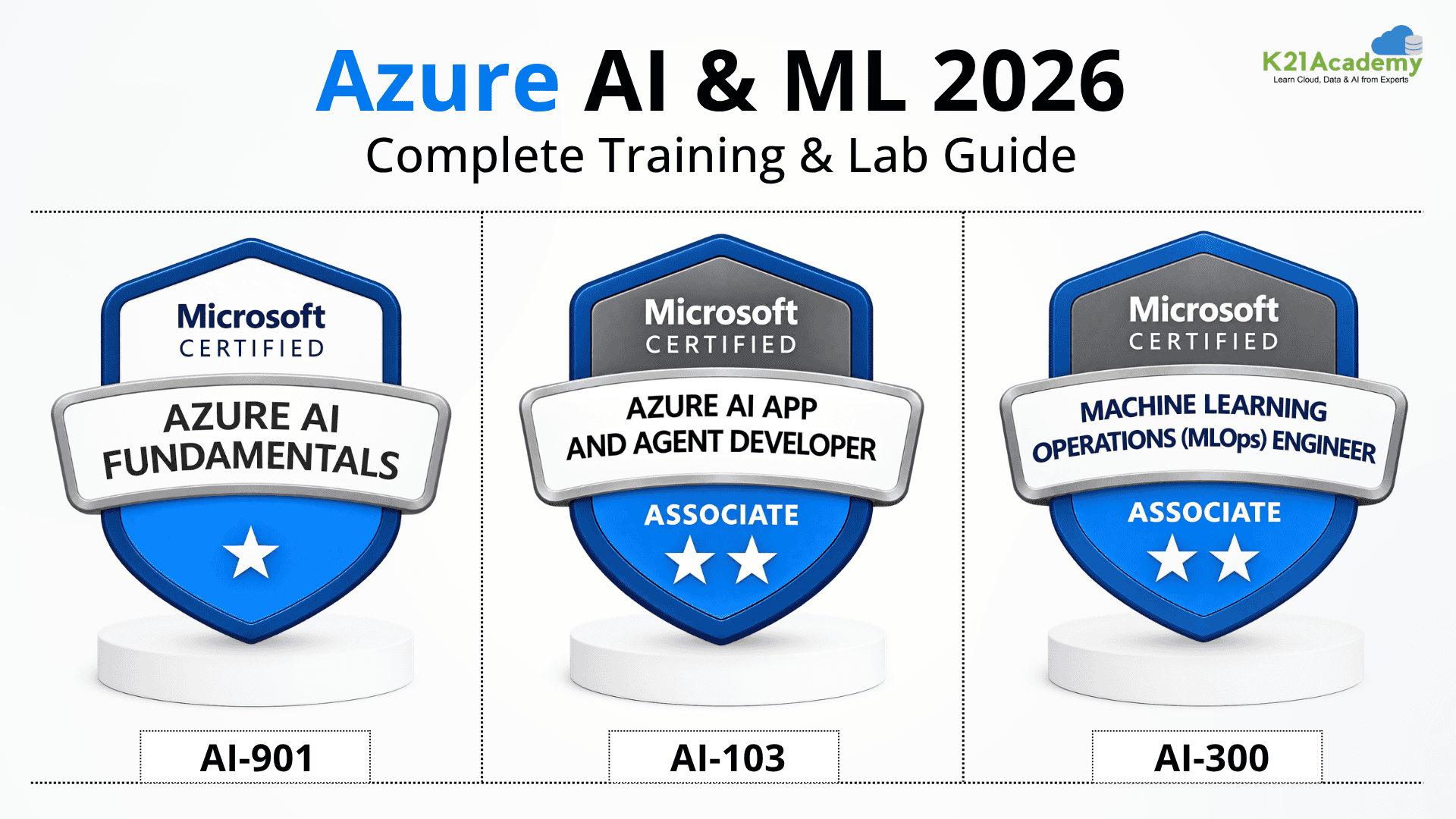
Earning an azure ai certification has become one of the most effective ways to validate cloud AI skills and improve career opportunities in data science, AI engineering, machine learning, and cloud computing. Certifications such as AI-901, AI-103, and AI-300 are widely recognized by employers and align closely with real-world Azure AI implementation skills.
These certification paths help learners build expertise progressively — from Azure fundamentals to advanced AI engineering and machine learning deployment workflows.
1. Microsoft Azure Fundamentals (AZ-900)
The AZ-900 certification is designed for beginners who want to understand cloud concepts and Microsoft Azure services before moving into specialized AI or data certifications. It is ideal for students, business professionals, and anyone starting their cloud learning journey.
Exam Details
| Exam Component | Details |
|---|---|
| Exam Code | AZ-900 |
| Exam Format | Multiple-choice, scenario-based questions |
| Number of Questions | 40–60 Questions |
| Exam Duration | 60 Minutes |
| Passing Score | 700/1000 |
| Exam Cost | Approximately $99 USD |
Key Skills Covered
-
Cloud concepts and benefits
-
Core Azure services
-
Azure pricing and support
-
Security, governance, and compliance
Why It Matters
AZ-900 builds the cloud foundation required for advanced certifications like ai-901, ai-103, and ai300. It also helps learners understand Azure terminology, architecture, and pricing models used in enterprise environments.
Recommended Certification Prep Resources
-
Microsoft Learn modules
-
Azure free account labs
-
Practice assessments and mock tests
-
Beginner Azure fundamentals projects
Career Impact
Professionals with Azure fundamentals knowledge are often considered for:
-
Cloud Support Roles
-
Junior Azure Administrator Roles
-
Technical Support Positions
-
Entry-Level Cloud Operations Jobs
Related Readings: Exam AZ-900: Microsoft Azure Fundamentals Certification
2. Microsoft Azure AI Fundamentals (AI-901)
The ai-901 certification validates foundational AI knowledge and practical implementation skills using Azure AI services and Microsoft Foundry. It is the updated successor to AI-900 and is ideal for beginners exploring Artificial Intelligence, Generative AI, and core Azure AI concepts on Azure.
Exam Details
| Exam Component | Details |
|---|---|
| Exam Code | AI-901 |
| Exam Format | Multiple-choice and scenario-based questions |
| Number of Questions | 30–35 Questions |
| Exam Duration | 45 Minutes |
| Passing Score | 700/1000 |
| Exam Cost | Approximately $99 USD |
Key Domains Covered
| Domain | Weightage |
|---|---|
| AI Concepts and Capabilities | 40–45% |
| Implement AI Solutions Using Microsoft Foundry | 55–60% |
Recommended Certification Prep Strategy
- Complete hands-on ai-901 labs covering Azure AI services and Microsoft Foundry
- Practice using Azure AI Vision, Language, and Speech services
- Build beginner AI projects using Azure OpenAI and Azure AI Foundry tools
- Study responsible AI principles and Azure AI governance concepts
- Use Microsoft Learn learning paths and attempt timed practice tests regularly
Career Impact
AI-901 helps learners qualify for:
- AI Support Roles
- Cloud AI Internships
- Junior AI Engineer Positions
- Technical AI Consulting Roles
It also provides a strong foundation for advanced azure ai certification paths like AI-103.
Related Readings: Microsoft Azure AI Fundamentals – AI-901 Exam Detailed Overview
3. Microsoft Azure AI Apps and Agents Developer Associate (AI-103)
The ai-103 certification is designed for professionals who build, deploy, and manage AI applications and agentic solutions using Azure AI Foundry, Azure OpenAI, and related Azure AI services. It focuses on practical implementation of Generative AI, RAG systems, AI agents, and intelligent application development on Azure.
Exam Details
| Exam Component | Details |
|---|---|
| Exam Code | AI-103 |
| Exam Format | Case studies, scenario-based, multiple-choice |
| Number of Questions | 40–60 Questions |
| Exam Duration | 100 Minutes |
| Passing Score | 700/1000 |
| Exam Cost | Approximately $165 USD |
Key Domains Covered
| Domain | Weightage |
|---|---|
| Plan & Manage Azure AI Solutions | 25–30% |
| Implement Generative AI and Agentic Solutions | 30–35% |
| Implement Computer Vision Solutions | 10–15% |
| Implement Text Analysis Solutions | 10–15% |
| Implement Information Extraction Solutions | 10–15% |
Recommended Certification Prep Strategy
- Complete hands-on Azure AI Foundry projects and agentic AI labs
- Practice building Generative AI applications using Azure OpenAI
- Build RAG systems using Azure AI Search with vector and hybrid search
- Study AI agent design, function calling, and multi-step workflow orchestration
- Use official Microsoft Learn AI-103 course materials and scenario-based practice tests
Career Impact
AI-103 certification can help professionals transition into:
- Azure AI Engineer Roles
- Generative AI Developer Positions
- Agentic AI Engineer Careers
- AI Application Developer Roles
Professionals with practical Generative AI and agent-building skills are in high demand as enterprise AI adoption continues to grow rapidly in 2026.
Related Readings: Microsoft Azure AI Apps and Agents Developer: AI-103 Exam Detailed Overview
4. Microsoft Machine Learning Operations (MLOps) Engineer Associate (AI-300)
The ai-300 certification focuses on operationalizing machine learning and generative AI solutions on Azure using MLOps and GenAIOps practices. It is best suited for machine learning engineers, DevOps professionals, and data scientists who want to manage production-ready AI systems at scale.
Exam Details
| Exam Component | Details |
|---|---|
| Exam Code | AI-300 |
| Exam Format | Scenario-based and technical implementation questions, including case studies |
| Number of Questions | 40–60 Questions |
| Exam Duration | 100–120 Minutes |
| Passing Score | 700/1000 |
| Exam Cost | Approximately $165 USD |
Key Domains Covered
| Domain | Weightage |
|---|---|
| Design and Implement an MLOps Infrastructure | 15–20% |
| Implement Machine Learning Model Lifecycle and Operations | 25–30% |
| Design and Implement a GenAIOps Infrastructure | 20–25% |
| Implement Generative AI Quality Assurance and Observability | 10–15% |
| Optimize Generative AI Systems and Model Performance | 10–15% |
Recommended Certification Prep Strategy
- Practice advanced Azure MLOps workflows and infrastructure setup using Azure Machine Learning
- Build end-to-end ML pipelines with CI/CD using GitHub Actions and Azure DevOps
- Deploy models using Azure ML endpoints, AKS, and ACI
- Work on GenAIOps infrastructure using Microsoft Foundry environments
- Study model monitoring, drift detection, RAG optimization, and observability tools
- Use AI-300 practice exams and official Microsoft Learn study materials
Career Impact
AI-300 certified professionals are commonly hired for:
- MLOps Engineer Roles
- Machine Learning Engineer Positions
- AI Operations Engineer Careers
- DevOps Engineer Roles Transitioning into AI
Advanced Azure MLOps and GenAIOps expertise is particularly valuable because many organizations struggle with production-grade AI deployment, lifecycle management, observability, and generative AI quality assurance at scale.
Best Study Tips for Azure Certification Prep
To improve certification success rates, learners should focus on both theory and practical implementation.
Effective Preparation Tips
-
Follow structured Microsoft Learn paths
-
Build hands-on projects instead of only reading theory
-
Complete cloud labs regularly
-
Take timed practice tests weekly
-
Create revision notes for Azure services and workflows
-
Practice deploying real AI solutions on Azure
Hands-on implementation is especially important for AI-103 and AI-300, where practical Azure experience is heavily tested.
Why Azure Certifications Matter in 2026
Cloud AI certifications are becoming increasingly valuable as businesses expand AI adoption across healthcare, finance, retail, cybersecurity, and automation industries. Employers now prefer candidates who can demonstrate verified cloud AI expertise along with real implementation experience.
Strong certification prep combined with practical projects can help learners:
-
Increase interview opportunities
-
Build industry credibility
-
Improve salary potential
-
Transition into AI and cloud careers faster
-
Stand out in competitive technology roles
For learners preparing seriously for Azure certifications, structured training programs, guided labs, and mentorship-based learning paths can significantly accelerate progress and improve exam readiness.
FAQs
Ans: Azure AI ML training is a structured learning program that teaches learners how to build, deploy, and manage Artificial Intelligence and Machine Learning solutions using Microsoft Azure. It typically includes Azure AI services, machine learning workflows, cloud deployment, Generative AI concepts, and hands-on Azure ML labs for practical skill development.
Ans: Azure AI ML training is important because organizations are rapidly adopting cloud-based AI solutions for automation, analytics, customer support, and intelligent applications. Professionals with Azure AI skills are increasingly in demand for AI engineering, data science, and cloud computing roles, especially in enterprise environments using Microsoft technologies.
Ans: Most Azure AI ML training programs combine theoretical learning with practical implementation through projects and cloud labs. Learners typically progress from Azure fundamentals to AI services, machine learning, NLP, computer vision, Generative AI, deployment workflows, and Azure AI certification preparation for exams such as AI-901, AI-103, and AI-300.
Ans: The main benefits of Azure AI ML training include gaining cloud AI skills, preparing for Microsoft certifications, building real-world projects, and improving career opportunities in AI and machine learning. Hands-on Azure ML labs also help learners develop practical implementation experience required for modern AI engineering and data science roles.
Ans: Azure AI ML training is suitable for students, developers, cloud engineers, data analysts, IT professionals, and beginners interested in Artificial Intelligence and Machine Learning. It is especially useful for professionals preparing for Azure AI certifications or transitioning into AI engineering, data science, MLOps, and cloud-based AI careers.
Ans: Most beginner-level Azure AI ML training programs require only basic computer knowledge and familiarity with cloud concepts. For advanced topics such as MLOps and machine learning deployment, knowledge of Python, data analysis, and machine learning fundamentals can be helpful but is not always mandatory for starting.
Ans: To get started with Azure AI ML training, learners should begin with Azure fundamentals and AI basics before moving to practical projects and certification-focused learning paths. Creating a free Azure account, completing beginner Azure ML labs, and following Microsoft Learn modules are effective starting points for structured learning.
Ans: The future of Azure AI ML training is strongly connected to the rapid growth of Generative AI, automation, AI copilots, and enterprise cloud adoption. As organizations increasingly rely on AI-powered systems, demand for professionals skilled in Azure AI services, machine learning deployment, and cloud AI engineering is expected to continue growing in 2026 and beyond. Q1) What is Azure AI ML training?
Q2) Why is Azure AI ML training important?
Q3) How does Azure AI ML training work?
Q4) What are the benefits of Azure AI ML training?
Q5) Who should learn about Azure AI ML training?
Q6) What are the prerequisites for Azure AI ML training?
Q7) How to get started with Azure AI ML training?
Q8) What is the future of Azure AI ML training?