




You most likely don’t need another beginner’s introduction to cloud computing if you intend to move from AWS Cloud Architect to AI/ML Engineer. You already have a solid technical foundation after five to fifteen years of managing infrastructure, creating automated workflows, and designing AWS systems.
The real question is, what exactly do you need to learn next to become an AI/ML Engineer?
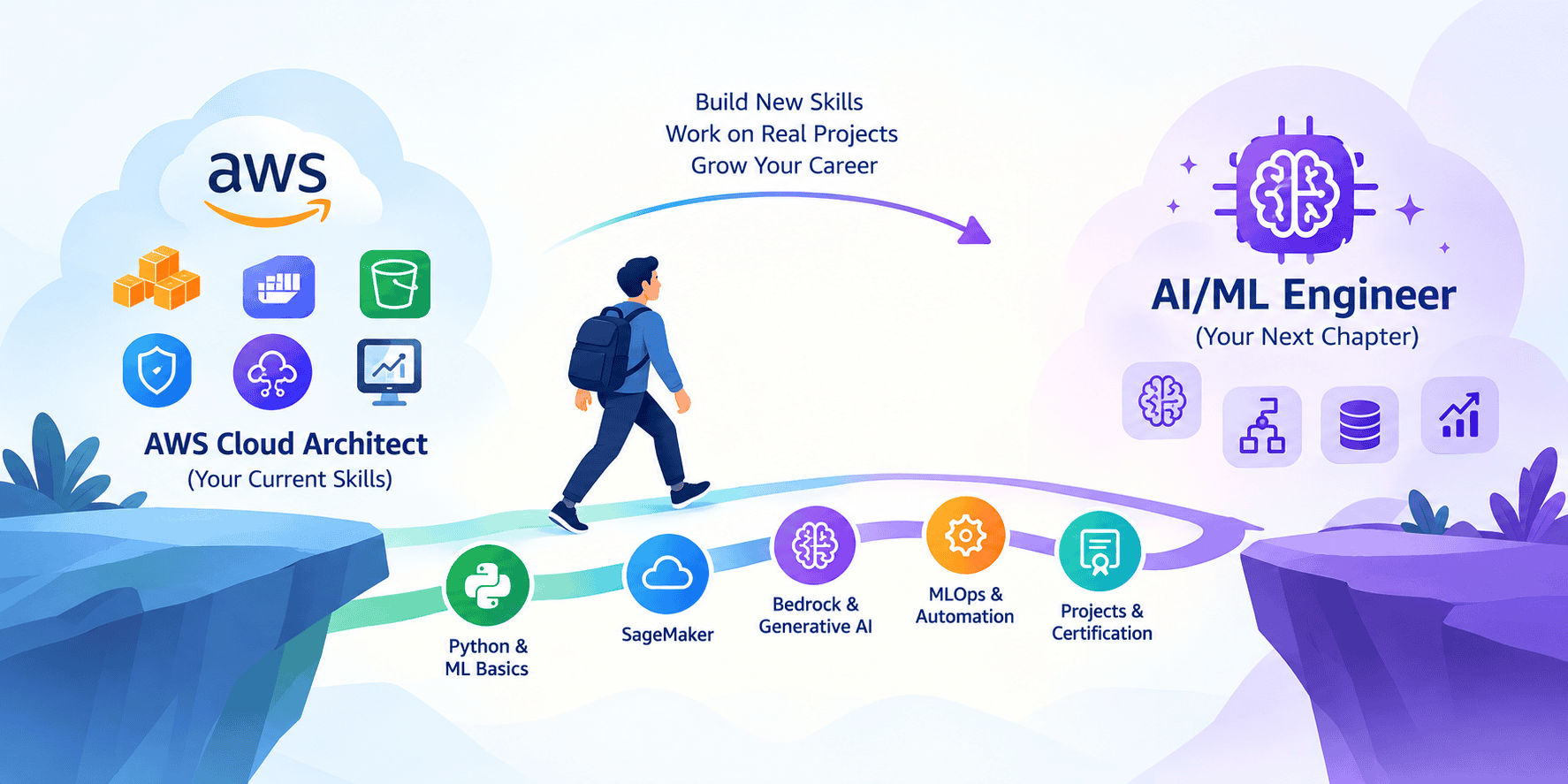
Contrary to what many career roadmaps indicate, the solution is more targeted. You must improve your foundational knowledge of Python and machine learning, obtain practical experience with Amazon SageMaker and Amazon Bedrock, comprehend ML pipelines and MLOps, and showcase your abilities through real-world projects.
You don’t have to give up your AWS experience. It serves as the basis for developing your next area of expertise.
This guide explains how to make that transition, relevant certification, and practical projects designed for experienced cloud professionals.
Why AWS Cloud Architects Are Well Positioned for AI/ML Roles
Secure infrastructure, scalable computing, dependable data storage, networking, monitoring, and automated deployments are still essential for AI/ML applications. Experienced AWS experts already have an advantage in these areas.
|
Your Existing AWS Skill |
How It Applies to AI/ML |
|---|---|
|
EC2, Containers, and Serverless |
Hosting model-serving applications |
|
S3 and Data Storage |
Storing training datasets and model artifacts |
|
IAM, KMS, and VPC |
Securing models, data, and AI applications |
|
Lambda and Event-Driven Architecture |
Building AI application workflows |
|
CloudWatch and Monitoring |
Tracking endpoint health, latency, and failures |
|
CI/CD and Infrastructure as Code |
Automating ML deployments |
|
Cost Optimization |
Managing model training and inference costs |
Nevertheless, implementing a machine learning model is not the same as implementing a traditional application. Additional difficulties brought about by ML systems include data preparation, model evaluation, experiment tracking, and model drift.
Instead of reiterating what you already know, your transition should concentrate on these new skills.
Related Readings: How to Build a Production-Ready Agentic AI Customer Service Agent on AWS Bedrock and SageMaker
The Skill Gap: What You Actually Need to Learn
For professionals moving from AWS Cloud Architect to AI/ML Engineer, four areas deserve particular attention.
Machine learning fundamentals: Understand supervised and unsupervised learning, model training, feature engineering, overfitting, and evaluation metrics such as precision, recall, and accuracy.
Amazon SageMaker AI: Learn how to prepare data, run training jobs, tune models, deploy inference endpoints, and manage model versions.
Amazon Bedrock: Explore foundation models, embeddings, retrieval-augmented generation (RAG), knowledge bases, guardrails, and tool integration for generative AI applications.
ML pipelines and MLOps: Learn to automate data preparation, training, evaluation, deployment, and monitoring. Your CI/CD knowledge provides a useful starting point, but ML pipelines must also manage datasets, experiments, and model artifacts.
Python, SQL, and basic data manipulation support all four areas.
Related Readings: What is Generative AI & How It Works?
A Practical Roadmap to Transition From AWS Cloud Architect to AI/ML Engineer
Before taking action, you don’t have to become an expert in AI. Building on your AWS expertise and concentrating on the abilities that directly prepare you for AI/ML engineering employment is a wiser course of action.
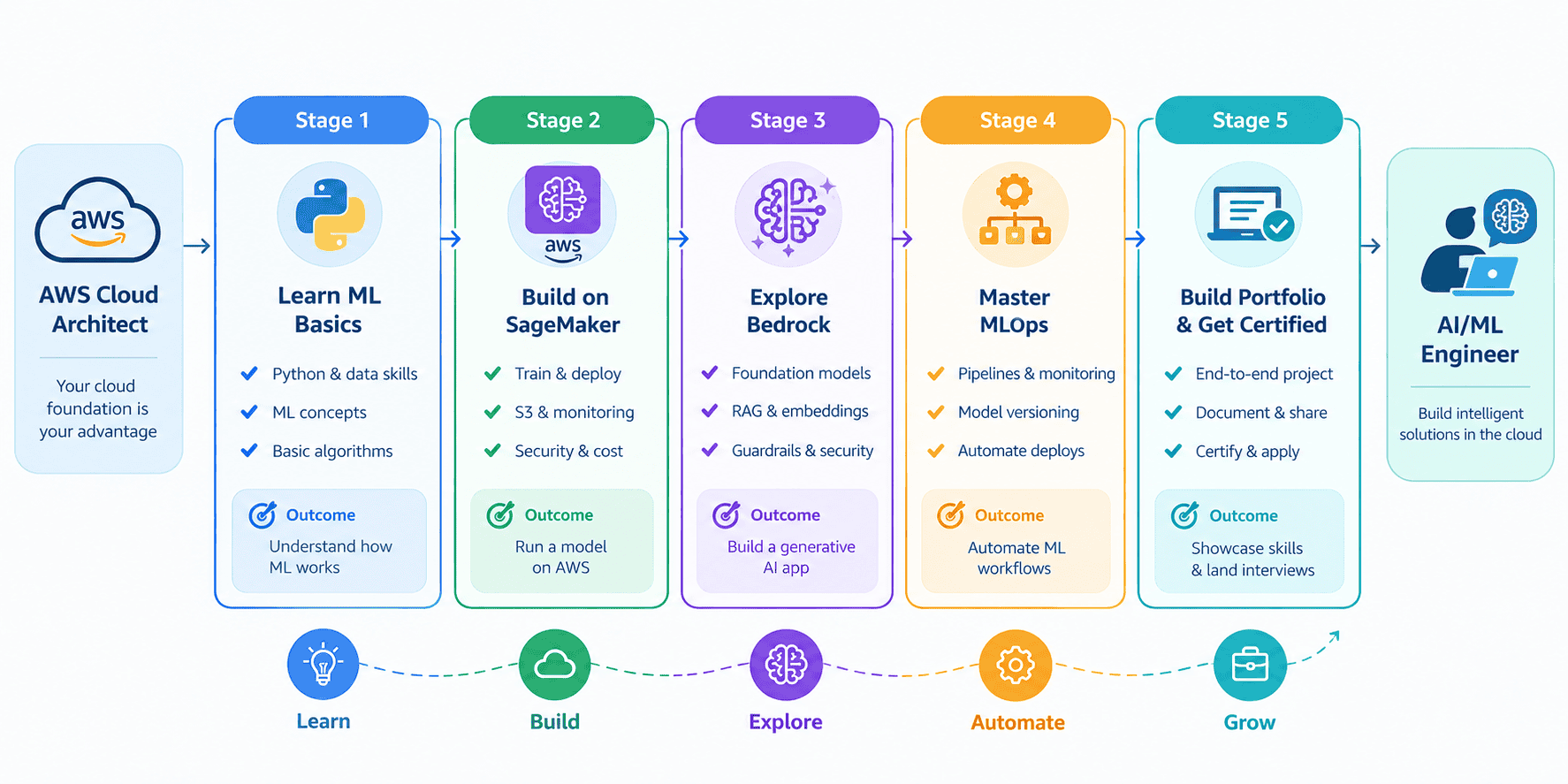
To transform your current cloud expertise into useful AI/ML skills, follow these five steps.
Related Readings: How K21 Academy Helps You Become an AWS AI Engineer?
Stage 1: Build the ML Foundation You Actually Need
You already understand how applications run in the cloud. Now, learn how machine learning models are trained, evaluated, and used to make predictions.
Focus on:
- Python for data manipulation and ML development.
- NumPy, pandas, and SQL for working with datasets.
- Core ML concepts, including training, testing, feature engineering, and model evaluation.
- Common algorithms such as regression, classification, and decision trees.
Put it into practice: Build a basic prediction model using a public dataset. Prepare the data, train the model, evaluate its performance, and understand where its predictions fail.
Your outcome: You can explain the ML lifecycle and work with a basic model before deploying it on AWS.
Stage 2: Use Amazon SageMaker to Build and Deploy ML Models
This is where your AWS experience becomes directly useful. Instead of learning cloud infrastructure again, focus on the services and workflows that support machine learning.
Focus on:
- Preparing datasets and storing them in Amazon S3.
- Running training jobs and tuning models with Amazon SageMaker AI.
- Managing model artifacts and evaluating model performance.
- Deploying models through inference endpoints.
- Applying IAM, CloudWatch, and cost-management practices to ML workloads.
Put it into practice: Train a model using SageMaker, deploy it to an endpoint, and expose its predictions through an API. Add monitoring and appropriate access controls.
Your outcome: You can deploy and operate a machine learning model in an AWS environment.
Related Readings: AWS SageMaker Algorithms: Linear Learner, XGBoost, KNN & Random Cut Forest Explained
Stage 3: Build Generative AI Applications With Amazon Bedrock
Traditional ML is only one part of the opportunity. You should also understand how foundation models can be integrated into business applications.
Focus on:
- Working with foundation models through Amazon Bedrock.
- Prompt engineering and structured outputs.
- Embeddings, vector search, and retrieval-augmented generation (RAG).
- Bedrock knowledge bases and guardrails.
- Application integration, security, latency, and cost optimisation.
Put it into practice: Build a document question-answering application using Amazon Bedrock and documents stored in S3. Include source references, access controls, and basic answer-quality checks.
Your outcome: You can design and build a practical generative AI application using AWS services.
Stage 4: Apply Your CI/CD Skills to ML Pipelines and MLOps
An important benefit in this situation is your prior automation experience. Extending your deployment and monitoring procedures to the full machine learning lifecycle is the next stage.
Focus on:
- Automating data preparation, model training, and evaluation.
- Using SageMaker Pipelines to orchestrate ML workflows.
- Managing experiments, model versions, and artifacts.
- Setting quality checks before model deployment.
- Automating deployments and rollbacks.
- Monitoring model performance, failures, and costs.
Put it into practice: Create a pipeline that prepares data, trains a model, evaluates it against a defined baseline, and deploys it only when it meets the required criteria.
Your outcome: You can automate and maintain ML workflows instead of treating model deployment as a one-time activity.
Related Readings: AWS AI/ML: Hands-On Labs & Projects for High-Paying Careers in 2026
Stage 5: Build a Portfolio, Validate Your Skills, and Prepare for Interviews
Acquiring knowledge of individual services is insufficient. Employers require proof that you can integrate them to address real-world issues.
Focus on:
- Building one end-to-end AI/ML project that combines AWS infrastructure, model deployment, and automation.
- Documenting architecture decisions, security controls, evaluation results, and cost considerations.
- Preparing for AI/ML system design and technical interviews.
- Updating your resume to connect your existing AWS experience with your new skills.
- Preparing for the AWS Certified Machine Learning Engineer – Associate certification, if it aligns with your target roles.
- Applying for suitable AI/ML Engineer, MLOps Engineer, or AI Platform Engineer positions.
Put it into practice: Build an AI-powered support analytics platform that classifies tickets using an ML model, summarizes information with Bedrock, exposes results through an API, and uses automated deployment and monitoring.
Your outcome: You have a practical project to discuss in interviews, evidence of your new skills, and a clearer path toward relevant roles.
Your project experience, available study time, and level of Python competence will all affect the timeline. Instead of seeing these phases as deadlines, treat them as milestones.
Which AWS Certification Should You Target?
The AWS Certified Machine Learning Engineer Associate is a suitable choice for a seasoned AWS professional transitioning to practical ML engineering.
|
Certification |
Best Suited For |
|---|---|
|
Building foundational knowledge of AI, ML, and generative AI |
|
|
Demonstrating knowledge of ML engineering and operationalisation |
Certification can validate your knowledge, but it should complement your hands-on projects rather than replace them.
Related Readings: K21 Academy: Your Ultimate Guide to AWS AI/ML Certification in 2026
Which AI/ML Roles Can You Target?
Your next role should reflect both your existing strengths and the new capabilities you develop.
If you enjoy coding and model deployment, AI/ML Engineer may be a good fit. If automation is your strength, consider MLOps. If you prefer architecture and platform design, AI Platform Engineer or Cloud AI Solutions Architect may be more suitable.
How to Turn Your Existing AWS Experience Into an Advantage
Don’t position yourself as a complete beginner. Connect your existing experience to the needs of AI/ML systems.
- Cloud architecture: Apply your experience designing scalable, resilient infrastructure to AI workloads.
- CI/CD and automation: Extend deployment automation to ML pipelines.
- Security: Use your IAM, encryption, and networking knowledge to protect data and AI applications.
- Monitoring and troubleshooting: Apply observability skills to model endpoints, latency, and operational failures.
- Cost optimization: Use your cloud cost-management experience to control training and inference expenses.
Support these skills with real examples from your work and portfolio projects. Be clear about which capabilities come from professional experience and which you have developed through hands-on practice.
Related Readings: AWS Machine Learning (MLA-C02) Labs & Hands-o Guide 2026
Conclusion
Moving from AWS Cloud Architect to AI/ML Engineer doesn’t mean starting over. Your experience in cloud architecture, security, automation, and production systems gives you a strong foundation. Focus on the skills that close the gap: Python and ML fundamentals, SageMaker, Bedrock, ML pipelines, and model evaluation. Build practical projects, validate your knowledge, and target roles that align with your strengths.
You already know how to build and operate systems in the cloud. Now, learn how to build and operate the intelligence that runs on them.