




Pipelines, deployments, and maintaining AWS infrastructure are no longer the only aspects of DevOps. Teams are developing, deploying, monitoring, troubleshooting, and scaling apps differently as a result of AI, and DevOps experts are at the forefront of this change.
From AI-assisted CI/CD and intelligent monitoring to GenAIOps, automated incident response, and AI workload management, AWS DevOps and AI are quickly becoming interconnected skill sets. And that creates a bigger career opportunity.
The question isn’t “Will AI replace DevOps?”
It’s:
“What happens when DevOps engineers learn to build and operate AI-powered systems?”
The answer: a new generation of AI-ready cloud and DevOps professionals who can bridge infrastructure, automation, and artificial intelligence.
Why Are AWS DevOps and AI Converging?
There are two major reasons.
1. DevOps teams are using AI
AI can assist engineers with:
- Writing infrastructure code
- Generating deployment configurations
- Reviewing code
- Creating test cases
- Analyzing logs
- Investigating incidents
- Detecting anomalies
- Explaining infrastructure problems
- Generating documentation
- Identifying potential security issues
- Automating repetitive operational tasks
As part of its DevOps ecosystem, AWS is emphasising autonomous operations and AI-driven software delivery. AI-assisted software delivery and AWS DevOps Agent use cases for operational troubleshooting and incident procedures are among the most recent AWS DevOps guidelines.
Related Readings: Role of AI in DevOps | Benefits and Job Roles

2. AI applications need DevOps
The second direction is just as important. Organisations building generative AI applications need reliable ways to:
- Deploy applications
- Manage infrastructure
- Version prompts
- Test AI outputs
- Monitor models and applications
- Manage costs
- Secure data
- Control access
- Handle failures
- Monitor latency
- Evaluate model quality
- Continuously improve applications
This is where DevOps principles meet MLOps and GenAIOps. AWS specifically notes that traditional DevOps practices alone aren’t sufficient for generative AI workloads because AI systems can produce probabilistic and non-deterministic outputs.
AWS DevOps vs AI-Enabled DevOps
The difference can be understood simply:
| Traditional DevOps | AI-Enabled DevOps |
|---|---|
| Manual troubleshooting | AI-assisted root-cause analysis |
| Rule-based monitoring | Intelligent anomaly detection |
| Manually written configurations | AI-assisted IaC generation |
| Traditional application testing | AI-assisted test generation |
| Human-heavy incident investigation | AI-assisted incident analysis |
| Static documentation | AI-generated documentation |
| Traditional applications | AI and agentic applications |
| Application CI/CD | Application + model/prompt/evaluation lifecycle |
| Infrastructure automation | Intelligent infrastructure operations |
| DevOps | DevOps + AI + MLOps/GenAIOps |
The important point is that AI does not eliminate DevOps. Instead, it expands what DevOps teams can automate and the types of systems they are expected to operate.
Where AI Is Changing AWS DevOps
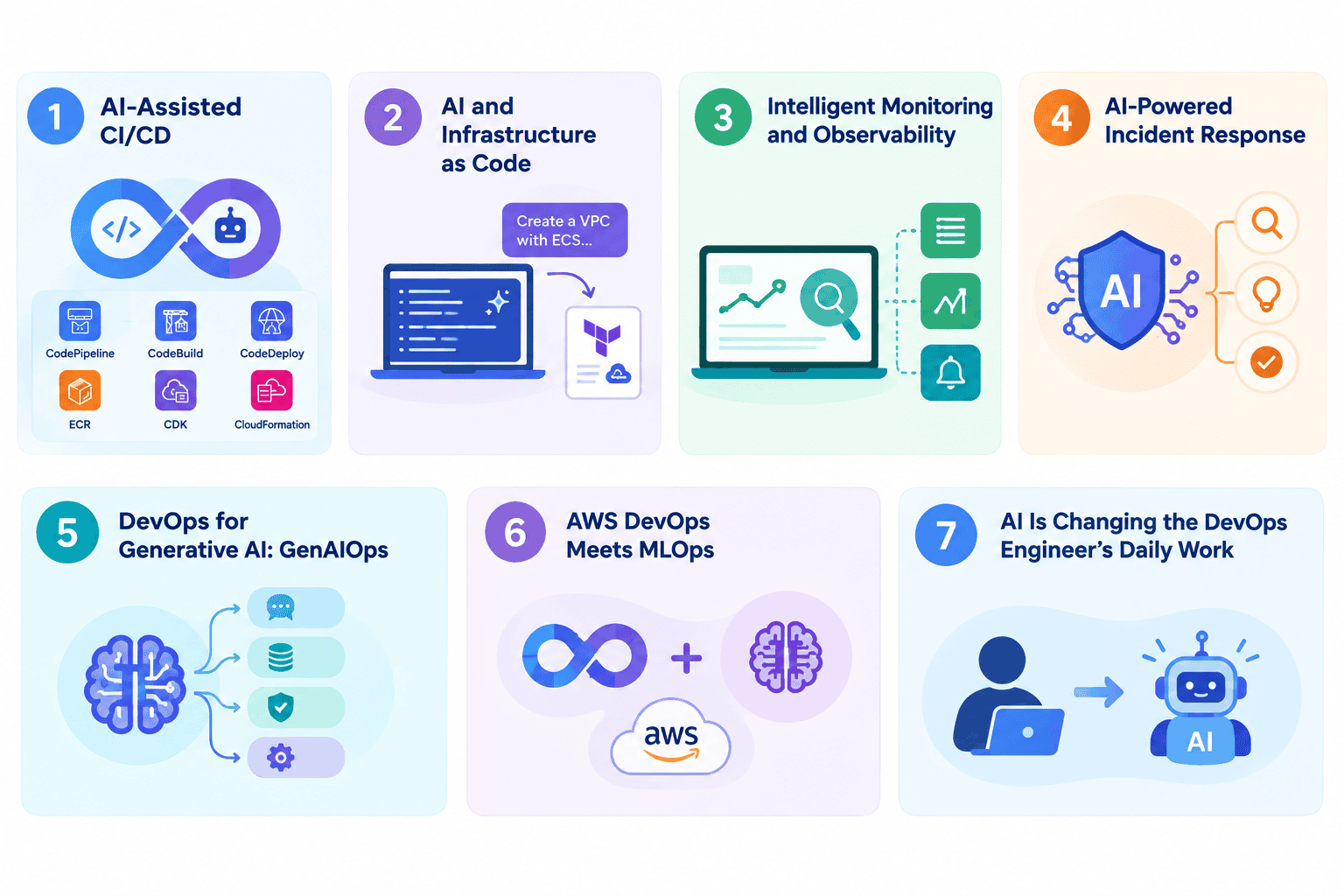
1. AI-Assisted CI/CD
CI/CD has always been one of the foundations of DevOps. AWS DevOps professionals work with services such as:
- AWS CodePipeline
- AWS CodeBuild
- AWS CodeDeploy
- Amazon ECR
- AWS CDK
- AWS CloudFormation
For instance, CI/CD implementation, automated testing, artefact management, and deployment methodologies across instance, container, and serverless environments are all covered in the AWS DevOps Engineer Professional exam.
AI can now augment these processes. An AI-enabled pipeline could help:
- Analyse a code change.
- Identify potential issues.
- Generate or recommend tests.
- Review infrastructure changes.
- Analyse deployment risks.
- Recommend deployment strategies.
- Monitor the release.
- Help investigate failures.
The DevOps engineer still defines the controls and acceptance criteria, but AI can reduce the amount of repetitive analysis required.
2. AI and Infrastructure as Code
Infrastructure as Code has become essential for managing large AWS environments. DevOps engineers commonly work with:
- Terraform
- AWS CloudFormation
- AWS CDK
- Kubernetes manifests
- Helm
- YAML
- JSON
AI coding assistants can help generate infrastructure configurations from natural-language requirements. For example:
“Create a highly available web application across multiple Availability Zones with an application load balancer, private application subnets, an RDS database, and autoscaling.”
An AI assistant may generate a starting point for the required infrastructure configuration. But this creates an important career distinction. Generating IaC is becoming easier. Validating and governing IaC is becoming more important. AI-generated infrastructure still needs human review for:
- Security
- IAM permissions
- Networking
- Cost
- Resilience
- Compliance
- Scalability
- Operational requirements
That makes cloud architecture knowledge even more valuable.
3. Intelligent Monitoring and Observability
Monitoring is another area where AWS DevOps and AI are converging.
Traditional monitoring generally involves:
Metrics → Threshold → Alert → Human investigation
AI-enabled operations can move toward:
Telemetry → Pattern recognition → Correlation → Root-cause hypothesis → Recommended or automated action
AWS DevOps already emphasises monitoring, logging, metrics, alarms, and operational troubleshooting.
4. AI-Powered Incident Response
A DevOps engineer’s time can be significantly consumed by incident response. In the event of a production incident, engineers may need to:
- Determine which service is impacted.
- Analyse recent deployments
- Search logs
- Examine the health of the infrastructure
- Compare metrics
- Examine dependencies
- Determine the underlying cause
- Implement remediation
- Check for recovery
- Record the event
AI can help with a number of these tasks. AWS DevOps Agent use cases for operational workflows and root-cause analysis are among the AI-powered operational capabilities that AWS has been creating. A new operational model results from this:
Observe → Examine → Suggest → Accept → Correct → Confirm
Certain low-risk tasks may eventually become more automated.
5. DevOps for Generative AI: GenAIOps
GenAIOps is among the most significant innovations for DevOps experts. Application lifecycle management is the main emphasis of traditional DevOps. These methods are extended to machine learning systems by MLOps. Operational procedures are extended to generative AI applications by GenAIOps. An application of generative AI could include:
- Prompts for foundation models
- Systems for retrieval
- Vector databases
- Tools for Agents and APIs
- Guardrails
- Systems of evaluation
- Infrastructure for applications
- User information
Operational difficulties that are uncommon in conventional applications are brought about by this. For instance, even when an application is technically operating properly, the quality of its AI responses may have declined. Monitoring must therefore go beyond CPU, memory, latency, and availability. AWS’s GenAIOps guidance specifically addresses operationalising generative AI workloads and adapting DevOps practices to these requirements.
6. AWS DevOps Meets MLOps
DevOps professionals don’t necessarily need to become data scientists. But it’s becoming more and more important to comprehend the ML lifecycle. An example of a conventional software pipeline might be:
Code → Build → Test → Deploy → Watch
An ML pipeline may resemble this more:
Data → Evaluate → Train → Register → Deploy → Monitor → Retrain
By automating procedures throughout the ML lifecycle, MLOps links machine learning development and operations.
7. AI Is Changing the DevOps Engineer’s Daily Work
Consider a traditional DevOps workflow.
Before: A pull request is made by a developer.
The DevOps specialist:
- Examines modifications to the infrastructure
- Verifies the configuration of the pipeline
- Evaluates the needs for deployment
- Examines logs
- Troubleshoots errors
- Documentation is updated
- Oversees operational tickets
But with the AI assistance the process may turn into:
- AI examines the pull request.
- AI detects possible configuration issues
- AI recommends tests
- Deployment risks are summarised by AI
- AI examines pipeline failures
- Infrastructure problems are explained by AI
- AI summarises events
- AI creates documentation
The engineer moves from performing every task manually to supervising, validating, and designing automated workflows. This is a major career shift.
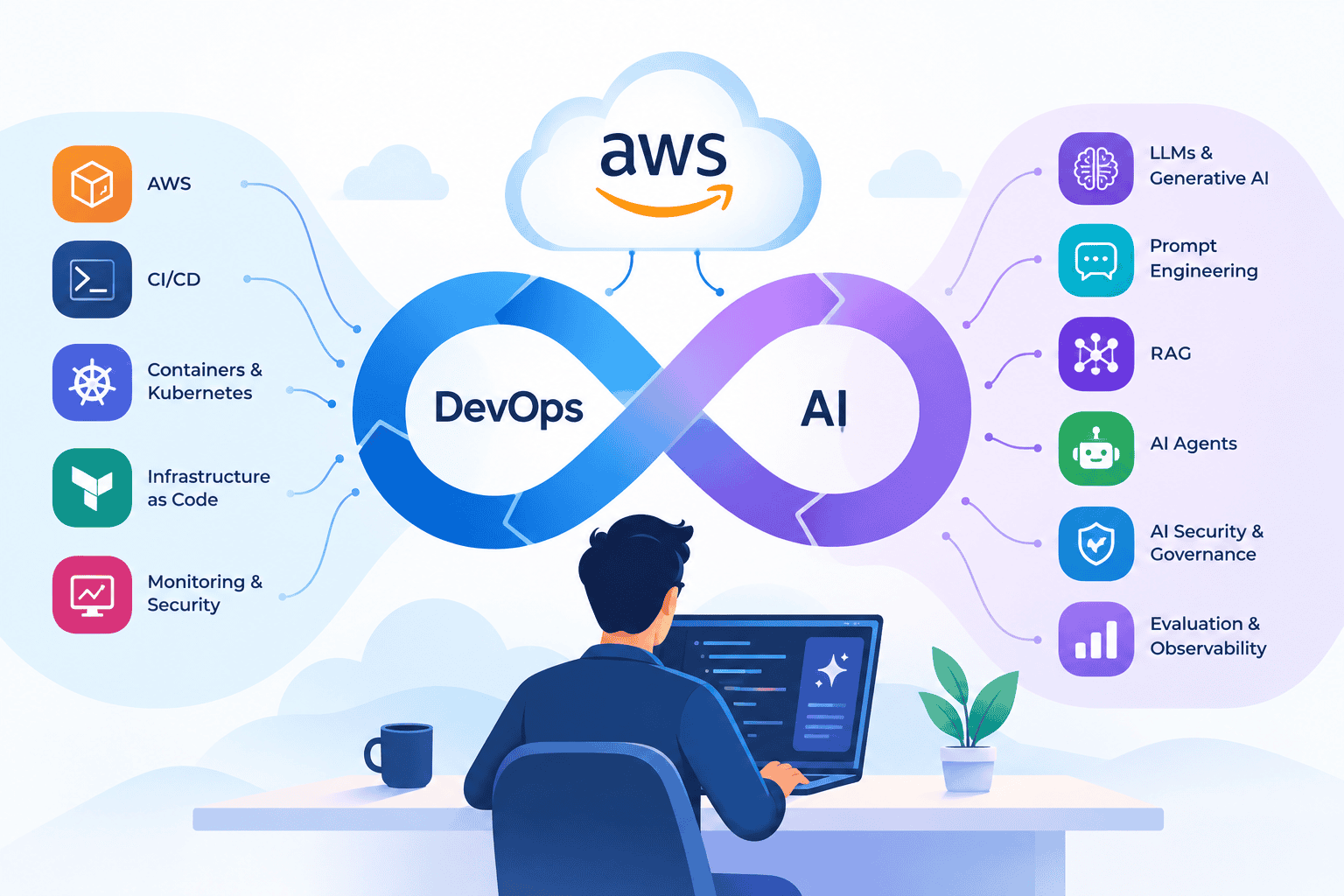
The AWS DevOps + AI Skill Stack
You don’t need to leave DevOps behind to move into AI. The smarter approach is to build AI skills on top of your existing AWS and DevOps knowledge.
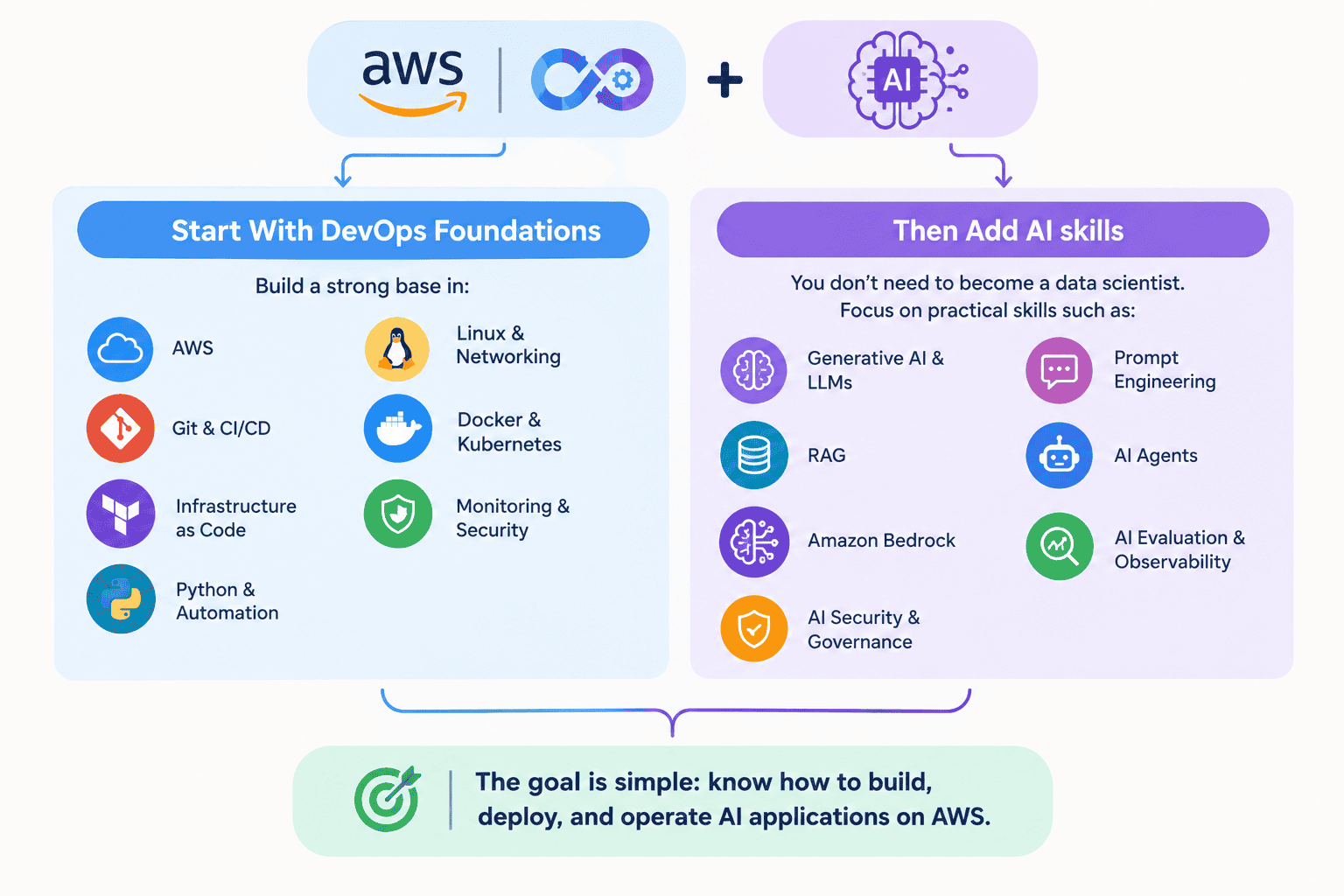
Start With DevOps Foundations
Build a strong base in:
- AWS
- Linux & Networking
- Git & CI/CD
- Docker & Kubernetes
- Infrastructure as Code
- Monitoring & Security
- Python & Automation
Then Add AI skills
You don’t need to become a data scientist. Focus on practical skills such as:
- Generative AI & LLMs
- Prompt Engineering
- RAG
- AI Agents
- Amazon Bedrock
- AI Evaluation & Observability
- AI Security & Governance
The goal is simple: know how to build, deploy, and operate AI applications on AWS.
Related Readings: 10 Best AI Tools for DevOps
Where Can Your Career Go?
As DevOps and AI converge, several career paths are opening up:
- AI-Enabled DevOps Engineer: Combines AWS, DevOps, automation, and AI-powered operations.
- MLOps Engineer: Builds and manages the infrastructure and pipelines needed to deploy and monitor ML models.
- GenAIOps Engineer: Focuses on deploying, monitoring, evaluating, securing, and managing generative AI applications.
- AI/Cloud Solutions Architect: Designs scalable, secure AI solutions using AWS cloud and AI services.
- AI Platform Engineer: Builds platforms that make it easier for teams to deploy and operate AI workloads.
The common thread? You don’t have to choose between DevOps and AI. The opportunity is increasingly in knowing both.
Will AI Replace AWS DevOps Engineers?
Not likely, but it will change what they do.
AI can generate code, analyse logs, suggest fixes, and automate repetitive tasks. But engineers still need to make decisions around security, scalability, reliability, cost, and business requirements.
Conclusion
AWS DevOps and AI are coming together, and you don’t need to start your career from scratch to keep up.
If you already work in DevOps, begin by expanding your skill set to include AI. Discover the fundamentals of generative AI and LLMs, investigate Amazon Bedrock, try out AI-assisted automation, and comprehend the deployment, security, and monitoring of AI applications on AWS.
Then use what you’ve learned. Create a tiny project that integrates AWS, CI/CD, monitoring, and an AI application, or investigate a GenAI use case like AI-assisted incident investigation.
Above all, avoid attempting to learn every AI technique at once. Choose one area, develop something in it, and then progressively broaden your skill set.