






Reinforcement Learning (RL) is a branch of Machine Learning in which an agent learns to make decisions by interacting with an environment. It uses feedback in the form of rewards or penalties to identify which actions lead to better outcomes over time.
Unlike supervised learning, which relies on labeled training data, Reinforcement Learning learns through trial and error. The agent observes the environment, takes actions, receives feedback, and gradually improves its decision-making strategy to maximize cumulative rewards.
In this blog, we will explore how Reinforcement Learning works, its key concepts, different approaches, real-world applications, advantages, and challenges.

What is Reinforcement Learning (RL)?
Reinforcement Learning (RL) is a type of Machine Learning in which an agent learns to make decisions by interacting with a real or simulated environment. The agent performs actions, observes the results, and receives feedback in the form of rewards or penalties to improve its future decisions.
To explore practical implementations of Reinforcement Learning, check out Reinforcement Learning with Amazon SageMaker AI
The main objective of Reinforcement Learning is to learn a strategy, known as a policy, that helps the agent maximize its cumulative rewards over time.
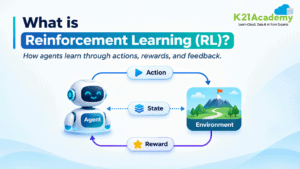
The key components of Reinforcement Learning include:
-
Agent: The learner or decision-making system that interacts with the environment.
-
Environment: The surroundings or system in which the agent operates.
-
State: The current situation or condition of the environment.
-
Action: A decision or move performed by the agent.
-
Reward: Feedback received after performing an action, indicating how beneficial that action was.
The agent repeatedly observes the environment, takes actions, and receives rewards. Through this trial-and-error process, it learns which actions lead to better outcomes and gradually improves its decision-making strategy.
Example: Training a Dog
A simple way to understand Reinforcement Learning is to compare it with training a dog.
When training a dog, you give it a command such as “sit.” If the dog follows the command, you reward it with a treat. If it does not follow the command, it may not receive a treat.
Similarly, an RL agent learns through feedback. Actions that produce higher rewards are encouraged, helping the agent improve its behavior over repeated interactions.
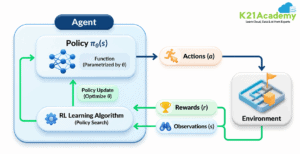
Reinforcement Learning Using a Neural Network Policy
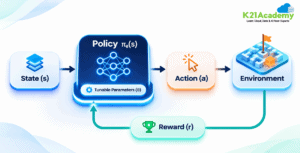
In Deep Reinforcement Learning, a neural network can be used to represent the agent’s policy. It takes information about the current state as input and determines which action the agent should perform.
This allows agents to learn decision-making strategies in complex environments where manually defining rules for every possible situation would be difficult.
What is the Difference Between Reinforcement Learning and Supervised Learning?
Reinforcement Learning (RL) trains an agent to make decisions through interactions with an environment and feedback in the form of rewards. The agent learns which actions produce better long-term outcomes.
In contrast, Supervised Learning trains models using labeled datasets containing input-output pairs. The model learns patterns from these examples to predict outputs for new, unseen data.
What are the Types of Reinforcement in Reinforcement Learning?
Reinforcement Learning uses rewards and penalties to guide an agent’s behavior. Two common forms of feedback are:
-
Positive Rewards: The agent receives a positive reward for performing an action that contributes toward achieving its objective. For example, a robot receives a reward for successfully reaching its destination.
-
Negative Rewards or Penalties: The agent receives a negative reward or incurs a cost for actions that lead to undesirable outcomes. For example, a robot receives a penalty for hitting an obstacle.
These feedback signals help the agent learn which actions are more beneficial and develop a policy that maximizes cumulative rewards over time.
What is Policy Search?
In Reinforcement Learning, a policy defines how an agent selects actions based on the current state or observations of its environment. It determines the agent’s decision-making strategy and guides its interactions with the environment.
Policy Search is an approach used in Reinforcement Learning to find an effective policy that maximizes the expected cumulative rewards.
Key points about Policy Search:
-
Policy: Defines the strategy an agent follows to select actions based on the current state.
-
Neural Network Policy: A neural network can represent a policy by taking observations as inputs and generating suitable actions as outputs.
-
Policy Optimization: Reinforcement Learning algorithms update and improve the policy based on feedback received from the environment.
-
Objective: The goal is to learn a policy that helps the agent make effective decisions and maximize long-term rewards.
What is Learning in Reinforcement Learning?
In Reinforcement Learning, learning is the process through which an agent improves its decision-making strategy by interacting with an environment and receiving feedback in the form of rewards or penalties.
During this process, the agent updates the parameters of its policy to improve its actions and maximize cumulative rewards over time.
Key aspects of learning in Reinforcement Learning include:
-
Policy Improvement: The agent gradually improves its strategy based on feedback from the environment.
-
Parameter Updates: Learning algorithms adjust the parameters of the policy to improve decision-making.
-
Trial and Error: The agent explores different actions, observes their outcomes, and learns which actions produce better rewards.
-
Continuous Improvement: Through repeated interactions, the agent develops a more effective policy for achieving its objectives.
Unlike traditional programming, where every decision must be explicitly defined, Reinforcement Learning allows an agent to learn effective strategies through experience and feedback.
Read: Learning Big Data & Hadoop
How Is Reinforcement Learning Similar to Traditional Control Systems?
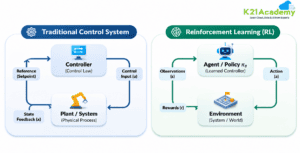
Reinforcement Learning (RL) and traditional control systems share a common objective: determining the appropriate actions or control inputs required to achieve a desired system behavior.
Both approaches observe the current state of a system and determine which actions or control signals should be applied to achieve specific objectives.
The key similarities include:
-
Decision-Making: Both approaches determine suitable actions or control inputs based on the observed state of a system.
-
Feedback Mechanism: Both use feedback from the environment or system to evaluate performance and guide future actions.
-
Control Strategy: Traditional control systems use controllers, while Reinforcement Learning uses policies to determine which actions should be taken.
-
Performance Optimization: Both aim to improve system behavior and achieve desired outcomes, although their optimization methods differ.
The main difference is that traditional control systems often rely on predefined mathematical models and control strategies, whereas Reinforcement Learning can learn an effective policy through interactions with the environment and reward-based feedback.
Read: Deep Learning on AWS
RL Workflow Overview
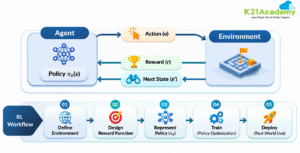
Building a Reinforcement Learning system involves several stages, from defining the learning environment to deploying and evaluating the trained agent.
1. Define the Environment
The first step is to establish an environment in which the agent can learn and interact. This includes defining the environment’s states, available actions, rules, and possible outcomes.
The environment can be a computer simulation or a physical setup, depending on the problem being solved.
2. Design the Reward Function
Next, define the objective of the agent and design a reward function that provides feedback on its actions.
The reward function assigns positive or negative values based on the outcomes of the agent’s actions, guiding it toward achieving the desired objective.
3. Define the Policy
A policy determines how the agent selects actions based on its current state or observations.
It can be represented using predefined rules, mathematical functions, or neural networks, depending on the complexity of the environment and the learning task.
4. Select and Train the RL Algorithm
Choose an appropriate Reinforcement Learning algorithm to train the agent and optimize its policy.
During training, the agent interacts with the environment, collects feedback, and updates its policy to improve its decision-making and maximize cumulative rewards.
5. Deploy and Evaluate the Trained Policy
Once the agent has been trained, deploy its learned policy in the target environment.
Evaluate its performance using relevant metrics, such as cumulative rewards, success rate, and efficiency. Continue monitoring and improving the system when necessary to ensure it performs reliably in real-world scenarios.
What are the Main Points to Consider in Reinforcement Learning?
Reinforcement Learning involves several challenges that should be considered during development and deployment:
- Computational Requirements: Training RL agents can require significant computing resources and extended training time.
- Reward Design: Poorly designed reward functions can encourage unintended behavior.
- Exploration vs. Exploitation: Agents must balance exploring new actions with using actions that have already produced good results.
- Sparse Rewards: Learning can become difficult when useful feedback is received infrequently.
- Hyperparameter Tuning: RL algorithms often require careful tuning of learning rates, discount factors, and other parameters.
- Model Interpretability: Understanding why an agent selects a particular action can be challenging, especially with complex neural network policies.
What is an Environment in Reinforcement Learning?
In Reinforcement Learning, the environment refers to everything outside the agent that it interacts with while learning and making decisions.
The environment provides the agent with observations about its current state and responds to the agent’s actions by generating new states and rewards.
Key responsibilities of the environment include:
- Providing States: Supplies information about the current situation in which the agent operates.
- Receiving Actions: Accepts actions performed by the agent.
- Generating Rewards: Provides positive or negative feedback based on the agent’s actions and their outcomes.
- Updating States: Changes its state based on the agent’s actions and the environment’s underlying rules or dynamics.
Through repeated interactions with the environment, the agent learns which actions lead to better outcomes and improves its decision-making strategy.
How Does the CartPole Environment in Gymnasium Illustrate Reinforcement Learning?
- The CartPole environment demonstrates Reinforcement Learning through a simulation in which an agent must balance a pole attached to a moving cart.
- The agent observes the cart’s position, velocity, pole angle, and angular velocity. It can then choose actions to move the cart left or right.
- The agent receives rewards for keeping the pole upright and is penalized when the pole falls beyond the permitted angle or the cart moves outside the allowed boundaries.
- Through repeated interactions and trial and error, the agent learns a policy that helps it keep the pole balanced for as long as possible.
Model-Based RL vs. Model-Free RL
Reinforcement Learning can be broadly divided into two approaches: Model-Based Reinforcement Learning and Model-Free Reinforcement Learning. The main difference lies in whether the agent uses a model of the environment to make decisions.
1. Model-Based Reinforcement Learning
Model-Based RL uses a model of the environment to predict the possible outcomes of an agent’s actions. This model helps the agent understand how the environment may change and plan actions accordingly.
By predicting future states and rewards, the agent can evaluate different strategies before taking action. This can improve learning efficiency by reducing the need for repeated trial-and-error interactions.
However, the effectiveness of this approach depends on how accurately the environment model represents real-world behavior.
2. Model-Free Reinforcement Learning
Model-Free RL enables an agent to learn directly through interactions with its environment without requiring an explicit model of the environment’s dynamics.
The agent explores different actions, receives rewards or penalties, and gradually improves its policy or value estimates based on experience.
For example, a robot learning to walk through trial and error does not necessarily need prior knowledge of its joint movements or physical dynamics. It can learn effective movements by interacting with its environment and evaluating the results.
Key Differences Between Model-Based and Model-Free RL
| Feature | Model-Based RL | Model-Free RL |
|---|---|---|
| Environment Model | Uses an explicit model | Does not require an explicit model |
| Learning Approach | Uses predictions and planning | Learns through direct interaction |
| Data Efficiency | Can be more data-efficient | May require more interactions |
| Computational Cost | Planning can be computationally expensive | Learning can require extensive training |
| Main Challenge | Accuracy of the environment model | Sample efficiency and training requirements |
Both approaches are useful for different Reinforcement Learning problems. The choice depends on factors such as environment complexity, available data, computational resources, and the accuracy of the available environment model.
What is the Effectiveness of Reinforcement Learning in Decision-Making and Optimization?
Reinforcement Learning supports decision-making and optimization by enabling agents to learn from interactions and improve their actions based on feedback. By maximizing cumulative rewards, RL can help solve complex problems involving sequential decisions, dynamic environments, and changing conditions.
It is particularly useful in applications such as robotics, resource allocation, autonomous systems, and game-playing.
What are the Disadvantages of Using Reinforcement Learning?
Despite its capabilities, Reinforcement Learning has several limitations:
- High Computational Requirements: Training RL agents can require significant processing power and time.
- Data Requirements: Agents may need many interactions with an environment to learn effective strategies.
- Sparse Rewards: Learning becomes difficult when useful feedback is received infrequently.
- Hyperparameter Sensitivity: Poor parameter settings can affect training stability and performance.
- Exploration Risks: Exploring unfamiliar actions can lead to undesirable outcomes, particularly in real-world environments.
- Limited Interpretability: Understanding the decisions made by complex RL agents can be challenging.
Conclusion
Reinforcement Learning is an important branch of Machine Learning that enables AI agents to learn and improve their decision-making through interactions with an environment. By using rewards and penalties as feedback, agents gradually develop strategies to maximize cumulative rewards and achieve specific objectives.
From understanding policies, environments, and RL workflows to exploring Model-Based and Model-Free approaches, Reinforcement Learning provides a powerful framework for solving complex decision-making problems.
As AI continues to evolve, Reinforcement Learning will play an important role in advancing applications such as robotics, autonomous systems, gaming, and intelligent automation. Understanding its fundamentals is a valuable first step toward exploring more advanced AI techniques and real-world applications.
FAQ’s
What is Reinforcement Learning?
Reinforcement Learning (RL) is a type of Machine Learning in which an agent learns to make decisions by interacting with an environment. It receives rewards or penalties based on its actions and learns to maximize cumulative rewards through trial and error.
How does Reinforcement Learning work?
Reinforcement Learning works through interactions between an agent and its environment. The agent observes the current state, selects an action using a policy, and receives feedback in the form of rewards and new observations. Over time, it improves its decision-making strategy to maximize cumulative rewards.
What are the main components of Reinforcement Learning?
The main components of Reinforcement Learning are the agent, environment, state, action, reward, and policy. The agent makes decisions, the environment responds to those actions, and rewards guide the agent toward better decisions.
What is a policy in Reinforcement Learning?
A policy is the strategy an agent uses to select actions based on its current state or observations. It can be represented using rules, probability distributions, or a neural network. The goal of learning is to improve the policy to achieve better outcomes.
What is the difference between Model-Free and Model-Based Reinforcement Learning?
Model-Based Reinforcement Learning uses a model of the environment's dynamics to plan actions and predict possible outcomes. Model-Free Reinforcement Learning learns directly through interactions with the environment without requiring an explicit model of its dynamics.
How is Reinforcement Learning different from Supervised Learning?
Supervised Learning trains models using labelled datasets containing input-output pairs, whereas Reinforcement Learning trains agents through interactions with an environment. Instead of receiving predefined correct answers, an RL agent learns from rewards and penalties based on its actions.
What are the real-world applications of Reinforcement Learning?
Reinforcement Learning is used in robotics, autonomous navigation, game-playing systems, resource optimization, recommendation systems, and industrial automation. It is particularly useful for problems that involve sequential decision-making and learning through interaction.
What are the challenges of Reinforcement Learning?
Reinforcement Learning can require significant computational resources, extensive training time, and many interactions with the environment. Other challenges include designing effective reward functions, handling sparse rewards, balancing exploration and exploitation, and ensuring reliable performance in real-world environments.