



Throughout the last few years, Amazon has dominated the cloud market. It is the largest tech company. Additionally, a faster rate of growth for AWS is anticipated in the future.
AWS specialists are becoming increasingly necessary since there is a greater demand for AWS cloud services. The majority of students are currently getting ready to work with AWS cloud technology. The Top 50+ AWS Interview Questions You Must Check in 2026 are also included in this blog for candidates preparing for AWS Interviews.
Related Readings: How to create a free tier account in AWS

Two Interview questions you can always expect !!
Question 1: Tell me about yourself! or Introduce yourself
Suggestion:
Pretty common, but you want to be prepared for this to differentiate yourself from the crowd.
Most people start rambling about all their experiences, their schooling, and the certifications they have.
That doesn’t help the company at all.
They’re not actually hiring for that.
They’re hiring because they have a problem, and they need to find someone who can help them solve it
So, when companies ask me about myself, for example, I give a brief short (few lines like “Connect your experience to the job: Tailor your response to align with the job description and the company’s needs. Emphasize how your skills and experience make you an ideal candidate for the Azure Cloud position you’re interviewing for. For example, “I noticed that this role requires expertise in [mention a specific skill or area], which I’ve honed over the years. I’m excited about the opportunity to contribute to [Company Name] by leveraging my Azure Cloud experience.””)
and then flip the question on them and answer something like this, “You know, I have a lot of experience that I could talk about, but I don’t want to bore you with that. Could you let me know the specific problem you’re hiring for, and I can tell you about my experience in that area?”
Boom!
Now you are addressing their specific problem and identifying how my skill set will add value to their company.
Question 2: Any questions that you would like to ask?
Suggestion:
Any question that you would like to ask;
Make sure you stand out by asking
“Based on everything that we discussed today about my background and my experience, is there any reason why you wouldn’t offer me this job?”
Yes, it feels uncomfortable.
But the reason why you want to ask this question is it gives you the opportunity to overcome any objections they may have. You have to remember that you’re selling your services and a good salesperson is good at handling objections.
They might say, “Hey, you know what? We’re not sure you have the right experience that we’re looking for right now.”
This gives you a chance to offer a rebuttal and clear up any misconceptions they may have about you.
As uncomfortable as this question may be, it saves you heartache in the long run.
This question will clarify exactly what their needs are and why you might not be the right fit… instead of feeling like you killed an interview and finding out you still didn’t get the job.
Follow Up –
Finally, you must send an email to the person who interviewed you to thank them for their time. Remember, they’re giving you something that they can never get back: their time.
And it’s only right to thank them for spending their valuable time with you.
Let’s look at the technical questions now!
Top 10 Realistic AWS Cloud Interview Questions
Q1. Could you provide an example of a situation where you had to identify and mitigate risks, security issues, or bottlenecks in an AWS architecture?
Q2. What monitoring tools and practices do you prefer to use when ensuring system health and optimizing efficiency on AWS?
Q3: What CI/CD tools have you worked on, and how have they contributed to the automation of infrastructure deployment and management?
Q4. Can you explain the difference between AWS Elastic Beanstalk and AWS Elastic Kubernetes Service (EKS)? When would you choose one over the other for a specific application or workload?
Q5. Describe your approach to optimizing cost in AWS. How do you ensure that resources are used efficiently while maintaining system performance and reliability?
Q6. Have you worked with AWS Identity and Access Management (IAM) extensively? How do you ensure proper security and access control for resources in your AWS environment?
Q7. Describe a situation where you needed to scale an application dynamically based on traffic spikes. What AWS services and strategies did you use to handle sudden increases in load?
Q8. AWS provides a range of database services, including RDS, Aurora, DynamoDB, and Redshift. How do you choose the right database service for a specific application’s requirements? Tell a little bit more about your experience.
Q9. How do you handle secrets and sensitive configuration data in your AWS applications? What AWS services or tools do you use for secure secret management?
Q10. Describe a situation where you needed to implement a zero-downtime deployment or update of an application on AWS. What techniques and AWS services did you use to achieve this?
Click on the above image to get the answers to the above questions:
Top 10 AWS Solution Architect Interview Questions
Q1. What observability tools have you utilized, specifically? How do you employ them for system monitoring?
Q2. Tell us about an incident when you had to develop a fault-tolerant, highly available system. What difficulties did you encounter and how did you resolve them?
Q3. Which risks and security problems are frequently seen in AWS settings, in your experience? How are the risks reduced?
Q4. How can you be confident that your systems can withstand traffic spikes and are scalable?
Q5. Your business wants to lower its AWS expenses. What are a few of the tactics you would suggest?
Q6. In its AWS environment, your organization is having performance problems. Which actions would you take to address the problem and improve performance?
Q7. Can you give an example of a real-world situation where you hosted a high-performance, scalable web application using EC2?
Q8. Can you provide an example of a real-world situation where you managed a mission-critical database using RDS?
Q9. Can you give an example of a time when you used VPC to protect an AWS multitier architecture?
Q10. Can a connection be made between a company’s data center and the Amazon cloud? How?
Click on the above image to get the answers to the above questions:
Related Readings: AWS Certified Solutions Architect Associate SAA-C03: Everything You Need To Know
Top 10 AWS DevOps Professional Interview Questions
Q1. Your applications are being deployed to a fleet of EC2 instances using AWS CodeDeploy. Inactivity is present in one of the instances. What could be the issue’s causes, and how would you resolve it?
Q2. You are building a new infrastructure for your application using AWS CloudFormation. The CloudFormation template has an error that you have committed. What could happen as a result of the error, and how would you correct it?
Q3. How would you create a scalable and affordable application using serverless computing?
Q4. How would you keep an eye on your applications to make sure they are functioning properly?
Q5. What problems does a large organization face while deploying DevOps?
Q6. What are the most effective methods for dealing with change in a DevOps setting?
Q7. How could you make your CI/CD workflow more effective?
Q8. How would you track the modifications made to your applications and infrastructure using your CI/CD pipeline?
Q9. You have been given the responsibility of setting up Elastic Beanstalk so that it can automatically deploy updated versions of your application each time you upload a modification to your code repository. You are an AWS DevOps Engineer. What method would you use?
Q10. You have been given the duty of using Systems Manager to automate the deployment of your applications because you are an AWS DevOps Engineer. What method would you use?
Click on the above image to get the answers to the above questions:
Related Readings: AWS Certified DevOps Engineer – Professional DOP-C02 Exam
Top AWS Terraform Interview Questions
Q1. What is IaC, and why is it relevant in an AWS environment?
Q2. What is Terraform, and how does it differ from CloudFormation?
Q3. What is Terraform state management, and why is the Terraform state file important?
Q4. How do you ensure that your Terraform state files are secured in a production environment?
Q5. How do you manage different environments like Dev, Test, and Production using Terraform?
Q6. How do you integrate Terraform into CI/CD pipelines?
Q7. What is a Terraform module, and why is it useful?
Q8. How do you update or change AWS infrastructure with Terraform?
Q9. How do you manage secrets in Terraform?
Q10. What are some best practices while working with Terraform on AWS infrastructure?
Top AWS Generative AI Interview Questions
Q1. Define Amazon Bedrock and explain how it aids in creating Generative AI applications.
Q2. Explain the architecture of RAG application on AWS.
Q3. What is the difference between Amazon Bedrock and Amazon SageMaker?
Q4. Define Amazon Bedrock Agents and Amazon Bedrock Knowledge bases.
Q5. How will you design an enterprise-level AI chatbot using AWS services?
Q6. How will you ensure security of your Generative AI applications created using AWS?
Q7. Define embeddings and their use in AWS Generative AI applications.
Q8. How can we prevent hallucination in Generative AI application?
Q9. Which AWS services can be used to monitor and govern the Generative AI applications?
Q10. Define Amazon Bedrock Guardrails and their uses.
Click on the above image to get the answers to the above questions:
Let’s look at theory-based interview questions that can be asked
1). What is the relation between the Availability Zone and Region?
An Availability Zone (AZ) is a distinct location within an AWS Region that is engineered to be isolated from failures in other Availability Zones. AZs are physically separated from each other, often by hundreds of miles, and each has its own power, cooling, and networking infrastructure. A Region is a geographic area that contains multiple Availability Zones.
Related Readings: AWS Management Console Walkthrough
2). What are Connection Draining and Deregistration Delay in AWS Load Balancers?
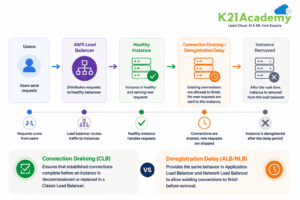
Connection draining ensures that the connections established are allowed to finish before an instance is decommissioned or replaced within a load balancer. Connection draining is referred to as such for Classic Load Balancer (CLB). However, Application Load Balancer (ALB) and Network Load Balancer (NLB) have a similar feature referred to as Deregistration Delay.
3). What is a Stateful and Stateless Firewall?
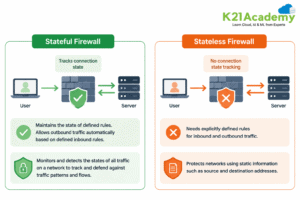
- Stateful Firewall maintains the state of defined rules. Based on the defined inbound rules, it lets the outbound rules flow. Stateful firewalls can monitor and detect the states of all traffic on a network in order to track and defend against traffic patterns and flows.
- A stateless Firewall needs explicitly defined rules for inbound and outbound traffic. Stateless firewalls are intended to protect networks using static information such as source and destination addresses.
4). What is Power User Access in AWS?
The Power User Access role lets users create, configure, and manage AWS resources. Users having PowerUserAccess permissions do not have any control over IAM users, IAM groups, IAM roles, and permissions. The policy grants users access to AWS services and restricts identity and access management.
5). What are an Instance Store Volume and an EBS Volume?
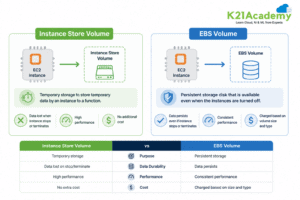
- Instance Store Volume is temporary storage to store temporary data by an instance to a function.
- EBS Volume is a persistent storage disk that is available even when the instances are turned off.
6). What are the Recovery Time Objective and Recovery Point Objective?
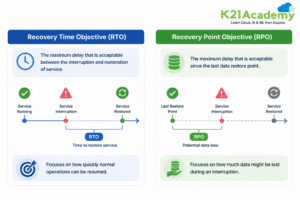
- The Recovery Time Objective is the maximum delay that is acceptable between the interruption and restoration of service.
- Recovery Point Objective is the maximum delay that is acceptable since the last data restore point.
7). What is the way to upload a file that is greater than 100 MB in Amazon S3?
To upload a file greater than 100 MB on Amazon S3, use Multipart Upload Utility from AWS. It helps in uploading large files independently in multiple parts, and the upload time can be decreased by uploading parallelly.
8). What are DDoS attacks, and What Services can minimize them?
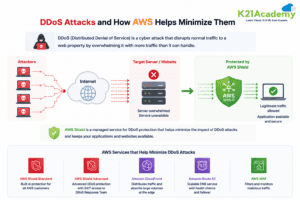
DDoS or Distributed Denial of Service is a cyber attack that disrupts the normal traffic to a web property. It attacks online services and websites by giving them more traffic than they can handle. The AWS Shield is a managed service for DDoS protection.
9). How does AWS ensure data security and compliance?
AWS provides multiple security features and compliance programs to ensure the security of customer data. These include security controls, compliance certifications, attestations, and a shared security responsibility model.
10). How does AWS handle scalability and elasticity for its customers?
AWS provides automatic scalability and elasticity to its customers through the use of services such as Auto Scaling and Elastic Load Balancing. These services allow customers to automatically increase or decrease the number of resources they are using based on demand.
11). Can you explain the concept of “hybrid cloud” and how it relates to AWS?
“Hybrid cloud” refers to the use of a combination of on-premises, private cloud, and public cloud services to meet the specific needs of an organization. AWS offers services such as AWS Direct Connect and AWS VPN to facilitate hybrid cloud deployments.
12). What are some Security Best Practices for Amazon EC2?
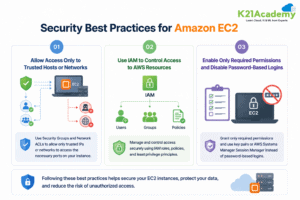
Security best practices for Amazon EC2 are:
- Only allowing the trusted hosts or networks to access ports on an instance.
- Using Identity and Access Management (Identity and Access Management) to control access to AWS resources.
- Only enabling those permissions you require and disabling password-based logins for instances launched from your AMI.
13). Differentiate between Stopping and Terminating an EC2 Instance.
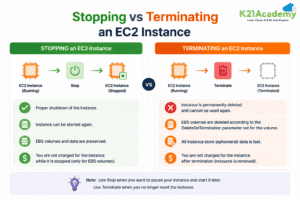
In case of stopping an EC2 instance, there will be a proper shutdown of the instance. In case of terminating an EC2 instance, the instance will be permanently deleted and cannot be used again. The EBS volumes that were attached to the instance will be deleted according to the DeleteOnTermination parameter set for the volume.
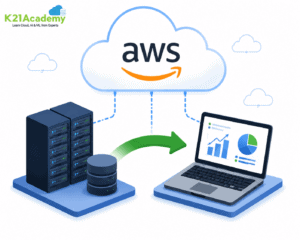
14). What are the factors to consider while Migrating to AWS?
Considered factors while migrating to AWS are:
- Operational Costs
- Workforce Productivity
- Cost avoidance
- Operational resilience
- Business agility
15). How does AWS handle disaster recovery and business continuity?
AWS provides various disaster recovery and business continuity solutions such as AWS Backup, AWS Snowball, and AWS Snow Family, that allow customers to create copies of their data in multiple locations for disaster recovery and business continuity.
16). What is the difference between an IAM role and an IAM user?
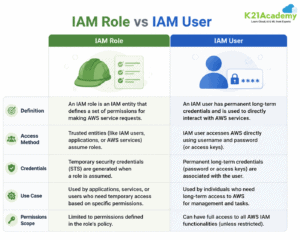
Q17). What are the different uses of the various load balancers in AWS Elastic Load Balancing?
- Application Load Balancer – Used if you need flexible application management and TLS termination.
- Network Load Balancer – Used if you require extreme performance and static IPs for your applications.
- Gateway Load Balancer – Gateway Load Balancer helps you easily deploy, scale, and manage your third-party virtual appliances.
Q18). What distinguishes AWS CloudFormation from AWS Elastic Beanstalk?
Here are some differences between AWS CloudFormation and AWS Elastic Beanstalk:
- AWS CloudFormation assists you in provisioning and describing all infrastructure resources in your cloud environment. AWS Elastic Beanstalk, on the other hand, provides an environment that makes it simple to deploy and run cloud applications.
- AWS CloudFormation meets the infrastructure requirements of a wide range of applications, including legacy applications and existing enterprise applications. AWS Elastic Beanstalk, on the other hand, is integrated with developer tools to assist you in managing the lifespan of your applications.
Q19). How does Amazon Route 53 provide high availability and low latency?
Here’s how Amazon Route 53 provides the resources in question:
- Globally distributed servers – Amazon is a global service and consequently has DNS services globally. Any customer creating a query from any part of the world gets to reach a DNS server local to them that provides low latency.
- Dependency – Route 53 provides a high level of dependability required by important applications
- Optimal locations – Route 53 uses a global anycast network to automatically answer queries from the optimal location.
Q20). You’re working on a project that necessitates high availability and fault tolerance. How would you construct the AWS infrastructure to fulfill these objectives?
I would leverage AWS services such as Auto Scaling, Elastic Load Balancing, and Amazon RDS Multi-AZ deployments to ensure high availability and fault tolerance. To provide redundancy and reduce downtime, I would deploy the application across many Availability Zones (AZs). I would also utilize Amazon CloudWatch to monitor the application’s health and initiate automated scaling events based on predetermined thresholds.
Q21). Your web application must handle abrupt spikes in traffic during specified events. How would you design the AWS application architecture to deal with scalability and assure peak performance during these events?
I would construct the application to leverage Amazon Elastic Compute Cloud (EC2) instances in an Auto Scaling group to handle abrupt traffic spikes. I’d set up the Auto Scaling group to scale out based on measures like CPU consumption or network traffic. In addition, I would use Amazon CloudFront, a content delivery network (CDN), to cache and provide static content, which would reduce the burden on the application servers. As a result, the application can scale horizontally and efficiently manage additional traffic.
Q22). A customer wants to build a disaster recovery plan for its AWS-hosted critical systems. What business continuity strategies and services would you recommend?
To ensure business continuity and implement a disaster recovery plan, I would recommend using services like AWS CloudFormation for infrastructure provisioning and AWS CloudWatch for monitoring. I would utilize Amazon S3 for data backup and versioning, and leverage AWS Elastic Beanstalk or AWS Lambda to deploy and run the application in multiple AWS regions for redundancy. Additionally, I would enable cross-region replication for critical databases using services like Amazon RDS Multi-AZ or Amazon Aurora Global Database.
Q23). You’ve been tasked with lowering the cost of an AWS infrastructure. What steps would you take to find cost-cutting opportunities and cut costs?
To reduce expenses in an AWS environment, I would first analyze resource utilization using AWS Cost Explorer reports and AWS Trusted Advisor recommendations. To match resource requirements with actual usage, I would discover underutilized instances and rightsizing opportunities. I would also use AWS Lambda and Amazon S3 for serverless computation and storage, removing the requirement to manage and maintain dedicated resources. Costs can be reduced further by implementing scheduled instance shutdowns or employing AWS Spot Instances for non-critical applications.
Q24). A corporation wants to store sensitive data in AWS in a secure manner. How would you construct a system that maintains data confidentiality and integrity?
To manage encryption keys for data at rest and in transit, I prefer AWS Key Management Service (KMS). I would encrypt sensitive data via AWS Encryption SDK or the native encryption capabilities of AWS services such as Amazon S3, Amazon RDS, or Amazon EBS. In addition, I would use AWS Identity and Access Management (IAM) to enforce rigorous access restrictions and network security mechanisms such as VPCs, Security Groups, and Network ACLs to limit who may access the data and secure data in transit.
AWS Architecture Scenario-Based Interview Questions
Q1. Develop a highly available architecture for an e-commerce application on AWS. Mention the services and reasons behind them.
Q2. How would you develop a multi-region disaster recovery solution for an AWS application?
Q3. Your company plans to migrate the application hosted in-house to AWS. Which approach and services would you recommend?
Q4. How would you develop a secure web application architecture in three tiers on AWS?
Q5. There is an increase in traffic due to peak activity in the application. How would you develop the architecture on AWS to handle such a case?
Q6. How would you develop a cost-effective architecture on AWS without compromising on performance and availability?
Q7. How would you secure the data and application in an AWS production environment?
Q8. How would you develop a highly available and fault-tolerant architecture on AWS?
Q9. A company plans to develop a serverless application on AWS. Which services would you recommend?
Q10. How would you monitor and troubleshoot the production workload in AWS?
Frequently Asked Questions (FAQs)
Q1. What are the common AWS interview questions?
The interview questions related to AWS usually revolve around cloud architecture, EC2, VPC, IAM, S3, Databases, Security, Networking, DevOps, and Generative AI Services, including Amazon Bedrock.
Q2. Which AWS Certification is the best for cloud engineers?
The AWS Certified Solutions Architect – Associate (SAA-C03) is among the popular certifications for cloud experts who are at the beginning of their journey with AWS Cloud.
Q3. Is AWS Certification enough to get a cloud job?
Though AWS certifications can help you prove your knowledge, an employer will also consider your practical experience and expertise.
Q4. What are the AWS skills required in 2026?
Among the required AWS skills are cloud architecture, Kubernetes, Terraform, DevOps, Serverless technologies, Security, and Generative AI services such as Amazon Bedrock.
Q5. How can I prepare for AWS Interviews?
Prepare AWS architecture scenarios, be well-versed with the core AWS services, create practical projects and prepare answers from real-life situations.
Next Task For You
Begin your journey towards an AWS Cloud by joining our FREE Informative Class on Amazon Cloud Free Class by clicking on the image below.