




Amazon Titan is a family of AI models created by Amazon Web Services (AWS). Offered through Amazon Bedrock. These models help businesses build AI-powered applications for tasks such, as search, retrieval-augmented generation (RAG) image generation and multimodal search. Because Amazon Titan integrates smoothly into the AWS ecosystem organizations can develop AI solutions while using AWS security and infrastructure capabilities.
Amazon Titan models can be used through Amazon Bedrock. Amazon Bedrock is a managed service that gives you access to foundation models from Amazon and other AI providers. Amazon Titan models support tasks such, as e-commerce product discovery, document retrieval and image-based search. Amazon Titan models help businesses add AI features to their processes.
In this blog, we’ll explore Amazon Titan’s features, its integration with AWS, and its advantages over other AI models, along with ethical considerations and real-world applications.
Related Reading: Introduction to Generative AI and Its Mechanisms

Table of Contents
- Understanding Amazon Titan
- Types of Models in Amazon Titan
- Amazon Titan vs Amazon Nova: Key Differences and Use Cases
- Seamless Integration with the AWS Ecosystem
- Prioritizing Ethics and Security
- Real-World Applications and Benefits
- Conclusion
- Frequently Asked Questions
Understanding Amazon Titan
Amazon Titan is a family of foundation models created by Amazon Web Services (AWS). These models help companies add AI capabilities to their applications. They support tasks like semantic search, text embeddings, multimodal search, and image generation, making them useful for building AI-driven solutions.
Businesses across industries, including e-commerce, media, and enterprise software, can benefit from Amazon Titan models. For example, Titan Text Embeddings V2 supports semantic search and Retrieval-Augmented Generation (RAG), while Titan Multimodal Embeddings helps with image-based searches and product recommendations.
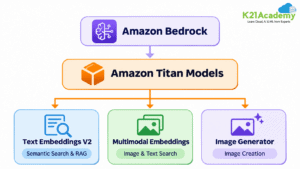
Amazon Bedrock is a fully managed service from AWS that gives developers access to foundation models from Amazon and other AI providers. Through Amazon Bedrock, developers can access supported Titan models and integrate them with other AWS services to build secure and scalable AI applications.
In simple terms, Amazon Titan is a family of AI models, while Amazon Bedrock is the service that allows developers to access and use these models.
To know more about Amazon Bedrock in detail Click Here.
Types of Models in Amazon Titan
- Amazon Titan Text Embeddings V2 turns text into vectors that hold the meaning and context of the words. This helps with tasks like search, Retrieval-Augmented Generation (RAG) and document retrieval. It makes it easier for businesses to find the information quickly and accurately.
- Amazon Titan Multimodal Embeddings G1 creates vector representations from both text and images. This allows systems to understand how visual and written content connect. It works well for image-based search, product recommendations and multimodal retrieval. These features are especially helpful in e-commerce and media platforms where both pictures and words matter.
- Amazon Titan Image Generator G1 v2 lets users create and edit images using text prompts. This tool is great for making marketing visuals, product images and other creative content. It helps businesses speed up their content creation process and stay consistent in their branding.
To know more about Amazon Titan read this, AWS – Amazon Titan Models
Each of these models supports AI functions and can be used together with other AWS services through Amazon Bedrock. Companies can build solutions, for finding information, processing images and generating content. They get the power of AI while also using the reliable infrastructure of AWS.
With these tools Amazon Titan helps businesses make customer experiences simplify their work processes and create smart AI solutions that fit their needs.
Related Reading: Demystifying Natural Language Processing (NLP)
Amazon Titan vs Amazon Nova: Key Differences and Use Cases
Amazon Web Services (AWS) provides foundation models through Amazon Bedrock. These include Amazon Titan and Amazon Nova. Both model families help businesses create AI-powered applications. However, their capabilities and use cases differ.
Amazon Titan includes models for text embeddings, multimodal search, and image generation. Titan Text Embeddings V2 supports semantic search, document retrieval, and Retrieval-Augmented Generation (RAG). Titan Multimodal Embeddings G1 allows applications to search and retrieve information using both text and images.
Amazon Nova offers models for text generation, multimodal understanding, image creation, and video generation. It also includes multimodal embedding capabilities that support applications working with text, images, and other data types.
Key Differences Between Amazon Titan and Amazon Nova
| Feature | Amazon Titan | Amazon Nova |
|---|---|---|
| Primary capabilities | Text embeddings, multimodal embeddings, and image generation | Text generation, multimodal understanding, embeddings, image and video generation |
| Common use cases | Semantic search, RAG, image search, and product recommendations | AI assistants, content generation, multimodal applications, and media creation |
| Embedding capabilities | Titan Text Embeddings V2 and Multimodal Embeddings G1 | Nova Multimodal Embeddings |
| AWS integration | Available through Amazon Bedrock | Available through Amazon Bedrock |
Related Reading: Exploring Large Language Models (LLMs)
Which One Should You Choose?
The choice between Amazon Titan and Amazon Nova depends on your application’s requirements.
For semantic search and document retrieval, Titan Text Embeddings V2 is a suitable option. For applications requiring text generation, multimodal understanding, or video generation, Amazon Nova offers models designed for these tasks.
Both model families are accessible through Amazon Bedrock, allowing developers to build AI applications using AWS services and infrastructure.
Related Reading: The Essentials of Prompt Engineering
Seamless Integration with the AWS Ecosystem
One of the major benefit of Amazon Titan is how well it works with the AWS ecosystem. Developers can get Amazon Titan models via Amazon Bedrock. Pair them with services, like Amazon S3, AWS Lambda and Amazon OpenSearch Service. By doing this developers can create AI applications that grow easily.
For instance Titan Text Embeddings V2 can turn documents into vector embeddings that help with search and Retrieval-Augmented Generation (RAG). The Titan Text Embeddings V2 embeddings can be saved in a vector database. This lets applications pull out information that matches the meaning of user questions instead of just looking for matching words.

Steps in the Diagram:
- Image Upload: Users upload images to Amazon S3 to store them securely.
- Image Processing: AWS Lambda processes the uploaded images and prepares them for embedding generation.
- Multimodal Embeddings: Amazon Titan Multimodal Embeddings G1, available through Amazon Bedrock, converts images or text into numerical vectors.
- Vector Storage: The embeddings are stored and indexed in Amazon OpenSearch Service to enable fast similarity searches.
- Search Query: Users enter text- or image-based search queries through the application.
- Similarity Search: The system compares query embeddings with stored vectors to find matching images or related content.
- Monitoring: Amazon CloudWatch tracks application performance and collects operational metrics.
By using Amazon Titan with AWS tools like Amazon S3, AWS Lambda and Amazon OpenSearch Service companies can create scalable systems for image search, product suggestions and multimodal retrieval.
To know more about AWS Lambda Click Here.
Amazon Titan’s integration with the AWS ecosystem offers several benefits:
- Scalability: Effortlessly scale AI applications to meet the demands of different projects.
- Security: Utilize AWS’s robust security framework to protect sensitive data and ensure compliance with industry standards.
- Cost-Effectiveness: Optimize costs with AWS’s pay-as-you-go pricing model, ensuring that businesses only pay for what they use

Steps in the Diagram:
- Data Source: Documents and other text files are stored in Amazon S3.
- Data Processing: Amazon Bedrock Knowledge Bases processes the documents and splits them into smaller chunks.
- Embedding Generation: Amazon Titan Text Embeddings V2 converts the text chunks into vector embeddings.
- Vector Storage: Amazon OpenSearch Serverless stores and indexes the embeddings for similarity search.
- User Query: Users submit questions through an AI-powered application.
- Information Retrieval: Amazon Bedrock Knowledge Bases retrieves relevant document chunks using semantic search.
- Response Generation: A supported text-generation model available through Amazon Bedrock uses the retrieved information to generate a response.
By combining Amazon Titan, Amazon S3, Amazon Bedrock Knowledge Bases, and Amazon OpenSearch Serverless, businesses can build RAG applications that improve document search and information retrieval.
This integration allows organizations to develop AI-powered solutions using their own data while benefiting from AWS security and infrastructure capabilities.
Prioritizing Ethics and Security
- Amazon Web Services (AWS) emphasizes responsible AI development and security across its AI services, including Amazon Titan. AWS evaluates its models to help identify potential risks, reduce bias, and improve model performance. However, businesses should also evaluate AI outputs to ensure they meet their specific requirements.
- Security is an important consideration when using Amazon Titan models through Amazon Bedrock. AWS provides encryption, identity and access management (IAM), and data protection controls to help organizations protect sensitive information and manage access to AI resources.
- Amazon Bedrock also provides Guardrails to help developers filter harmful content, detect sensitive information, and implement responsible AI policies. Although Titan embedding models do not directly support Guardrails during inference, developers can use the ApplyGuardrail API to evaluate content separately within their applications.
- Responsible AI practices involve monitoring model performance, reviewing outputs, and addressing potential risks related to bias, privacy, and inappropriate content. These measures help organizations develop more reliable and trustworthy AI applications.
- By combining Amazon Titan with AWS security features and responsible AI practices, businesses can build AI-powered solutions while maintaining greater control over data protection, application behavior, and compliance requirements.

Real-World Applications and Benefits
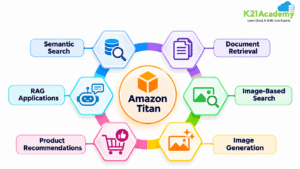
Amazon Titan models help businesses with tasks such as semantic search, document retrieval, image-based search, and product recommendations. Companies can use these models through Amazon Bedrock to improve information discovery, streamline workflows, and enhance customer experiences.
Here are some real-world examples of companies using Amazon Titan and Amazon Bedrock.
iFood
iFood is a food delivery platform in Latin America. It used Amazon Bedrock, Amazon Titan, and Anthropic Claude to develop a virtual waiter called Garçon. The project used generative AI and Retrieval-Augmented Generation (RAG) to support personalized voice and text-based ordering experiences.
Genesys
Genesys is a customer experience technology company that uses Amazon Bedrock to access foundation models, including Amazon Titan. This helps the company explore AI capabilities for customer engagement and applications that require handling large volumes of requests efficiently.
OfferUp
OfferUp is an online marketplace in the United States. It used Amazon Titan Multimodal Embeddings with Amazon OpenSearch Service to improve product discovery. The system combines text and image information to deliver relevant search results, even when product descriptions contain limited details.
According to an AWS case study published in February 2025, OfferUp improved local search results by 54% and relevance recall by 27%.
Bynder
Bynder is a digital asset management company that uses Amazon Titan Multimodal Embeddings through Amazon Bedrock to improve image search and digital content discovery. Users can find relevant assets using natural language descriptions or visually similar images.
According to AWS, one Bynder customer reduced the time spent searching for digital assets by 75%, improving productivity and content discovery.
Genpact
Genpact is a global professional services company that uses Amazon Bedrock and Amazon Titan to support generative AI applications. These include employee background-check validation and an internal AI platform with capabilities such as content summarization, translation, and image creation.
These examples demonstrate how Amazon Titan and Amazon Bedrock help businesses improve search experiences, automate workflows, and increase operational efficiency.
Conclusion
Amazon Titan continues to support AI applications inside the AWS ecosystem. Amazon Titan is especially useful in areas such as search, Retrieval-Augmented Generation (RAG) multimodal search and image generation. Through Amazon Bedrock businesses can add supported Titan models to AWS services. Build scalable AI solutions.
When AWS security features and responsible AI practices are in place organizations can manage data protection better monitor AI applications closely and address potential risks. These strengths make Amazon Titan valuable for businesses that want to improve information retrieval streamline workflows and enhance customer experiences.
As AI technologies continue to evolve Amazon Titan remains an option for specific AI workloads. Newer model families such as Amazon Nova also offer capabilities, for generative AI applications.
Frequently Asked Questions
Ans: You can access supported Amazon Titan models through Amazon Bedrock, a fully managed AWS service that provides API access to foundation models. Developers can use the AWS Management Console, AWS SDKs, or APIs to integrate Titan with services such as Amazon S3, AWS Lambda, and Amazon OpenSearch Service.
Ans: Amazon Bedrock is a fully managed AWS service that provides access to foundation models from Amazon and other AI providers. Amazon Titan is a family of AWS foundation models that supports tasks such as text embeddings, multimodal search, and image generation. In simple terms, Amazon Titan provides the models, while Amazon Bedrock provides the service to access and use them.
Ans: Amazon Titan offers models for text embeddings, multimodal search, and image generation. Amazon Nova includes models for text generation, multimodal understanding, embeddings, and media generation. Titan Text Embeddings V2 is useful for semantic search and Retrieval-Augmented Generation (RAG), while Amazon Nova offers additional capabilities for AI assistants and content generation. The right choice depends on your application requirements.
Ans: Amazon Titan models are accessible through Amazon Bedrock, which provides security features such as encryption and AWS Identity and Access Management (IAM). Developers can also use Amazon Bedrock Guardrails through supported workflows to help filter harmful content and protect sensitive information. However, embedding models do not directly support Guardrails during inference, and organizations should independently evaluate model performance, fairness, and security.
Ans: Amazon Titan supports applications such as semantic search, document retrieval, image-based search, and product recommendations. For example, OfferUp used Amazon Titan Multimodal Embeddings with Amazon OpenSearch Service to improve product discovery. Businesses can also use Titan Text Embeddings V2 to build RAG applications that retrieve relevant information from documents. Q1) How do I access Amazon Titan?
Q2) What is the difference between Amazon Bedrock and Amazon Titan?
Q3) What is the difference between Amazon Titan and Amazon Nova?
Q4) How does Amazon Titan help protect data and support responsible AI?
Q5) What are some real-world applications of Amazon Titan?
Next Task For You
Ready to take your AI and machine learning skills to the next level? Our AWS AI/ML training program covers everything you need to excel, including comprehensive exam objectives, hands-on labs, and practice tests. Whether you’re aiming to become an AWS Certified AI Practitioner, an AWS Certified ML Engineer, or specialize in AWS Certified Machine Learning, we have the resources to help you succeed.
Join our waitlist today and be the first to access our training program. Click the image below to secure your spot and start your journey toward AWS certification success!