




As AI systems evolve from simple prompt-based tools into autonomous decision-makers, agentic AI protocols are becoming the backbone of intelligent automation. Four major standards are shaping how AI agents communicate, collaborate, and access tools: MCP (Model Context Protocol), A2A (Agent2Agent), ACP (Agent Communication Protocol), and ANP (Agent Network Protocol). This guide provides a complete comparison of these protocols, helping you understand how each enables scalable and interoperable agent ecosystems.
Agentic AI protocols are standardized communication frameworks that allow AI agents to interact with tools, data sources, users, and even other agents. Instead of building custom integrations for every system, these protocols provide structured methods for context sharing, decision-making, task delegation, and multi-agent collaboration. In this article, we compare MCP vs A2A vs ACP vs ANP in terms of architecture, use cases, strengths, and real-world adoption to help you choose the right protocol for your AI project.
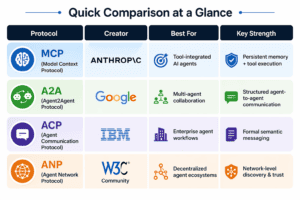
This blog provides an in-depth comparison of four emerging protocols, their key capabilities, and a core comparison of their functionalities.
Table of Contents:
- What Are Agentic AI Protocols and Why Do They Matter?
- Model Context Protocol
- Agent-to-Agent Protocol
- Agent Communication Protocol
- Agent Network Protocol
- MCP vs A2A vs ACP vs ANP: Side-by-Side Comparison
- Real-World Implementation Examples
- Conclusion

What Are Agentic AI Protocols and Why Do They Matter?
Agentic AI protocols are standardized frameworks that enable intelligent agents to discover each other, exchange information, access tools, and coordinate actions across systems. In simple terms, AI agent protocols define how autonomous AI systems communicate with data sources, APIs, users, and other agents in a structured and reliable way. These protocols make agent communication scalable, consistent, and interoperable across different platforms and vendors.
Without standardized protocols, every AI integration would require custom-built connections between models, tools, and services, slowing innovation and increasing complexity. Agent communication protocols act as a shared language for AI agents, similar to how HTTP standardized communication on the web. By defining how agents share context, delegate tasks, maintain memory, and establish trust, these protocols make it possible to build complex ecosystems of cooperating AI systems instead of isolated tools.
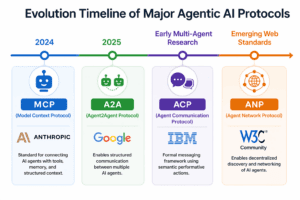
As AI moves toward multi-agent architectures, selecting the right protocol becomes critical for enabling scalability, reliability, and cross-platform compatibility. The four major protocols shaping this space, MCP, A2A, ACP, and ANP, each address different layers of agent interaction, from tool usage to decentralized agent networks.
Related Readings: What is Agentic AI?

Now let’s take a closer look at and a comparison of MCP, A2A, ACP, and ANP.
MCP (Model Context Protocol): Architecture and Use Cases

MCP (Model Context Protocol) is a foundational standard in agentic AI protocols that enables AI agents to interact with tools, structured data, and persistent memory in a consistent way. Developed and maintained by Anthropic, anthropic MCP helps AI systems operate as stateful agents capable of reasoning, planning, and executing multi-step workflows. Because of this capability, MCP in agentic AI is widely used for building reliable copilots, assistants, and automation agents.
MCP Architecture Overview
The model context protocol follows a client–server architecture that standardizes how AI agents access external capabilities.
Core components
- Client (AI agent or application)
Requests context, tools, or actions - MCP Server
Provides structured access to external capabilities - Transport layers
- Stdio
- HTTP
- Server-Sent Events (SSE)
- Core primitives
- Resources – Structured data such as files, APIs, or databases
- Tools – Executable functions the agent can invoke
- Prompts – Reusable workflows or instructions guiding agent behavior
This structure allows agents to maintain context across sessions and dynamically interact with real-world systems.
Minimal MCP Server Example (JSON-RPC format)
A minimal MCP setup typically uses JSON-RPC messaging to define available tools and allow agents to call them. The server exposes structured tool definitions, including tool name, description, and input schema. The AI agent can then invoke these tools dynamically as part of its reasoning process.
This standardized communication ensures reliable tool execution and consistent integration across different environments.
Real-World MCP Implementations
Several real-world systems already leverage MCP:
- Claude Desktop – Enables AI assistants to access local files securely
- IDE integrations – Supports coding assistants with project context awareness
- Database connectors – Allows agents to query structured enterprise knowledge
- Enterprise copilots – Enables persistent context across workflows
Anthropic continues to maintain and evolve MCP, making the model context protocol one of the most widely adopted standards for tool-enabled AI agents.
Why MCP is Important in Agentic AI
Among all agentic AI protocols, MCP plays a critical role in enabling:
- Persistent contextual memory
- Structured tool usage
- Multi-step reasoning workflows
- Integration with enterprise systems
- Scalable AI agent development
Because of its strong ecosystem and practical usability, MCP is often considered the backbone protocol for building advanced autonomous AI systems.
A2A (Agent2Agent Protocol): How Agents Communicate

A2A (Agent2Agent Protocol) is designed to enable structured agent-to-agent communication, allowing multiple AI agents to collaborate, share tasks, and coordinate decisions efficiently. Developed by Google, Google A2A focuses on enabling interoperability between autonomous systems so they can work together as part of larger intelligent workflows.
Unlike protocols focused on tool integration, the A2A protocol is specifically built for communication between agents across different platforms or ecosystems. This makes agent2agent communication essential for multi-agent environments such as customer service automation, research assistants, workflow orchestration, and AI-powered enterprise systems.
A2A Protocol Design Overview
The A2A protocol enables agents to discover each other’s capabilities and delegate tasks dynamically.
Core capabilities
- Agent discovery – Agents identify available collaborators
- Capability sharing – Agents publish skills, tools, or services they provide
- Task-based messaging – Structured communication for delegating tasks
- Streaming responses – Supports real-time updates between agents
- Secure communication – Identity verification and metadata exchange
This design allows AI agents to coordinate efficiently without requiring tight coupling between systems.
A2A Message Flow (Conceptual)
Typical agent2agent workflow:
- Agent registration – Agent announces capabilities
- Capability discovery – Other agents identify suitable collaborators
- Task delegation – Request is sent to the most relevant agent
- Execution – Agent performs the requested task
- Result return – Output is shared back to the requesting agent
This structured communication allows multiple agents to collaborate seamlessly on complex problems.
A2A vs MCP Comparison
Understanding the difference between MCP and A2A helps clarify their roles in agentic AI protocols:
- A2A protocol – connects agents to other agents
- MCP (Model Context Protocol) – connects agents to tools and data
- A2A focuses on coordination and collaboration
- MCP focuses on context, memory, and tool execution
In many real-world systems, both protocols can work together; MCP enables individual agent capabilities, while A2A enables multi-agent teamwork.
Why A2A Matters in Multi-Agent Systems
The agent-to-agent communication model enables:
- Distributed problem-solving
- Specialization across agents
- Scalable AI workflows
- Collaboration across platforms
- Modular AI system design
As multi-agent ecosystems grow, the A2A protocol plays a critical role in enabling intelligent agents to communicate, delegate tasks, and operate collectively.
ACP (Agent Communication Protocol): Standards and Adoption

ACP (Agent Communication Protocol) is a structured messaging standard within agentic AI protocols, designed to enable reliable communication between intelligent agents in complex systems. Often associated with IBM research and influenced by standards like KQML and FIPA-ACL, IBM ACP focuses on enabling agents to exchange messages with clearly defined intent, making interactions more predictable and interpretable.
The agent communication protocol approach is particularly useful in enterprise environments where multiple AI systems, platforms, or vendors must coordinate actions using standardized communication rules.
How ACP Works
ACP is based on the concept of performative messaging, where each message clearly defines its purpose. Instead of sending plain text instructions, agents communicate using structured message types such as:
- Inform – Share knowledge or results
- Request – Ask another agent to perform a task
- Propose – Suggest an action or solution
- Accept / Reject – Confirm or decline a proposal
These standardized message formats make ACP well-suited for workflows involving negotiation, planning, approvals, and structured decision-making.
Where ACP is Commonly Used
The agent communication protocol model is particularly effective in structured enterprise environments:
- Multi-agent workflow orchestration
- Enterprise negotiation systems
- Supply chain coordination
- Contract or bidding automation
- Rule-based decision systems
Because ACP focuses on semantic clarity, it is often preferred when systems must follow clearly defined communication logic.
ACP vs MCP
Understanding ACP vs MCP helps clarify their different roles in agentic AI protocols:
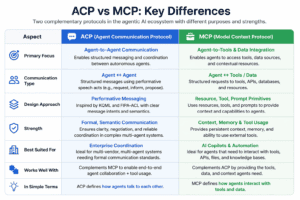
In simple terms:
- ACP defines how agents communicate with each other
- MCP defines how agents access tools, memory, and external systems
Both can be used together in advanced AI ecosystems where agents need structured communication as well as tool access.
Why ACP Matters in Enterprise AI
Among modern agentic AI protocols, ACP plays an important role in enabling:
- Standardized agent communication
- Reliable multi-vendor interoperability
- Structured negotiation workflows
- Consistent decision logic
- Scalable enterprise automation
Because of its structured messaging approach, ACP remains highly relevant for organizations building complex multi-agent systems that require formal communication standards.
ANP (Agent Network Protocol): Decentralized Agent Networks

ANP (Agent Network Protocol) is an emerging standard in agentic AI protocols designed to support large-scale ecosystems of decentralized agents. Developed through W3C community initiatives, the agent network protocol (ANP) enables AI agents to discover, communicate, and collaborate across open networks without relying on a central authority.
Often compared to how DNS enables internet discovery or how BitTorrent enables peer-to-peer sharing, the ANP protocol focuses on network-level coordination rather than individual agent capabilities. This makes it particularly valuable for open ecosystems where agents from different organizations must interact dynamically.
How ANP Works
The agent network protocol (ANP) enables decentralized agent interaction through distributed discovery and communication layers.
Core characteristics
- Decentralized architecture – No central controller managing all agents
- Dynamic agent discovery – Agents can join or leave the network anytime
- Peer-to-peer communication – Agents interact directly with each other
- Trust and identity layers – Helps verify agent reliability
- Scalable network topology – Supports large distributed agent ecosystems
This structure allows decentralized agents to collaborate across domains while maintaining flexibility and resilience.
Why ANP is Different from Other Agentic AI Protocols
Compared to MCP, A2A, and ACP, ANP focuses on enabling open and distributed agent ecosystems rather than single-agent capabilities or structured messaging formats.
Key advantages of agent network protocol (ANP):
- supports web-scale agent discovery
- allows cross-platform agent interoperability
- enables resilient decentralized communication
- reduces dependency on centralized infrastructure
- supports future open agent marketplaces
This decentralized approach makes ANP a strong candidate for building open, scalable, and interoperable agent ecosystems.
Why ANP Matters for the Future of AI
As the ecosystem of agentic AI protocols evolves, ANP plays a critical role in enabling:
- open agent ecosystems
- decentralized AI marketplaces
- cross-organization collaboration
- scalable multi-agent systems
- interoperable AI services
Because of its decentralized approach, the agent network protocol ANP is considered a key building block for the future of autonomous digital ecosystems.
Related Readings: AI Agents vs Human Agents: Key Differences & Benefits in Modern Business
MCP vs A2A vs ACP vs ANP: Side-by-Side Comparison
The MCP vs A2A vs ACP vs ANP comparison highlights how each protocol supports a different layer of the agentic AI protocols ecosystem. While some protocols focus on tool usage, others enable communication between agents or large-scale decentralized networks. Understanding this protocol comparison helps in selecting the right architecture for scalable AI agent systems.

Key Differences (Snippet Optimized)
- MCP vs A2A vs ACP vs ANP shows that each protocol solves a different problem in agentic AI architecture.
- MCP focuses on connecting agents with tools, APIs, and memory.
- A2A enables agent-to-agent collaboration for multi-agent workflows.
- ACP provides formal semantic messaging useful in enterprise coordination systems.
- ANP supports decentralized agent discovery across open networks.
These protocols can complement each other when building scalable agentic AI protocols comparison architectures.
Which Agentic AI Protocol Should You Choose?
Choosing the best AI agent protocol depends on the specific capabilities your AI system needs. Each of the major agentic AI protocols, MCP, A2A, ACP, and ANP, solves a different problem, from tool integration to multi-agent coordination and decentralized discovery.
Instead of competing, these protocols often work together to build scalable and flexible AI agent architectures. The visual guide below maps common use cases to the right protocol and helps simplify agentic AI protocol selection.
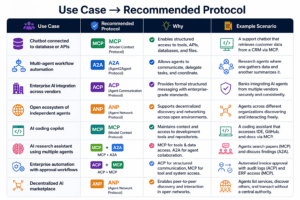
Quick Decision Guide
Use this simple logic when deciding which protocol to choose:
- Need an AI agent to access tools, APIs, files, or databases → MCP
- Need multiple agents to communicate or collaborate → A2A
- Need structured enterprise-grade messaging standards → ACP
- Need decentralized agents operating across open networks → ANP
Can These Protocols Work Together?
Yes. Many real-world AI systems combine multiple agentic AI protocols:
- MCP + A2A → tool access + multi-agent collaboration
- ACP + MCP → structured enterprise communication + system integration
- A2A + ANP → agent coordination across decentralized networks
Selecting the right combination ensures scalable, interoperable, and future-ready AI agent systems.
Related Readings: Top 10 Open-Source AI Agent Tools
Real-World Implementation Examples
Understanding AI agent protocol examples helps clarify how these standards are applied in production environments. Below are practical MCP implementation, A2A example, ACP, and ANP use cases that demonstrate how different agentic AI protocols solve real business problems.
1. MCP Implementation Example, Claude Desktop File Integration
Scenario: An AI assistant needs access to local files, documents, and internal knowledge sources.
How MCP helps: Using MCP (Model Context Protocol), the AI agent connects securely to local folders, databases, or APIs. The protocol allows the agent to retrieve structured information, maintain session memory, and execute workflows such as summarizing documents or retrieving project data.
Example workflow
- User asks the AI assistant to summarize internal documents
- MCP connects the AI to local files or the company’s knowledge base
- AI retrieves relevant data using a structured tool access
- Results are returned with contextual understanding
Why MCP fits
- Enables persistent context across sessions
- Provides secure, structured tool access
- Supports enterprise knowledge assistants and copilots
2. A2A Example, Multi-Agent Customer Support Workflow
Scenario: A customer support system uses multiple AI agents to resolve user queries efficiently.
How A2A helps: Using the A2A protocol, specialized agents collaborate to solve tasks:
- One agent retrieves customer history
- Another analyzes sentiment
- Another generates response suggestions
Agents communicate using structured agent-to-agent messaging, delegating tasks, and sharing results.
Example workflow
- Customer submits query
- The routing agent assigns subtasks to specialized agents
- Agents exchange structured messages
- Final response is generated collaboratively
Why A2A fits
- Enables agent specialization
- Improves the scalability of complex workflows
- Supports distributed decision-making
3. ACP Example, Enterprise RFQ (Request for Quotation) Automation
Scenario: A procurement platform coordinates multiple vendor agents to submit and evaluate quotations.
How ACP helps: Using ACP (Agent Communication Protocol), agents communicate using formal structured messages such as request, propose, accept, or reject. This ensures consistent negotiation workflows across vendors.
Example workflow
- Buyer agent sends RFQ request
- Vendor agents submit proposals
- Evaluation agent compares offers
- System selects optimal vendor
Why ACP fits
- Provides structured negotiation logic
- Ensures consistent communication standards
- Supports enterprise-grade workflow automation
4. ANP Example, Decentralized Agent Marketplace
Scenario: Multiple independent AI agents offer services such as translation, analytics, or automation in an open ecosystem.
How ANP helps: Using the ANP protocol, agents can discover each other dynamically and interact without a central authority. This supports decentralized marketplaces where agents publish capabilities and collaborate peer-to-peer.
Example workflow
- The agent publishes available services
- Other agents discover service via the network registry
- Agents interact directly without centralized control
- Transactions occur across distributed systems
Why ANP fits
- enables open agent ecosystems
- supports peer-to-peer discovery
- scalable across organizations
Why These Examples Matter
These AI agent protocol examples demonstrate that:
- MCP implementation enables tool-aware intelligent assistants
- A2A example enables collaborative multi-agent workflows
- ACP enables structured enterprise communication
- ANP enables decentralized AI ecosystems
Together, these protocols provide the foundation for scalable and interoperable intelligent systems.
Conclusion
The rise of autonomous AI agents calls for new standards of communication that are structured, interoperable, secure, and scalable. Each of the four Agentic AI protocols we’ve explored plays a distinct role in this emerging ecosystem:
- MCP enables powerful individual agents with memory and tool use.
- A2A allows teams of agents to communicate, coordinate, and collaborate.
- ACP brings formal reasoning, negotiations, and behavioural logic into play.
- ANP empowers entire networks of agents to function resiliently and autonomously.
As we move forward into the era of agentic AI platforms, autonomous service networks, and interoperable digital ecosystems, understanding and applying the right agentic AI protocol will be essential to building robust, intelligent systems.
Frequently Asked Questions
A2A (Agent2Agent) enables communication between multiple AI agents so they can collaborate, share tasks, and coordinate workflows. MCP (Model Context Protocol) connects AI agents to external tools, APIs, and structured data sources. In simple terms, A2A supports agent-to-agent communication, while MCP supports agent-to-tool interaction.
A2A enables structured collaboration between known agents using task-based messaging and capability discovery. ANP (Agent Network Protocol) allows decentralized agent discovery across open networks without a central authority. A2A is ideal for controlled workflows, while ANP supports large-scale decentralized agent ecosystems.
Agentic AI refers to AI systems that can autonomously plan, reason, and take actions to achieve defined goals. Traditional AI typically responds to individual prompts without maintaining long-term context or executing multi-step workflows. Agentic AI enables decision-making, memory usage, and tool interaction.
MCP (Model Context Protocol) currently has the strongest adoption due to its integration with developer tools, AI copilots, and enterprise assistants. A2A adoption is increasing as multi-agent workflows grow. ACP is used in structured enterprise communication, while ANP is emerging for decentralized agent ecosystems.
Yes, MCP is open source and maintained by Anthropic. Developers can freely build MCP servers and clients to enable AI agents to interact with tools, APIs, and structured data sources. Its open ecosystem has contributed to widespread adoption in AI assistants and enterprise automation platforms.
Yes, MCP and A2A serve complementary roles in agentic AI architectures. MCP enables agents to access tools, memory, and external data, while A2A enables communication between multiple agents. Many modern AI systems combine MCP for tool integration with A2A for multi-agent collaboration.
For enterprise environments requiring structured communication standards, ACP (Agent Communication Protocol) is often suitable. However, many enterprise systems combine MCP for tool integration and A2A for agent collaboration. The best AI agent protocol depends on scalability, interoperability, and workflow complexity.
Many modern AI frameworks are beginning to support agentic AI protocols. MCP already has growing ecosystem adoption, while A2A integrations are emerging. ACP and ANP may require custom adapters depending on system architecture. Framework support continues evolving as multi-agent AI systems become more common. What is the difference between A2A and MCP AI protocols?
What is the difference between A2A and ANP?
What is agentic AI vs AI?
Which agentic AI protocol has the most adoption in 2026?
Is MCP open source?
Can MCP and A2A be used together in the same system?
Which protocol should I choose for enterprise AI agents?
Do frameworks like LangChain support these protocols?