

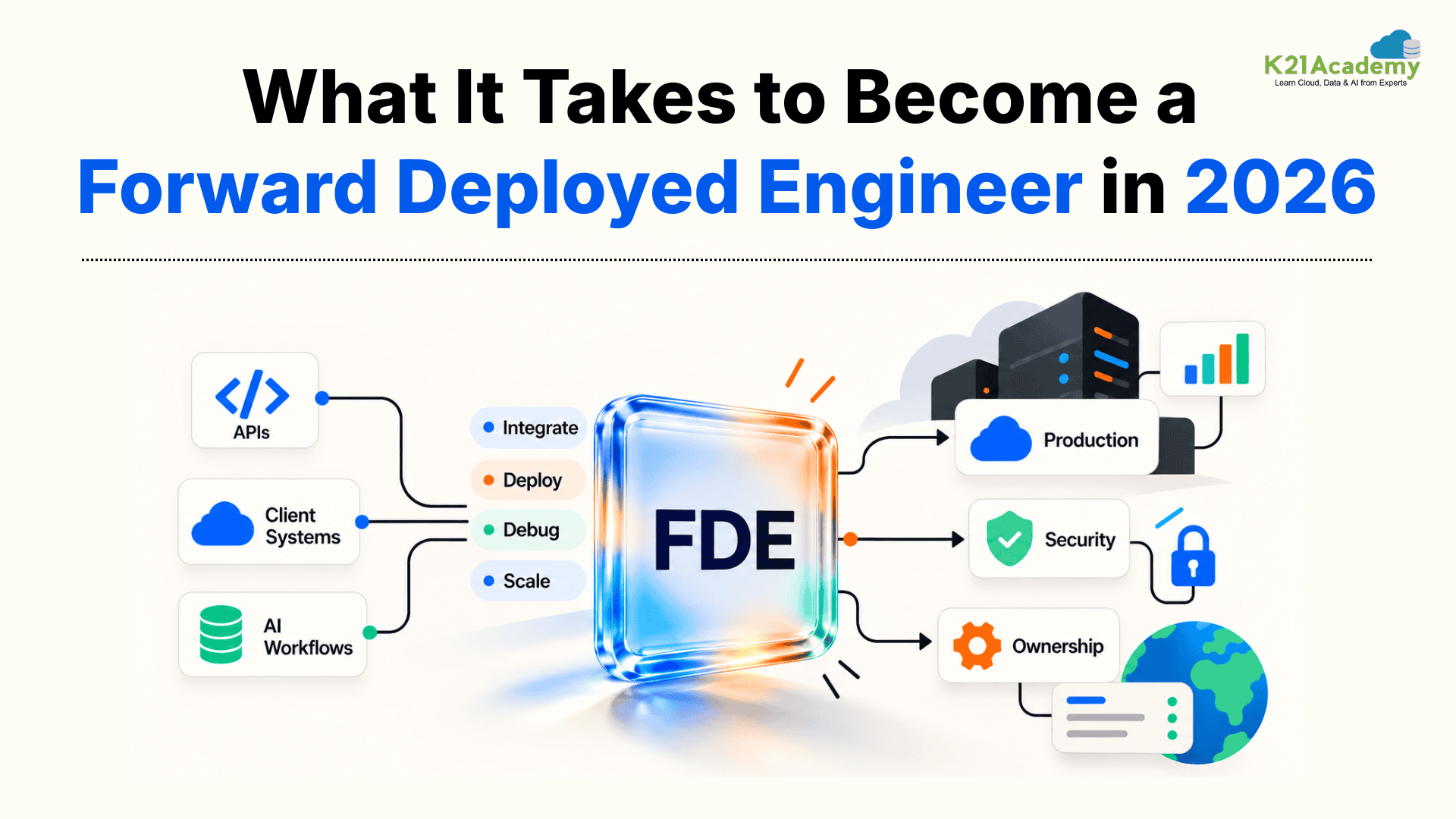




Building stunning prototypes has become easier thanks to AI. Getting those systems to function in an actual business with complex data, historical apps, security constraints, current workflows, and users who genuinely need to rely on them is more difficult. And that is where Forward Deployed Engineer (FDEs) comes in.
In 2026, businesses developing AI products will be seeking engineers with more skills than just writing code. They require individuals who can comprehend a customer’s issue, provide a solution, integrate several systems, implement it in production, and collaborate closely with users. The Forward Deployed Engineer position differs from a typical software engineering position because of this combination.
What exactly does an FDE perform, then? What skills are required? Is there a certain certification? And what is your earning potential?
What Is a Forward Deployed Engineer?
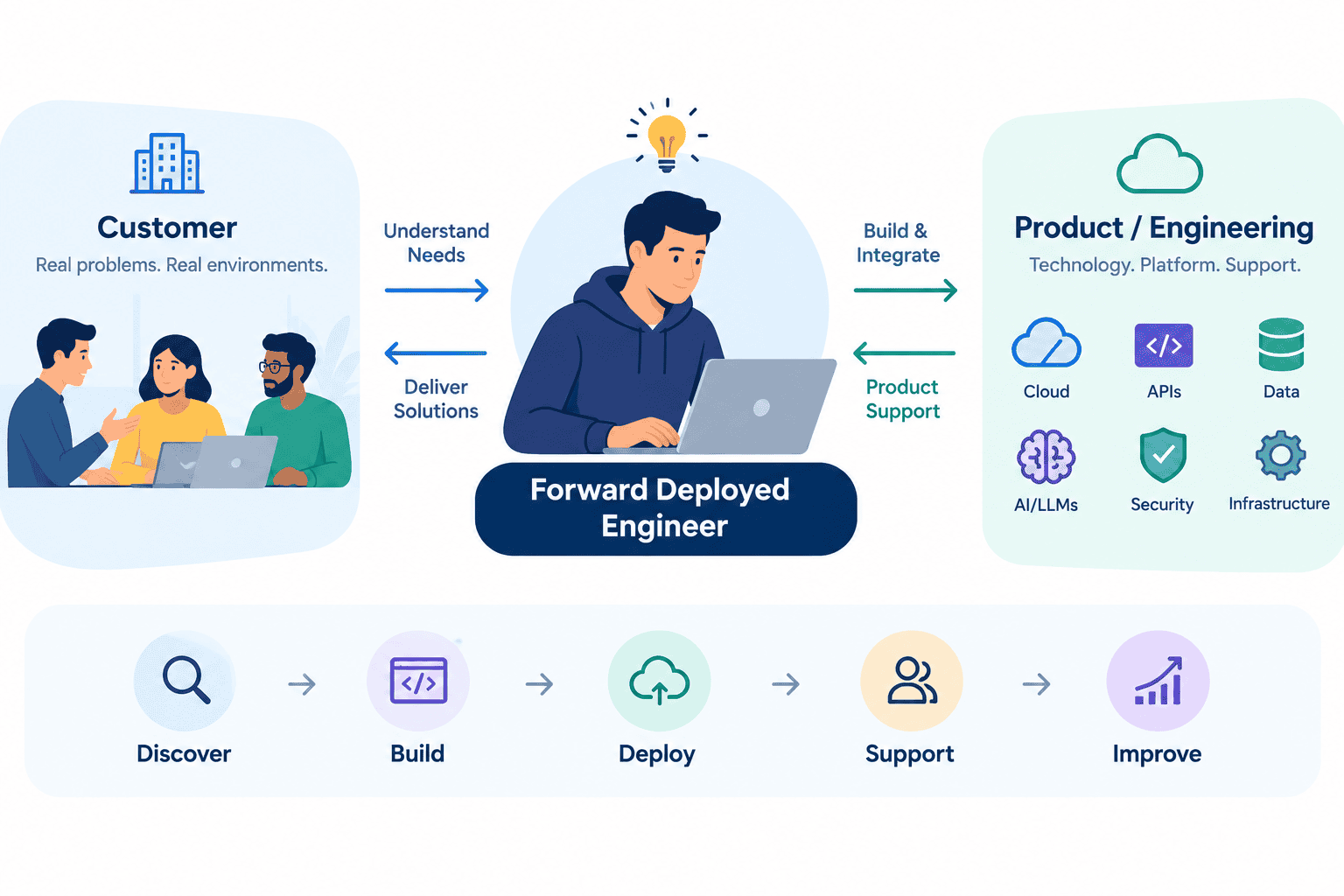
A Forward Deployed Engineer (FDE) is a technical professional who works closely with customers to turn their business or operational problems into working software and AI solutions.
Think of an FDE as the bridge between:
Customer problem → Engineering → Product → Production deployment
An FDE works directly with customers to understand their environment and adapt technology to solve genuine problems, as opposed to creating a generic product and waiting for customers to figure out how to utilise it. For example, imagine a company wants to use an AI system to investigate failed software deployments. The FDE might:
- Understand the current methods used by the engineering team to investigate incidents
- Link Jenkins, Git, logs, and monitoring tools to the AI system.
- Create the necessary integrations and APIs.
- Create the workflow.
- Test the AI’s responses
When the code functions, the task continues. Until the solution functions in the customer’s actual environment, the FDE remains involved.
The current FDE positions at OpenAI are similar in that they involve engineers working closely with customer teams on discovery, technical scoping, system design, implementation, and production deployment.
Why Is the FDE Role Becoming More Important in 2026?
The rise of generative AI and agentic AI is one of the biggest reasons. Companies don’t just want access to an LLM. They want AI connected to their:
- Internal applications
- Databases
- APIs
- Documents
- Cloud infrastructure
- Security systems
- Business workflows
- Monitoring platforms
Additionally, the environment of each organisation varies slightly. Before it can function properly in production, a model that performs flawlessly in a demo can need extensive engineering. As a result, there is a gap between AI’s potential and practical application. Forward-deployed engineers help close that gap. Additionally, the job is changing. Software engineering, AI integration, systems thinking, customer discovery, and deployment are increasingly combined in FDE roles today. For instance, OpenAI now lists FDE positions in government, healthcare, law, and several other countries.
What Does a Forward Deployed Engineer Do?
A Forward Deployed Engineer (FDE) works closely with customers to understand their problems, build technical solutions, and get those solutions into production. The role typically involves:
1. Understand Customer Problems: Work directly with customers to understand their goals, workflows, challenges, data, and technical constraints.
2. Turn Problems Into Solutions: Translate business requirements into practical technical solutions using software, APIs, cloud services, AI, and other technologies.
3. Build and Test Prototypes: Quickly create proof-of-concepts to validate whether a solution works before investing in a full production system.
4. Build Production Systems: Turn successful prototypes into reliable, secure, and scalable applications that customers can use in real-world environments.
5. Integrate Existing Systems: Connect new solutions with the customer’s existing tools, APIs, databases, cloud infrastructure, and internal applications.
6. Work Directly With Customers: Run technical discussions, demonstrate solutions, troubleshoot issues, gather feedback, and work alongside customer engineering teams.
7. Own the Solution End to End: Think beyond simply making a demo work. FDEs consider security, reliability, scalability, monitoring, cost, and ongoing maintenance.
8. Share Customer Feedback: Bring real-world customer insights back to engineering and product teams to improve the product and identify new use cases.
Forward Deployed Engineer vs Software Engineer
The two roles overlap heavily, but their focus is different.
| Area | Software Engineer | Forward Deployed Engineer |
|---|---|---|
| Primary Focus | Build and maintain products. | Solve customer problems. |
| Customer Interaction | Usually limited | High |
| Coding | High | High |
| Requirements | Often defined by product or engineering teams | Often discovered directly with customers |
| Environment | Internal or product environment | Customer and company environments |
| Problem Definition | Usually clearer | Often ambiguous |
| Deployment | Usually handled by the product/team | Often owns or drives deployment |
| Travel | Usually limited | May involve customer-site travel |
| Success Metric | Product and technical outcomes | Customer adoption and measurable impact |
This doesn’t mean an FDE is “less technical”. In many cases, the FDE has to be technical & customer-facing at the same time.
Skills You Need to Become an FDE in 2026
A forward-deployed engineer needs a T-shaped skill set: strong expertise in one technical area, combined with enough breadth to work across the entire solution.
1. Software Engineering
Strong programming fundamentals are essential. Python, JavaScript/TypeScript, Java, or Go can be useful, along with coding, testing, debugging, and backend development.
2. APIs & System Integration
FDEs regularly connect different systems. Understanding REST APIs, authentication, webhooks, service integration, and error handling is important.
3. Cloud & Infrastructure
Know at least one major cloud platform such as AWS, Azure, or Google Cloud. Containers, CI/CD, monitoring, Kubernetes, and infrastructure-as-code are also valuable.
Related Readings: Navigating the Cloud: A Guide to Selecting the Right Cloud Provider
4. Databases & Data
You should be comfortable with SQL, databases, data pipelines, APIs, and basic data modelling. For AI projects, understanding vector databases and data retrieval is also useful.
5. AI & LLMs
For AI-focused FDE roles, learn LLM APIs, prompt engineering, RAG, tool calling, AI agents, and evaluation. You should understand not just how to build AI applications, but how to measure their reliability, cost, and accuracy.
6. Security & Governance
Understand authentication, authorization, IAM, encryption, data privacy, access controls, logging, and AI guardrails. Enterprise solutions need security built in from the start.
7. System Design
Be able to design end-to-end solutions and make practical trade-offs around scalability, reliability, cost, latency, security, and maintainability.
8. Customer Communication
FDEs work directly with customers, so they need to explain technical concepts clearly, gather requirements, run discussions, demonstrate solutions, and communicate trade-offs.
9. Problem-Solving Under Ambiguity
Requirements are not always clearly defined. An FDE must be able to take a broad problem, ask the right questions, identify the real need, and turn it into a practical technical solution.
How Much Does a Forward Deployed Engineer Earn in 2026?
Geographical location, experience, company, technical depth, and equity all have a substantial impact on FDE salary. There isn’t a single, trustworthy global pay figure.
According to public predictions for 2026, senior/global-remote posts can reach ₹55–90 LPA or more, whereas experienced FDE roles are often estimated around ₹28–55 LPA. Instead of being standardised employer salary bands, these numbers represent third-party estimations.
For the US, compensation can be substantially higher, particularly at frontier AI companies. For instance, OpenAI currently lists a San Francisco FDE post with a base pay and equity of between $185,000 and $300,000.
| Region | Experience | Approximate Reported Range |
|---|---|---|
| India | Early Career | ₹18–28 LPA |
| India | 3–6 Years | ₹28–55 LPA |
| India | Senior / Global Roles | ₹55–90+ LPA |
| US | Senior FDE Roles | $185K–$300K+ base at some AI companies |
| UK / Europe | Varies | Depends heavily on company and location |
What Backgrounds Can Transition Into FDE?
You don’t need to start your career as an FDE. Several technical backgrounds can transition well into the role:
| Background | Useful Existing Skills | What to Add |
|---|---|---|
| Software Engineer | Coding, backend, system design | Customer interaction, deployment |
| DevOps / Cloud Engineer | Cloud, CI/CD, infrastructure, automation | Application development, AI |
| Solutions Architect | Customer engagement, architecture, solution design | Hands-on coding and implementation |
| AI/ML Engineer | AI, ML, LLMs, data | Enterprise integration, production engineering |
| Startup Engineer | Broad technical skills, fast development, ownership | Enterprise systems and customer engagement |
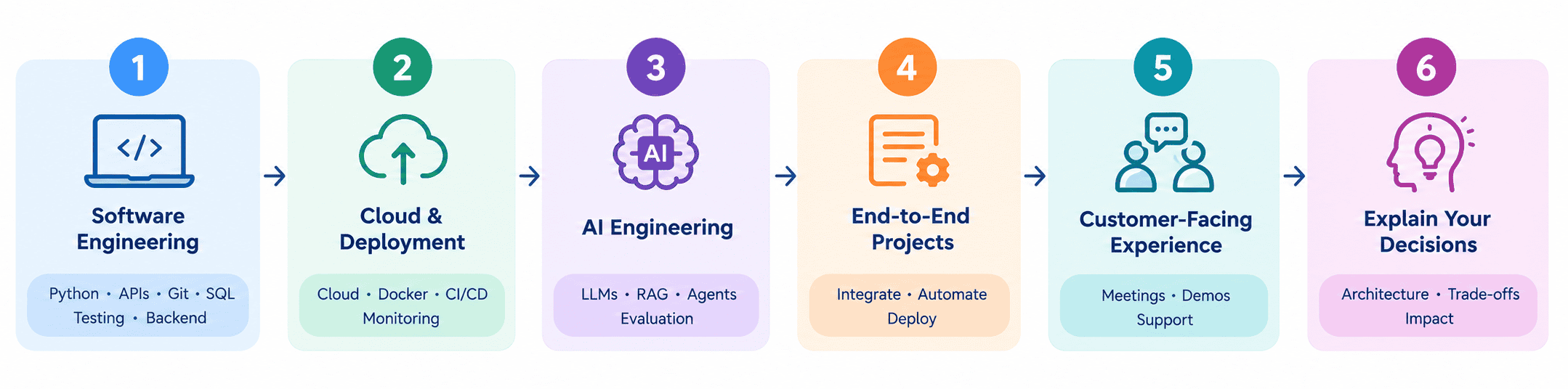
A Practical Roadmap to Become an FDE
Conclusion
The position of Forward Deployed Engineer involves more than just software engineering and customer meetings.
It is situated at the meeting point of:
AI, cloud computing, systems integration, software engineering, product thinking, and customer engineering
And for that reason, in 2026, the role is getting more and more important. A specific FDE degree is not required. It is not necessary to obtain ten certifications. You must show that you are capable of transforming a complex real-world issue into a dependable technical solution.
Start with solid engineering principles. Add AI and the cloud. Discover how systems work together. Create projects that function. Next, develop the communication and exploration abilities required to deal directly with clients.
Being familiar with every technology is not the aim. The goal is to become an engineer who can enter a new setting, comprehend the issue, determine what has to be constructed, and assist in getting it into production. That is the true essence of being a forward-deployed engineer.