

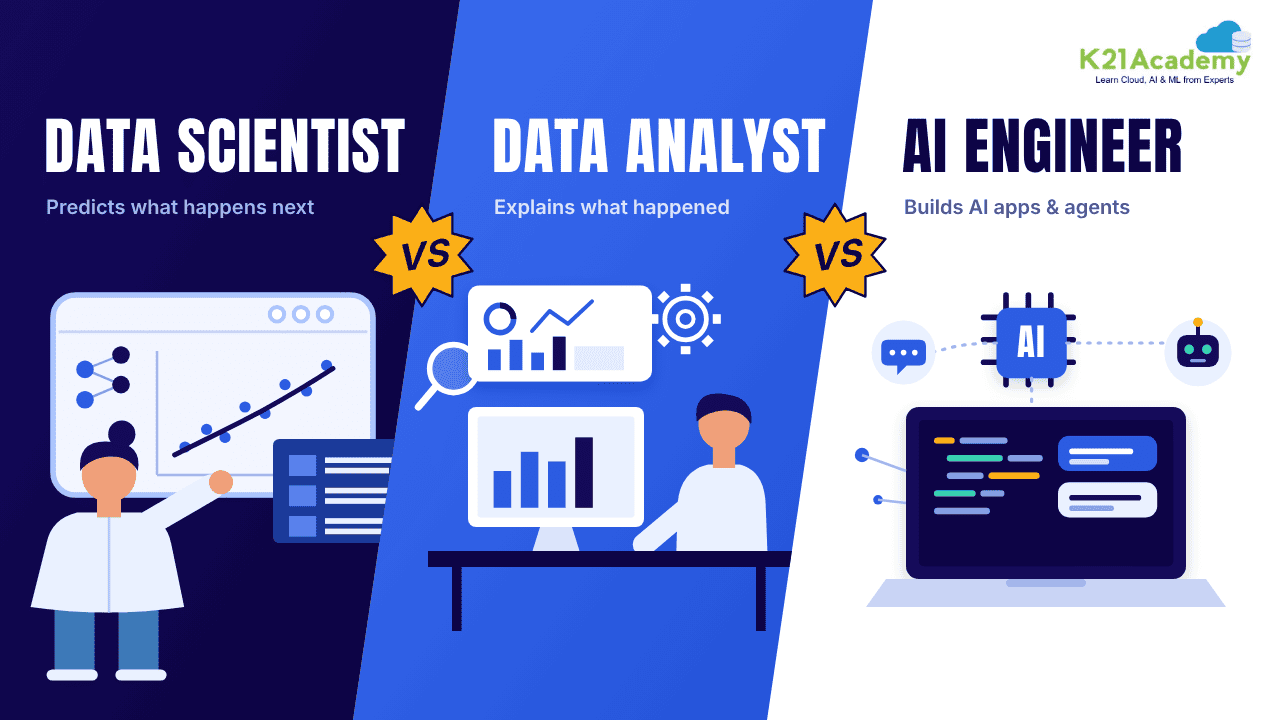




As organizations increasingly rely on data-driven decision-making and AI in 2026, the debate around data scientist vs data analyst now has a third role in the picture: the AI Engineer. All three roles work with data, but they solve very different problems, use different tools, and lead to different career paths.
In this article, we’ll break down these roles in detail, including responsibilities, tools, salaries, and real-world use cases, so you can choose the right career path with confidence.
Quick Answer:
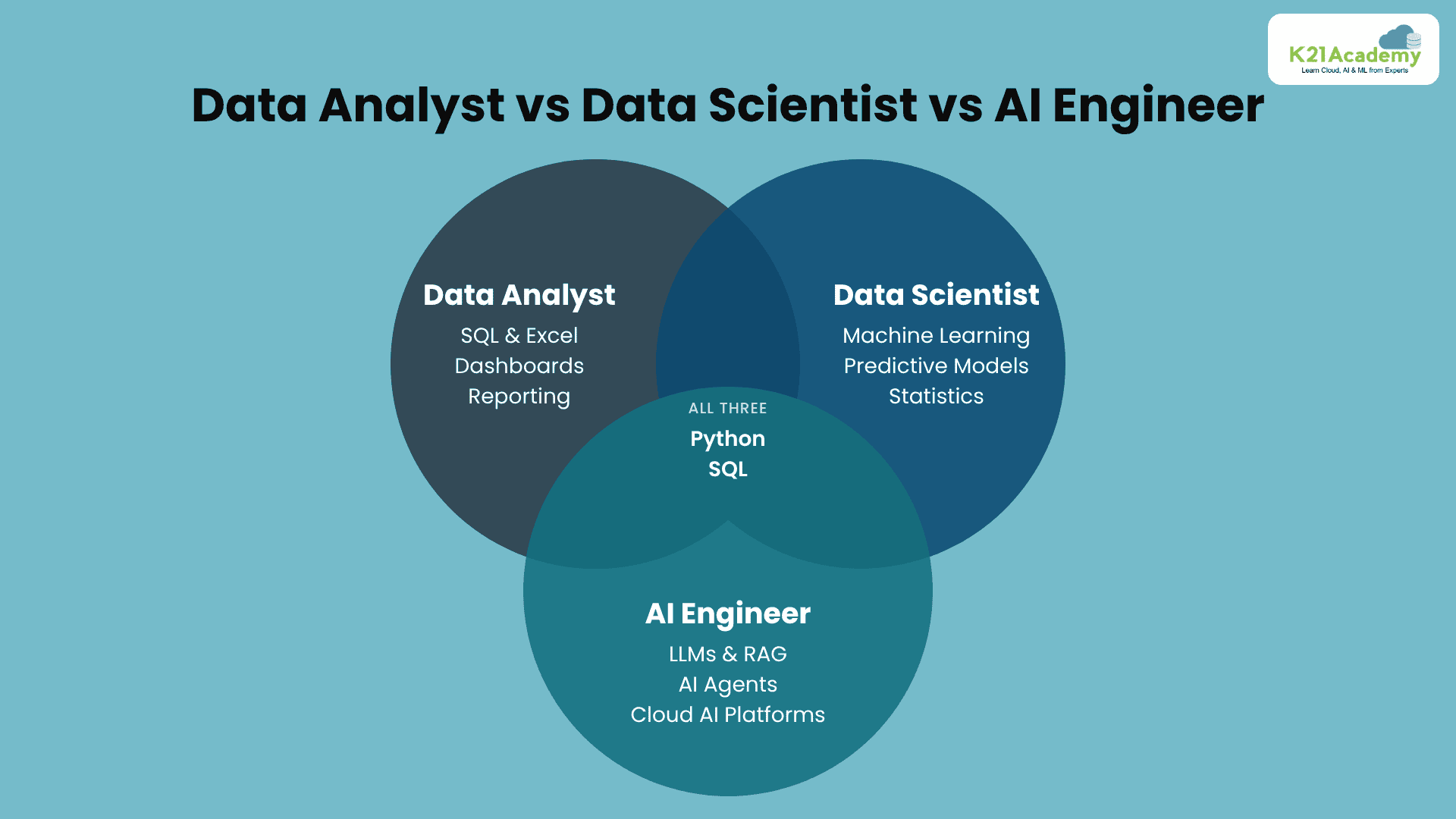
- Data Analyst: explains what happened using SQL, dashboards, and reports
- Data Scientist: predicts what will happen using Python and machine learning
- AI Engineer: builds AI-powered apps and agents that put models to work

What Is a Data Scientist?
A data scientist is a professional who uses statistics, machine learning, programming, and data analysis techniques to extract insights from complex data and build predictive models. The data scientist role focuses on solving business problems using advanced analytics, automation, and data-driven decision-making.
As organizations increasingly adopt AI and big data technologies, the demand for skilled data scientists continues to grow across industries such as healthcare, finance, retail, cybersecurity, and cloud computing. A modern data scientist not only analyzes data but also predicts trends, identifies patterns, and develops intelligent systems that support strategic business decisions.
Key Responsibilities & Data Scientist Skills
-
Building predictive machine learning models
-
Analyzing structured and unstructured datasets
-
Using Python, SQL, and visualization tools for analysis
-
Applying statistical methods and AI techniques
-
Communicating business insights through dashboards and reports
Important Data Scientist Skills
Common data scientist skills include:
-
Python or R programming
-
Machine learning and AI concepts
-
Statistics and probability
-
SQL and database management
How a Data Scientist Differs from a Data Analyst
While both roles work with data, a data scientist typically focuses more on predictive analytics, machine learning, and automation. In comparison, Data Analysts mainly interpret historical data and create reports to support business decisions.
What Is a Data Analyst?
A data analyst is a professional who collects, processes, and interprets data to help organizations make informed business decisions. The data analyst role mainly focuses on analyzing historical data, identifying trends, and creating reports or dashboards that support operational and strategic planning.
As businesses increasingly rely on data-driven insights in 2026, the demand for skilled data analysts continues to rise across industries such as finance, healthcare, marketing, retail, and technology. A modern data analyst helps organizations improve efficiency, track performance, and uncover actionable business insights using data visualization and analytical tools.
Key Responsibilities & Data Analyst Skills
-
Cleaning and organizing raw datasets
-
Creating dashboards and business reports
-
Analyzing trends and performance metrics
-
Using SQL, Excel, and BI tools for analysis
-
Supporting decision-making with actionable insights
Important Data Analyst Skills
Common data analyst skills include:
-
SQL and database querying
-
Excel and spreadsheet analysis
-
Data visualization tools like Power BI or Tableau
-
Basic statistics and reporting
-
Business intelligence and analytical thinking
How a Data Analyst Differs from a Data Scientist
While both roles work with data, a data analyst primarily focuses on reporting, visualization, and historical trend analysis. In comparison, Data Scientists typically use machine learning, predictive analytics, and advanced programming to build intelligent data-driven models and forecast future outcomes.
What Is an AI Engineer?
An AI Engineer designs, builds, and deploys AI-powered applications and agents using machine learning models, large language models (LLMs), and cloud AI platforms. Instead of building every model from scratch, an AI Engineer connects models to real data and real business workflows, turning AI into products that people can use.
Demand for AI Engineers is growing as businesses adopt generative AI across industries. The World Economic Forum’s Future of Jobs Report 2025 lists AI and machine learning specialists among the three fastest-growing roles to 2030.
Key Responsibilities & AI Engineer Skills
An AI Engineer is typically responsible for:
- Building generative AI applications such as chatbots and copilots
- Developing AI agents that automate business workflows
- Connecting LLMs to company data using RAG
- Integrating models into applications through APIs
- Deploying and monitoring AI solutions on cloud platforms
Important AI Engineer Skills
- Python and API development
- LLMs, prompt design, and RAG
- AI agent frameworks such as LangChain
- Cloud AI platforms such as Microsoft Foundry and Amazon Bedrock
- CI/CD, deployment, and monitoring basics
Python, LLMs, RAG, generative AI, and APIs are core AI Engineer skills.
How an AI Engineer Differs from a Data Scientist and a Data Analyst
Data Analysts focus on reporting and historical trends. Data Scientists focus on predictive models and machine learning. AI Engineers focus on turning models into working applications and agents, with more emphasis on coding, deployment, and integration.
Roles of Data Scientists, Data Analysts, and AI Engineers
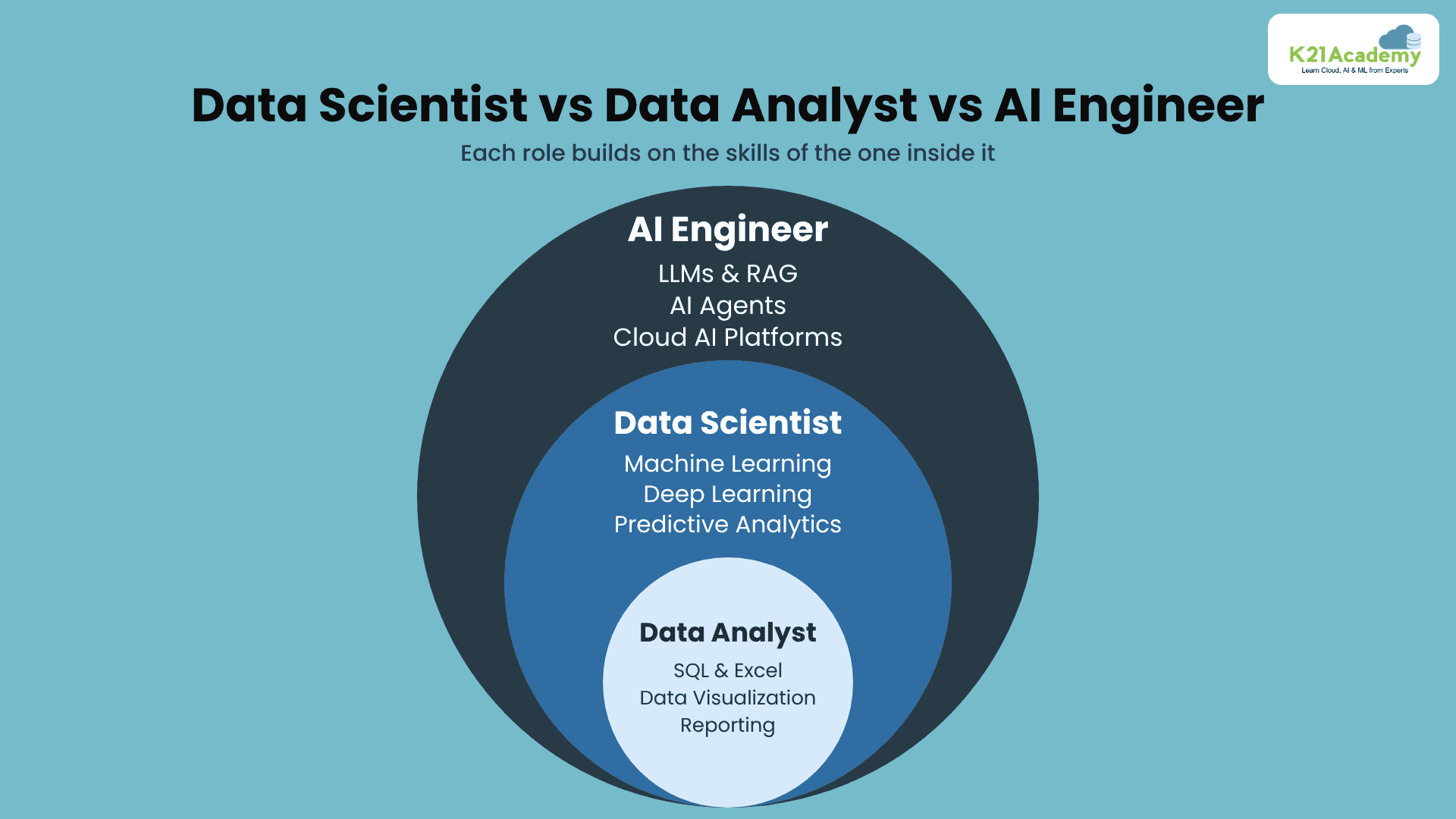
Data Scientist: A data scientist uses past data patterns to predict future trends, poses new questions, and tackles business problems that offer the most value.
Data Analyst: A data analyst extracts insights from data, answers specific questions already posed, and handles daily analytical tasks.
AI Engineer: An AI engineer turns models into working products, building applications and agents, connecting models to company data, and deploying them so businesses can use them every day.
This distinction clarifies how each role approaches data, with data scientists focusing on forecasting and innovative problem-solving, while data analysts concentrate on current data insights and routine analysis. AI engineers focus on building and deploying AI-powered solutions.
Key Differences Between Data Scientist, Data Analyst and AI Engineer
Understanding the difference between a data analyst, data scientist and AI engineer is important because all three roles work with data but solve different types of business problems. While Data Analysts mainly focus on interpreting historical data and creating reports, Data Scientists use advanced analytics, machine learning, and predictive modeling to forecast trends and automate decision-making. AI Engineers then take those models and turn them into working applications and agents that businesses can use every day.
| Feature | Data Analyst | Data Scientist | AI Engineer |
|---|---|---|---|
| Primary Focus | Data interpretation & reporting | Predictive analytics & AI models | AI apps & agents |
| Goal | Solve current business problems | Predict future outcomes | Turn models into working products |
| Tools Used | Excel, SQL, Power BI, Tableau | Python, R, ML frameworks | Python, model APIs, RAG & agent frameworks |
| Programming Requirement | Moderate | High | High |
| Machine Learning Usage | Limited | Extensive | Applied |
| Data Type | Mostly structured data | Structured & unstructured data | Structured & unstructured data |
| Business Role | Reporting & visualization | Advanced analytics & automation | AI product development & automation |
| Salary Range | Generally lower | Generally higher | Generally higher |
Real-World Use Cases
| Scenario | Better Role |
|---|---|
| Creating sales dashboards | Data Analyst |
| Forecasting customer churn | Data Scientist |
| Monthly business reporting | Data Analyst |
| Building recommendation systems | Data Scientist |
| AI agent that automates support tickets | AI Engineer |
| Tracking marketing KPIs | Data Analyst |
| Fraud detection using ML | Data Scientist |
| AI chatbot answering from company documents | AI Engineer |
When to Choose Which Career
Choose a Data Analyst role if you:
-
Enjoy working with reports and dashboards
-
Prefer business intelligence and visualization
-
Want a less programming-heavy role
-
Like solving operational business problems
Choose a Data Scientist role if you:
-
Enjoy machine learning and AI
-
Prefer advanced programming and modeling
-
Want to work on predictive systems
-
Are interested in automation and big data
Choose AI Engineer if you:
- Like turning ideas into working AI products
- Enjoy coding more than reporting
- Want to build chatbots, copilots, and agents
All three careers are highly valuable in 2026, but the right choice depends on your interests, technical background, and long-term career goals.
Data Scientist vs Data Analyst vs AI Engineer: Skills Comparison
Data Scientists, Data Analysts, and AI Engineers all work with data, but the required technical expertise, tools, and problem-solving approaches are different. While data analyst skills focus more on reporting, visualization, and business intelligence, data scientist skills involve machine learning, predictive analytics, AI, and advanced programming. AI engineer skills focus on building and deploying AI-powered applications and agents using LLMs, RAG, APIs, and cloud AI platforms.

In 2026, modern data roles are also evolving with Generative AI, cloud analytics platforms, and LLM-based workflows becoming increasingly important across industries.
| Feature | Data Analyst Skills | Data Scientist Skills | AI Engineer Skills |
|---|---|---|---|
| Core Focus | Reporting & business insights | Predictive modeling & AI | AI apps, agents & integration |
| Programming | SQL, Excel, basic Python | Advanced Python, R, Scala | Python, APIs, SQL |
| Visualization Tools | Power BI, Tableau, Excel | Tableau, Matplotlib, Seaborn | Basic (monitoring dashboards) |
| Machine Learning | Basic understanding | Advanced ML & Deep Learning | Applied ML, using & fine-tuning existing models |
| Cloud Platforms | Basic cloud analytics | AWS, Azure ML, Databricks | Microsoft Foundry, Amazon Bedrock, Azure, AWS |
| Big Data Tools | Limited usage | Hadoop, Spark, distributed systems | Limited |
| GenAI & LLM Skills | AI-assisted analytics | LLMs, prompt engineering, AI modeling | LLMs, RAG, agents, prompt design |
| Statistical Knowledge | Moderate | Advanced | Basic to moderate |
Real-World Skill Usage
| Use Case | Better Fit |
|---|---|
| Sales dashboard creation | Data Analyst |
| RAG chatbots on company documents | AI Engineer |
| Predictive customer analytics | Data Scientist |
| KPI tracking & reporting | Data Analyst |
| AI agents that automate workflows | AI Engineer |
| AI recommendation systems | Data Scientist |
| Business intelligence reporting | Data Analyst |
| AI-powered customer assistants | AI Engineer |
| LLM & GenAI model workflows | Data Scientist |
2026 Trending Skills
Modern data science skills comparison discussions now include:
-
Generative AI workflows
-
LLM integration
-
Cloud-based ML platforms
-
AI-assisted analytics tools
- AI agents
- Retrieval-augmented generation (RAG)
As AI adoption grows, Data Scientists are increasingly expected to work with machine learning pipelines and GenAI systems, while Data Analysts are using AI-powered BI tools to improve reporting and business intelligence workflows.
Data Scientist vs Data Analyst vs AI Engineer: Salary Comparison [2026]
Data scientists generally earn more than data analysts, and the gap reflects demand for AI, machine learning, and cloud skills. In the US, the Bureau of Labor Statistics reports a median annual wage of $120,230 for data scientists (May 2025).
The BLS does not track data analysts or AI engineers as separate jobs, so the closest official categories are operations research analysts ($88,940) and computer and information research scientists ($140,300), the group whose expertise the BLS says is needed to create new AI technologies. Pay also varies by country, experience, employer, and skills, so treat these figures as benchmarks, not exact numbers.
| Feature | Data Analyst | Data Scientist | AI Engineer |
|---|---|---|---|
| Median annual pay | $88,940 | $120,230 | $140,300 |
| Projected job growth | 12% | 35% | 22% |
| Technical Complexity | Moderate | High | High |
| AI & ML Requirement | Limited | Extensive | Applied, strong LLM focus |
| Cloud & Big Data Skills | Optional | Often required | Cloud required |
| GenAI & LLM Skills Impact | Helpful | Important | Core requirement |
Why Data Scientists Typically Earn More
A data scientist salary is usually higher because the role requires:
-
Advanced programming expertise
-
Machine learning and AI knowledge
-
Statistical modeling skills
-
Cloud ML platform experience
-
Predictive analytics capabilities
Organizations are willing to pay premium salaries for professionals who can build AI-driven systems, automate workflows, and generate predictive business insights.
Why AI Engineers Typically Earn Well
An AI engineer salary is usually in the same range as, or higher than, a data scientist salary because the role requires:
- Strong Python and API development skills
- LLM, prompt design, and RAG knowledge
- AI agent development experience
- Cloud AI platform experience, such as Microsoft Foundry and Amazon Bedrock
- Deployment and monitoring skills
Organizations value professionals who can turn AI models into reliable applications and agents that people use every day.
Data Analyst Salary Growth in 2026
Although Data Analysts generally earn less than Data Scientists, demand for skilled analysts remains strong. Companies increasingly rely on analysts for:
-
Business intelligence reporting
-
KPI tracking
-
Dashboard creation
-
Operational decision-making
-
AI-assisted analytics
Professionals with SQL, Power BI, Tableau, and cloud analytics skills can open the door to higher-paying roles.
AI Engineer Salary Outlook in 2026
Demand for AI Engineers is growing as businesses move generative AI from pilots into real products. The World Economic Forum’s Future of Jobs Report 2025 places AI and machine learning specialists among the three fastest-growing roles to 2030, and the US Bureau of Labor Statistics projects 22% growth from 2025 to 2035 for computer and information research scientists, the closest official category. Companies increasingly look for AI Engineers to build:
- Generative AI assistants and copilots
- AI agents that automate workflows
- Search and Q&A over company documents using RAG
- AI features inside existing applications
Professionals with Python, API, RAG, and cloud AI platform skills are well placed for these roles.
Real-World Career Scenarios
| Career Goal | Better Choice |
|---|---|
| Faster entry into tech careers | Data Analyst |
| Building AI apps and agents | AI Engineer |
| AI & machine learning careers | Data Scientist |
| Business reporting & dashboards | Data Analyst |
| Working with LLMs and generative AI | AI Engineer |
| Predictive analytics & automation | Data Scientist |
| Lower coding requirement | Data Analyst |
| Deploying and monitoring AI on cloud platforms | AI Engineer |
| Higher long-term salary potential | Data Scientist |
Factors Affecting Salary in 2026
Both data analyst salary and data scientist salary depend on:
-
Years of experience
-
Industry specialization
-
Cloud certifications
-
AI and GenAI expertise
-
Geographic location
-
Portfolio projects and practical skills
Professionals with cloud, machine learning, and Generative AI experience are currently among the highest-paid candidates in the data industry.
Roles at Top Companies (Amazon, Microsoft, IBM & More)
Top technology companies increasingly differentiate between Data Analysts, Data Scientists, and AI Engineers based on business impact, AI capabilities, and technical complexity. In 2026, companies such as Amazon, Microsoft, IBM, Apple, Intel, and Accenture are actively hiring professionals for specialized analytics, AI, and machine learning roles.
Understanding how a data scientist at amazon differs from a data analyst at microsoft helps learners understand real industry expectations, required skills, and long-term career growth opportunities.
| Company | Data Analyst Focus | Data Scientist Focus | AI Engineer Focus |
|---|---|---|---|
| Amazon | Business metrics & operational insights | ML models & predictive systems | Generative AI apps & agents on Amazon Bedrock |
| Microsoft | Product analytics & dashboards | AI systems & automation | AI apps & agents on Microsoft Foundry |
| IBM | Reporting & client analytics | Advanced ML & AI modeling | Enterprise AI agents & assistants on IBM watsonx |
| Apple | KPI dashboards & governance | AI optimization & Siri analytics | On-device AI features using Apple’s Foundation Models framework |
| Intel | Data integration & business analysis | AI & deep learning solutions | Optimized AI inference & deployment with OpenVINO |
| Accenture | Business reporting & stakeholder analysis | Predictive analytics & AI models | Enterprise AI agent solutions on Accenture AI Refinery |
Data Scientist at Amazon
A Data Scientist at Amazon typically works on machine learning models, predictive analytics, recommendation systems, and AI-driven business optimization. Responsibilities often include:
-
Handling large datasets
-
Improving ML model performance
-
Developing predictive algorithms
-
Building intelligent automation systems
Amazon Data Scientists frequently collaborate with AI, cloud, and engineering teams to optimize customer experience and operational efficiency.
Data Analyst at Microsoft
A Data Analyst at Microsoft mainly focuses on business intelligence, reporting, customer analytics, and visualization workflows. Key responsibilities include:
-
Creating data-driven reports
-
Supporting customer engagement analysis
-
Translating business requirements into analytical projects
-
Building dashboards and visualizations
Microsoft Analysts often work closely with product, operations, and customer success teams to improve decision-making processes.
IBM Data Scientist Roles
IBM Data Scientists typically focus on:
-
AI and machine learning solutions
-
Statistical modeling
-
Data cleansing and automation
-
Large-scale enterprise analytics
These roles often require strong expertise in Python, SQL, cloud AI systems, and advanced analytics.
AI Engineer Roles
AI Engineers at technology and consulting companies typically work on:
- Generative AI assistants and copilots
- AI agents that automate workflows
- Search and Q&A over company documents using RAG
- Deploying and monitoring AI on cloud platforms
Strong Python, API, and cloud skills are usually required.
Apple & Intel Data Roles
At companies like Apple and Intel, Data Scientists increasingly work on:
-
AI-driven personalization
-
Deep learning systems
-
NLP and voice technologies
-
Large-scale product analytics
Meanwhile, Data Analysts support:
-
KPI tracking
-
Reporting systems
-
Dashboard development
-
Cross-functional business insights
2026 Industry Trend
Modern data scientist roles at companies are evolving rapidly with:
-
Generative AI integration
-
LLM-based analytics workflows
-
Cloud AI platforms
-
Real-time business intelligence
-
AI-assisted decision systems
Companies increasingly expect Data Scientists to understand:
-
Machine learning pipelines
-
Cloud ML platforms like AWS & Azure
-
Prompt engineering and GenAI workflows
-
Predictive AI systems
At the same time, Data Analysts are expected to work with:
-
AI-powered BI tools
-
Advanced dashboarding platforms
-
SQL and cloud analytics solutions
-
Business-focused automation systems
Which Role Fits Better at Top Companies?
Choose Data Analyst roles if you:
-
Prefer business reporting and visualization
-
Enjoy working with dashboards and KPIs
-
Want less ML-heavy responsibilities
Choose Data Scientist roles if you:
-
Want to work on AI and machine learning
-
Enjoy predictive modeling and automation
-
Prefer solving complex data-driven problems
Choose AI Engineer roles if you:
- Enjoy building AI products and agents
- Prefer coding and deployment over reporting
- Want to work with LLMs and cloud AI platforms
As enterprise AI adoption continues growing in 2026, all roles remain highly valuable, but Data Scientist positions generally require deeper technical expertise and broader AI-related capabilities.
Data Scientist vs Data Analyst vs AI Engineer: What Does the Future Hold?
The future for data scientists, data analysts, and AI engineers looks promising, as the demand for data-driven decision-making and AI-powered solutions continues to grow.
Data Analysts will continue to play a crucial role in interpreting existing data to provide actionable insights. Their ability to analyze trends and create detailed reports will remain essential for businesses looking to make informed decisions quickly. With the increasing volume of data, data analysts will need to enhance their skills in data visualization and automation tools to handle complex datasets efficiently. AI-assisted BI tools can now answer questions in plain language, so analysts will spend less time building routine reports and more time checking AI outputs and explaining results to the business.
Data Scientists, on the other hand, will be at the forefront of innovation. They will not only analyze data but also predict future trends and develop new models and algorithms. Their role will expand as they tackle more complex and unstructured data, leveraging machine learning and artificial intelligence to uncover deeper insights. The need for data scientists to communicate their findings effectively to both technical and non-technical stakeholders will also become more critical.
AI Engineers will be the ones turning AI into everyday products. They will take models, whether built by data scientists or available through cloud AI platforms, and turn them into reliable applications and agents such as chatbots, copilots, and document assistants. Their role will grow as businesses move generative AI from pilots into real products, and the World Economic Forum’s Future of Jobs Report 2025 places AI and machine learning specialists among the three fastest-growing roles to 2030. Strong skills in cloud AI platforms, deployment, and monitoring will help them keep these systems reliable at scale.

In summary:
- Data Analysts will focus on improving their data manipulation and visualization skills.
- Data Scientists will drive innovation through advanced analytics and predictive modeling.
- AI Engineers will drive adoption by turning models into reliable applications and agents.
All three roles are integral to the future of data science and AI, each contributing uniquely to the evolving landscape of data-driven business strategies.
Data Analyst vs Data Engineer vs Data Scientist
As organizations increasingly depend on data-driven systems in 2026, understanding the difference between Data Analysts, Data Engineers, and Data Scientists has become more important than ever. Although all three roles work with data, their responsibilities, tools, and career paths are very different.
The debate around data engineer vs data analyst often confuses beginners because both roles support data-driven decision-making. However, Data Engineers mainly build data infrastructure, Data Analysts interpret business data, and Data Scientists develop predictive AI and machine learning systems.
| Feature | Data Analyst | Data Engineer | Data Scientist |
|---|---|---|---|
| Primary Focus | Business insights & reporting | Data pipelines & infrastructure | AI, ML & predictive analytics |
| Main Goal | Analyze historical data | Build scalable data systems | Predict future outcomes |
| Core Tools | SQL, Excel, Power BI | Spark, Hadoop, Airflow | Python, ML frameworks |
| Programming Requirement | Moderate | High | High |
| Machine Learning Usage | Limited | Minimal | Extensive |
| Cloud Platform Usage | Moderate | Extensive | Extensive |
| Key Output | Dashboards & reports | Data architecture | Predictive models |
| Business Interaction | High | Moderate | High |
Why These Roles Matter
A Data Analyst helps businesses understand trends, KPIs, and operational performance through dashboards and reporting tools. These professionals are heavily involved in business intelligence and decision-making support.
A Data Engineer focuses on building and maintaining the infrastructure that stores, processes, and moves data across systems. Without Data Engineers, organizations would struggle to manage large-scale data pipelines efficiently.
A Data Scientist uses advanced analytics, machine learning, and AI techniques to build predictive systems, recommendation engines, and automation workflows.
Real-World Use Cases
| Scenario | Best Role |
|---|---|
| Building ETL pipelines | Data Engineer |
| Creating sales dashboards | Data Analyst |
| Fraud detection models | Data Scientist |
| Cloud data warehouse setup | Data Engineer |
| KPI & business reporting | Data Analyst |
| AI recommendation systems | Data Scientist |
Data Roles Comparison in 2026
Modern data roles comparison discussions now include:
-
Cloud data platforms
-
Generative AI workflows
-
LLM integration
-
Real-time analytics systems
-
Data governance and automation
Data Engineers increasingly work with:
-
AWS, Azure, and Google Cloud
-
Databricks and Snowflake
-
Streaming and distributed systems
Data Scientists focus more on:
-
AI and machine learning
-
Predictive analytics
-
LLMs and Generative AI
Data Analysts continue specializing in:
-
Business intelligence
-
Visualization platforms
-
AI-assisted reporting tools
When to Choose Which Career
Choose Data Analyst if you:
-
Enjoy dashboards and business insights
-
Prefer less coding-intensive work
-
Like reporting and visualization
Choose Data Engineer if you:
-
Enjoy backend systems and architecture
-
Like building scalable data pipelines
-
Prefer infrastructure-focused work
Choose Data Scientist if you:
-
Want to work in AI and machine learning
-
Enjoy advanced analytics and prediction
-
Prefer solving complex data problems
The data analyst vs data engineer vs data scientist comparison ultimately depends on your interests, technical strengths, and long-term career goals. All three roles remain highly in demand in 2026, especially as AI and cloud technologies continue expanding across industries.
How to Transition from Data Analyst to Data Scientist
The transition from data analyst to data scientist has become one of the most popular career upgrades in 2026 due to growing demand for AI, machine learning, and predictive analytics professionals. Since Data Analysts already work with SQL, dashboards, and business data, they often have a strong foundation for moving into Data Science roles.
The main difference is that Data Scientists require deeper expertise in programming, machine learning, statistics, and cloud AI platforms.
Prerequisites Before Starting
Before following this career path data science roadmap, learners should ideally have:
-
Basic SQL knowledge
-
Familiarity with Excel or BI tools
-
Basic Python understanding
-
Foundational statistics knowledge
-
Interest in AI and machine learning
Step 1: Learn Python for Data Science
Python is one of the most important skills required to become data scientist professionals.
Focus on learning:
-
Python basics
-
NumPy and Pandas
-
Data cleaning and preprocessing
-
Data visualization
Example Python Code
import pandas as pd

data = pd.read_csv("sales_data.csv")
print(data.head())
Step 2: Learn Statistics & Machine Learning
Data Scientists use advanced analytical techniques to predict trends and automate decisions.
Key topics:
-
Probability and statistics
-
Regression models
-
Classification algorithms
-
Clustering techniques
-
Model evaluation
Step 3: Build Machine Learning Projects
Hands-on projects are critical when moving from data analyst to data scientist.
Recommended beginner projects:
-
Customer churn prediction
-
Sales forecasting
-
Recommendation systems
-
Sentiment analysis
-
Fraud detection
Step 4: Learn Cloud & AI Platforms
Modern Data Scientists increasingly work with:
-
AWS
-
Azure Machine Learning
-
Google Cloud AI
-
Databricks
Cloud AI and GenAI skills are becoming major differentiators in 2026 hiring trends.
Step 5: Understand Generative AI & LLMs
Modern Data Science roles now involve:
-
Prompt engineering
-
LLM workflows
-
AI copilots
-
GenAI automation systems
Learning Generative AI concepts can significantly improve career opportunities.
Step 6: Build a Strong Portfolio
Recruiters increasingly prioritize practical projects over only certifications.
Your portfolio should include:
-
GitHub projects
-
ML model implementations
-
Dashboard projects
-
Cloud-based AI workflows
-
End-to-end analytics solutions
Step 7: Earn Relevant Certifications
Certifications help validate technical skills and improve credibility.
Popular certification paths include:
-
Azure AI & Data Science certifications
-
AWS Machine Learning certifications
-
Google Cloud Data certifications
-
Generative AI certifications
K21 certification training programs can help learners prepare for cloud AI, machine learning, and Data Science career transitions through hands-on labs and real-world projects.
Verification Checklist
You are likely ready for entry-level Data Scientist roles if you can:
-
Build ML models independently
-
Clean and preprocess datasets
-
Use Python and SQL confidently
-
Deploy basic AI workflows
-
Explain business insights using data
Common Issues & Troubleshooting
| Problem | Solution |
|---|---|
| Weak programming skills | Practice Python daily with projects |
| Difficulty understanding ML concepts | Focus on practical implementation first |
| Lack of portfolio projects | Build real-world end-to-end case studies |
Final Recommendation
The journey from data analyst to data scientist or AI engineer is highly achievable with consistent hands-on learning and project experience. Analysts already possess strong business and data interpretation skills. Adding machine learning, AI, and cloud expertise opens the door to data scientist roles, and adding RAG, AI agents, and cloud AI platform skills opens the door to AI engineer roles in 2026.
Conclusion
Understanding the differences between data scientists, data analysts, and AI engineers is crucial for anyone looking to enter the field of data and AI. While their roles overlap, each has unique responsibilities, skills, and impacts on business decision-making. Regardless of the path you choose, all three careers offer exciting opportunities in the evolving landscape of data science and AI.
FAQ
In the data scientist vs data analyst comparison, Data Analyst roles are generally considered easier to start because they require less advanced programming, mathematics, and machine learning knowledge. Data Scientists usually need deeper expertise in AI, predictive analytics, and cloud technologies, making the role more technically demanding than traditional Data Analyst positions.
Yes, many professionals successfully transition from data analyst to data scientist roles by learning Python, machine learning, statistics, and cloud AI platforms. Since Data Analysts already understand data visualization, SQL, and business insights, they often have a strong foundation for moving into advanced Data Science and AI-related careers. Others move into AI engineering by adding skills in RAG, AI agents, and cloud AI platforms.
In most markets, data scientists earn more than data analysts. In the US, the Bureau of Labor Statistics reports a median annual wage of $120,230 for data scientists (May 2025), compared with $88,940 for operations research analysts, the closest BLS category to data analysts, and $140,300 for computer and information research scientists, the closest BLS category to AI engineers. Pay also varies by country, industry, employer, and skills.
Most Data Analyst roles do not require advanced machine learning expertise, but having basic ML knowledge can improve career opportunities. Modern analytics teams increasingly use AI-assisted reporting and predictive insights, so understanding foundational machine learning concepts can help Data Analysts stay competitive in 2026 job markets.
A common career path starts with roles such as Junior Data Analyst or Business Analyst before progressing into Senior Analyst, Analytics Engineer, Data Scientist, or AI Engineer positions. Learning Python, cloud analytics, machine learning, RAG, and Generative AI skills can accelerate long-term career growth opportunities.
The choice depends on your interests and technical strengths. Choose Data Analyst if you prefer dashboards, business reporting, and visualization with moderate coding. Choose Data Scientist if you enjoy AI, machine learning, predictive analytics, and solving complex technical problems using advanced programming and mathematical models. Choose AI Engineer if you like turning ideas into working AI products and want to build chatbots, copilots, and agents.
Modern data scientist skills in 2026 include Python, machine learning, cloud ML platforms, Generative AI, prompt engineering, SQL, and statistical modeling. Many companies also expect Data Scientists to understand LLM workflows, automation systems, and AI deployment pipelines for enterprise-scale analytics and intelligent decision-making systems.
Important data analyst skills in 2026 include SQL, Excel, Power BI, Tableau, business intelligence, and data visualization. Many organizations also expect analysts to work with cloud analytics tools and AI-assisted reporting platforms to generate faster insights and improve data-driven business decision-making.
An AI Engineer builds and deploys AI-powered applications and agents using existing models, APIs, and cloud AI platforms such as Microsoft Foundry or Amazon Bedrock. A Data Scientist focuses more on analyzing data and building predictive models. The two roles overlap in Python and machine learning, but AI Engineers spend more time on application building, deployment, and integration.
The US Bureau of Labor Statistics projects 2025 to 2035 growth of 12% for operations research analysts (closest to data analysts), 35% for data scientists, and 22% for computer and information research scientists (closest to AI engineers), all much faster than the 3% average for all occupations. The World Economic Forum's Future of Jobs Report 2025 also places AI and machine learning specialists among the three fastest-growing roles to 2030.
Key AI engineer skills in 2026 include Python, API development, LLMs and prompt design, RAG, and AI agent frameworks such as LangChain. AI Engineers also work with cloud AI platforms such as Microsoft Foundry and Amazon Bedrock, and need deployment and monitoring basics to keep AI applications reliable. Is data analyst easier than data scientist?
Can a data analyst become a data scientist?
Which pays more: data analyst, data scientist, or AI engineer?
Do data analysts need machine learning skills?
What is the career path for a data analyst?
Data analyst vs data scientist vs AI engineer: which should I choose?
What skills are required for a data scientist in 2026?
What skills are required for a data analyst in 2026?
What does an AI engineer do, and how is it different from a data scientist?
Which role has better job growth: data analyst, data scientist, or AI engineer?
What skills are required for an AI engineer in 2026?
Next Task For You
Don’t miss our EXCLUSIVE Free Training on Generative AI on AWS Cloud! This session is perfect for those pursuing the AWS Certified AI Practitioner certification. Explore AI, ML, DL, & Generative AI in this interactive session.
Click the image below to secure your spot!