






AWS ML Data Engineering involves collecting, storing, processing, and transforming data to build scalable and reliable machine learning solutions. AWS provides services such as Amazon S3, AWS Glue, Amazon Kinesis, and Amazon SageMaker AI to support efficient data engineering workflows.
In this blog, you’ll explore key AWS services, including Amazon S3, AWS Glue, Amazon Kinesis, Amazon EMR, Amazon Athena, and Amazon SageMaker AI. You’ll also learn how these services support batch processing, real-time data streaming, and data transformation for machine learning applications.
Related Readings: Amazon SageMaker Built-in Algorithms
This blog post cover:
- Important Characteristics to Consider in A ML Solution
- Data Storage Options for Machine Learning On AWS
- Database Options for Machine Learning On AWS
- Streaming Data Ingestion Solutions on AWS for Machine Learning
- AWS Data Pipeline
- Data Transformation Overview on AWS for Machine Learning

Important Characteristics To Consider In A ML Solution
1) Data Characteristics
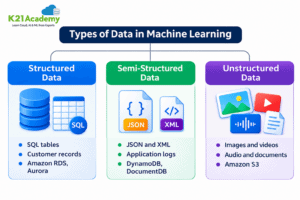
Data can be divided into three main categories: structured, semi-structured, and unstructured. Understanding these data types helps you choose the appropriate AWS storage and database services for machine learning tasks.
- Structured Data: Structured data follows a predefined schema and is usually organized into rows and columns. Examples include customer records, sales transactions, and financial data. AWS services such as Amazon RDS and Amazon Aurora can store and query structured data in relational databases.
- Semi-Structured Data: Semi-structured data does not follow a fixed relational schema but still contains organizational elements such as keys, tags, and metadata. Common examples include JSON, XML, and application logs. Amazon DynamoDB supports key-value and document data models, while Amazon DocumentDB is designed for JSON-like document workloads.
- Unstructured Data: Unstructured data does not follow a predefined tabular format. It includes images, videos, audio recordings, text documents, and other multimedia files. Amazon S3 is commonly used to store unstructured datasets for machine learning applications such as image classification, natural language processing, and computer vision.
Note : Do Check Our Blog Post on Modeling With AWS Machine Learning.
2) Batch And Stream Processing Characteristics
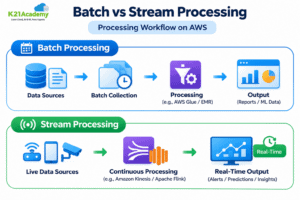
Batch and stream processing are two important methods of handling data in AWS machine learning workflows. Understanding their differences helps you select the right AWS services for data ingestion, processing, and analysis.
Batch Processing: Batch processing involves collecting and processing large volumes of data at scheduled intervals or when required.
Key characteristics of batch processing include:
- Processes large datasets in groups rather than individual records.
- Typically has processing latency ranging from minutes to hours, depending on the workload.
- Supports complex data transformations, historical analysis, and machine learning model training.
- Commonly used for ETL pipelines, sales reporting, and preparing datasets for machine learning.
- AWS services: AWS Glue, Amazon EMR, and AWS Batch support different types of batch processing workloads.
Stream Processing: Stream processing involves continuously ingesting and processing data as it arrives, enabling near-real-time or real-time analysis.
Key characteristics of stream processing include:
- Processes continuously arriving data in individual records or small batches.
- Supports low-latency processing, often within milliseconds to seconds, depending on the application.
- Enables real-time analytics, event processing, and continuous monitoring.
- Commonly used for fraud detection, IoT sensor monitoring, application logs, and real-time machine learning predictions.
- AWS services: Amazon Kinesis Data Streams, Amazon Data Firehose, and Amazon Managed Service for Apache Flink support streaming data workloads.
3) Application Characteristics
Application characteristics help determine which AWS storage, database, and processing services are suitable for machine learning workloads. Different applications have different requirements for data volume, performance, scalability, and availability.
Key characteristics to consider include:
Data Volume: Applications may process data ranging from gigabytes to petabytes, depending on their requirements. AWS services such as Amazon S3, Amazon RDS, and Amazon Redshift support different data storage and processing needs.
Scalability: Cloud applications need to handle changing workloads efficiently. AWS provides scalable services that can increase or decrease capacity based on application demand.
Performance and Latency: Different applications require different response times. Real-time machine learning applications may need low-latency predictions, while batch processing workloads can handle longer processing times.
Availability and Reliability: Applications should remain accessible and recover from failures. AWS services provide features such as Multi-AZ deployments, replication, and automated recovery to improve availability.
Security and Data Protection: Machine learning applications often process sensitive information. AWS services such as AWS Identity and Access Management (IAM), AWS Key Management Service (KMS), and Amazon S3 encryption help secure data and control access.
Cost Optimization: Selecting suitable storage and processing services helps manage costs. AWS offers different pricing and capacity options, including serverless and pay-as-you-go services, to support varying workloads.
Do Check : Our Blog Post On Amazon SageMaker.
Data Storage Options For Machine Learning On AWS
AWS offers different storage services for machine learning workloads. The choice depends on data volume, performance, scalability, and access requirements. In AWS ML Data Engineering, choosing the right storage service is essential for managing datasets used in model training and analytics.
1) Amazon S3
Amazon Simple Storage Service (S3) is a scalable object storage service used to store structured, semi-structured, and unstructured data for machine learning.
Key Features:
- Data Lakes: Stores large datasets for analytics and machine learning.
- ML Integration: Works with Amazon SageMaker AI, AWS Glue, and Amazon Athena.
- Security: Supports encryption and access controls.
- Cost Optimization: Offers different storage classes and lifecycle policies.
Amazon S3 plays an important role in AWS ML Data Engineering by providing scalable storage for training datasets, processed data, and machine learning artifacts.
To know more about Amazon S3 Bucket and Storage Classes click here.
2) Amazon EFS
Amazon Elastic File System (EFS) provides fully managed, scalable, shared file storage for AWS applications.
Key Features:
- Shared Access: Allows multiple EC2 instances to access the same files.
- Automatic Scaling: Adjusts storage capacity as data changes.
- ML Workloads: Supports shared datasets and data preprocessing.
- Security: Provides encryption and access controls.
3) Amazon EBS
Amazon Elastic Block Store (EBS) provides persistent block storage for Amazon EC2 instances.
Key Features:
- High Performance: Supports low-latency storage for demanding workloads.
- ML Workloads: Useful for data processing and model training on EC2.
- Storage Options: Offers volume types such as gp3 and io2.
- Data Protection: Supports encryption and snapshots.
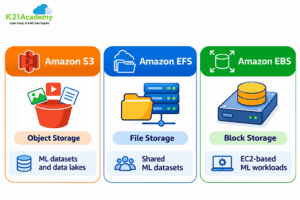
Amazon S3 vs Amazon EFS vs Amazon EBS
| Feature | Amazon S3 | Amazon EFS | Amazon EBS |
|---|---|---|---|
| Storage Type | Object storage | File storage | Block storage |
| Primary Use | Data lakes and ML datasets | Shared file systems | EC2 storage |
| Scalability | Automatically scalable | Automatically scalable | Configurable volume capacity |
| Data Access | APIs and object operations | Shared file-system access | Block-level access |
| ML Use Cases | Training datasets, data lakes, model artifacts | Shared datasets and ML environments | EC2-based processing and ML workloads |
| Management | Fully managed | Fully managed and serverless | Managed block storage |
Which AWS storage service should you choose?
- Choose Amazon S3 for storing large machine learning datasets, building data lakes, and integrating with AWS analytics and ML services.
- Choose Amazon EFS when multiple compute resources need shared access to files and datasets.
- Choose Amazon EBS when EC2-based machine learning applications require persistent block storage with predictable performance.
Database Options For Machine Learning On AWS
AWS provides managed database services that help store, process, and access data used in machine learning applications. Choosing the right database depends on data structure, scalability, performance requirements, and workload type. AWS ML Data Engineering relies on managed databases to store and access structured and semi-structured data for machine learning workloads.
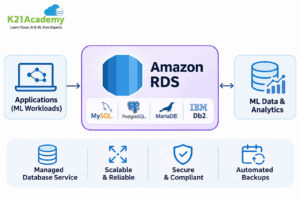
1) Amazon Relational Database Service (RDS)
Amazon RDS is a managed relational database service that simplifies database setup, operation, and scaling. It supports database engines including MySQL, PostgreSQL, MariaDB, Oracle, SQL Server, and Db2.
Key Features:
- Structured Data: Stores data in tables with defined relationships.
- Automation: Supports automated backups, maintenance, and monitoring.
- ML Workloads: Provides structured data for analysis and machine learning model training.
2) Amazon Aurora
Amazon Aurora is a fully managed relational database compatible with MySQL and PostgreSQL. It is designed for high performance, scalability, and availability.
Key Features:
- High Availability: Supports replication and automatic failover.
- Scalability: Allows compute and storage resources to scale according to workload requirements.
- ML Integration: Supports integration with Amazon SageMaker AI, Amazon Comprehend, and Amazon Bedrock in supported configurations.

Also Read : What is AWS Fargate?
3) Amazon DynamoDB
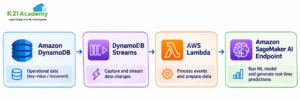
Amazon DynamoDB is a fully managed, serverless NoSQL database that supports key-value and document data models.
Key Features:
- Low Latency: Delivers single-digit millisecond performance for supported access patterns.
- Automatic Scaling: Adjusts capacity to accommodate changing workloads.
- ML Applications: Supports real-time applications that require fast access to operational data.
In AWS ML Data Engineering, Amazon DynamoDB supports applications that require low-latency access to operational data for real-time machine learning workflows.
To know more about AWS Database Services, click here.
Streaming Data Ingestion Solutions On AWS For Machine Learning
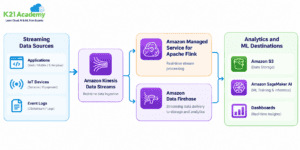
AWS provides streaming services to collect, process, and analyze data in real time. These services support machine learning applications such as fraud detection, IoT monitoring, and real-time analytics. Real-time data ingestion is an important part of AWS ML Data Engineering, enabling applications to process continuous data streams efficiently.
1) Amazon Kinesis Data Streams
Amazon Kinesis Data Streams is a scalable service for collecting and processing streaming data in real time.
Key Features:
- Real-Time Processing: Continuously ingests streaming data.
- Scalability: Supports on-demand and provisioned capacity modes.
- Data Retention: Stores records for 24 hours by default, extendable up to 365 days.
- ML Applications: Supports real-time analytics and machine learning workflows.
2) Amazon Data Firehose
Amazon Data Firehose is a fully managed service that captures, transforms, and delivers streaming data to supported destinations.
Key Features:
- Data Delivery: Sends streaming data to Amazon S3, Amazon Redshift, and Amazon OpenSearch Service.
- Automatic Scaling: Adjusts to changing data volumes.
- Data Transformation: Supports data transformation before delivery.
- ML Integration: Helps prepare streaming datasets for downstream machine learning workflows.
3) Amazon Managed Service for Apache Flink
Amazon Managed Service for Apache Flink enables real-time processing and analysis of streaming data using Apache Flink.
Key Features:
- Stream Processing: Processes continuous data streams with low latency.
- Multiple Languages: Supports Java, Python, SQL, and Scala.
- Scalability: Automatically scales application resources based on supported configurations.
- ML Applications: Supports real-time data processing for fraud detection and predictive analytics.
4) Amazon Kinesis Video Streams
Amazon Kinesis Video Streams securely ingests, stores, and processes video streams from connected devices.
Key Features:
- Video Ingestion: Collects video streams from cameras and other devices.
- Scalability: Supports streaming video from multiple connected devices.
- Security: Provides encryption and access controls.
- ML Applications: Supports video analytics, computer vision, and real-time monitoring.
Amazon Kinesis Data Streams – AWS Documentation
To know more about Amazon Kinesis Services, click here.
AWS ML Data Engineering: Pipeline Orchestration
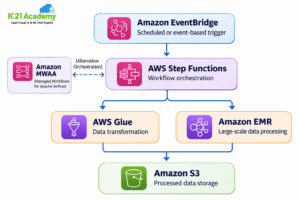
AWS ML Data Engineering uses services such as AWS Glue, AWS Step Functions, and Amazon EventBridge to automate data processing workflows. AWS provides services to automate, manage, and coordinate data pipelines for machine learning projects. These services help organizations collect, move, transform, and process large volumes of data efficiently while reducing manual effort.
Data pipeline orchestration ensures that different tasks run in the correct sequence, helping maintain reliable workflows for data analytics and machine learning applications.
Key AWS Services for Data Pipelines:
1) AWS Glue
AWS Glue is a fully managed, serverless data integration service that helps discover, prepare, clean, and transform data for analytics and machine learning.
It supports ETL (Extract, Transform, Load) processes and integrates with Amazon S3, Amazon Redshift, and other AWS services.
Key Features:
- Data Transformation: Converts raw data into useful formats for analysis and machine learning.
- Workflow Automation: Supports scheduled and event-driven ETL jobs.
- Data Catalog: Maintains metadata about datasets for easier discovery and management.
2) AWS Step Functions
AWS Step Functions is a serverless workflow orchestration service that coordinates multiple AWS services to automate complex data processing tasks.
It helps manage workflow execution, handle errors, and monitor the progress of data pipelines.
Key Features:
- Workflow Coordination: Connects services such as AWS Glue, AWS Lambda, and Amazon SageMaker AI.
- Error Handling: Supports retries and error-handling mechanisms.
- Monitoring: Tracks workflow execution and helps identify failures.
3) Amazon Managed Workflows for Apache Airflow (MWAA)
Amazon MWAA is a managed workflow orchestration service that uses Apache Airflow to schedule, monitor, and manage data processing pipelines.
It allows developers to define workflows using Python-based Directed Acyclic Graphs (DAGs).
Key Features:
- Workflow Scheduling: Automates recurring data processing tasks.
- Pipeline Management: Coordinates dependencies between different processing jobs.
- AWS Integration: Connects with AWS services such as Amazon S3, AWS Glue, and Amazon EMR.
4) Amazon EventBridge
Amazon EventBridge is a serverless event-driven service that helps automate workflows based on events and schedules.
It enables AWS services to communicate and trigger data processing tasks when specific events occur.
Key Features:
- Event-Driven Automation: Triggers workflows when new data arrives or specific events occur.
- Scheduled Processing: Supports recurring data processing tasks using EventBridge Scheduler.
- AWS Integration: Works with services such as AWS Lambda, AWS Step Functions, and AWS Glue.
Note: AWS Data Pipeline is no longer available to new customers. For modern data pipeline workloads, AWS recommends alternatives such as AWS Glue, AWS Step Functions, and Amazon MWAA, depending on workflow requirements.
Related Reading: Deep Learning on AWS
Frequently Asked Questions
Q1) What is AWS ML Data Engineering?
Ans: AWS ML Data Engineering involves collecting, storing, processing, and transforming data to prepare reliable datasets for machine learning applications. AWS services such as Amazon S3, AWS Glue, Amazon Kinesis, and Amazon SageMaker AI help build scalable data pipelines for model training, analytics, and predictions.
Q2) Which AWS services are commonly used for machine learning data engineering?
Ans: Common AWS services include Amazon S3 for data storage, AWS Glue for data transformation, Amazon Kinesis for streaming data ingestion, Amazon Athena for querying data, and Amazon SageMaker AI for machine learning development. AWS Step Functions and Amazon EventBridge can also help automate and coordinate data processing workflows.
Q3) What is the difference between batch processing and stream processing in AWS?
Ans: Batch processing handles large volumes of data at scheduled intervals or when required. Services such as AWS Glue and Amazon EMR support batch workloads. Stream processing continuously handles incoming data with low latency using services such as Amazon Kinesis Data Streams and Amazon Managed Service for Apache Flink. Batch processing is useful for historical analysis and model training, while streaming supports real-time analytics and monitoring.
Q4) What is the difference between Amazon S3, Amazon EFS, and Amazon EBS for machine learning?
Ans: Amazon S3 provides scalable object storage for machine learning datasets, data lakes, and model artifacts. Amazon EFS offers shared file storage that multiple compute resources can access. Amazon EBS provides persistent block storage for Amazon EC2 instances. The appropriate service depends on dataset size, access requirements, performance needs, and the machine learning workload.
Q5) How can AWS automate data pipelines for machine learning?
Ans: AWS provides services such as AWS Glue, AWS Step Functions, Amazon Managed Workflows for Apache Airflow (MWAA), and Amazon EventBridge to automate machine learning data pipelines. AWS Glue performs data integration and ETL tasks, Step Functions coordinates workflows, MWAA schedules and manages Apache Airflow pipelines, and EventBridge triggers processing based on events or schedules. These services help reduce manual work and improve pipeline reliability.
Next Task For You
If you are also interested and want to more about the AWS certified Machine Learning Specialist then join the Webinar.