




Large Language Models or LLMs can produce responses that sound like a person. They can have trouble with old information, narrow subject knowledge and wrong answers. Retrieval-Augmented Generation or RAG solves these problems by linking AI models to knowledge sources. RAG lets the model produce responses that’re more precise, relevant and aware of the situation all without the need to keep retraining the model. In this blog we will look at what RAG’s how RAG works, the advantages of RAG and how Google Cloud services can help build RAG applications.
Related Reading: Overview of LangChain Expression Language (LCEL)

What is Retrieval-Augmented Generation (RAG)?
Retrieval-Augmented Generation or RAG is an AI method that mixes information search with AI models to create replies that come from useful outside data. Traditional LLM applications usually depend mostly on the models built-in knowledge. RAG by contrast pulls facts from documents, databases, websites and knowledge bases before it writes a reply. For example a business can use RAG to create an AI chatbot that answers employee questions by pulling data from policies HR documents and company guidelines. By mixing the retrieved facts, with the language models skills RAG delivers replies that’re more correct and aware of the context and it lowers the chance of hallucinations.
For a deeper understanding of the concept, refer to Google’s official guide on Retrieval-Augmented Generation (RAG).
How does Retrieval-Augmented Generation work?
Retrieval-Augmented Generation (RAG) combines information retrieval with large language models (LLMs) to produce more accurate and relevant responses. Instead of depending only on training data, RAG retrieves information from external sources and uses it to generate answers.
Below is the step-by-step process that RAG follows:

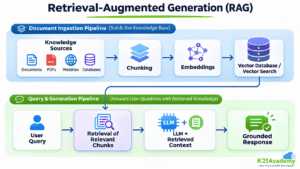
1. Document Ingestion: The first step is to gather information from sources such as PDFs, websites, databases and documents. This collected data becomes the knowledge base for RAG.
2. Document Chunking: Large documents are divided into smaller pieces called chunks. This makes it easier to locate and retrieve relevant information.
3. Embedding Generation: Each chunk is converted into a numerical representation called an embedding. These embeddings help the system identify the semantic meaning of the text.
4. Vector Storage: The generated embeddings are stored and indexed in a vector database or search system. This allows RAG applications to retrieve relevant information efficiently.
5. Query and Retrieval: When a user asks a question, the system searches the knowledge base to find relevant document chunks. It can use semantic search, keyword search or a combination of both methods.
6. Response Generation: The retrieved chunks are sent to a large language model along with the user’s question. The model uses this context to generate a relevant and grounded response.
7. Evaluation and Monitoring: RAG applications can be evaluated and monitored to measure retrieval quality, answer accuracy, response time and overall performance.
By combining retrieval with generation, RAG enables AI applications to provide more relevant answers using information from external knowledge sources.
Why Use RAG?
RAG is an effective solution for several challenges faced by traditional generative models:
- Factual Accuracy: By using real-time data retrieval, RAG models can provide answers that are factually grounded and up-to-date. This is particularly valuable in fields like healthcare, finance, legal, and more, where outdated or incorrect information can have significant consequences.
- Handling Knowledge Gaps: While LLMs are trained on vast datasets, they can still suffer from knowledge gaps, especially when dealing with very specific or niche information. RAG helps fill these gaps by allowing the model to pull information from specialized sources that might not have been included in the training data.
- Scalability: Since the retrieval component allows the system to access a constantly growing database, RAG models can scale more easily without needing to retrain the underlying generative model for every new fact or dataset.
- Personalization: RAG can be particularly useful for personalized content generation. By retrieving relevant information specific to the user’s preferences or needs, the model can generate more tailored and specific content, such as product recommendations or personalized news summaries.
Benefits of Retrieval-Augmented Generation?
Retrieval-Augmented Generation (RAG) improves AI-generated responses by combining language models with relevant information from external sources. RAG helps businesses build AI applications that provide more accurate, relevant and context-aware answers.
1. Improved Accuracy: RAG retrieves information from trusted sources before generating responses. This helps improve factual accuracy and reduces the risk of incorrect answers.
2. Reduced Hallucinations: Large language models sometimes produce incorrect or misleading information. RAG helps reduce hallucinations by grounding responses in retrieved documents, although it cannot eliminate them completely.
3. Access to Updated Information: RAG allows AI applications to retrieve information from updated databases, documents and websites without retraining the language model. The freshness of the answers depends on how frequently the knowledge sources are updated.
4. Better Handling of Domain-Specific Knowledge: RAG helps AI systems answer questions about specialized topics by retrieving information from company documents, technical manuals, research papers and other knowledge sources.
5. Cost Efficiency: RAG can reduce the need for frequent model fine-tuning by using external knowledge sources. However, the overall cost depends on factors such as data storage, retrieval operations and model usage.
6. Scalability: RAG applications can expand their knowledge bases by adding new documents and data sources without retraining the underlying language model.
7. Personalized Responses: RAG can retrieve information based on user preferences, previous interactions or relevant business data to generate more personalized responses when appropriate data access controls are in place.
Related Readings: Understanding RAG with LangChain
What Google Cloud Products and Services are Related to RAG?
Google Cloud offers AI, storage and search services to create Retrieval-Augmented Generation (RAG) applications. These services allow developers to keep data, make embeddings, find information and create responses that are connected to the context using large language models.
1. Gemini Enterprise Agent Platform: Gemini Enterprise Agent Platform (previously called Vertex AI) gives tools and systems for making, putting into use and handling AI apps and agents. It works with Gemini models and other parts needed to make RAG apps with company data.
2. Vertex AI RAG Engine: Vertex AI RAG Engine helps developers make RAG apps by handling document loading, splitting into parts, making embeddings, putting in order and finding information. It makes it easier to link information sources with AI models.
3. Agent Search (previously called Vertex AI Search): Agent Search helps developers find and get information from websites, documents and company knowledge sources. It helps make AI answers based on the information found.
4. Vector Search: Vector Search allows finding items using vector data. It helps RAG apps find parts of documents based on what they mean instead of just using words.
5. Cloud Storage: Google Cloud Storage offers storage that can grow as needed for data that is not organized, like PDFs, text files and other documents. These files can act as sources of information for RAG processes.
6. BigQuery: BigQuery is the data analysis platform from Google Cloud that can store and look at data. It can also do similarity search for RAG apps using its vector search features.
7. Gemini Models and Embeddings: Gemini models create answers using the information found, and embedding models turn text into numbers. Together, they help find meaning and make answers that are based on real information in RAG apps.
Related Reading: RAG vs Fine-Tuning on Google Cloud: When to Use Each for Generative AI Apps
Conclusion
Retrieval-Augmented Generation helps make AI responses better by using language models together with information from outside sources. This approach allows AI systems to give answers that’re more accurate, relevant and aware of the context. It also helps reduce the chances of the AI making up facts, which is often called hallucination.
Using Google Cloud tools like Gemini Enterprise Agent Platform, Vertex AI RAG Engine, Vector Search and Cloud Storage developers can create RAG applications that grow easily. These applications work well for customer support, managing company knowledge and many other business needs.
As generative AI keeps changing and improving RAG stays a method for building AI systems that rely on trustworthy, specific and up-, to-date information.
Frequently Asked Questions
What is the difference between traditional LLMs and RAG?
Traditional LLM applications primarily rely on model knowledge and the information provided in prompts. RAG retrieves relevant information from external sources before generating responses, helping improve accuracy and relevance.
What are the main benefits of RAG?
RAG helps improve answer accuracy, reduce hallucinations, access updated information and use domain-specific knowledge without frequently retraining the language model.
Is RAG suitable for all AI applications?
No. RAG is most useful for applications that need external, updated or domain-specific information, such as enterprise search, customer support and document-based question answering.
What is RAGOps?
RAGOps refers to the practices used to manage, evaluate and monitor RAG applications. It includes data pipeline management, retrieval evaluation, response quality monitoring and performance optimization.
What is the difference between RAG and fine-tuning?
RAG retrieves external information when generating responses, while fine-tuning updates a model through additional training. RAG is generally more suitable for frequently changing knowledge, whereas fine-tuning can help adapt model behavior or performance on specific tasks.
Which Google Cloud services are used for RAG?
Google Cloud supports RAG using services such as Vertex AI RAG Engine, Vector Search, Cloud Storage, BigQuery and Gemini models. These services support document storage, retrieval and grounded response generation.
Can RAG completely eliminate hallucinations?
No. RAG can reduce hallucinations by providing relevant context, but incorrect retrieval, unreliable sources or model errors can still produce inaccurate answers.