







Data Science, Artificial Intelligence (AI), and Machine Learning (ML) are three closely related fields transforming how businesses collect, analyze, and use data. From uncovering hidden patterns and predicting future trends to automating complex tasks, these technologies are driving innovation across industries.
Although often discussed together, Data Science, AI, and ML serve different purposes and use distinct techniques. Before exploring how they work and how they differ, it is important to understand what data is and why it matters.
Why is it important to clearly define a problem statement in Data Science?
Clearly defining a problem statement in Data Science helps establish the project’s objectives, identify the right data, and select appropriate analytical methods. It ensures that the analysis remains focused on solving a specific business problem and produces meaningful, actionable insights aligned with organizational goals.
Related Readings: Python for Microsoft Azure Data Scientist (DP-100)

What is Data?
Data refers to raw facts, observations, and information collected from different sources. It can exist in various formats, including numbers, text, images, audio, videos, and other digital records.
In computing, data is processed and manipulated by programs to produce meaningful information. For example, customer details, sales transactions, website activity, and sensor readings are all forms of data that organizations use to understand patterns, solve problems, and make informed decisions.
Related Readings: Data Science: Empowering Today’s World, Businesses and Careers
Data can generally be classified into two broad categories:
- Structured Data: Organized information stored in predefined formats, such as spreadsheets, relational databases, and tables.
- Unstructured Data: Information without a predefined tabular structure, such as emails, documents, images, audio recordings, and videos.
Understanding different types of data is essential before exploring how data is collected, prepared, and analyzed.
How to Analyze Data?
Data analysis involves examining, organizing, and interpreting information to identify patterns, relationships, and meaningful insights. Two common approaches to data analysis are:
- Qualitative Data Analysis
- Quantitative Data Analysis
1. Data Analysis in Qualitative Research
Qualitative data analysis focuses on non-numerical information, such as text, interviews, descriptions, images, and observations. It helps researchers understand opinions, experiences, behaviors, and underlying patterns.
Unlike quantitative analysis, which focuses on numerical measurements, qualitative analysis involves identifying common themes, categorizing information, and interpreting patterns to gain deeper insights.
Example: Analyzing customer reviews to understand customer satisfaction, identify recurring complaints, and discover areas for product improvement.
How Does Data Science Work?
Data Science combines statistics, programming, data analysis, and machine learning to extract meaningful insights from data. It typically involves collecting data, cleaning and preparing it, exploring patterns, building analytical or predictive models, and communicating the results.
These processes help organizations solve business problems, identify opportunities, forecast trends, and make informed decisions.
2. Data Analysis in Quantitative Research
Quantitative data analysis focuses on numerical information and uses mathematical and statistical techniques to identify patterns, measure relationships, and test hypotheses.
It is commonly used when researchers need measurable results, statistical comparisons, or predictions based on numerical datasets.
Preparing Data for Analysis
Data preparation is an essential step in quantitative research. It involves converting raw data into a consistent, reliable format suitable for analysis.
Common data preparation activities include:
- Data Validation: Checking whether the collected data is accurate, complete, and consistent.
- Data Cleaning and Editing: Identifying and correcting errors, duplicates, missing values, and inconsistencies.
- Data Coding: Assigning numerical or categorical representations to data so it can be processed and analyzed effectively.
After preparing the data, researchers often use descriptive statistics to summarize information through measures such as mean, median, mode, percentages, and standard deviation.
However, descriptive statistics explain what the data shows rather than necessarily explaining why something happened. Further statistical analysis may be required to investigate relationships, test hypotheses, and identify underlying causes.
What are the Ethical Considerations in Data Science Regarding Data Privacy and Bias?
Ethical considerations in Data Science include protecting personal information, obtaining appropriate user consent, maintaining data confidentiality, and complying with applicable privacy regulations such as GDPR.
Addressing algorithmic bias is equally important. Data scientists must evaluate datasets for potential biases, use representative data, and assess models to reduce unfair or discriminatory outcomes.
How Does Data Science Contribute to Decision-Making in Organizations?
Data Science helps organizations make informed decisions by analyzing large datasets, identifying patterns, predicting trends, and evaluating business performance.
Organizations use these insights to improve operational efficiency, understand customer behavior, optimize processes, reduce costs, and identify new business opportunities.
How Do Data Scientists Use Data Visualization and Modeling in Their Work?
Data scientists use data visualization to explore datasets, identify trends, detect anomalies, and communicate findings through charts, graphs, and dashboards.
They also use statistical and machine learning models to understand relationships, test hypotheses, make predictions, and solve real-world problems.
How is Data Science Different from Traditional Statistics?
Traditional statistics primarily focuses on collecting, analyzing, interpreting, and drawing conclusions from data using mathematical and statistical methods.
Data Science builds on these foundations by combining statistics with programming, machine learning, data engineering, and data visualization to work with complex datasets and solve broader real-world problems.
What Tools and Programming Languages are Commonly Used in Data Science?
Data Science professionals use various programming languages, libraries, and platforms depending on their analytical requirements.
Commonly used tools include:
- Python: Popular for data analysis, automation, and machine learning, with libraries such as Pandas, NumPy, and Scikit-learn.
- R: Used for statistical computing, data analysis, and visualization.
- SQL: Helps retrieve, manage, and analyze data stored in relational databases.
- Jupyter Notebook: Provides an interactive environment for writing and executing code.
- Apache Spark: Supports distributed processing and analysis of large datasets.
- TensorFlow and PyTorch: Used for deep learning and neural network development.
What are the Advantages of Data Science?
Data Science offers several benefits to organizations, including:
- Better Decision-Making: Supports informed decisions through data-driven insights.
- Predictive Analysis: Helps forecast trends, demand, and potential business outcomes.
- Improved Efficiency: Identifies bottlenecks and opportunities to optimize operations.
- Customer Understanding: Helps organizations analyze customer preferences and behavior.
- Innovation: Supports the development of new products, services, and business strategies.
What are the Disadvantages of Data Science?
Despite its advantages, Data Science also presents certain challenges:
- High Implementation Costs: Infrastructure, software, and skilled professionals can require significant investment.
- Data Quality Issues: Incomplete, inaccurate, or inconsistent data can affect analytical results.
- Privacy and Security Risks: Handling sensitive information requires appropriate safeguards and compliance.
- Technical Complexity: Working with large datasets and advanced models requires specialized knowledge.
- Model Bias: Biased datasets or poorly designed models can produce misleading or unfair results.

What is Artificial Intelligence?
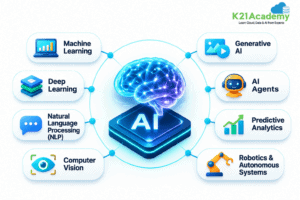
Artificial Intelligence (AI) is a branch of computer science that enables machines to perform tasks that typically require human intelligence, such as learning, reasoning, problem-solving, understanding language, and recognizing patterns.
AI systems use different techniques, including Machine Learning (ML), Deep Learning (DL), and Natural Language Processing (NLP), to process information, identify patterns, and generate useful outputs.
Today, Artificial Intelligence is used in various applications, from virtual assistants and recommendation systems to self-driving cars, fraud detection, and intelligent chatbots. Modern Generative AI tools can also create text, images, audio, and code based on user instructions.
To understand how AI and Machine Learning differ, explore AWS’s guide on the difference between Artificial Intelligence and Machine Learning
AI History
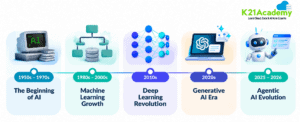
Artificial Intelligence has evolved through decades of research and technological breakthroughs. Here are some important milestones in its development:
- 1951 – Early Computer Game Programs: The Ferranti Mark 1 computer ran an early chess-playing program developed by Dietrich Prinz. Christopher Strachey later developed a checkers-playing program for the same computer.
- 1956 – Dartmouth Conference: American computer scientist John McCarthy, along with Marvin Minsky, Nathaniel Rochester, and Claude Shannon, helped organize the Dartmouth Summer Research Project on Artificial Intelligence. The term “Artificial Intelligence” had been introduced in their 1955 research proposal, marking an important milestone in establishing AI as a field of study.
- 1958 – Development of LISP: John McCarthy developed the LISP programming language, which became an important language for artificial intelligence research and symbolic computing.
- 1973 – WABOT-1: Researchers at Waseda University in Japan, led by Professor Ichiro Kato, completed WABOT-1, widely recognized as the world’s first full-scale humanoid robot. It could walk, recognize objects, grasp items, and communicate in simple Japanese.
What is Machine Learning?
Machine Learning (ML) is a branch of Artificial Intelligence (AI) that enables computers to learn from data, identify patterns, and make predictions or decisions without being explicitly programmed for every task.
Machine Learning algorithms use historical data to improve their performance over time. Instead of relying entirely on predefined rules, these algorithms learn from examples and apply the patterns they discover to new information.
Today, Machine Learning plays an important role in business operations and digital transformation. Organizations use it for applications such as fraud detection in banking, product recommendations in e-commerce, predictive maintenance in manufacturing, and demand forecasting in retail.
As businesses generate and process increasing amounts of data, Machine Learning helps them automate processes, improve accuracy, identify opportunities, and make data-driven decisions.
Related Readings: Deep Learning vs Machine Learning: Key Differences Explained
What Industries Benefit Most from Machine Learning?
Machine Learning benefits industries such as healthcare, banking and finance, retail, e-commerce, manufacturing, transportation, and logistics.
Some common applications include:
- Healthcare: Disease prediction, medical image analysis, and personalized treatment recommendations.
- Banking and Finance: Fraud detection, credit risk assessment, and transaction monitoring.
- Retail and E-commerce: Product recommendations, customer segmentation, and demand forecasting.
- Manufacturing: Predictive maintenance, quality control, and production optimization.
- Transportation and Logistics: Route optimization, traffic prediction, and supply chain forecasting.
Types of Machine Learning
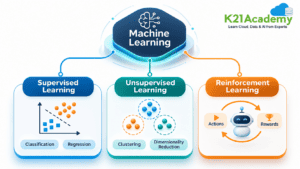
Machine Learning is generally classified into three main types based on how algorithms learn from data: Supervised Learning, Unsupervised Learning, and Reinforcement Learning.
Related Readings: Learn ML & Data Using Python: Step-by-Step Labs
1. Supervised Learning
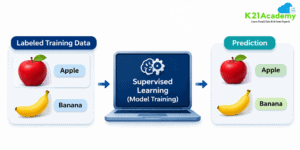
Supervised Learning is a type of Machine Learning in which an algorithm is trained using labeled data. Each training example contains input data along with its corresponding expected output, allowing the model to learn the relationship between them.
The algorithm analyzes these examples, identifies patterns, and uses what it learns to make predictions on new, unseen data.
The quality and accuracy of the labeled training data are important because incorrect or inconsistent labels can affect the model’s performance.
Example: Fruit Classification
Suppose you have a basket containing different types of fruits. You want to train a Machine Learning model to identify apples and bananas based on their characteristics.
The model is provided with labeled examples:
- Apple: An object with a rounded shape, a depression at the top, and typically a red or green color is labeled as an apple.
- Banana: An object with a long, curved shape and typically a green or yellow color is labeled as a banana.
After training on these labeled examples, the model can learn the patterns and classify new fruit images based on their characteristics.
2. Unsupervised Learning
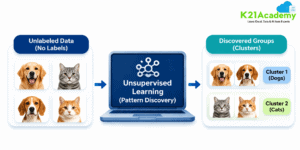
Unsupervised Learning is a type of Machine Learning in which algorithms work with unlabeled data. Unlike supervised learning, the dataset does not contain predefined output labels or categories.
Instead, the algorithm analyzes the data to discover hidden patterns, similarities, relationships, and structures without being given the correct answers in advance.
One common application of unsupervised learning is clustering, where similar data points are grouped together based on their characteristics.
Example: Grouping Dogs and Cats
Suppose you provide a Machine Learning algorithm with a collection of images containing dogs and cats without any labels.
The algorithm does not initially know which images contain dogs or cats. Instead, it analyzes visual characteristics such as shapes, patterns, and other similarities to group related images.
As a result, it may create two distinct clusters:
- Cluster 1: Images containing similar dog characteristics.
- Cluster 2: Images containing similar cat characteristics.
These clusters can then be interpreted and labeled by humans based on the patterns identified by the algorithm.
3. Reinforcement Learning
Reinforcement Learning (RL) is a type of Machine Learning in which an agent learns to make decisions by interacting with an environment.
The agent performs actions and receives feedback in the form of rewards or penalties. Over repeated interactions, it learns which actions are more effective in achieving its objective.
The goal is to develop a policy that helps the agent maximize its cumulative reward over time.
Example: Training a Robot to Navigate a Maze
Imagine a robot learning to find the shortest path through a maze.
- Agent: The robot responsible for making decisions.
- Environment: The maze in which the robot operates.
- State: The robot’s current position in the maze.
- Action: Moving forward, backward, left, or right.
- Reward: Positive feedback for reaching the destination and penalties for hitting obstacles or taking inefficient paths.
As the robot explores the maze, it learns from the feedback it receives and gradually improves its decisions to reach the destination more efficiently.

What is Natural Language Processing (NLP)?
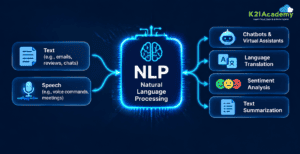
Natural Language Processing (NLP) is a branch of Artificial Intelligence (AI) that enables computers to understand, interpret, analyze, and generate human language.
NLP combines techniques from computer science, linguistics, and machine learning to help computers process both written and spoken language. It allows machines to perform language-related tasks such as text classification, language translation, sentiment analysis, speech recognition, and text summarization.
Today, NLP powers many applications, including AI chatbots, virtual assistants, search engines, automated translation tools, and intelligent customer support systems.
Related Readings: Natural Language Processing with Python
Why is NLP Important?
Natural Language Processing plays an important role in helping organizations process large volumes of human language and extract meaningful information. Its importance can be understood through the following applications:
1. Processing Large Volumes of Text and Speech
Organizations generate enormous amounts of textual and spoken data through customer reviews, emails, support conversations, documents, and voice recordings.
NLP helps computers process this information at scale. For example, businesses can use NLP to analyze customer feedback, identify common complaints, recognize sentiment, and extract important information from documents.
2. Understanding Unstructured Language Data
Human language is complex and constantly evolving. People communicate using different languages, dialects, accents, abbreviations, slang, and grammatical structures.
NLP helps computers interpret these variations and extract useful information from unstructured text and speech. It can identify relevant words, recognize entities, understand context, and determine the intent behind a message.
For example, an AI-powered customer support chatbot can interpret different ways of asking the same question and provide an appropriate response.
Related Readings: What Is NLP (Natural Language Processing)?
Conclusion
Data Science, Artificial Intelligence (AI), Machine Learning (ML), and Natural Language Processing (NLP) play an important role in shaping the future of technology. While each field serves a different purpose, they work together to help organizations analyze data, automate processes, make predictions, and solve complex real-world problems.
As these technologies continue to evolve, their applications across industries such as healthcare, finance, retail, manufacturing, and education will continue to expand. Understanding their fundamentals is an important first step toward exploring the opportunities they offer in today’s data-driven world.
FAQ’s
What is Data Science?
Data Science is an interdisciplinary field that uses statistics, programming, machine learning, and data analysis to extract meaningful insights from structured and unstructured data. It helps organizations identify patterns, solve problems, and make data-driven decisions.
What is the difference between Data Science, Artificial Intelligence, and Machine Learning?
Data Science focuses on collecting, analyzing, and interpreting data to generate insights. Artificial Intelligence (AI) enables machines to perform tasks that typically require human intelligence, while Machine Learning (ML) is a subset of AI that allows systems to learn patterns from data and make predictions without being explicitly programmed for every task.
What is Machine Learning and how does it work?
Machine Learning is a subset of Artificial Intelligence that enables computers to learn from data and improve their performance through experience. It works by training algorithms on datasets, identifying patterns, and using the learned patterns to make predictions or decisions on new data.
What are the three main types of Machine Learning?
The three main types of Machine Learning are Supervised Learning, Unsupervised Learning, and Reinforcement Learning. Supervised Learning uses labelled data, Unsupervised Learning identifies patterns in unlabelled data, and Reinforcement Learning trains an agent to make decisions through interactions with an environment and feedback from rewards or penalties.
What is the difference between Supervised and Unsupervised Learning?
Supervised Learning trains models using labelled datasets with known outputs to make predictions, such as classifying emails as spam or not spam. Unsupervised Learning works with unlabelled data to discover hidden patterns, relationships, and groups, such as customer segmentation.
What is Natural Language Processing (NLP) in Artificial Intelligence?
Natural Language Processing (NLP) is a branch of Artificial Intelligence that enables computers to understand, interpret, and process human language. It is used in applications such as chatbots, speech recognition, language translation, sentiment analysis, and text classification.
What are the real-world applications of Data Science and Machine Learning?
Data Science and Machine Learning are used across industries such as healthcare, finance, retail, manufacturing, aerospace, and logistics. Common applications include fraud detection, customer segmentation, demand forecasting, medical image analysis, recommendation systems, and predictive maintenance.
What skills are required to start a career in Data Science?
A career in Data Science requires programming skills in Python or R, knowledge of statistics and mathematics, SQL, data cleaning, data visualization, and Machine Learning fundamentals. Practical experience through real-world projects and familiarity with tools such as Pandas, NumPy, Scikit-learn, and Jupyter Notebook can also help build job-ready skills.