




You probably don’t need another beginner’s explanation of Amazon Bedrock if you are already familiar with AWS. Where does Bedrock truly fit into a business AWS architecture? This is a more practical topic that needs to be addressed.
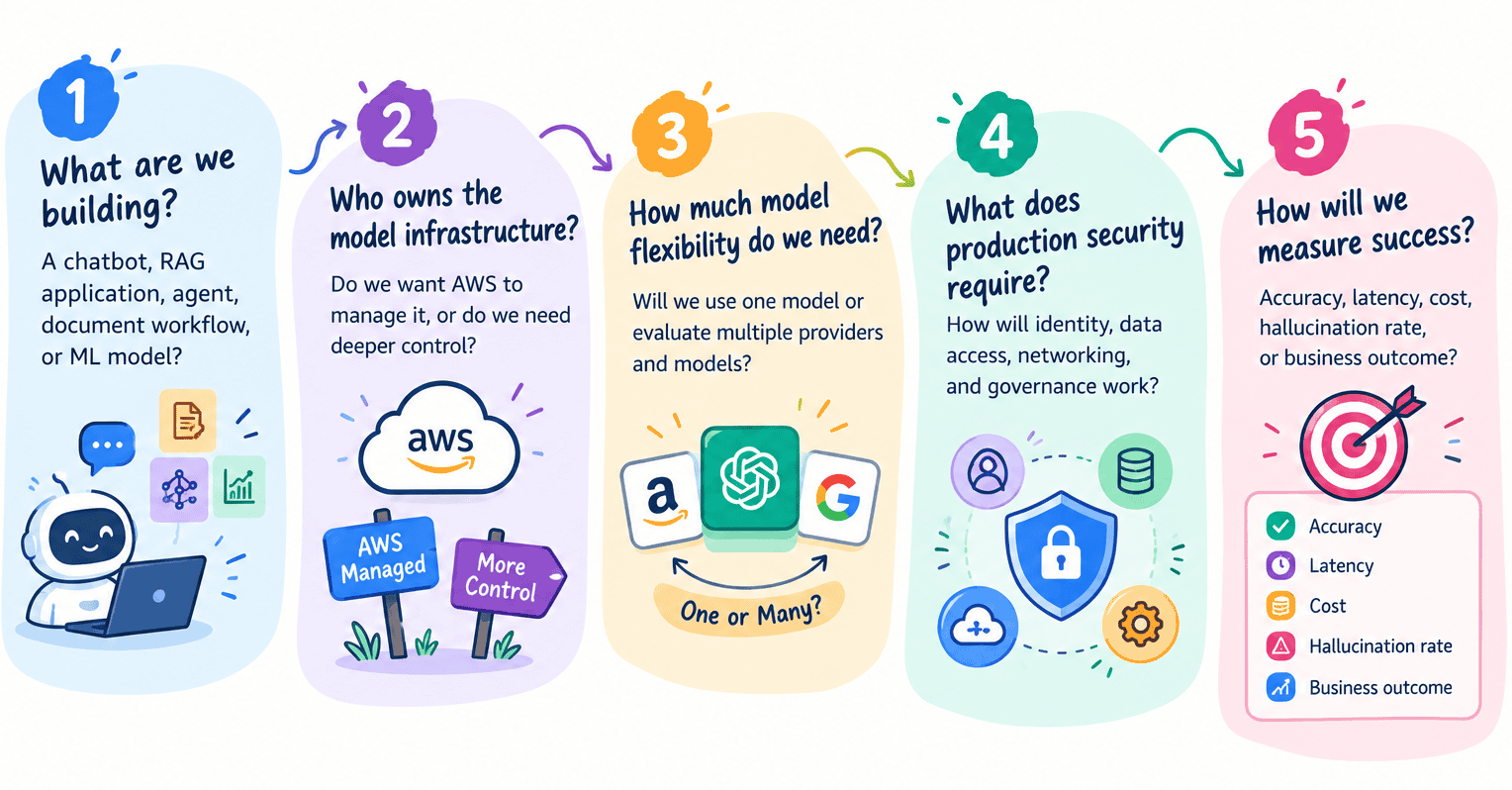
That is where AWS Bedrock for Enterprise Architects becomes an important topic. Should you use Bedrock or SageMaker? Where does Lambda fit? Should you build your own RAG platform? And how much of your GenAI infrastructure should AWS actually manage?
This guide looks at AWS Bedrock for enterprise architects from that perspective, focusing on architecture decisions rather than another feature-by-feature introduction.
What is Amazon Bedrock?
Building generative AI applications with foundation models from Amazon and other model providers is possible with Amazon Bedrock, a managed AWS service.
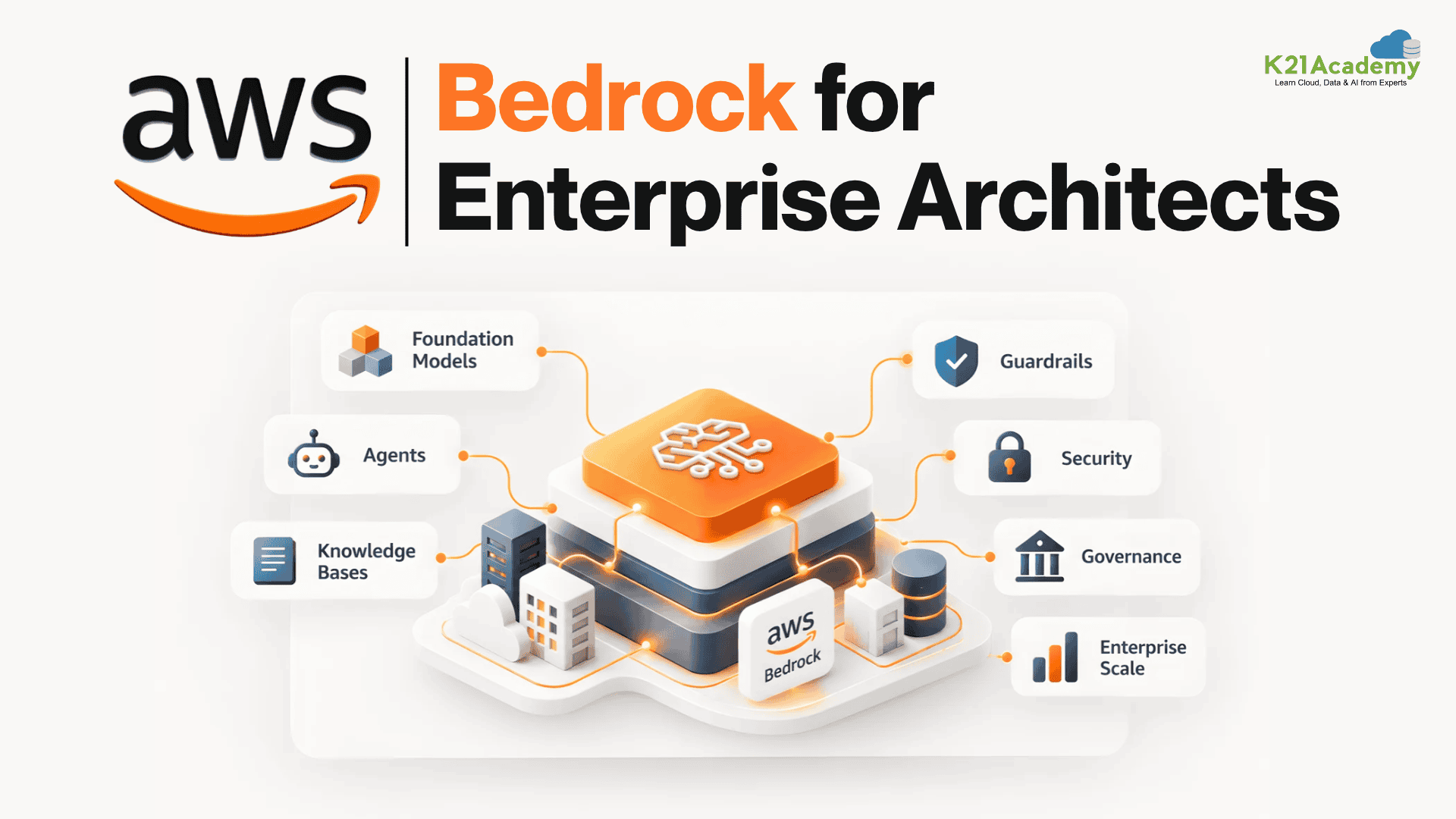
It provides access to foundation models along with capabilities such as:
- RAG and Knowledge Bases
- Guardrails
- Model evaluation
- Model customisation
- Agents
- Model inference
For AWS Bedrock for Enterprise Architects, the important distinction is that Bedrock is not your entire AI stack. It is the GenAI platform layer within your AI stack.
A typical architecture might look like this:
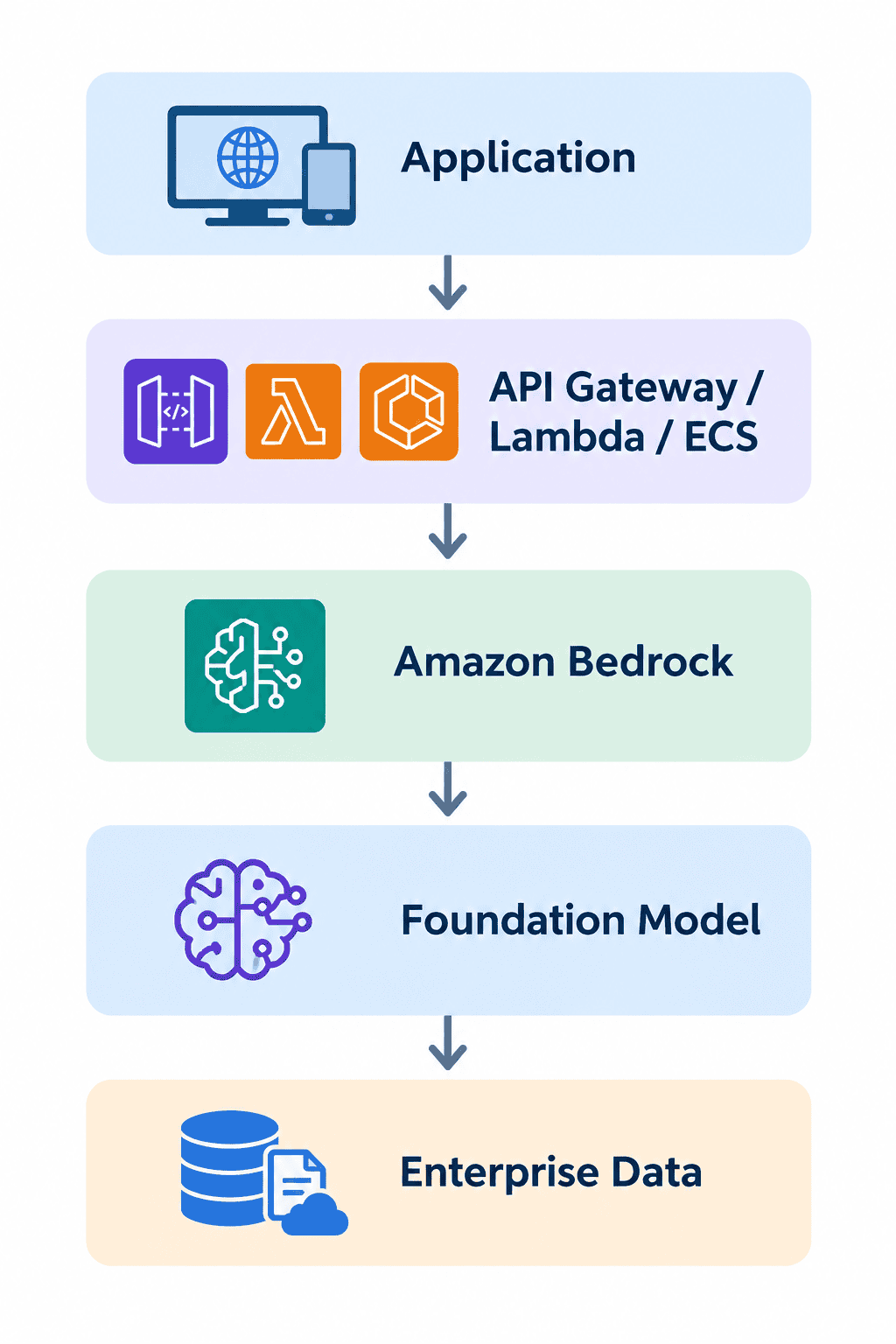
Security, networking, monitoring, identity, and governance still surround these components.
What Bedrock Is Not
This is where many enterprise architecture discussions become confusing.
1) Bedrock Is Not SageMaker
Bedrock and SageMaker can work together, but they solve different problems.
| Requirement | Typical AWS Service |
|---|---|
| Managed foundation-model access | Amazon Bedrock |
| GenAI application development | Amazon Bedrock |
| RAG with foundation models | Amazon Bedrock |
| Managed guardrails and evaluation | Amazon Bedrock |
| Custom ML model training | Amazon SageMaker |
| Greater control over model deployment | Amazon SageMaker |
| Custom model-serving infrastructure | Amazon SageMaker |
| Traditional ML workflows | Amazon SageMaker |
A useful mental model for AWS Bedrock for Enterprise Architects is:
- Bedrock → consume and build with foundation models
- SageMaker → build, train, deploy, and operate ML models with greater control
The two are not necessarily competing choices. An enterprise may use both.
2) Bedrock and Lambda: Different Layers, Different Jobs
Another common question is whether Bedrock replaces AWS Lambda. It doesn’t. Lambda provides compute and application logic. Bedrock provides GenAI capabilities.
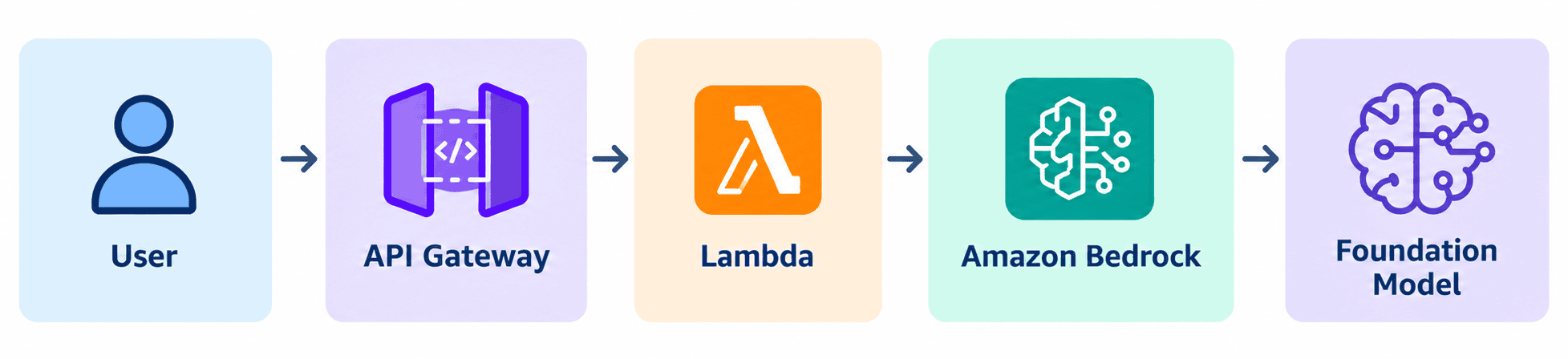
Lambda might handle:
- Authentication context
- Business rules
- Prompt construction
- API calls
- Response processing
- Integration with other AWS services
Bedrock handles the model interaction.
So the question isn’t “Bedrock or Lambda?” It’s:
“How should Lambda and Bedrock work together?”
This distinction is central to designing AWS Bedrock for enterprise architects’ solutions that can move beyond a proof of concept.
Where Bedrock Fits in an Enterprise AI Stack
A practical way to understand AWS Bedrock for Enterprise Architects is to look at the AI stack in layers.
Application Layer
Your:
- Web application
- Mobile application
- Internal assistant
- Customer-facing application
Application and Orchestration Layer
Services such as:
- API Gateway
- Lambda
- ECS
- Step Functions
- EventBridge
GenAI Layer
This is where Amazon Bedrock fits.
It can provide:
- Foundation models
- RAG
- Guardrails
- Evaluation
- Agents
- Model customisation
Data Layer
Your enterprise information may live in:
- Amazon S3
- Aurora
- DynamoDB
- OpenSearch
- Data lakes
- Enterprise APIs
Related Readings: AWS Database Services – Amazon RDS, Aurora, DynamoDB, ElastiCache
Security and Governance
You still need:
- IAM
- KMS
- VPC
- CloudTrail
- CloudWatch
- Data authorization
- Cost controls
Related Readings: CloudWatch vs. CloudTrail: Comparison, Working & Benefits
This is why simply saying “we’re using Bedrock” doesn’t describe an enterprise AI architecture.
Where RAG Comes In
One of the most practical Bedrock use cases is building applications that need access to enterprise knowledge.
Imagine an employee asks:
“What is our process for handling customer data deletion requests?”
You don’t want the model relying only on its training data.
You need a flow such as:
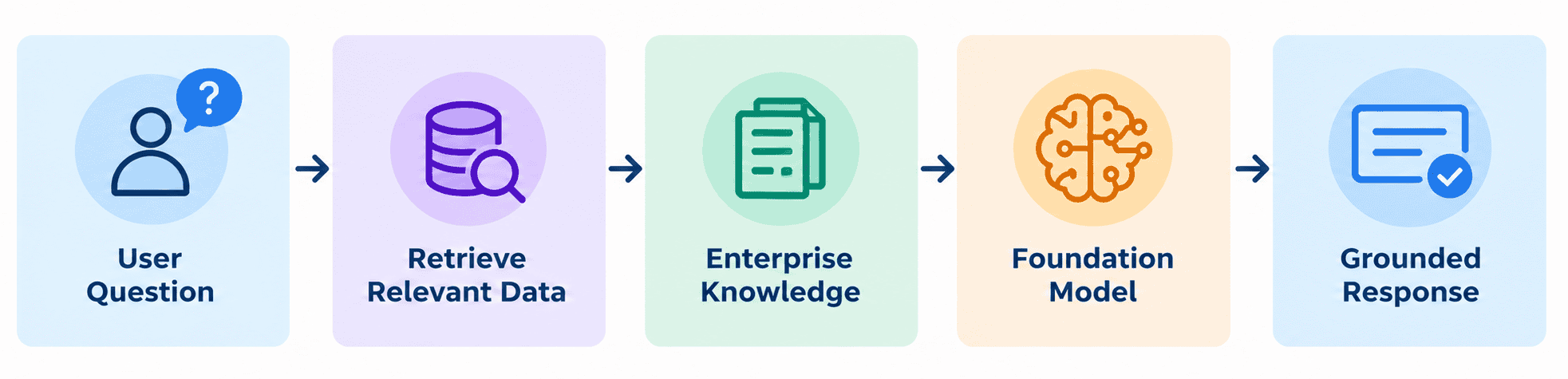
Bedrock Knowledge Bases provides a managed way to implement this pattern without building every retrieval component from scratch. But here’s an important point for AWS Bedrock for enterprise architects: RAG doesn’t automatically mean accurate answers. Architects still need to consider:
- Data quality
- Chunking
- Retrieval quality
- Access control
- Metadata
- Evaluation
- Freshness
- Hallucinations
The managed service reduces infrastructure work. It doesn’t remove architecture decisions.
What About Bedrock Agents?
Traditional GenAI applications often look like:
Prompt → Model → Response
Agentic applications introduce another layer:
Goal → Reason → Retrieve → Call Tool → Take Action
For example, an internal IT assistant could:
- Understand an employee’s request.
- Search internal documentation.
- Check an approved system.
- Call an API.
- Return the result.
Bedrock can provide agent capabilities, but that doesn’t mean the AI should have unrestricted access to enterprise systems. For AWS Bedrock for Enterprise Architects, the important question is:
What is the agent allowed to do, and which controls enforce those boundaries?
The model can help decide what should happen. Your application and AWS security controls should determine what it is actually allowed to do.
When Does Bedrock Make Sense?
Bedrock is worth evaluating when you want:
- Managed foundation models: You don’t want to operate model-serving infrastructure yourself.
- Multiple model choices: You want to evaluate different foundation models for different workloads.
- AWS-native integration: Your organization already relies heavily on IAM, VPC, KMS, CloudWatch, CloudTrail, S3
- Faster GenAI development: You want managed capabilities for RAG, guardrails, evaluation, and agents rather than building everything internally.
For AWS Bedrock for Enterprise Architects, these advantages become especially relevant when the organisation wants to move from isolated GenAI experiments toward a reusable enterprise AI platform.
When Should You Look Beyond Bedrock?
Bedrock isn’t automatically the right answer.
Consider other approaches when you need:
- Deep control over model serving
- Custom inference infrastructure
- Specialized GPU requirements
- Extensive model modification
- Custom ML training pipelines
- Highly specialized model operations
This is where SageMaker or lower-level AWS infrastructure may become more relevant.
The real question is:
How much of the AI infrastructure do you want AWS to manage for you?
The more control you need, the more you may need to move toward lower-level ML infrastructure.
Bedrock vs. Building Your Own AI Platform
This is ultimately the enterprise decision behind AWS Bedrock for Enterprise Architects.